


THIS WEEK IN VIOLENCE: Crack-up
2026, Week 35
This week, we’ve got excerpts from two essays recently published in Foreign Affairs for you, which are striking in their candour about ‘the current situation’ and surprising in their proposed routes out. Capping it off, we briefly dwell on Mark Carney’s recent remarks about the ongoing US-Canada trade war. Put it this way:
It’s too early to say what ‘it’ is, but ‘it’ is happening.
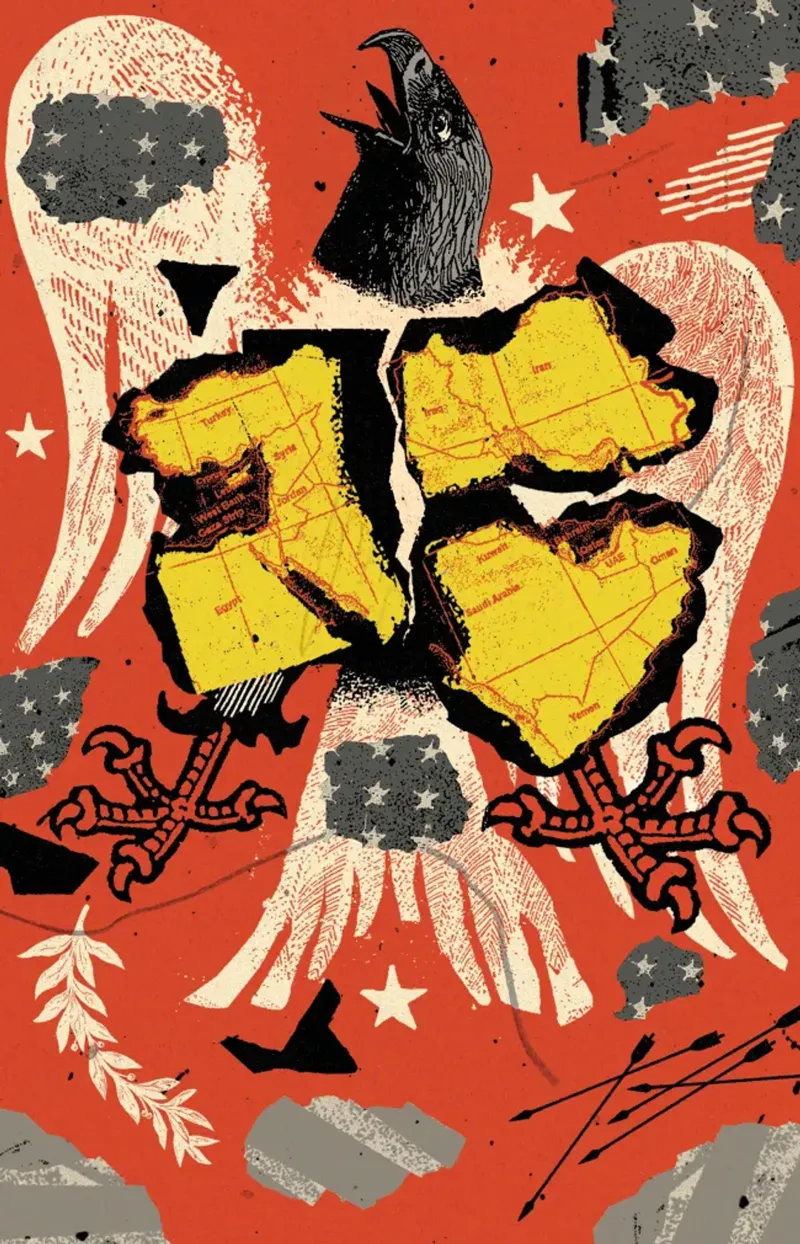
The End of the American Middle East
Iran and the Last Gasp of a Failed Order
Foreign Affairs – Aug 18, 2026
Essay by Marc Lynch
The American Middle East is finished. The regional order that has prevailed since 1991 has been one of the many casualties of the U.S.-Israeli war with Iran. The American and Israeli failure to dislodge the regime in Tehran has proved the bankruptcy of decades of sanctions and violence. The inability of the United States to protect its Gulf allies from Iranian attacks or to keep the Strait of Hormuz open has fatally undermined the core security bargain that justified its network of military bases in the region. And Israel’s increasingly threatening posture and abandonment of any pretense of interest in reaching an accommodation with the Palestinians have ended Washington’s decades-long mission of bringing its Arab allies and Israel together into an enduring security partnership.
The United States’ primary goal for three and a half decades has been to lock its disparate allies into an order built around protecting Israel while containing, at first, Iran and Iraq, and more recently Iran and its nonstate allies. Far from being a deviation from that strategy, President Donald Trump’s war took it to its logical end, seeking to remove the Iranian threat by force in one fell swoop. As American leaders did before the 2003 invasion of Iraq and Israel has done in its wars against Hezbollah and Hamas, the architects of this war vastly exaggerated what military power could achieve, underestimated the capacity of adversaries to adapt, took for granted that allies would fall in line, and callously disregarded the lives of ordinary people. Washington’s misadventure was not an aberration so much as the ultimate expression of the inherent vice of its Middle East strategy.
At first, it may not look as though the war has had much effect on the alliances that form the American order. Facing an inconclusive war and an empowered Iran, the Gulf states may ramp up their arms purchases and their demands for renewed security guarantees, creating the illusion of continuity. But the old order is in fact giving way to something new. The 1956 Suez crisis is remembered today as the last gasp of British and French imperial power in the Middle East, but it took years to reach that inevitable end. American primacy will not disappear immediately, either, but long-building doubts about American power and purpose have passed their tipping point. The revelations of the Iran war and of the Israeli war in Gaza before it have already changed the calculations of U.S. allies and adversaries. Another round of fighting or the election of a different American president will not repair the rupture.
The years ahead promise further discord. Israel and Iran have a shared interest in keeping the Middle East in a state of lawlessness and violence, and the United States has few means of holding back either of them. Israel hopes to expand its de facto borders, including by annexing as much as possible of historic Palestine, and to impose its writ by force across vast swaths of the region. And assuming that the Iranian regime does not collapse any time soon—which it appears highly unlikely to do—an emboldened Tehran will hope to defend and expand its regional influence by bogging Washington down in the kinds of endless, borderless “gray zone” conflicts in which it has always thrived.
If the United States is finally willing to abandon its failed strategy, however, the collapse of one order could still be an opportunity to build a new and better one. The conditions, admittedly, are far from ideal. Although most of the region’s leaders and publics desperately want a respite from military strikes and economic disruption, they also deeply resent Washington for dragging them into a disaster. But discarding its policy of support for autocrats, impunity for allies, and militarized containment of enemies might enable the United States to engage with the region in a healthier way—one that eventually could yield the durable stability Washington has claimed to want all along.
The Abandoned Order
Learning to Live in a Post-American World
Foreign Affairs – Aug 18, 2026
Essay by Mark Leonard
Five years ago, the Chinese housing market crashed, leaving thousands of apartment buildings unfinished across the country. A generation of Chinese citizens who had bet all their savings on indefinite expansion suddenly found themselves homeless. Over time, however, some intrepid people moved into the ruins of these edifices, setting up tents on the concrete floors, using bed sheets as walls, cooking on makeshift stoves. The Chinese call these abandoned structures lanwei lou, a phrase that literally means “rotten-tail buildings,” signifying a project gone awry, a plan in suspension. The inhabitants of rotten-tail buildings repurpose the old and improvise to find a way of surviving an economic storm.
The state of the Chinese housing market is a good metaphor for the U.S.-led rules-based international order. After decades of expansion, it, too, is being abandoned. Never fully accepted by China and Russia and resented by newly assertive middle powers, its main financial backers—the American people—have lost interest in underwriting its further development. And as in the case of China’s failed housing projects, no alternative provider is stepping in to take over.
A rotten-tail world is emerging, one in which states will have to adapt cunningly, improvise new uses for elements of the old order that remain valuable, and adjust swiftly to the dramatic decay of others. But too many leaders still act as if the old order can somehow be salvaged or even perfected. The UN General Assembly still meets every year, despite being increasingly sidelined from diplomatic efforts. The World Trade Organization carries on adjudicating trade disputes, despite a surge in protectionism. UN climate change conferences convene to chart an increasingly hopeless path to net-zero emissions. International working groups still meet to discuss grand plans for a two-state solution, even as the Middle East burns.
The United States’ allies, in particular, simply do not understand yet that Washington has withdrawn its support from the old order and from them. NATO Secretary-General Mark Rutte has mocked those Europeans who suggest learning to defend themselves without U.S. help, telling them to “keep on dreaming.” NATO’s July 2026 summit offered one of the most surreal examples of cognitive dissonance: European leaders frenetically pledged tributes to U.S. President Donald Trump in the form of arbitrary defense spending increases—unrelated to their own defense analysts’ assessments—in the hope that he would not withdraw from the alliance. The United Kingdom continues to entrench its security dependence on the United States by buying U.S. fighter jets, and Denmark is approving major arms purchases from Washington even as Trump threatens to forcibly annex its constituent territory, Greenland. Australia is plowing ahead with investments in AUKUS, its trilateral security partnership with the United Kingdom and the United States, subsidizing the U.S. industrial base even as American commitments falter.
Leaders who fail to confront their new reality are failing their countries. It is time to acknowledge that the old order really has disappeared—and to plot a new approach to geopolitics. This moment does not constitute a short interregnum between a U.S.-led order and a Chinese-led one. For some time, the world will be without any order at all—swept by fragmentation, contagion, and strangulation or the temptation to weaponize a wide variety of geographic, economic, and technological chokepoints. Rather than constructing a grand strategy, states will need to develop far more flexible and artisanal responses.
These are not the types of essay ledes you would typically expect, or at least hope to see published in the in-house magazine of the Council of Foreign Relations. But here they are, published alongside one another in the September/October edition of Foreign Affairs magazine, the cover of which bears an equally grim headline: “The End of the Alliance?”
The first essay, penned by director of the Institute for Middle East Studies and the Middle East Studies Program at George Washington University, is about as damning an analysis of the past quarter-century of US foreign policy in the Middle East as one might expect to read in the pages of an insiders’ publication.
The second, by the co-founder and director of the CfR’s European counterpart, casts a broader view, acknowledging the rapidly-changing norms of our era, the reality of the US’s withdrawal from the world stage, and the need for Europe and other middle powers to abandon reliance on the US and adapt to a more fragmented world of internal defence and mutual leverage if they want to retain their influence and relevance.
Both essays are long and go into considerable detail, with only the opening paragraphs shared here, but are worth reading in full.
Regarding Marc Lynch’s essay on the failure of US Middle-East policy, most striking is the bluntness with which he asserts a number of statements which only a few years ago were cardinal sins in polite commentary.
Lynch states (correctly, in our view) that the US-led order that prevailed in the post-Cold War Middle East has sustained US primacy to the detriment of the region and its inhabitants. Regional objectives in this period have included isolating the anti-US bloc represented by Iran, the Assad Dynasty in Syria, and their regional allies such as Hezbollah, Hamas and Ansar Allah (the Houthis); normalising relations between Israel and the majority Muslim nations of the Middle East and North Africa; and keeping them all onside, against Russia and China, to deny those competing powers deeper footholds in a strategically vital region for resources and trade.
The price paid for this arrangement has been numerous destabilising wars in and across the region; the strengthening of numerous authoritarian and anti-democratic governments over and against the wills of their own people; and the emboldening of a number of these governments in their own regional foreign policy objectives, particularly Israel, the UAE and Saudi Arabia.
All of these incoherences and contradictions were tenable under the unspoken terms of the US-led rules-based international order, in which the implicit understanding was that, in exchange for maintaining amiable conditions for all parties, the US would enjoy disproportionate right to exceptional actions.
The culmination of events over the past half-decade, however, have so thoroughly undermined the values which ostensibly underpin and justify that trade-off as to have discredited them entirely.
The US and its allies’ condemnation of Russia’s occupation of Ukrainian territory versus their quiet acquiescence, even enthusiastic enabling of Israeli landgrabs in Gaza, the West Bank, and now Syria and southern Lebanon, have trashed the notion that the end of this order is territorial sovereignty. (And this is before we even touch on Trump’s reducing Venezuela to a vassal state, his expressed desire to do the same to Canada, and his repeatedly stated intentions over Greenland.)
Continued ironclad support for Israel as human rights groups and NGOs around the world line up to condemn that country’s political system as apartheid, as well as increasingly desperate (and frankly careless) bartering with governments like Saudi Arabia, UAE and Turkey without acknowledging, let alone challenging their repression of their own citizens gives lie to the claim that liberal or democratic values are the ends of US assistance to Israel or anywhere else in the Middle East.
The Assad government in Syria being succeeded by a former al-Qaeda militant who has done little to quell sectarian violence behind the scenes while allowing growing parts of his country’s own security and sovereignty concerns to be determined by governments in Ankara and Tel Aviv doesn’t simply challenge the notion that US Middle East policy was about countering terrorism and Islamic fundamentalist politics.
The western bloc’s embrace of Ahmed al-Sharaa also, once more, reveals the limits of Western commitments to democracy in the region. His supplicant posture to his more powerful neighbours also, contra Assad with Russia and Iran, demonstrates that Washington’s issue isn’t puppet regimes or client states as such, but simply the identity of the client holding the strings.
Lastly, and most crucially, the US’s increasingly uncompromising support for Israel and its political-military objectives, internal and regional, has combined with the disastrous fallout of their illegal war against Iran to fatally undermine the premise of the US security umbrella in the Middle East. US partners in the Gulf normalised relations with Israel and acceded to the construction of an archipelago of US military bases on their own soil because they believed both actions would reduce conflict in the region and provide deterrence to an Iranian government perceived as aggressive, expansionist and unstable.
Instead, these governments are now awakening to the reality that the US-Israel partnership has created a belligerent neighbour which strikes even non-hostile nations like Qatar with impunity, and which views the current normalising phase of Israeli-Arab relations as a stepping stone to achieving its ultimate objective of not simply regional primacy, but sole possessor of the right to military intervention and action in the Middle East, writ large.
As for the military base archipelago, the farce of the US war on Iran has exposed the other face of the US security umbrella; the wet face. While aircraft carriers languish in the Indian Ocean as the US attempts to assert sovereignty over the Straits of Hormuz via Truth Social post, Iran has successfully struck, and allegedly forced the evacuation of sixteen US military bases across the region, forcing American partner states to withstand humiliating and economically damaging attacks on their own soil. And all of this as their own protector proves neither willing nor able to pursue whichever pragmatic pathways might restore the region to a mere baseline of stability. The entire bargain has collapsed, and by the salesman’s own doing.
As stated before, Lynch’s essay is so laden with assertions which might be second nature to you or I, but which in this context are quite startling, and so the piece is worth reading on that basis alone. It ends with suggestions for a potential pathway which might redeem the US in the region and lay the grounds for a better future. Lynch’s suggestions are, for the most part, eminently pragmatic and reasonable, which is also why, in the shadow of the US’ normal approach to Middle East policy, they come across as rather idealistic.
But again, that such obvious statements are now openly colliding with establishment orthodoxy like this is striking. The long-and-short of Lynch’s advice to US strategic planners might as well be the following: Get the fuck out of the Middle East, stop propping up dictators and genocidal regimes, isolate Israel until it’s brought to heel, and start working to actually promote democracy and human rights before these despots find another global partner more to their liking. And CFR magazines only publish advice like this when they’re very distressed.
The second essay by ECfR co-founder Mark Leonard takes a broader view on the steady collapse of the current global order underwritten by the United States, and the international institutions which comprise it: the UN Security Council, the World Health Organisation, global aid initiatives, NATO, the Nuclear Nonproliferation Treaty, and so on.
Leonard divides the prevailing approaches of governments around the world into two camps: Architects, who view themselves as the historical creators of the blueprints, standards and norms of the world order, and so continue to seek to impose and maintain these forms; and Artisans who, rather than assuming their agency or control over structures, have instead learned to evolve, adapt and seek advantage within or adjacent to the rules. Like Chinese citizens learning to endure and make lives within the wreckages of abandoned apartment blocks. And yes, it should alarm us that someone from the European Council on Foreign Relations is comparing the rules-based international order to a failed real estate development.
The World Trade Organisation, or International Monetary Fund, for example, are quintessentially Architectural arrangements. BRICS+, on the other hand—that somewhat inconsequential but flexible organisation comprising Brazil, Russia, India, China, South Africa and a growing list of other nations—is an Artisan one. Less powerful partners form alliances of convenience in pursuit of competitive advantage in relations, trade, logistics or security, treat rules as largely secondary to internal stability and self-interest, and use disputes and diplomacy to demonstrate their value to other international partners.
One component of Leonard’s argument appears to be that while emerging nations around the globe, such as the BRICS bloc, have been working in recent decades to build these countervailing Artisan structures and prepare to engage an increasingly termless world on their own terms, the governments of Europe and the North Atlantic have clung to an old order believing it can be salvaged—even when it is under continuous assault by the primary underwriter and guardian of that same order.
The implications of the crack-up Leonard speaks to in his piece are broad and deep. Not just security and international relations, but trade routes, strategic resources, financial mechanisms, food supplies and even international law are under threat with the breakdown of the US-backed order (US-imposed or otherwise), and so it is vital that Europe and its partners abandon the fantasy of continued cooperation with the US and begin forging their own inward-oriented and internally coherent alternative arrangements as soon as possible.
One area where this proposal becomes really concerning is regarding international law. While Leonard’s position on the merits of South Africa’s attempts to bring genocide charges against Israel at the International Court of Justice isn’t clear, he believes that the failure of that action to remotely stymie neither Israel’s behaviour nor that of any of its allies and accomplices suggests applicants to the Court are in some sense knocking on the door of a room no longer occupied. How one might construct and conduct a new form of Law in a multipolar world in which states and governments form blocs of convenience based on this or that mutual objective is not clear, and the image it conjures is not a pleasant one. Nevertheless, as with Lynch’s essay, Leonard’s message is clear. This thing is done. It is time to cut bait and move on—quickly.
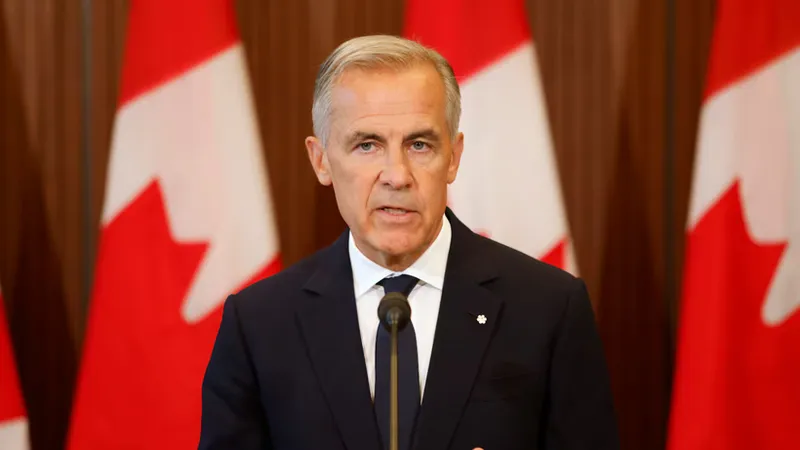
Prime Minister Carney delivers remarks on Canada-U.S. trade negotiations
Ottawa, Ontario, Aug 22, 2026
If there has been a man who has best demonstrated both the strengths and pitfalls of both the Architectural and Artisanal approaches to global ordering over the past year, it’s Canadian Prime Minister Mark Carney.
Carney clearly possesses a keen sense of political headwinds. In April 2025, mere months after Trump’s election and while US political commentary was talking about a new era of Conservative political hegemony, Carney leapt on Trump’s disastrous and unpopular tariff regime to awaken the apparent sleeping giant of Canadian nationalism to banish Trump toady Pierre Polievre to political irrelevancy.
With his speech at Davos at the beginning of this year, he garnered headlines and acclamation around the world for plainly naming the sunset of the US-led order and the need for Canada and other middle-sized nations to forge new arrangements and alliances in preparation for what comes next.
Unfortunately, however, Carney is also an economist and a technocrat. He was governor of the Bank of England for most of the 2010s. This is a role for which one doesn’t usually get hired if they are prone to bold or envelope-pushing ideas, at a time when bold or even different ideas were very much unwelcome. As a consequence, Carney’s passing flashes of fallen Quebecois Gaullism have always faltered on the fact that, when all is said and done, he is someone who colours inside of the lines, because he likes and respects the lines. It’s difficult to leave the fold when you are very much a creature of the fold.
All that being said, Carney is a technocratic economist at heart, and so Donald Trump’s recent decision to reignite a trade war with Canada might ultimately prove to have been the straw that broke the pocket-protector-using camel’s back.
A few days ago, it was alleged that amidst ongoing trade agreement discussions between the US and Canada, the Trump administration put forward a set of demands (or impositions) which would have been tantamount to Canada ceding its political sovereignty over who it conducts trade with around the globe, and on what terms.
The full text of Carney’s remarks on the ongoing trade disputes have been published in full, while the fallout of his clash with Trump—the imposition of 50% tariffs; his proclaimed renaming of Lake Ontario to Lake America, and renewed threats to annex Canada and reduce it to a US state—has been and continues to be discussed at length elsewhere.
For our purposes, in light of the previous two pieces shared this week, we were interested in one segment in particular;
“Early last year, I observed that the decades-long process of steadily increasing integration between our economies was over.
Our government understood, before many, that America would transform all its commercial relationships. That it would put a series of tariffs on its closest allies and use economic integration as a weapon. That its signature was written in pencil.”
That casual assertion, that the US signs its documents in pencil, at a glance seems minor, but is essentially making the same statement on the fact of dealing with Trump and the US government as the Iranians are now making with their blockade of Hormuz and refusal to commence any renewed discussions with the Americans until they make good on their commitments in the aborted Memorandum of Understanding.
With the US midterm elections now two months away, and with Trump increasingly weak and desperate domestically, it is almost certain that Carney can smell blood in the water and has spied an opportunity to strengthen his own standing by ratcheting up the economic pain for American voters when Trump’s other actions have already caused so much harm.
Again, like the Iranians, Carney has made the bet that he, and Canada, will be able to withstand the economic consequences of Trump’s belligerence longer than Trump will. The proof of the pudding is in the eating, but if the US’ second largest trading partner, longest historical ally and fondest neighbour can prove that it is possible to stand up to Washington and draw blood in return, that would go some ways to laying the foundation for the alternative order, or orders, that Lynch and Leonard are pointing toward—and which Carney himself as proposed.
In the meanwhile, the most enduring line in Carney’s statement will probably be that throwaway remark about American agreements being written in pencil — an assertion repeatedly proven true by their belligerent and hostile treatment of the Iranians even while actively engaged in negotiations. It’s a simple, quippy line, but the import on the global stage is much blunter, and much more severe.
“Forget it. You can’t trust them.”