


THIS WEEK IN VIOLENCE: Power Trip
2026, Week 34
Earlier this week, Israel carried out airstrikes on a defunct airbase in northwestern Syria, in an action both stated and perceived as aimed at Turkey. This week, we offer a little background on Israel and Turkey’s regional rivalry in the context of Syria’s civil war, and speculate on how Israel’s actions might have another target in their sights: Turkey’s NATO membership.
Israel strikes an air base in northwest Syria to prevent Turkish troops from deploying
AP – Aug 19, 2026
Reported by Samar Kassabali
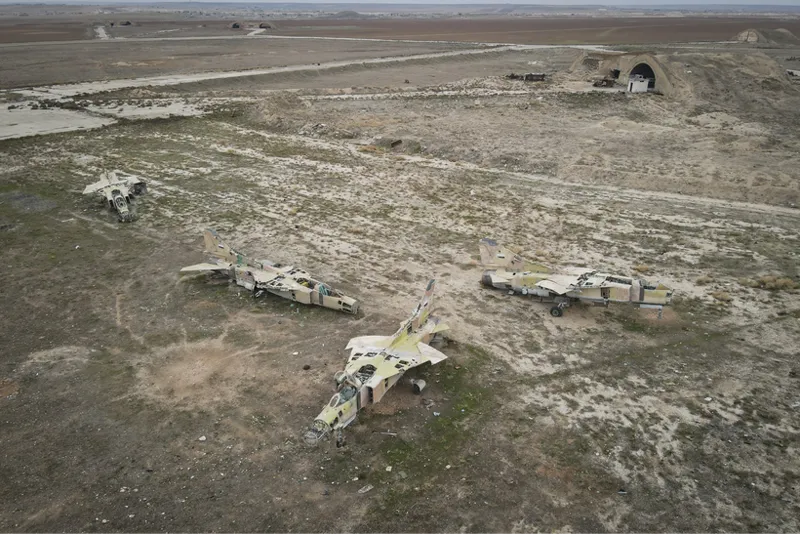
DAMASCUS, Syria (AP) — Israel struck an air base in northwest Syria early Tuesday, saying it aimed to prevent Turkish troops from deploying there.
Turkey, which has close ties with the Syrian government and has been providing assistance to Syria’s military, has tense relations with Israel. The rival countries have sought to curb each other’s influence in neighboring Syria.
Eight strikes hit the runway of the Abu Duhur air base in the northwestern province of Idlib, causing damage but no casualties, state TV said. Syria’s Foreign Minister Asaad al-Shibani told reporters in Damascus that Syria condemns the “Israeli aggression,” adding that the strikes were “an unjustified provocation, a violation of Syria’s sovereignty, and a direct threat to regional and global stability.”
Israeli Prime Minister Benjamin Netanyahu’s office said in a statement that Israel had attacked the base because Syria had been “on the verge of breaching” an agreed-upon “status quo in security matters” by allowing Turkish troops to deploy there.
“Israel repeatedly warned Syria that such a deployment would pose a threat to Israel’s security. Syria chose to ignore these warnings,” the statement said.
The Foreign Ministry of Turkey condemned the attack in a statement and called for “the international community to take a more decisive stance to end Israel’s escalating aggression against Syria and to ensure accountability for these actions that disregard international law.”
[...]
Tom Barrack, the U.S. ambassador to Turkey and special envoy to Syria, posted on X that Washington is “deeply concerned that the confirmed Israeli airstrikes” on the Abu Duhur air base constitute “an unnecessary escalation that does not advance regional stability.”
The government of Syria’s Interim President Ahmad al-Sharaa has neither “adopted a predatory posture nor maintained proxy forces” but has repeatedly indicated a preference for de-escalation with Israel, Barrack said.
The United States has in the past hosted, and will continue in the future to host, discussions to encourage diplomacy, Barrack added.
[...]
The new authorities in Damascus have said they do not want a conflict with Israel, but Israel has remained suspicious of the government led by former Islamist insurgents.
U.S.-mediated talks between Israel and Syria aimed at reaching a security agreement have been ongoing for more than a year but have so far failed to produce a deal.
The conclusion of Syria’s civil war and transition to normal governance under Ahmed al-Sharaa was a topic we covered in one of our earliest newsletters, at that time in the context of rising violence against ethnic and religious minorities such as Alawites and the Druze.
One thrust of that newsletter was a sense that events in Syria represented not simply the end of Assad, but the beginning of something new, and within that transition, several continuities. A post-Assad era is not the same as an era without conflict and violence, and even as the Syrian government has taken great pains to normalise its outward appearance and normalise relations with the West, the territory itself remains a site of struggle for both internal and external actors.
Throughout Syria’s civil war, which coincided with the ascendance of Islamic State in both that country and neighbouring Iraq, numerous surrounding countries played various roles in attempting to contain, direct, leverage or quell the conflict.
Turkey, which shares a long land border along Syria’s northern edge, was one of the primary routes through which militants and volunteers for fighters on all sides of the multi-factional conflict entered and exited the country. Turkish President Recep Tayyip Erdoğan was also happy to use the conflict as cover for his country’s ongoing war against Kurdish groups operating in and around the Turkish-Syrian border.
You may remember events in late 2019 when, following Donald Trump’s decision to withdraw US troops from the border regions where US-allied Kurdish groups had been operating, the Turkish Armed Forces carried out a series of airstrikes on border towns ostensibly targeting the Syrian Democratic Forces—whom Turkey views as an extension of the Kurdistan Workers Party (PKK)—and which displaced several hundred thousand people.
In the south-west of Syria, close to the capital of Damascus, is the country’s border with Israel, as well as the Golan Heights, which has been occupied by Israel military since 1967. Given the Assad dynasty’s historical alliances with the Islamic Republic of Iran, as well as Israel’s territorial and regional power ambitions, it played a number of roles in the Syrian civil war, providing medical treatment to fighters from numbers of rebel groups including, Jabhat al-Nusra, the al-Qaeda offshoot which, through a series of mergers, would later form Hayat Tahrir al-Sham, led by current Syrian leader Ahmed al-Sharaa.
Following the downfall of the Assad regime in late 2024 and the ascendance of al-Sharaa to the presidency, Israel seized on the situation to strengthen its hand regionally, carrying out a series of air strikes on ports, depots, military bases and other strategic locations to effectively cripple the Syrian military, actions ostensibly taken to neutralise any potential threat post-war Syria might pose. Given the ascendant faction was one which benefitted from Israeli assistance and al-Sharaa has been perplexingly compliant with Israel and the West despite deriving his nom de guerre from the region of Syria Israel is military occupying, this is a strange rationale, if justifiable.
Based on those initial strikes and subsequent attacks since, analysts have reasonably inferred that Israel’s overarching intention is to prevent the new Syrian government from having either an air force or even air defence. Israel has made clear that it perceives any of its neighbours possessing their own defence capabilities as an a priori threat to its safety, and has demonstrated its willingness to use the long leash granted it by its western allies to establish a regional security framework it finds preferable, i.e. total unilateralism.
This latest attack on Abu al-Duhur, situated far beyond Israel’s borders in Syria’s northwest, is a strange choice as far as defending its own security is concerned. Allegedly the air base had been non-operational throughout the civil war, and for the most part had been used as a shelter or staging ground for this or that rebel group. Rather than being aimed at Syria’s government (as one might expect in an attack on Syrian soil), many suspect the bombing was aimed at a third party: Turkey.
Israel justified their attack by claiming that Turkey had been working to rebuild the air base — though for what purposes is unclear. Ankara was a backer of al-Sharaa’s faction from early on in the civil war, and as a consequence has enjoyed good relations with the new Syrian government. This stands in contrast to Israel who, despite al-Sharaa’s overtures, perceive a stabilising Syrian state as a potential new Iran in the making—which is strange, given how enthusiastic Israel usually is about playing with others.
The metagame playing out here is competition between two regional powers. Both Turkey and Israel are economically and military strong powers with aspirations of being the regional kingmaker. During the post-war period, both Turkey and Israel have occupied sections of Syria to attempt to maintain security in their border regions (and also, let’s be real about it, pursue their own objectives against, for example, the Kurds). An important distinction, however, is that Turkey is occupying its territories at the request of the Syrian government; Israel, quite uncharacteristically, is occupying Syrian territory illegally.
As a consequence, Syria is once again becoming a proving ground for different political factions seeking to tilt the scales in their favour. Israel’s actions earlier this week were brazen enough that even the US Ambassador to Turkey, Tom Barrack, felt compelled to issue a strong condemnation of Israel’s actions, calling their actions “an unnecessary escalation that does not advance regional stability.”
It’s possible that Israel’s actions against Turkey in Syria concern a territory much wider than Syria, however. As we stated in last week’s newsletter in the context of its new defence agreement with Saudi Arabia and Pakistan, Turkey is both the possessor of one of the largest militaries in NATO, as well as being one of its most mercurial members.
Article 4 of the North Atlantic Treaty is the provision which allows for consultations on major security concerns and is effectively the precursor to Article 5. Of the nine times Article 4 has been invoked, five were by Turkey, primarily pertaining to issues around Syria. As with several other more peripheral members in the defence pact, as opposed to France, Britain and Germany, there have been questions about how far NATO would actually go to defend Turkey were it attacked.
Turkey’s membership in NATO is a longstanding bugbear of Israel, which perceives it as a hindrance to its own desires with the alliance. It’s possible that Israel’s latest round of escalations against Turkey in Syria are part of a longer-term strategy intended to exacerbate that fracture with the hopes of cleaving Turkey away from NATO.
When NATO General Secretary Mark Rutte was questioned about the prospects of Article 5 being invoked in the event of Israel attacking Turkey, he demurred, refusing to “speculate”, calling Erdogan wise and pivoting to boilerplate remarks about October 7. The subtext, it seemed, was to imply that if Israel were to attack a NATO member state, NATO would side with the attacker, Israel.
This probably shouldn’t come as a surprise to anyone, of course. But it doesn’t do much to resolve the growing incoherences and contradictions in NATO and the broader European security framework.
According to reporting by Israel’s Channel 13, Netanyahu first proposed performing strikes against Turkey in Syria to the Americans several weeks ago, but was rebuffed. Whether this week’s attacks were related to that proposal or not is unclear.
But given Netanyahu and Israel’s behaviours over the past few years, it wouldn’t be surprising if they had smelled an opportunity to pursue flagrantly aggressive belligerent actions in furtherance of their own interests—knowing that neither friends nor allies would stop them—and decided to go for it.
Actions like these hardly form firm bases for regional or global security, of course. But it’s not like anybody seems particularly concerned about silly things like that right now. Take a look around you. It’s a fire sale.