


THIS WEEK IN VIOLENCE: Time to Hedge
2026, Week 33
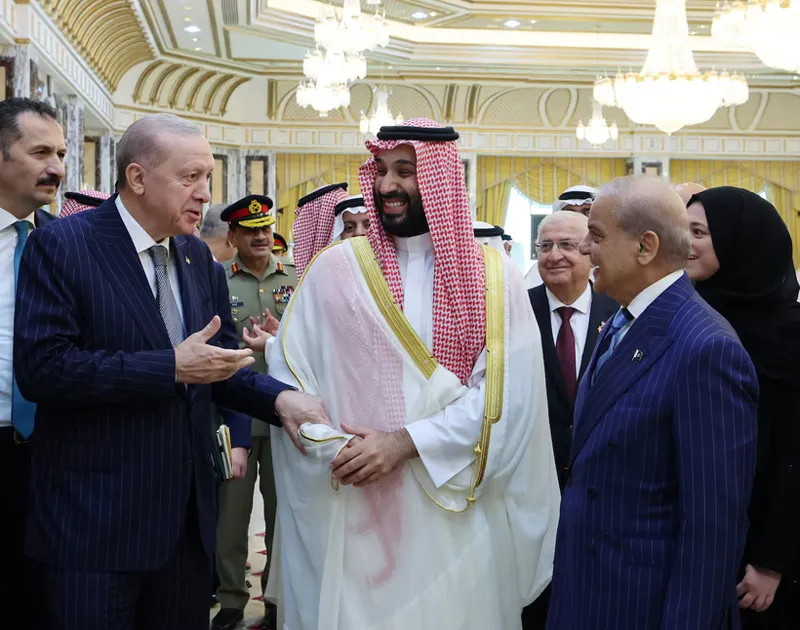
Earlier this week, three countries across the Middle East and South Asia signed a new defence pact which has several potential ramifications for the region, and indeed security arrangements around the world. This week, we’re going to discuss that announcement and why we should hope it never has to be worth more than the paper it’s printed on. Because if it does, things could get silly.
Turkey lays out plans for defence pact with Pakistan and Saudi Arabia
Reuters – Aug 13, 2026
Reporting by Tuvan Gumrukcu, Editing by Huseyin Hayatsever and Ece Toksabay; Editing by Aidan Lewis
ANKARA, Aug 13 (Reuters) - Turkey, Saudi Arabia and Pakistan will group senior ministers, hold joint exercises and deepen defence industry cooperation under a military pact signed between the regional powers last week, Turkey's defence ministry said on Thursday.
The three Sunni Muslim U.S. allies, alarmed by a regional conflagration that has brought Iranian missile fire onto Gulf oil exporters, signed the "Mecca Joint Defence Agreement" on August 7. They said the accord stipulates that an armed attack against any member would be regarded as an attack on all, similar to NATO's Article 5 collective defence clause.
At a weekly briefing in Ankara, the defence ministry said the pact's fundamental goal was to ensure defence and military ties were put on a "more institutional and sustainable" footing.
"Under the accord, strategic political and military mechanisms plan to be established involving the Defence Ministers, Foreign Ministers, and Chiefs of General Staff/Armed Forces Commanders, and that coordination among the three countries will be conducted at the highest level," it said.
The ministry added that joint military exercises involving land, naval, and air forces, as well as air defence and unmanned systems were planned, in addition to deeper defence industry cooperation.
"The aim is to provide not only product and system supply, but also joint development and production, technology cooperation, and sustainable maintenance and logistics support," it said, adding that unmanned and autonomous systems, electronic warfare and artificial intelligence capabilities would be prioritised.
Turkey, which has NATO's second-largest army, has said the pact with nuclear-armed Pakistan and top oil exporter Saudi Arabia was open to expansion — with Egypt as a potential candidate — and did not seek to replace any existing alliances.
The ministry also said Turkey was participating in meetings in Jeddah aimed at establishing an international coalition to protect Red Sea shipping.
You will recall that during his barnburner speech delivered at the World Economic Forum in Davos earlier this year, Canadian Prime Minister Mark Carney spoke about the perilous position so-called ‘middle powers’ find themselves in.
In that speech, Carney made gestures to threats to the global institutions states rely on to safeguard and uphold international agreements, frameworks and law; to the sovereignty and territorial integrity of middle-powers by more powerful security partners; and to the ability of institutions and nations alike to continue depending on the global military and economic hegemon which ostensibly serves as their backstop, owing to increasingly erratic and unpredictable behaviour.
That these issues all emanated from the same place, and that that place is the ostensible backstop, the United States, is a point that was alluded to more than stated outright. But both the spirit and the letter of Carney’s speech were well-received by global leaders and the public more broadly.
Carney’s speech offered a glimmer of hope that, after a decade, politicians in the rest of the world might finally be accepting the need to plan for an international order in which the United States is no longer the guarantor of security and prosperity in the Global North and further afield, and may in fact be the primary threat.
Carney’s open recognition of a new, emergent order and an attendant need to plan for it placed a sign of hope in the window, to riff on the opening to his speech; hope that the nations of the world who have yet to completely sacrifice their sense of moral or ethical duty at the altar of capital might be willing, and perhaps even actively preparing, to make sacrifices in order to protect them.
It was an acknowledgement which was not just prudent, but had in fact been a long time coming, and which any honest assessment would have to concede did not begin with Donald Trump, but preceded him, merely finding its latest and most grotesque culmination in his figure.
During the 2015 Primary season and subsequent 2016 Presidential election, Donald Trump had ascended to the GOP nomination and then the presidency condemning the sins of his predecessors, particularly the wars in Iraq and Afghanistan.
In power, he reverted, in quintessentially Donald Trump fashion, to committing the same sins as his predecessors, only in stupider and more thoughtless fashion. During his first term these included moving the US embassy in Israel from Tel Aviv to Jerusalem, the abandonment of the Kurds in Syria, and the pointless assassination of IRGC Commander Qassem Soleimani.
In the second term, following a brief Biden interregnum that feels more pointless and inconsequential with each passing day, Trump’s behaviour has only gotten worse. The practice of extraordinary rendition which began under Bill Clinton and expanded under George W. Bush, feeding the cells of Guantanamo Bay and black sites the world over, resurfaced in the kidnapping and trafficking of individuals labelled synonymously as immigrants and criminals to detention centres inland and overseas.
The surgical drone strike assassination programme pioneered during the Obama presidency has metastasised into a universal prerogative to commit murder against fishing boats in the Caribbean. These two strands arguably found their synthesis in how Trump conducted foreign policy proper. In Venezuela, his administration seized the prerogative to abduct the Head of Government of a sovereign nation and reduce the country concerned to an imperial annex. In Iran, the tactic of Death From Above which produced so much glory against alleged drug traffickers was put to use in service of a regime change war. In practice, such an approach proved akin to kicking a hornet’s nest to try and kill the queen.
Trump and Netanyahu’s flagrantly illegal and vastly destructive attack on Iran commenced barely a month after Carney’s speech, and so presented the perfect test case for Carney’s ambitious rhetoric. In the event, the Canadian premiere’s words reduced to that which they always simply were; words. Within days, he endorsed Trump’s war, and has periodically reiterated his support for attacks against Iran by the United States since.
Is it possible that other countries are now heeding Carney’s words? Or are they simply making similar inferences about the global state of things on their own steam? Responses to this new defence pact between Saudia Arabia, Pakistan and Turkey indicate some onlookers think so, but it’s possible other things are going on.
In September of 2025, the Kingdom of Saudia Arabia and the Islamic Republic of Pakistan signed a Strategic Mutual Defence Agreement. Though the text of the agreement itself was not published, it was declared to make the same assertion as NATO’s Article 5: Asserting that any attack on one would be received as an attack on all and responded to accordingly, collectively.
Just under a year later, this original SMDA appears to be expanding with the addition of Turkey, a development which has complicated the task of unpacking both the defence pact’s spirit and its substance.
The initial reaction among onlookers and analysts in the media has been to interpret the move as a response to the US’ actions in Iran; that the defence pact signals a loss of faith in America’s ability to provide security and stability in the Middle East, and that Saudi Arabia is joining up with nuclear-armed Pakistan and Europe’s most mercurial security partner, Turkey, to assemble a secondary defence pact whose immediate individual interests are more closely aligned.
There are reasons this interpretation is plausible. Over the past few months, the United States has been inching toward a nuclear deal with Saudi Arabia. On its face, the agreement would allow the Kingdom to establish its own civilian nuclear energy programme as the country prepares to transition to a post-fossil economy. There are reasonable fears, however, that the Saudis would use the deal as a stepping stone to building a nuclear weapon programme, an ambition the Saudis themselves have repeatedly stated.
As a condition for signing off on the deal, the US has demanded that Saudi Arabia sign onto the Abraham Accords, a peace treaty normalising relations between Israel and various Arab states launched during the first Trump term. Fortunately, the leaders of the Kingdom have amply demonstrated they don’t much care for the Palestinians or, indeed, for principles in general. Unfortunately, the same can’t be said for their population, who would probably respond poorly to the deal, particularly in the context of a US-Israeli war which has resulted in their own country being struck by drones and missiles.
This is where that original bilateral agreement between the Saudis and Pakistan illuminates a different story. That agreement was signed barely a week after September 9, 2025, when Israel carried out an airstrike in Doha, Qatar, a country with whom it was not at war and had not announced hostilities, in a failed attempt to assassinate the senior leadership of Hamas.
It was this illegal and unannounced flagrant act of aggression by Israel, the United States’ preferred regional partner for ensuring security and stability in the Middle East, which appeared to have triggered that hasty search for alternative arrangements.
It is unlikely, after all, that aggression with Iran was the inciting event. Saudi Arabia has long viewed Iran as a regional adversary for a multitude of reasons. During this current war, the Kingdom reportedly pushed for further attacks by the US on the Islamic Republic even as it publicly distanced itself from America’s actions.
But this ambiguity can be identified in the respective interests of each of the partners concerned. Despite one of its primary exports to the United States apparently being imperial blowback, Pakistan has been a longstanding ally and partner of the United States, whose heft it has used as a backstop against India.
Far from being adversarial to the United States, the country’s current leadership is assuredly loyal. In 2022, the country’s Prime Minister Imran Khan was removed from office, allegedly after the US expressed disapproval over his response to Russia’s invasion of Ukraine.
Since then, Pakistan has remained firmly within the fold, but not without continuing to look out for its own interests, which are manifold given the country directly borders Iran. Destabilisation and unrest in Iran could quickly produce knock-on effects for Pakistan; one of the most heavily armed countries in the Middle East descending into civil war could create numerous opportunities for Baloch separatists in Pakistan’s southwestern province to arm themselves, for example.
More simply, as the bridge connecting the Middle East to South Asia, Iran is also a buffer, helpfully shielding Pakistan from events unfolding further west. And so even as a reliable[-ish] US ally, Pakistan has emerged from this war as an apparent voice of reason, facilitating peace talks in Islamabad and keeping Tehran onside during negotiations even as the US does everything in its power to trash them.
Turkey, meanwhile, remains the most unreliable partner in Europe, NATO, the Middle East and elsewhere. The inconsistency of Erdoğan’s commitment to the ostensible tenets of his international arrangements is notorious: buying arms from Russia while a member of NATO; ascending to become Russia’s second-largest trading partner during the Ukraine War; and the hall of mirrors which is Turkey’s relationship with Israel, which vacillates constantly between strategic cordiality and mutual vying for regional supremacy.
Why it is that Erdoğan is allowed to get away with such behaviour is a mystery, but may reside in the fact that Turkey possesses one of the largest militaries in NATO and theoretically possesses the political and military heft to disrupt the balance in the Middle East were it so inclined.
There is also the fact that Turkey is the land bridge connecting the region of the Middle East most devastated by war and western interventions to Southern and Central Europe, and is also host to numerous refugee encampments of peoples displaced by those wars.
It would not be difficult, in theory, for Erdoğan to temporarily turn his back, and for Europe to find itself overwhelmed by a sudden influx of dreaded migrants. Fortunately, Erdoğan is not a fickle and capricious guy, and as the European reaction to events in Ceuta demonstrate, sudden waves of migrants across a vulnerable borderzone are never the product of malice, and only ever the result of negligence by this or that leader. Right?
As for the KSA, the country is, as we say, at a crossroads. Knowing that one day the oil money will run out, Crown Prince Mohammad bin Salman has been working like Wile E. Coyote, desperately trying to secure a post-fossil future for the kingdom, and its place on the world stage. Unfortunately, this has mostly produced Wile E. Coyote-esque boondoggles like NEOM, The Line, and the LIV Golf Tournament, which all seemed like fine investments to throw mountains of cash at provided nothing happened to disrupt economic stability in the region like, say, a war with Iran with no perceivable end.
Along with the obvious threat of Israeli dominance in the region—which it has been flouting with its ongoing attacks and occupations in Lebanon and Syria, as well as Gaza and the West Bank—Saudi Arabia also has reasons to be concerned about the UAE, which has been aggressively working to establish its own regional empire across the Gulf and Horn of Africa, and has willingly performed the pliant partner role for the US much more willingly to do so.
Discerning how these composite parts assemble into a coherent whole in this new tripartite defence agreement, then, is where the challenge arises. On the nuclear front, it is possible that KSA is pulling closer to Pakistan as a bargaining chip. If they can signal to Washington their ability to access nuclear weapons independent of the US, perhaps even under the table—this cannot be ruled out with Pakistan—then perhaps the Trump administration might advance the Saudi nuclear deal without insisting on the Abraham Accords, a clause which the Saudis are probably eager to skirt.
Looking at the three on a map, it’s certainly fair to assume the agreement is a supplementary regional safeguard against Iran, establishing a triangle of defence around the Islamic Republic’s borders. But even then, conflict with Iran would not be desirable for any of these parties, particularly the two who share land borders with it.
As we’ve already seen ample evidence of, however this war ends, it will likely produce manifold new arrangements for the Middle East in terms of security, trade, diplomacy, and regional relations. Iran is suffering heavily in that rearrangement right now, but when the war ends it will likely emerge considerably more powerful and influential. It’s possible that collectively, KSA, Turkey and Pakistan are aligning to form a bloc which could counter both Iran as well as the US’s most cooperative regional partners, the UAE and Israel. Defence agreements, after all, are not inked primarily for the purpose of conducting war, but repulsing it through potentiality. The trio might not want to do anything, but simply to signal that they could.
Signalling is probably the best that they, and we, should hope for. This is because the Article 5-style agreement between the countries raises uncomfortable questions regarding their personal issues. Pakistan, for example, has been involved in a longstanding dispute with India over Kashmir. Tensions between those two nuclear powers erupted into a brief, but incredibly scary, hot war just last year. How would this new defence pact respond if that war were to turn hot again? Would Saudi Arabia and Turkey really attack India in defence of Pakistan? What ramifications does that then produce?
The same holds for Saudi Arabia. For the past decade, in partnership with the US and UAE, the Kingdom has pursued a disastrous war against the Houthis in Yemen, which produced few changes in the political structure of that country, demonstrated by the fact that the Houthis were able to initiate blockades and exact concessions from the US, the global military hegemon, attendant to Israel’s genocide in Gaza. Are we to believe that if the Houthis carry out further strikes on Saudi infrastructure and oil facilities during this war, that Pakistan and Turkey will respond? Again, it’s hard to discern how this works in practice—which is not the same as saying that it won’t happen.
As for Turkey, as stated, Erdoğan has built a personal brand on being NATO’s most mercurial and slippery partner, and so it’s difficult to predict what activities he and his sizeable military might become embroiled in, particularly as both Israel’s genocide and the illegal US-Israeli war on Iran continue to metastasise into a larger, region-wide war. A foot set wrong here or there could conceivably put Turkey in conflict with Israel, or Greece, or the new government of Syria. Where will Pakistan and Saudi Arabia be if and when?
More to the point, Turkey is also a member of NATO, which has its own Article 5. If Turkey engages in military actions pursuant to this new defence pact with the KSA and Pakistan, that could well result in Turkey being attacked in response. What then? If Turkey is attacked in response to a conflict which originated with the Saudis or Pakistan, will Article 5 then be triggered for the militaries of the North Atlantic to come to their defence?
It’s a good thing defence pacts operate primarily on the semiotic level, because this latest pact is one which certainly presents issues once its implications are traced into the realm of the real.
At the risk of creating a catchphrase on the show, this is, once again, a development which seems like it will probably be fine, just so long as nobody does anything stupid. Here’s hoping.