


THIS WEEK IN VIOLENCE: Tatmadaw’s Shiny Happy People Committee for Lo-Fi Beats to Study To
2026, Week 32
This week, we’re staying in Southeast Asia, jumping just over Thailand’s north-western border to Myanmar, where the ongoing civil war between the country’s military dictatorship and numerous armed groups across the country is showing slithers of hope that a resolution might be on the horizon, nestled amidst a morass of repression and violence which has persisted, practically uninterrupted, for over sixty years.
The conflict in Myanmar is another one which myself and Thomas would like to cover and examine more deeply in the future, so this is another historical primer episode to bring you up to speed. Hopefully it goes without saying that the history of Burma and Myanmar is deep and complex, and so we can only hope to scratch the surface here. But if you want a brief overview to get you started, then hopefully we’ve done an okay job.
Thank you again for supporting the show, and we’ll catch you next episode to answer the following question: Who would win? Muammar Gaddafi, or four-hundred trucks?
Myanmar civil war nears a rare opening for talks as diplomacy gains ground
Reuters – Aug 05, 2026
Reporting by Reuters staff and Panu Wongcha-um in Bangkok, Writing by Devjyot Ghoshal; Editing by Saad Sayeed
After more than five years of fighting, a rare window for talks over Myanmar's devastating civil war is appearing, driven by a shift on the battlefield where the military has regained ground and mounting regional pressure to engage.
Analysts say the change is most visible in the position of an umbrella body that brings together several major ethnic armed organisations and the shadow government that includes remnants of the last elected administration.
The Steering Council for the Emergence of a Federal Democratic Union (SCEF) said after a meeting last month with Thai and Philippine foreign ministers, who separately also met with Myanmar's military negotiation committee, that it is committed to pursuing a political settlement.
Myanmar's junta chief turned president Min Aung Hlaing has yet to accept the SCEF as a negotiating partner, but his visit this week to Thailand, which is pushing for the gradual re-engagement of the regional ASEAN bloc with its war-torn neighbour, highlights wider efforts for a truce.
"It therefore seems that they have abandoned their previously stated public objective of overthrowing the Tatmadaw," said Morgan Michaels, research fellow at the International Institute for Strategic Studies, referring to the SCEF and the Myanmar military.
"Still, political dialogue between the Tatmadaw and SCEF groups may be quite a way off. The more near-term prospect is that we'll witness a movement towards ‘talk of talks’."
[...]
The SCEF's objective is to secure civilian supremacy and push Myanmar's military out of any political role, said spokesperson Saw Nimrod.
"That's our final call but for now, we are committed to achieving a negotiated political solution," he told Reuters. "We are open to dialogue and open to political negotiation."
To create conditions for meaningful dialogue, the SCEF has called on the military to end attacks on civilians and release all political prisoners.
Myanmar's new government, which took office following an army-engineered election that allowed Min Aung Hlaing to take a civilian role, had also called on armed groups for talks by July 31.
"Peace is our desire, our greatest wish," Min Aung Hlaing told parliament last week, although a conflict monitor flagged a sharp escalation in military attacks on civilians since the leadership transition.
The Thai government -- which will host Min Aung Hlaing on Thursday and Friday -- has been a key player in pushing for Myanmar's re-engagement with the regional ASEAN bloc that shunned the leadership in Naypyitaw after the coup for dragging their feet on a peace plan.
For Bangkok, the priority is reducing violence, expanding humanitarian access and containing the conflict's spillover into Thailand, a senior Thai official said, asking not to be named due to the sensitivity of the issue.
So far, Naypyitaw has not accepted the SCEF as an interlocutor, instead seeking bilateral discussions with individual groups, said Richard Horsey, Senior Adviser for Asia at the International Crisis Group.
"All the conflict parties are in principle ready to hear what the other side has to say, but a peace process requires concessions towards a jointly-agreed outcome of some kind," he said.
"That looks far off for most groups."
From the vantage point of a developed, liberal state in the west, the notion of a government led by the military is an unnerving one. But in the grand scheme of things military dictators or juntas—from a Spanish word for ‘committee’—are sadly neither novel nor rare.
Twentieth century history is littered with states and governments which were dominated and then run by their armed wings. This was particularly the case in the decolonising and developing nations of the Global South, where an autochthonous iron fist forcing a fledgling free populace toward free markets and capitalism was seen as preferable to them teetering toward collectivism, social democracy or worse by elective means.
If there is one country whose name could be deemed synonymous with military junta, and which actualises the model’s worst potentialities and possibilities, it is Myanmar, formerly Burma. In 1948, after over a century of British rule, the country secured its independence and transitioned to a parliamentary democracy.
As in other countries across the region, however, Burma was afflicted by both communist insurgencies and ethnic disputes which fractured political unity. Minority ethnic and religious groups in the country advocated for political federalism, which would grant greater autonomy to groups in their respective territories. During the colonial period, Britain had deployed a divide-and-rule strategy in Burma, elevating individuals from the country’s minority ethnic groups, such as the Karen, Kachin, Chin and Rakhine, in positions of power, particularly in the military.
A key player in Burma’s fight for independence was Aung San, an individual who was politically… pragmatic. He was an anti-colonial nationalist who wanted Burma to become a multi-ethnic democracy. In support of this goal, he founded a paramilitary called the Burmese Independence Army, who assisted the Japanese invasion and occupation of Burma.
Eventually, it became clear that Japan didn’t actually care much about Burmese independence—quelle surprise—and that what they actually planned for was to turn Burma into a puppet state. In his efforts to free his country from one devil, Aung San had hopped into bed with another.
As Japanese rule crystallised, the BIA changed its name to the Burma National Army, the BNA, but tensions between them and the Japanese increased, and by mid-to-late 1944 the BNA had linked up with communist and rebel groups across the region as well as nearby allied British forces. They turned on their former allies, spearheaded a nationwide rebellion against the Japanese, and ejected them from the country.
What bears remembering on this note is that the Burmese Independence Army was founded in opposition to colonial British rule and its organisational branches, and so its ethnic makeup was almost entirely ethnic Bamar. And so the historiography of Burma’s independence struggle became entangled amongst questions like who was fighting for it, who were they fighting against, and so on.
When independence finally came to Burma, Aung San’s Burmese National Army formed the skeletal structure of the armed military of the independent Burmese state. It also informed many of the strong ties and associations, real or felt, between Burma’s military and its government.
Again, Aung San, a key figure on both sides of this politico-military debate, was pragmatic and interested in a unified Burmese state which nonetheless accommodated its ethnic and religious diversity. Not everyone agreed. In 1947 he was assassinated by a group of rivals allegedly led by U Saw, a former Prime Minister from the British colonial period who was right-wing, conservative, and intensely Bamar nationalist.
This history, then, informs the tensions and contradictions that have been at play in Burma and Myanmar ever since. Desires to maintain the territorial unity of the country as a whole, versus desires for autonomy and self-governance among ethnic minorities, particularly in peripheral regions. A government and military with a unique relationship to its majority Bamar ethnic group, and which then creates fraught narratives and conceptions regarding Burmese independence and national identity, and what that fight was for.
Aung San, founder of the Burmese Independence Army, has been memorialised as Burma’s Father of the Nation. He is also memorialised as Father of Burma’s National Military, the Tatmadaw. Free Burma and the Tatmadaw share the same, noble, revolutionary origin, and it was the Tatmadaw which bequeathed the nation to its people. Hopefully you can see why a family tree like this might be hazardous.
Burma’s military was not initially dominated by ethnic Bamars, but as the years went on their representation gradually increased. When calls for federalism and autonomy persisted into the ‘60s, these were interpreted as calls for dissolution of the Burmese state. In 1962, amidst splits within the popular front party which had governed the country since 1948, the Tatmadaw staged a coup, and Burma fell under a military dictatorship.
Since then, the government has been under one or another form of military rule with periodic restructurings or fleeting gasps of freedom. Post-’62, the country was governed by a Revolutionary Council and Socialist Programme Party pursuing what it called the Burmese Way to Socialism. In reality, every member of the Revolutionary Council was drawn from the Tatmadaw, and their programme was a form of authoritarian Bamar nationalism which centralised the country’s industry and economy under military oversight and was fervently anti-international and isolationist in posture.
Improvements were made in some areas, such as education and literacy, but ultimately the Burmese Way was a catastrophic path for both the country and its people, crippling Burma’s development for over a quarter of a century.
In 1988, widespread protests and uprisings by students, religious leaders and workers prompted a brief gesture toward democracy, but not before a crackdown which claimed thousands of lives.
Democratic elections were finally held in 1990, but when Aung San’s daughter, Aung San Suu Kyi, swept the elections with 60% of the vote, the Tatmadaw refused to recognise the results, placed her under house arrest, and assumed control under its new banner, the State Law and Order Restoration Council, later the State Peace and Development Council, continuing a time-honoured tradition in global politics of giving your repressive government a super innocent name in the hopes that no one will notice all the repression and misery, which I like to call the Shiny Happy People Method.
All the while, the schism between the country’s majority Bamar government and military, and its various ethnic minorities—who, lest we forget, have their own military legacies from British colonial rule, World War II and beyond—continued to grow. Armed and political wings advocating for minorities like the Kachin, Karen, Chin, Shanni, Danu and others have continued to fight for autonomy and independence, while the Tatmadaw has insisted on a political programme which conflates territorial unity, political authority and Bamar supremacy.
When Myanmar finally moved toward liberalisation and democracy in the 2010s, there were hopes that the country might banish the military dictatorship’s worst tendencies to the past. Instead, events transpired suggesting whatever beliefs had animated the Tatmadaw’s actions had become deep-seated.
In 2010, the military government announced Myanmar’s first elections in two decades. Aung San Suu Kyi’s National League for Democracy, viewed as synonymous with the country’s drive for democratisation, boycotted the elections, and the Tatmadaw’s proxy party, the Union Solidarity and Development Party, won with 80% of the vote.
Subsequent by-elections in 2012 and a national election in 2015 saw Aung San Suu Kyi’s NLD achieve overwhelming successes, ultimately dominating both chambers of the country’s parliament. And though Aung San Suu Kyi was barred from assuming the presidency, she was appointed to a new role which positioned her functionally as head of government. A political prisoner for twenty years, her ascendance to government was heralded the world over as a turning point in Myanmar’s fortunes.
The good feelings would last for around a year.
Of the country’s dozens of ethnic groups, one in particular has been subjected to particularly harsh treatment. The Rohingya are a Muslim minority ethnic group situated in the northwest corner of Rakhine state, along Myanmar’s west coast. Since the 1970s, they have been subjected to discriminatory and exterminatory practices at the hands of Myanmar’s government, cultural, political, and physical, which are tantamount to genocide.
In 1982, the government passed a citizenship act which explicitly excluded the Rohingya from Burmese citizenship, claiming they are in fact citizens of neighbouring Bangladesh. Bangladesh, in turn, denies this claim, and as a consequence the Rohingya, like the Palestinians, are stateless people under international law.
In 2016, the government’s slow-boiling oppression of the Rohingya reached a head when the Tatmadaw carried out what appeared to be a planned and coordinated campaign of extermination against Rohingya villages in northern Rakhine state, killing civilians, torching villages, committing arbitrary arrests and mass sexual assaults, and pushing Rohingya people across the border into Bangladesh. Evidence later indicated the Tatmadaw had also used the social media platform Facebook to disseminate hate material about the Rohingya to provide popular justification and legitimacy for the campaign.
When pressed on the atrocities later, Aung San Suu Kyi demurred, claiming violence had been committed by both sides. It was even reported that in response to questions about the incidents she had, herself, made Islamophobic remarks.
It was unclear whether her reticence was due to concerns for her personal safety, or manifestations of personal prejudice. In any case, her inaction was widely condemned. An individual who had been a unifying figure in the fight for democracy in Myanmar became a rock against which that fight seemed doomed to languish.
Nevertheless, Myanmar’s experiment with democracy continued. In November 2020, in the height of the Coronavirus Pandemic, a general election was held in which the governing NLD party increased its majority to the detriment of the military’s USDP.
In February 2021, following months of disputes over the results, the Tatmadaw effectively flexed its old muscles, which had yet to atrophy, triggering blackouts across communication, broadcast and financial networks, seizing control of the government, and placing elected members of parliament under house arrest.
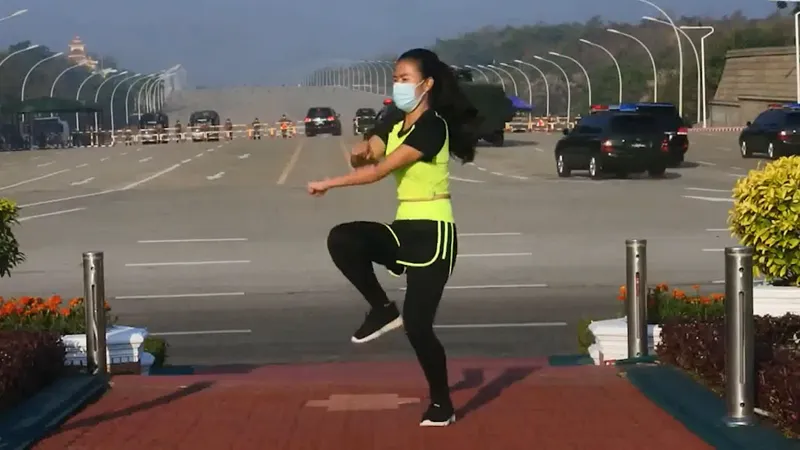
The event produced one of the most memorable cultural relics of the pandemic, a video of a fitness instructor recording a dance video in the streets of Naypyitaw as military vehicles carried out the coup behind her.
Democracy was over. The Tatmadaw was back in charge.
Unfortunately, the Tatmadaw was about to learn a familiar lesson of history. Those who experience even a fleeting taste of democracy are loathe to surrender it. In the aftermath of the coup, civilians across the country joined resistance groups called the People’s Defence Force, committing to armed civil war.
Myanmar’s military government had long been accustomed to struggles over territory in its peripheries with groups like the Kachin and the Karen. This new conflict was of a different order. Now, they were dealing with popular uprisings in the cities and urban centres, often in numbers which made ground confrontations impossible.
Resorts to brutal aerial attacks proved ineffective, only turning more of the population against them, and leading to numerous assassinations of military high command. Where before the Tatmadaw had confronted disparate groups in territorial pockets, they were now faced with a unified enemy which offered them little space for respite. As a consequence, morale in the military collapsed, with growing desertions and defections, while previously disempowered separatist militias strengthened and even increased their control of territory.
All of this being said, the reality of Myanmar right now should not be overlooked. Following a half-century of military rule and a brief foray into democracy which featured acts of genocide, a country already beleaguered by violence has descended into a multi-front civil war between a military whose self-conception is woven into the nation itself, and that nation’s civilian population, which the military confronts as a threat, as well as sundry armed groups who are both enjoying the respite a heavily-stretched adversary provides, and exploiting the chaos for their own gain.
Nonetheless, this current wave was triggered by an explicit attempt to deny democracy, and recent developments indicate an appetite to restore that process, and perhaps even expand it. In April of this year, a group called the Steering Council for the Emergence of a Federal Democratic Union (SCEF) announced itself.
This group saw members of the National Unity Government, a collective of exiles from the deposed 2021 parliament, aligning with several armed groups under a single political banner: the Karen National Union (KNU), the Karenni National Progressive Party (KNPP), the Chin National Front (CNF), and the Kachin Independence Organization (KIO).
In foundation, the SCEF expressed its goals through three pillars: the representation of states and federal units; the representation of ethnic armed organisations and the public; and the representation of women. In the months since, it has facilitated dialogue between the member groups, as well as the sharing of military, political, federal, and institutional perspectives among member groups with an aim to accelerate the overthrow of the Tatmadaw and the formation of an authentic federal democratic union under a new framework and constitution.
Hurdles remain, however. While the participation of several of the country’s largest ethnic armed organisations in the SCEF is significant, numerous others are notably absent, including the Arakan Army, an armed group from Rakhine State who were accused of collaborating with the Tatmadaw in the Rohingya genocide. (To be clear, they have also since engaged in armed conflict against and themselves been victims of atrocities committed by the Tatmadaw.)
Furthermore, while the Tatmadaw has certainly suffered losses during this latest phase of violent repression, it is obviously no stranger to prolonged armed politics. No matter how many small wars and fronts it may be engaged in at any one time, it remains a comparatively unified centre against a constellation of smaller, less well-armed adversaries.
As Reuters’ reporting states, the SCEF has succeeded in cohering and asserting itself as a negotiating partner, but the Tatmadaw has yet to recognise them, instead seeking one-on-one negotiations with its various adversaries. It’s an approach which echoes the divide-and-rule tactics the British used during their own violent colonial rule, but which also ensures the Tatmadaw’s status as the centre of political gravity in any developments moving forward.
What the ultimate remedy for the Myanmar situation is, is difficult to say. Left as an internal situation, the Tatmadaw will likely be happy, or existentially compelled to grind on until its adversaries are sufficiently weakened and it can assert its illegitimately reclaimed authority as the status quo.
International participation and oversight is therefore desirable. Right now that’s being led by Thailand, but as we discussed in last week’s newsletter, they face troubles of their own, including some concerning their border with Myanmar. If their priority is their own domestic stability over conflict resolution, then they might simply accept the return of the Tatmadaw so they can focus their energies elsewhere.
Perhaps what is needed, then, is a robust international response that might truly bring pressure to bear on the Tatmadaw. What form that would take, however, is another conundrum. Sanctions are unlikely to deter a government which endured for decades as a pariah state, and would also end up hurting many of the groups now fighting to dislodge the military government, not to mention civilians. Diplomatic isolation would only push Myanmar further away from the democratic means its people seek.
Military intervention would only exacerbate the suffering and destruction while creating scarce visible pathways toward a future which might redeem it; and besides, it is unlikely Myanmar has ever ranked high enough in the concerns of the international community to warrant that type of robust response.
And so it continues. Much the same as it has ever since the country first gained independence over sixty years ago. The pieces shuffle around, the names change, the song is sung slightly differently, but the beat remains the same. On and on. Relentless.