
THIS WEEK IN VIOLENCE: Southern Discomfort
2026, Week 31
This week, we’re moving our attention to another part of the world which has received scant attention amidst the violence unfolding elsewhere right now, but which we believe is worth knowing about all the same.
For several months, the government of Thailand has been engaged in peace talks with the BRN, a separatist group situated in the country’s southernmost regions bordering Malaysia. Now, it appears as though those talks might be breaking down amid renewed violence alleged to be perpetrated by BRN affiliates.
So for this newsletter, we’ve provided a brief overview of some of the violence plaguing Thailand’s border regions, and a little more detail on the ruptures in a region known as Thailand’s own ‘Deep South’.
Five soldiers killed in southern Thailand checkpoint attack
Al Jazeera – Jul 23, 2026
Report by Panarat Thepgumpanat and Panu Wongcha-um for Reuters; Editing by David Stanway
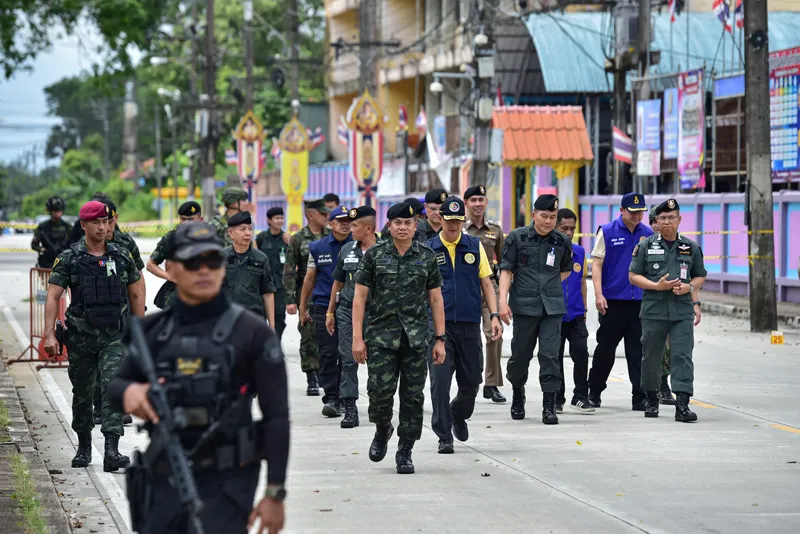
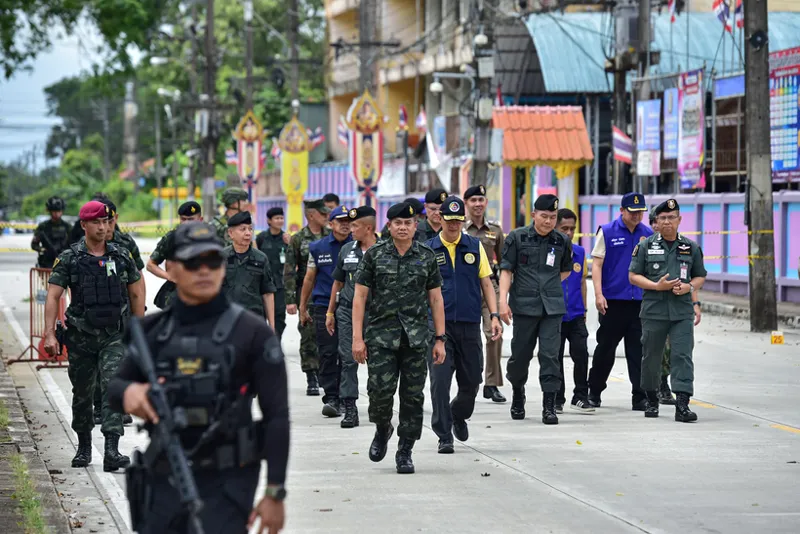
Five Thai security personnel were killed and six civilians, including two young children, injured in an attack in Thailand's restive deep south, the military said on Thursday.
About 10 assailants dressed in black and wearing black brimmed hats arrived in a pickup truck and on motorcycles before launching an attack on a roadside checkpoint in Narathiwat province late on Wednesday using military-grade firearms and pipe bombs, the military's Internal Security Operations Command Region 4 said in a statement.
Five paramilitary rangers were killed in the attack and six civilians were wounded, including a three-year-old girl and a 10-year-old boy.
Authorities said the attackers seized three AK-47 rifles, three bulletproof vests and several mobile phones from the checkpoint before fleeing. Security forces later found the pickup truck used in the assault abandoned and set ablaze about 21 km (13 miles) from the scene.
As with most attacks in Thailand's deep south, no group immediately claimed responsibility.
The government condemned the attack as an act of terrorism that posed "a serious threat to national security" and undermined ongoing efforts to revive the peace process, government spokeswoman Rachada Dhnadirek said in a statement.
Thailand's southern border region along the frontier with Malaysia has been the scene of a decades-long, slow-burning insurgency, with security forces battling groups seeking independence for the predominantly Muslim, ethnically Malay provinces of Pattani, Yala, Narathiwat and parts of Songkhla.
The region was once part of the independent Malay sultanate of Patani before it was annexed by Siam under a 1909 treaty with Britain.
The latest phase of the conflict erupted in 2004 and has claimed more than 7,800 lives, according to conflict monitor Deep South Watch.
Peace talks between the Thai government and several insurgent groups began in 2013 under Malaysian facilitation but have repeatedly stalled, yielding little tangible progress.
Prime Minister Anutin Charnvirakul has pledged to revive negotiations with the main insurgent group, the Barisan Revolusi Nasional, after appointing a new chief negotiator in April, although formal talks have yet to resume.
In a rare public statement earlier this month, the BRN said dialogue remained the only viable path to resolving the conflict and expressed appreciation for Malaysia's continued role as facilitator.
Despite enjoying a comparatively positive and peaceful reputation among western audiences, thanks to its popularity as a tourist destination and masterful soft power pushes over the past few decades, Thailand is incredibly fraught around its edges.
When it comes to border violence in and around the Thai kingdom, it’s a bit of a ‘take your pick’ situation. Along its west and northern border is Myanmar, a country which is bedevilled by the scars of British colonial rule.
Though the country is home to over 130 distinct ethnic groups, the Bamar make up around two thirds of the population, and so are heavily represented in the political structure. Consequently, an entire latticework of ethnic, religious and territorial separatist groups have been engaged in various stages of armed struggle for self-determination against the Myanmar state, which has effectively been governed by the national military, the Tatmadaw, since 1962. (As you might expect in a military government, the Tatmadaw are considered the highest of Myanmar’s elite meaning that, again, Bamars are heavily represented in the leadership and officer class.)
Jutting downward into the Kra isthmus is Kayin State, one of Myanmar’s southernmost regions and home to the Karen ethnic group. Almost as long as Myanmar (then Burma) was independent from British rule, different armed groups have been fighting for an independent Karen state, Kawthoolei. Most prominent of these is the Karen National Union and its armed wing, the Karen National Liberation Army.
As this conflict has endured across decades, periodic clashes between the Tatmadaw and the KNLA have displaced large numbers of Karen civilians, and tens of thousands of displaced peoples now reside in a number of refugee camps dotted along the Thai side of that border territory.
Across the country is Thailand’s eastern border with Cambodia where, again, legacies of both colonialism and its aftermath have left longstanding disputes. Treaties and agreements between the two countries dating as far back as the early twentieth century contain ambiguities concerning sovereignty over strategically valuable passes and hills, as well as ownership of Preah Vihear, a centuries-old Hindu temple built during the Khmer Empire which now rests almost precisely along the borderline.
Throughout the twentieth century, periodic clashes erupted over the border dispute, which remains unresolved. During their brief rule over Cambodia, the Khmer Rouge regularly directed their ethnonationalist hatred against their Thai neighbours, as with Vietnam. When the Vietnamese then invaded and occupied the country to put an end to the Cambodian Nightmare, the Khmer Rouge then used the Thai border regions as a staging ground for a decade-long insurgency, carried out with the support of both Thailand and the United States.
Such concerns are a considerable distance from the Thai capital of Bangkok, and so are unlikely to trouble tourists. It’s a similar story down the Kra isthmus toward Phuket, where travellers go to escape the urban rush and relax in the region’s immaculate beaches and idyllic resorts. An acquaintance who recently visited and made precisely this journey noted how, as you travel down through Kra, the culture notably shifts from the Hindu-inflected Buddhism which characterises popular representations of Thailand, to one more influenced by Islam.
Which brings us to Thailand’s southern border, which connects to Malaysia and that country’s majority Muslim Malay population. As the above reporting explains, the populations of Thailand’s southernmost regions of Songkhla, Pattani, Yala and Narathiwat are themselves predominantly Muslim, many of them ethnic Malay.
The latter three of those regions formed a large part of what was once called the Sultanate of Pattani which historically had longstanding ties to its south, but whose leaders also maintained amicable relations with Bangkok. In the late eighteenth century, Pattani was then conquered by Siam.
The kingdom continued to allow Pattani, known as Thailand’s ‘Deep South’ to operate with relative autonomy until 1909, when the Anglo-Siamese treaty formally incorporated it into the Kingdom of Siam, which then began imposing a more rigid Thai-Buddhist rule.
Though uprisings, rebellions and separatist aspirations have been a regular feature of the region throughout Thai rule, the violence ticked up in frequency and severity in the early 2000s, leading to an insurgency being declared in 2004.
Since then, armed politics in the Deep South has claimed thousands of lives and injured many more. One estimate from Deep South Watch, an autonomous organisation which seeks to mediate between the different groups involved, estimates that almost 8,000 people have been killed in the conflict, and over 14,000 injured.
The mix of ethnic, territorial, political and religious factors at play in this region are deep and longstanding, and so it would be short-sighted to attribute the resurgence in this century to contemporary concerns solely. That being said, it is notable that rising violence in the Deep South has occasionally tracked with broader global and regional trends.
Until only a few years ago, the insurgency was supported by Jemaah Islamiyah, the perpetrators of the devastating 2002 car bombings in Kuta, Bali, who had aspirations of establishing an Islamic state in Southeast Asia. Beginning around 2017, the insurgency also allegedly began receiving support from an East Asia branch of Islamic State.
Nevertheless, it should again be stressed that insurgent motivations in the Deep South are longstanding and very much autochthonous. The primary player in the fight against the Thai military is Barisan Revolusi Nasional (BRN), the National Revolutionary Front, a rebel group whose origins trace back to the 1960s.
Throughout the twenty-year insurgency, BRN and its various offshoots and allies have engaged in tit-for-tat violence against Thai state security forces and committed numerous terror attacks against civilians. These attacks have often targeted Buddhist monks and novices, who have become emblematic of Thai dominance over the region’s Muslim and ethnic Malay populations. And as is typical of insurgent warfare in population centres, many Malay civilians have also been victimised by both the BRN’s violence and responses from the Thai military.
Throughout the years, attempts have been made to address grievances and foster greater dialogue between the Thai government and military, and the BRN and other separatist groups. It is not always clear if the means and methods selected were properly geared for the issues at hand.
Applying a classic counterinsurgency approach to the conflict, the Thai government has, for example, promised development and uplift projects to improve economic conditions in the region. While admirable, it is not clear how such efforts will effectively address and resolve the conflict’s longstanding (and widely recognised) ethnoreligious underpinnings.
On the other side of the conflict, the BRN has allegedly benefitted from either tacit or material support from the Malaysian government, and has also proven adept at expanding its own governmental operations, building out schools, places of worship, agencies and parallel state apparatuses which directly challenge the Thai state.
Developments such as these have made the peace process slow, arduous and often unappealing. With the BRN having survived and endured for over two decades with little indication its power has waned, it is possible the group feels little incentive to negotiate for things which it believes it can still win on the battlefield.
On the other edge of the blade, given the swirl of ethnic, religious and historical factors at play in the conflict, willingness to negotiate with the Thai state has sometimes exposed BRN leadership to charges of being collaborators or compradors, which then motivates more radical, unaffiliated actors to take matters into their own hands.
Note that no group has claimed authorship of the attack which opened this newsletter, and that BRN’s official response was to reaffirm dialogue as the proper solution. It’s simply an unfortunate truth that a resurgence in violence during peace talks can be unrelated to the groups at the table, or a particularly provocative bargaining chip. Deciding which is which is an unenviable task.
As regards the Thai government and military, they too may have their reasons to frustrate negotiations and prolong the conflict. Over the course of decades, Thailand’s military has benefitted greatly from heavy investment and funding from the government, with anti-terrorist operations in the Deep South serving as strong justifications. These funding streams then often connect to various patronage and kickback networks, formal and informal, which stand to benefit from the continuation of conflict.
Widening the lens a little more, it might also be worth remembering that the Thai Kingdom has been a longstanding and reliable ally of western interests in the region. Situated as it is, Thailand is a strategically vital hub, linking the Indian subcontinent to East Asia, and providing a bridge down into South East Asia’s archipelago states.
With the US proclaiming a desire to pivot to China as its primary military adversary over the coming years, it will be looking for allies and partners in the region in which to position its forces and build alliances — always a lucrative endeavour. As the ‘hook’ of the last two decades of American geostrategy, the War on Terror remains a useful narrative with which US clients can demonstrate their commitment to shared values.
Thailand may not be able to resolve its Deep South issues through military, counterinsurgency or economic means, but it can certainly keep juicing the conflict in the hopes it might open up opportunities for future endeavours.
But again, as previously stated, broader international concerns aside, the unrest in southern Thailand is longstanding, and local. No matter the provenance of the actors involved, on either side, until a resolution is found which is amenable to those living, surviving and dying on the ground, there will be those willing to take up arms in the hopes of strengthening their hand. So it goes.
Comments (1)
TIL that Thailand also has a MIC (military industrial complex).