


THIS WEEK IN VIOLENCE: Collateral Famine
2026, Week 30
This week we’re presenting a hefty excerpt from a report published by the International Food Policy Research Institute (IFPRI) on fertiliser shortages produced by the US-Israeli war on Iran, and the looming threat of undernourishment, famine and starvation which becomes increasingly inevitable the longer Trump’s disastrous war drags on.
Iran war: From fertilizer to food crisis?
International Food Policy Research Institute (IFPRI) – Jul 02, 2026
Report by Rob Vos
The Iran war has disrupted critical supply chains and driven up the cost of energy and fertilizer, both essential agricultural inputs, sparking fears of another global food crisis. With input costs soaring, fertilizer exports from the Gulf countries suspended, and production facilities facing unprecedented challenges, the world’s ability to maintain stable food supplies is increasingly at risk.
The input crisis
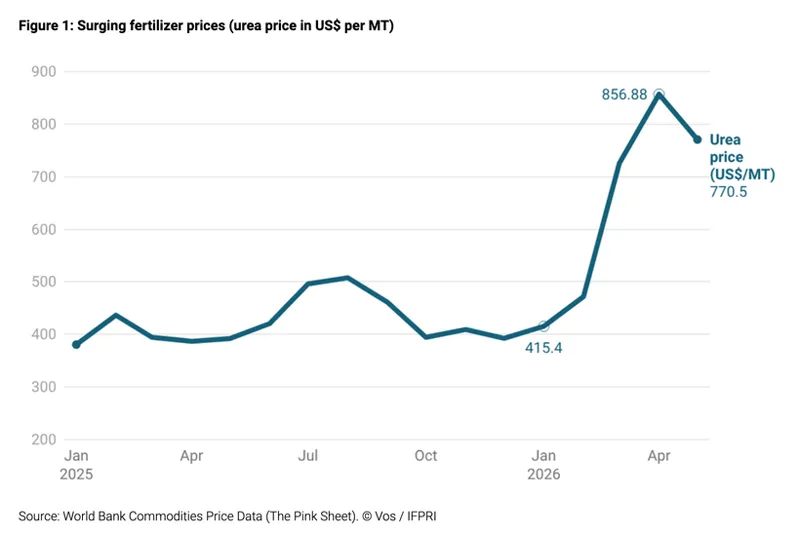
Before the Iran war, fertilizer prices firmed in early 2026, following seasonal demand for spring applications by farms in the northern hemisphere. Prices spiked, however, following the effective closure of the Strait of Hormuz at the end of February 2026, with prices of urea – a key chemical fertilizer – roughly doubling in a matter of weeks (Figure 1). Prices of phosphate (another main type of fertilizer) also increased, though more moderately from already elevated levels. [...]
The Middle East supplies about one-third of global urea exports. Since the end of February 2026, an estimated 3.9 million tonnes of these exports have been suspended. This is equivalent to 30 percent of annual fertilizer exports of the Gulf States. Most production facilities in the region continue to operate at reduced rates to prevent excessive stockpiling. While urea can generally be stored for several months, high temperatures and moisture can damage its quality. The risk of substantial fertilizer supply shortages is rising as the conflict prolongs and the Strait of Hormuz stays closed.
[...]
Continued military strikes into June 2026 and temporary production shutdowns in Bahrain, Iran, and Qatar highlight growing vulnerabilities in this supply chain for agricultural inputs. Restarting a fertilizer plant after a shutdown usually takes five to eight weeks, with structural damage and repairs it can take several years. Meanwhile, other suppliers have partially replaced exports coming from the Gulf region, though at higher prices.
No grain shortage – but increased production costs
The current situation is different from the global food price crisis that emerged after COVID in 2020 and the beginning of the Russia-Ukraine war in February 2022 (Vos, 2025). That crisis was marked by both grain and fertilizer shortages. The Middle East countries are not major global grain exporters, so there is no direct grain shortage, and international food prices have remained relatively stable, especially for cereals (FAO Food Price Index, Figure 2). Prices of vegetable oils, though, surged since the closure of the Strait of Hormuz, driven in good part by higher prices for oil and demand for biofuels.
For now, the warning signs of trouble ahead include rising costs for fertilizer, fuel, shipping, energy for irrigation and other farm equipment, and financing. Higher input prices are already making it more difficult and expensive to distribute and process food. When energy prices increase, transportation and food processing costs go up and it is more expensive to keep food fresh, with a high risk of food losses. The delivery of food assistance will require more financial resources.
Consequently, farmers may decide to use less fertilizer, which would lower yields and food supplies. In the short run, however, the implications of high prices and restricted supply of fertilizer will vary widely depending on reliance on the Gulf region and the extent to which farmers expect farm profitability will be affected by higher input costs.
The effects of the Iran crisis in detail
First, while global fertilizer price increases are being felt broadly, the risk of direct physical shortages differs across major production areas. In the United States, supplies for most farmers were sufficient for spring plantings, but autumn applications of fertilizer could be at risk, depending on how the crisis evolves. Farmers in Brazil are almost fully reliant on imports (of which 40% come via the Strait of Hormuz) and have seen local fertilizer prices jump over 35% in the first two weeks from the start of the conflict. India has enough supply for the kharif crops (sown at the start of the monsoon season in June-July), but rabi (winter) season availability is uncertain due to high dependence on Middle Eastern suppliers of fertilizers and natural gas. Farmers in Sub-Saharan Africa, but especially those in East Africa, are highly vulnerable, as one third of their fertilizer supplies come from the Gulf area. They also face high transport and distribution costs (Vos at al. 2025; Hebebrand et al. 2026).
Second, higher costs may translate into lower fertilizer use, affecting yields. This risk is high for the upcoming late summer and autumn planting seasons. So far, staple food prices have not risen along with input costs, causing a sort of “affordability crisis” for farmers. [...]
Third, even if the conflict ends today (mid-June 2026) fertilizer markets would not return to normality before the end of 2026. A more pessimistic scenario, with a more prolonged conflict and continued restrictions on shipments out of the Strait of Hormuz, expects the fertilizer crisis could extend into 2028 (Arita et al. 2026).
Fourth, governments are stepping up efforts to limit impacts of lower fertilizer usage on food supplies. China’s decision at the end of May 2026 to lift its ban on urea exports may further help curb the initial surge in world market prices. The U.S. Department of Agriculture has taken steps to boost domestic fertilizer production and revived a program to support farmers adopting practices that reduce the need for chemical fertilizer use. However, it may take a year or longer before this has an impact on fertilizer prices. Similarly, the EU’s Fertiliser Action Plan (EU 2026) aims to both boost fertilizer production and promote fertilizer-efficient farming practices, including targeted financial support to farmers to mitigate rising input costs and supply shortages. Low- and middle-income countries (LMICs) traditionally rely on input subsidies, but compensating farmers for the steep price rise in fertilizer markets would come at a likely prohibitive fiscal cost to most governments, especially those in Sub-Saharan Africa.
Protecting farmers from price volatility will require considerable future investments for alternatives like biofertilizers and fertilizer-saving farming practices, like conservation agriculture. Many farmers therefore will have to ride through the storm of higher input prices during 2026 hoping that governments will sustain their support for more sustainable farming practices that will lower their dependence on chemical fertilizers and fossil fuels.
The impact on consumers and the poor
In wealthier countries, the cost of farming is a small part of the final price of food, so higher farm costs do not immediately lead to more expensive groceries. Energy and shipping costs eventually work their way through the system, but it can take three to six months for these higher costs to show up in store prices, and once they do, they can last for 12 to 18 months after the initial increase. Rising energy prices also risk lowering food quality and safety, especially if it becomes harder to keep food cold or process it safely.
[...]
The burden of higher consumer prices will be distributed unevenly. They will be felt the most by those nations and consumers who are least equipped to handle rising costs. Households in low-income countries spend around 50% of their income on food. This means that if food prices rise by 10%, their disposable income drops by 5%. On the other hand, families in high-income countries use a much smaller portion of their income for food, so price increases have a far lesser effect on their finances. In other words, supply chain disruptions and rising prices hit hardest those with less purchasing power and weaker social protection systems.
Low-income countries that rely on food imports face an added challenge known as the “dollar double-whammy.” Not only do global commodity prices go up in U.S. dollars, but geopolitical instability often makes the dollar even stronger. As a result, when these countries convert import costs into their local currencies, the prices become even higher, stretching budgets and making food less affordable.
With declining food supplies there is also the risk that major food-producing countries restrict their exports to protect their own domestic supply, as they have done during previous global food price shocks (Martin et al. 2024). These restrictions reduce the amount of food available globally and speed up price increases, hitting import-dependent countries the hardest.
[...]
A global food price crisis could still emerge if the Iran war drags on despite all efforts at negotiations. However, if hostilities end in the coming weeks and shipments can flow freely again through the Strait of Hormuz, it is unlikely that there will be a global food crisis for everyone.
But for many poor households the crisis will erode purchasing power and their access to food. It will hurt farmers through constrained access to farming supplies and it will weaken humanitarian support for the hundreds of millions already facing high levels of acute food insecurity and malnutrition.
When Donald Trump and Benjamin Netanyahu first launched their disastrous war against Iran on February 28, it was touted by the former as though it were a blockbuster episode of the reality TV show that is his life, or perhaps a spectacular big ticket WWE event.
Following hot on the heels of the administration’s whirlwind regime change operations in Venezuela, Trump swaggered into what was promised to be a swift and decisive showdown with perhaps the US’s greatest foreign adversary; the military equivalent of ‘six minute’ abs, a three-step programme which went ‘shock, awe, win’.
Unfortunately, things did not play out the way Trump envisioned. A popular refrain among backers of the war insisted that the US had been at war with Iran for 47 years. Even if we stipulate that such a claim is true, it now appears as though the architects of this war did not consider once that Iran might have been making preparations of its own during that period.
A combination of mosaic warfare tactics, the imposition of economic blockades via the Straits of Hormuz, and attacks on US military bases, critical infrastructure and civilian centres in nearby Gulf States has meant that Iran, even in its significantly weakened state, has managed to hold out against the world’s military superpower.
Not only that, Iran has also managed to significantly deplete many of the US’s crucial weapons stocks (most notably missile defence) without needing to advance to its own most modern weapons systems. And all the while, its actions against Gulf states like Bahrain, Qatar and the UAE have exposed glaring deficiencies in the US-helmed security umbrella presumed to be securing the region, and prompted questions about whether US presence in the region does in fact provide security, or whether military bases make these states more vulnerable to attack.
Early into the war, the political scientist Robert Pape identified a hazard now confronting the Trump administration, entirely of their own making: The Escalation Trap.
So Pape’s argument goes, Trump and Hegseth’s aerial bombardment was effective in producing tactical successes for the US, but these proved unable to translate to a mor decisive strategic victory. Whatever damage may have been inflicted on Iran’s military capabilities, it remained able not only to respond, but to escalate the conflict, including in horizontal ways that the US failed to anticipate.
Confronted by the limitations of its strategy, but either unwilling or unable to commit to other approaches (i.e. a likely disastrous and deeply unpopular ground invasion), the Trump administration was left with two choices: Retreat, or escalate. Given the first was obviously unacceptable to President Wins, they have subsequently escalated, over and over, hoping the ‘illusion of control’ produced by footage published on social media will paper over the total absence of meaningful victory.
The Memorandum of Understanding signed between the US and Iran roughly a month ago, which brought a brief end to open hostilities, has now collapsed under the weight of the contradiction between what that document actually says, and what Trump would have liked for it to say. No amount of Donald’s spin could distract from what the letters of the MoU spelled out: A near-total US surrender.
And so, over the past ten days or so, Trump and the US military have quietly returned to the escalation ladder, resuming with bombing campaigns against Iran targeting civilian infrastructure such as bridges, airports and train stations. By now, the idea that further waves of aerial bombings will weaken Iran’s resolve or dislodge their government has been thoroughly discredited. But when the alternatives are either committing to a deeper engagement that everyone acknowledges would be disastrous, or admitting retreat and pulling back, the only choice is to keep climbing that ladder. (That’s why Pape calls it a Trap.)
The issue is not that Trump doesn’t understand this. A growing number of reports and commentaries indicate that for all their bluster, Trump, his advisors, and even his cheerleaders on cable news know that this war has been a disaster, and that it needs to end, for everyone’s sake.
With the midterm elections fast approaching and both Trump and the GOP’s approval numbers in the toilet over a number of issues, an end to the Iran debacle would get one of the more deeply damaging stories out of the news, and provide an opportunity for some much-needed positive spin on Trump’s achievements.
All of this matters, in the context of the report which opened this newsletter, because the threat of food shortages, famine, and attendant death as a result of this war is one which has loomed large ever since Iran first enforced its closure of the Hormuz Straits.
Aside from fossil fuels, the Persian Gulf is also a crucial transitway for agricultural chemicals and fertilisers. As with fossil fuels, analysts and onlookers have expressed concern about the wide-ranging and potentially catastrophic ramifications for global economy and production should this pointless war drag on.
And yet, as with fossil fuels, the threat has been downplayed, with many choosing to trust either Trump’s clockwork market-stabilising affirmations, or simply the vague idea that things will necessarily work out because they have to. As of now, neither of those have proven to be very reliable baskets in which to place one’s eggs.
News outlets have reported extensively on the risk to food systems, particularly in the developing world, should this war drag on. A piece by Ertharin Cousin in Foreign Policy from early April lays out precisely the potential scenario that the IFPRI is now reporting in its becoming actual.
Now, reporting in Fortune points to a joint report between five UN agencies indicating that, in the worst case scenario, the fallout from Trump and Netanyahu’s war against Iran could push as many as 18.8 million more people into conditions of undernourishment, the majority of them in Asia and Africa. As the Fortune report also points out, this would be four times the number of those killed by famine in Ukraine during the early 1930s, and ten times those killed during the famine in Ireland.
This, in turn, connects to a more hot story which has been doing the rounds this week, an interview with Elon Musk published by The Economist, conducted by the magazine’s Editor-in-Chief, Zanny Minton Beddoes.
One of the unfortunate paradoxes of Elon Musk is that his words, actions and deeds have widespread implications for the world at large, but that he is so viscerally unpleasant to look at or listen to that you avoid paying attention to him in the same way you might stoically look straight ahead as you step over a heaving pile of dog shit.
But Beddoes’ interview with Musk did produce one illuminating exchange, in which she pressed him on reports that his cuts to the US Agency for International Development (USAID) as part of the cuts imposed by his Department of Governmental Efficiency (DOGE) may have contributed to tens of thousands of unnecessary deaths.
Musk’s refutation of the charges followed a classic playbook deployed by bullshit artists and charlatans, a form of DARVO formulated for political commentary. Deflecting with shallow, pop commentary remarks about the agency being a CIA front; blanket denials that even a single human being died as a consequence of Musk ripping away funding for, among other things, delivery of medication to HIV patients in the Global South; and ultimately combining these denials into a dual insistence that international NGOs would have simply stepped in to make up for the shortfall or that other wealthy billionaires like Bill Gates or MacKenzie Scott (ex-wife of Jeff Bezos) would be at fault for not using their billions to save the lives he scattered to the wind.
It would be tempting to think Musk is simply ignorant of how fragile and sensitive to volatility systems such as global aid are; how even slight disruptions to massive, complex apparatuses can incur long-lasting impacts, and adaptations thereto taking even longer to implement, like turning around an oil tanker. But then one has to remember that Elon Musk operates in the industries of space travel and auto manufacturing. It’s not that he doesn’t understand hazards such as these. He simply doesn’t care about those which don’t threaten him, personally.
And yet it ties back to the main story of this week’s newsletter, because the very same thing is playing out, right now, in the case of Donald Trump — perhaps with higher degrees of ignorance, and comparable levels of sociopathy.
If there had been an actual strategy for effective conduct and achieving victory at some point earlier on in this war, it quickly became clear that it would not be happening. Ever since, global supply chains and distribution systems for energy and agriculture — that is, basic human survival — have been hanging around in a holding pattern, hoping the moment will come when the US realises it has been defeated, cuts its losses, and allows the world to return to equilibrium.
But because such a sequence would require Donald Trump looking like a loser, and taking the actions of a loser, because he is one, the world has been forced to keep limping on, waiting for such a time when he can claim victory in an unwinnable war on his own terms.
The acute impact of this war, in terms of deaths, has already been unconscionable enough; hundreds of Iranian civilians murdered, many of them children, and a steadily growing number of US military personnel needlessly killed in a pointless war.
But now, the potential ripple effects of this debacle are spreading in ways which mean that six, twelve, eighteen months from now, the body count of Trump’s Middle Eastern folly could ultimately climb into the tens of thousands, as innocent people in Africa, Asia and elsewhere are forced to suffer and starve as a consequence of his stupidity.
And so as we consider Elon Musk scoffing and handwaving away the deaths he contributed to, as a consequence of deliberate choices intended to inflict precisely such suffering and, worse still, ponder what Trump’s eventual response will be, when confronted with the famine and starvation he will have inflicted upon the world as a consequence of his inability to take an L, it’s probably worth repeating a refrain of ours.
We can stop this at any time.
Comments (1)
Great analysis. Thanks for pointing out a catastrophic crisis constantly looming that seemingly no regular news outlet is pointing out.