




THIS WEEK IN VIOLENCE: The Eleventh Night
2026, Week 28
For this week’s newsletter we’re returning to Northern Ireland to examine a recent story about alleged hate crimes being perpetrated in connection with traditional Loyalist celebrations. (I know, shocker.)
On top of that, we situate these recent events in dialogue with the racist pogroms committed in Belfast several weeks earlier, as well as with the rise of the ‘besieged civilisation’ model of ethnonationalism which Ulster Loyalism has long shared with other colonial projects, most recently Israeli Zionism, and which is now crystallising as the predominant narrative hook for far-right political projects across the developed world.
A 300-year-old bonfire tradition in Northern Ireland has turned its flames on Muslims
CNN – Jul 10, 2026
Reported by Kara Fox
In a tradition dating back more than 300 years, towering pyres have been lit every July in Northern Ireland to mark the Battle of the Boyne, which effectively cemented Protestant rule.
They’re held in loyalist neighborhoods – communities that strongly support the union with the United Kingdom – and often carry a political message, with effigies of the pope, the Republic of Ireland’s flag and other symbols of Catholicism and Irish nationalism being burned in the past.
But this year, in the village of Moygashel, County Tyrone, the flames found a new target.
A replica mosque, with a figure holding what appeared to be an ISIS flag and banners on the tower reading “Secure our borders” and “End the threat of radical Islam,” was burned on Thursday night.
The group responsible, the Mogyashel Bonfire Association, said it was aware their display might “shock offend or outrage others” and blamed “uncontrolled illegal mass immigration” for their “protest.”
It marked a further departure from the traditional Eleventh Night bonfires, lit in mainly working-class Protestant neighborhoods on the eve of parades celebrating King William III’s 1690 victory over the Catholic King James II.
The bonfires are the centerpiece of the loyalist calendar, underlining an identity built on being British. Many loyalists insist they carry no politics at all and claim the pallet towers are a cultural and cherished expression of heritage. But many Catholic and republican neighbors have long felt them intimidating.
In Moygashel, police are treating the display as a “hate motivated crime,” and have charged a 56-year-old man with incitement to hatred. The man denied the charges at a hearing on Friday, and was refused bail.
[...]
Race hate crime in Northern Ireland has reached its highest level since records began in 2004, according to Amnesty International, which called the Moygashel display “a blatant attempt to stir up anti-Muslim hatred and intimidate local families.” Allowing such spectacles to go ahead has helped normalize racism in Northern Ireland, the human rights organization added.
The pattern extends to the rest of the UK. An average of four to five anti-Muslim incidents were reported every week in June alone, with more than 40% of them arson or firebombing attacks, according to the Muslim Council of Britain (MCB), a representative body for the Muslim community in the UK.
[...]
Last year, the same Moygashel pyre burned an effigy of migrants in a boat. The figures in the boat represented people of color, with one appearing to be dressed in Islamic attire.
[...]
Researchers and human rights monitors have described a region where the old architecture of sectarian hostility has not disappeared but been repurposed: Sectarian violence has given way to racially motivated violence.
The Moygashel Bonfire Association defended the display as “lawful protected expression” and “political protest,” saying that its opposition “is not to people, but rather to ideology and Government policy.”
[...]
In addition to the anti-migrant rioting that swept parts of Belfast in June, last summer saw similar riots that led to buildings housing migrants being attacked and burned.
“A lot of the rhetoric around that was Muslims, and this conflation of Muslims as migrants, as illegals. You know, it’s all kind of collapsed into one category, even though Muslims are part of the society here,” [Naomi Green, MCB assistant secretary general, who lives in Northern Ireland] said.
On the morning of this newsletter’s publication, July 12th, it will be the morning after Eleventh Night, an annual celebration among Northern Ireland’s Protestant communities which celebrates the deposition of the Catholic King James II by the Dutch Protestant William of Orange in the Glorious Revolution of 1688, as well as the subsequent defeat of the war of resistance waged by James and his Jacobite army in Ireland in the years that followed.
Following on from Eleventh Night, July 12th is then the culmination of ‘marching season’, the period in which Unionist or ‘Orange’ organisations hold parades in Northern Ireland celebrating William’s victory, which began several centuries of ascendant Protestant domination in Ireland. As such, the marches are perceived by individuals outside of those communities as triumphalist affirmations of minoritarian dominance.
As Thomas highlighted in our recent appearance on Corner Späti, July 12th is also the centrepiece of another period, ‘riot season’ with the bulk of riots and public order disturbances occurring within a roughly two-month period around this date. Historically, these events have been the consequence of what can euphemistically be described as ‘sectarian tensions’ between Loyalist and Irish Republican communities.
In recent years, however, inciting events behind riots in Northern Ireland have become inflected by political Americanisation (in which political cultures around the world either become subsumed by, or consciously ape, the culture wars and political shibboleths of the western hegemon) and the aftershocks from mainland Britain’s ongoing terminal decline and self-destruction — itself, in part, a consequence of its own Americanisation processes.
Since 2020, riots across Northern Ireland have been triggered by, inter alia, political fallout from Britain’s vote to exit the European Union, restrictions related to the COVID-19 pandemic, and reactions to offences committed by immigrants, real or alleged.
Again, as discussed on Corner Späti, since the establishment of the Good Friday Agreement came into force at the turn of the millennium, the function of armed militant groups on both sides of the Northern Ireland conflict has been somewhat diminished.
And while the electoral system of the North was intentionally structured so as to permanently favour the Unionists, this advantage has also placed them in a permanent defensive posture, struggling to retain dominance as the Irish Republican Sinn Féin has made steady gains in recent elections.
With Ulster Loyalism’s ideological weddedness to the United Kingdom and the politics driving it, and with the GFA having diminished the salience of the Northern Irish question among mainland Brits — Ulster Loyalism’s theoretical backstop in the British political system — it’s unsurprising that Loyalist would seek to reinvigorate their relevance by diving into the UK’s culture wars du jour: immigration, migrants, and racial and ethnic minorities.
With the GFA having tamped down Irish Republican militancy, and so denying Ulster Loyalists the Republican threat which legitimised their own activities, extremist factions within Northern Ireland’s Unionist communities have synthesised their own militant deployment of the Union Jack with the ‘Raise the Colours’ actions on the British mainland to perform a renewed PR push on the mainland.
Alongside the usual decorations of Irish tricolours and references to renowned Irish Republicans, organisers of these bonfires have begun placing more current effigies on their pyres to be burned: migrant boats, mosques, and even mannequins dressed like members of the rap trio Kneecap.
Questioned on its provocative displays, the Moygashel Bonfire Association in County Tyrone, responsible for both the boat and mosque effigies, defended its actions on the basis of free speech, claiming its actions were in opposition not to specific people or groups, but to government policy and ideology.
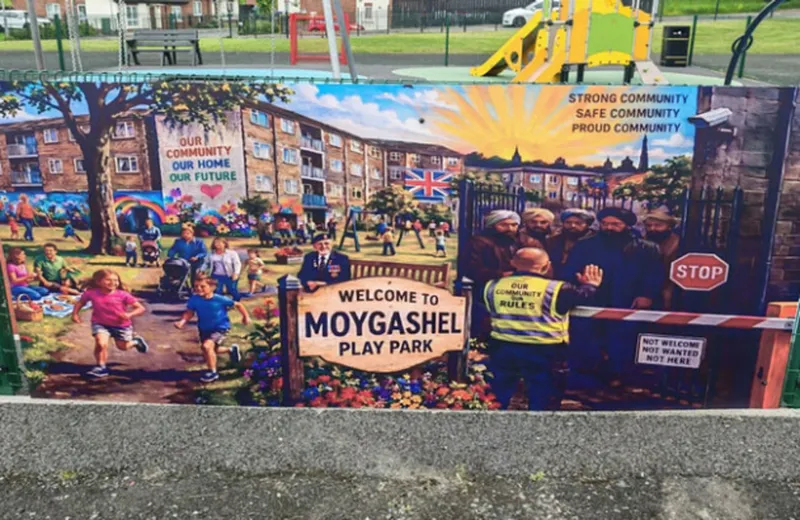
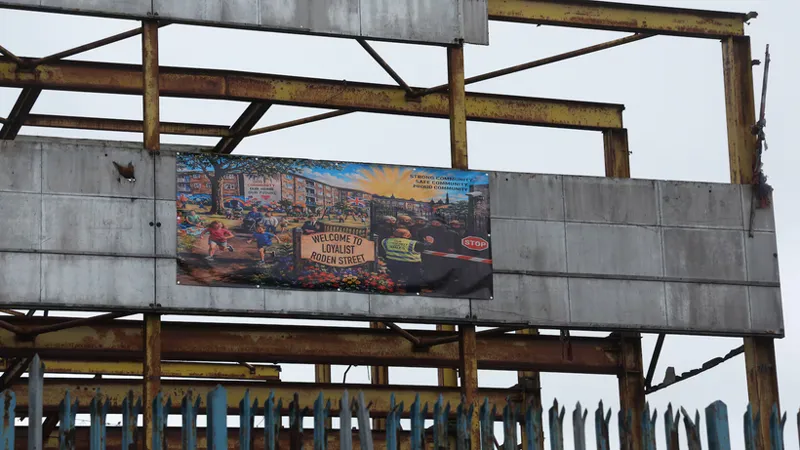
This claim would perhaps be more believable had Moygashel also not been where, the previous year, an AI slop mural was erected near a children’s playground depicting smiling white children playing on a sunlit green while a group of men are caged in a dark fenced area, overseen by a man in a fluorescent jacket and a CCTV camera. A message beneath them then reads, “Not welcome / Not wanted / Not here”. Since its erection and subsequent removal, the same mural design has appeared in several other Loyalist areas.
It would be easy to look at the rise of white nationalist militancy in Northern Ireland, particularly among Loyalist communities, and perceive this as a ‘becoming’ of Ulster Loyalism in a new phase however you might designate it: racist; supremacist; nationalist?
But trying to pin the shift down in words only highlights the incoherence in that this is always what the movement has been. Only, because the movement’s violence was previously situated within a conflict that was coded as confessional and sectarian (read: not racist, supremacist) and against a nationalist enemy, such aspects of Ulster Loyalism have been chronically downplayed or deliberately misapprehended.
To anyone vaguely familiar with the ideological tenets of Ulster Loyalism, periodic ‘discoveries’ in the press of the intimate connections between Loyalist factions and white nationalist or neo-nazi organisations on the British mainland and further afield tend to have the flavour of the famous Onion article: “Why Do All These Homosexuals Keep Sucking My Cock?”
Through the Troubles and beyond, the Loyalist movement has defined itself as a proud, virtuous, noble, and civilised (read: white) community surrounded — besieged — by barbarian enemies on all sides, first Irish Republicans, now Muslim hordes. The fluency with which the movement has integrated the figures of Muslims and migrants into its repertoire of enmity does not represent a radicalisation, but simply an expansion of the scope of a radicalism that was always present.
Likewise, following developments such as the ‘Raise the Colours’ project on the mainland, which saw roundabouts, streetlights and assorted signage patriotically ‘decorated’ with St. George’s Crosses, in the form of cheap Temu flags or crude red spray paint, there is the occasional suggestion in commentary that these events represent a transference of the politics and praxis of Tommy Robinson across the Irish Sea.
This, again, misapprehends the reciprocity and symbiosis that has always existed between English nationalists on the British mainland, and Northern Ireland’s Ulster Loyalists who, throughout successive waves of political struggle, have been permitted to perform their patriotism with the fervour and violence mainlanders can only dream of.
One should, then, understand ‘Raise the Colours’, at least in part, as a project which knowingly or not sought to adopt the Loyalist deployment of British nationalism as a latent threat. Ulster Loyalism’s adoption and amplification of British racist sentiments against immigrants and Muslims, in turn, re-centres Northern Ireland in the British field of vision, while also exploiting permissiveness around Loyalist ‘symbolism’ to up the ante.
The burning mosques, migrants and Muslims atop Loyalist bonfires are merely symbolic, representative. They exist to convey a political message. They are also, coincidentally, what the Loyalists would like to actually do to the individuals depicted. This is not much different from how the phrase ‘Kill All Taigs’ is persistently dismissed as mere political rhetoric, despite also neatly expressing how Loyalist extremists would ideally resolve their ‘sectarian’ disputes.
These effigy burnings, then, serve a dual purpose, both expressing the real and sincere beliefs of those who build them and attend to bear witness to their immolation, while also communicating with and invigorating their ideological counterparts on the British mainland.
As far as the message being transmitted from Ulster Loyalists to their British nationalist counterparts, then, the message of these effigies might be read as something like this: “This is what we want to do, but currently cannot, like you. But we can at least perform this gesture, unlike you. And since our goals are the same, why shouldn’t you be allowed to do the same? And once that has been permitted, then we can work to go further — together.”
Finally, to recapitulate a point Thomas made on Corner Späti, this story should also provide an object lesson about the sentiments which subtend the affinities between Ulster Loyalism (and British Nationalism), and Zionism. All perceive themselves—or in the British Nationalist case, would very much like to perceive themselves—as racially, culturally or ethnically supreme exclaves of civilisation beset on all sides by enemies. In the Loyalist case, militant Protestants who have always framed and pursued their actions on this basis have simply re-coded to make their plight more harmonious with the mode of politics which has proven so successful both on the mainland and in Palestine.
As regards the public actions themselves — the marches and the bonfires, and the extension of both their rehearsals and their performances earlier and later throughout the year, dominating nearly the entirety of the summer — they should be understood the same way as Israeli MKs accused of war crimes proudly marching unmolested on the streets of New York City, or Israel’s President Isaac Herzog visiting the UK to shake hands and smile with cabinet MPs, or Tommy Robinson organising successive racist rallies on British streets despite their predictable descent into thuggish violence.
A proud display of defiance against the moral and political stances of the public, who by and large have distaste for such aggressive, sectarian politics, and a threatening show of supremacy. We are here, we are not going anywhere, you’re not getting rid of us, and there’s nothing you can do about it, because those empowered to stop us either fear us, or agree with us.
Tradition set aside, the fact is that these Loyalist bonfires, which seem to grow in size and scale each year, becoming adorned more and more with objects of these groups’ violent hatreds, operate as a metaphor for the failure of the British state to confront white supremacist and far-right politics over decades — right down to how many of them are now so large, and burn so intensely, that they occasionally damage or even ignite the nearby homes of Protestant families whose communities they proclaim to defend.
You can play along with narratives about heritage, traditional and national pride as long as you like, but the whole while, the flames are only going to get bigger. And unless someone decides to step in and stop it, we shouldn’t act surprised when the flames make their predictable transition from the realm of the symbolic to that of the real.
Comments (1)
Man, I listened to this when it came out but seeing the photo hits different. The verdant hills with a mosque to burn makes me think of Bosnia.