

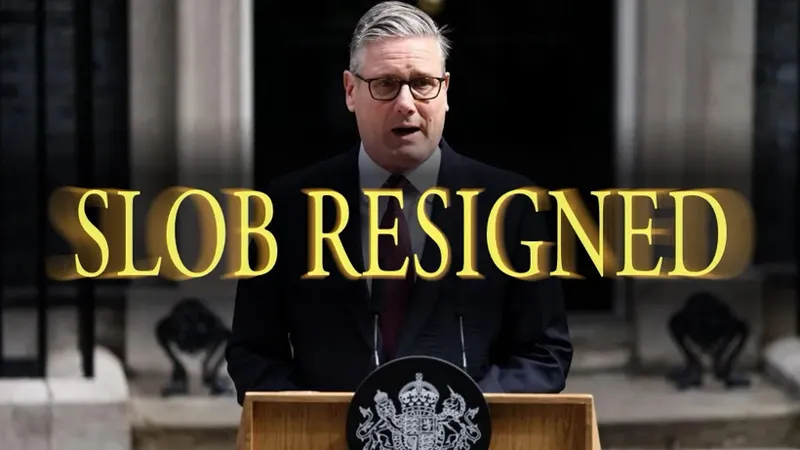


THIS WEEK IN VIOLENCE: Slob Hog Down
2026, Week 26
By the time you read this newsletter it will have been one whole week since Monday, June 22, when Keir Starmer announced his long-awaited resignation as Prime Minister of the United Kingdom. No doubt you will all have already supped your celebratory pints, read countless post-mortems and heard more than a few eulogies and ‘good riddances’ from other beloved content creators.
That being said, if you follow Gregk on social media you will be well apprised of his personal loathing for the man once lauded as the managerial redeemer of the Labour Party and, indeed, the entire liberal-left project in the United Kingdom.
And so now that that prophecy has well and truly failed, and the UK’s vaunted emperor-administrator has been exposed in both his bare-arsed nudity and his interior vacuity, we surely couldn’t pass up an opportunity to give that bare arse a courtesy Blood Work kick as it shambles out the door.
And for our excerpt, we’ve drawn from an excellent sign-off by Tom Blackburn published in Tribune magazine. It’s short, frank and ruthless, but more importantly, ends with a plausible prediction, the prospect of which should terrify us all.
Good Riddance to Keir Starmer
As pundits rush to portray Keir Starmer as a ‘decent man’ overwhelmed by events, they overlook the defining feature of his political career: a willingness to deceive and betray in pursuit of power.
Tribune – Jun 22, 2026
Written by Tom Blackburn
Keir Starmer’s resignation, announced today, saw him finally bowing to the inevitable. His authority had been crumbling for months, but its collapse has accelerated over the last six weeks: first, with Labour’s atrocious showing in the local, Senedd and Holyrood elections, and then with the confirmation of Andy Burnham’s return to the House of Commons in last week’s Makerfield by-election.
[...]
Already, the dominant media narrative is taking shape: that of Starmer as a ‘decent man’ who regrettably proved not to be up to the job of Prime Minister amid difficult circumstances and an unfavourable inheritance. A chorus of despairing centrist pundits frets that perhaps the country has simply become ungovernable. But this charitable interpretation suggests a severe and wilful case of collective amnesia. The defining characteristic of Starmer’s political career is dishonesty, not well-meaning ineptitude.
[...]
Centrist political journalists profess bafflement at why a politician as technocratic and grey as Starmer should attract so much hostility. But it can’t be denied that millions of people saw Starmer make one set of promises before gaining power and then repudiate them in office. What are they supposed to think? Starmer is by no means uniquely dishonest among his Westminster colleagues, but his lack of embarrassment about it — he always seemed to expect congratulations for leading Labour members up the garden path — must have turned many against him.
During his campaign for the Labour leadership, Starmer played up his prior track record as a human rights lawyer (though far less was said about his less flattering tenure as Director of Public Prosecutions). In the light of his subsequent response to Israel’s genocide in Gaza, first as Leader of the Opposition and then as Prime Minister, the audacity of the swindle is simply staggering. This is the most damning aspect of Starmer’s legacy, and the stain which he will never erase. It should, but probably won’t, haunt him for as long as he lives.
[...]
Nevertheless, Starmer may feel he has some legitimate grounds for grievance. He appears especially bewildered that the British establishment has not shown him greater gratitude for his success in driving the socialist left out of the Labour Party and thereby neutering it not just as a vehicle for fundamental change, but even for modest social reform and redistribution of wealth. But the British ruling class cares little for sentiment; this is what Starmer seemingly fails to grasp. He might believe that he’s been a good and loyal servant, but he’s outlived his usefulness — and now he can be dispensed with.
But we may not have seen the last of Starmer. A future tilt at becoming secretary general of NATO would make sense for him. It would allow him to continue as a loyal lackey of US empire, as he has been throughout his career, while safely insulating him from democratic accountability so that he never has to suffer through the inconvenience of selling himself to the hoi polloi again. For a dyed-in-the-wool securocrat, it would be the ultimate destination and crowning achievement. Don’t be surprised if he turns up there.
With a tenure as pathetically lacklustre as his proved to be, it would be easy to simply write a newsletter dancing on the grave of Sir Keir Starmer’s political career with a shit-eating grin — and so that is what we are going to do.
That being said, our official remit at Blood Work is the exploration, examination and delineation of this thing that we call ‘violence’. So, in keeping with that commitment, we’re going to commemorate the man’s downfall by enumerating some of the many violences, cruelties and damages he inflicted upon the social and political fabric of the country and further afield.
Already, commentators from political factions sympathetic to Keir Starmer and the broader Labour-Right faction of which he was the figurehead (however guileless) have begun spinning soft-hagiographies and attempts at mythmaking around the tragedy of his downfall.
The prevailing mode, well-demonstrated by a particularly odious eulogy by The Observer’s Political Editor Rachel Sylvester, might be called ‘bewilderment concerning a void’. So the argument goes (and as Sylvester’s own sub-head puts it), the “deep public hostility” Starmer experienced during his tenure is “hard to explain”, because the man never even presented a substantive persona or programme to be hostile to to begin with. Another post-mortem, written by Guardian columnist John Harris, attributes to Starmer a “blankness”; a “painful lack of clarity.”
When articulated by members of the British political commentariat, this claim is a tell. The reality is that there have been numerous instances in which Keir Starmer engaged in behaviour or implemented policies which (justifiably or not) incensed members of the public, in many cases those who would otherwise have been part of the core electoral base of his own party.
What they are saying, then, is that there were no issues as concerned them which made Starmer such an alienating figure. Like the android ‘hosts’ in the HBO series Westworld, they are looking at these clear and obvious examples of Starmer’s own cruel behaviour or reactionary politics, and the individuals and groups he has harmed, and bluntly declaring, “That doesn’t look like anything to me.”
In an interview with Beth Rigby of Sky News last week, Starmer was pressed on what achievement he was most proud of. He replied, “Lifting half a million children out of poverty by removing the two-child benefit cap,” referring to the ending of a policy which limited the tax credits and benefits childcarers received to cover only two children. “That is something I’m proud of because that will be felt not just this year, next year, not just during the duration of this government, but for those children it will be felt for the rest of their lives.”
This would have been news to anyone who remembered that Labour had to be dragged, kicking and screaming, into removing the cap to begin with. It would also have been a revelation to the seven Labour MPs who had the whip removed for supporting a motion forwarded by the Scottish National Party calling for the cap to be abolished.
Then again, other accomplishments were hardly the kind one crows about on national television. Since taking office in July 2024, the Labour government under Keir Starmer has pursued a campaign of relentless cruelty against transgender people in the United Kingdom.
By elevating the voices of fringe transphobic activist groups, using questionable studies like the Cass Review in its policymaking, and feeding into the escalating cycle of bigotry propagated by the British press, Keir Starmer’s Labour government has succeeded in making this country one of the most hostile to transgender rights in western Europe, earning it the derisive nickname of ‘TERF Island’ on the global stage.
In human terms, the impact of this performative vendetta against one of the country’s most vulnerable minority groups is shocking. Efforts to restrict access to Gender Recognition Certificates; prohibiting transgender people from being able to self-identify on government documents; the provision of loopholes for the continued use of debunked conversion therapy practices against transgender children; and, worst of all, the widely publicised campaign to exclude transgender people from normal participation in public life, localised around bathrooms, and spearheaded by key figures in the Labour government, most notably the Education Minister Bridget Phillipson.
This is a government which has willingly and openly participated in a vicious campaign of dehumanisation, marginalisation and exclusion against transgender people which has garnered widespread condemnation from the international community and will lead to the misery and death of transgender individuals, many of them children.
As Joe Kassabian stressed in our episode with him, the end goal of genocide is not simply the murder of a group, but to remake the political, social and cultural terrain so it is as though the targeted group never existed in the first place.
Placed in that light, it should not be controversial to say that the campaign against transgender people and their rights in the UK, legitimated, facilitated and advanced by Keir Starmer’s Labour government, has been a genocidal one. That widely-read commentators in the British press cannot (or refuse) to recognise that fact says as much about them as it does about the image of Keir Starmer they now wish to crystallise.
They could, instead, look to an area more immediately relevant to Starmer’s previous career as a barrister and Director of Public Prosecutions at the Crown Prosecution Service. But again, unfortunately, they would be unlikely to find achievements worth shouting about.
Over the past few years, Starmer’s Labour has spearheaded a disturbing project to rollback the rights and liberties of the British public in both the courts and the streets. David Lammy, Starmer’s one-time Foreign Secretary and now his combination Deputy Prime Minister and Justice Secretary, has been at the forefront of a push to do away with jury trials for cases which would likely incur a sentence of three years or less if found guilty.
Again, civil liberties organisations, particularly those advocating for racial and religious minorities have expressed concern over the changes and their potential ramifications. Nevertheless, Lammy has held firm, justifying his position through recourse to efficiency improvements and the removal of backlogs.
More infamous, because proudly performed and widely advertised, has been the UK government’s vicious crackdown on civil liberties regarding the right to protest and dissent – particularly concerning activism in support of Palestine.
The proscription of Palestine Action as a terrorist group has led to an absurd state of affairs producing countless videos of priests, elderly pensioners and even disabled people being arrested by the police and facing prosecution for terror offences for simply holding signs.
Keir Starmer and the Labour government’s open vendetta against activists for the Palestinian cause has placed them at direct odds with the vast majority of their own party. A Survation study conducted in late May of this year found that an overwhelming majority of Labour members supported banning trade with illegal Israeli settlements in the occupied West Bank, suspending all arms exports to Israel, and suspending the UK-Israel trade agreement.
Nevertheless, Starmer and his government have only accelerated and radicalised in their attempts to suppress popular opposition to his government’s steadfast support for Israel and complicity in its genocide. Following numerous prosecutions which have seen activists acquitted for vandalising and sabotaging Israeli weapons manufactories operating on UK soil, the British state has advanced its crackdown to dystopian levels.
Earlier this month, following months of remand in custody and acquittal in a previous trial, four Palestine activists were convicted on charges of criminal damage relating to an action at a factory operated by Elbit Systems — Israel’s largest arms manufacturing company — in August 2024.
After the four accused had been convicted for criminal damage, and following the lifting of reporting restrictions, it was revealed that the judge presiding over the case had made the decision to apply a ‘terrorism enhancement’ designation without the jury being informed. Consequently, the verdict the jury returned was then applied to a far more severe form of charges that they had not been made aware of.
There is no way of sugar-coating this state of affairs. During a Labour government, the normal functioning of the legal system as understood in liberal democracies has been thoroughly undermined and distorted in a fundamental manner, in order to subject political activists to some of the harshest sentencings and post-imprisonment regimes possible. The effect (and, indeed, the intent in allowing it to proceed) will be a severe chilling of speech and protest action among the wider public, all in defence of the right of a foreign state to continue committing a genocide, with British assistance, on a global stage.
The only reason an individual could not factor this into their assessment of Keir Starmer’s tenure, again, is that it simply ‘does not look like anything to them’. And again, this is a tell.
And on this note, the centrepiece of Keir Starmer’s political legacy must be his position on Gaza; an abandonment of innocent men, women and children to wholesale slaughter by an Israeli war machine which, to this day, is continuing to flout both the concerns of its allies and international law in pursuit of a barely-concealed project for territorial expansion and regional dominance.
On October 11th, 2023, four days into the Israeli onslaught on Gaza which would escalate to full-blown genocide, Keir Starmer appeared on the popular talk radio channel LBC. He was being interviewed by the radio host Nick Ferrari, and was speaking from the annual Labour Party Conference in Liverpool.
After affirming Israel’s “right to defend herself,” Ferrari pressed Starmer to define the limit of acceptable proportionality, asking: “A siege is appropriate? Cutting off power? Cutting off water?” Starmer’s immediate response was: “I think that Israel does have that right.”
A few weeks later, on October 31st, during a speech delivered at Chatham House, he rejected calls for a ceasefire, insisting, in effect, that a continuation of Israel’s implementation of a ‘Dahiya Doctrine’ strategy in Gaza — entailing wholesale destruction of civilian infrastructure — was the only way to “alleviate Palestinian suffering.”
From any other British politician, the majority of whom have voiced similar support, or simply averted their gaze and offered mealy-mouthed utterances when questioned on the legality or morality of Israel’s conduct in Gaza, these stances would be unconscionable. From a former human rights lawyer who once represented Croatia at the International Court of Justice accusing Serbia of genocide, they are unforgivable.
But that was 2023, before Starmer had ascended to No. 10. The next Labour conference occurred in September 2024, roughly two months after the party had manufactured a paper-thin electoral landslide.
During his triumphant flagship speech that year, Starmer stated that, “Every child, every person, deserves to be respected for the contribution they make.” In response, a member of the audience shouted in reply: “Does that include the children of Gaza?” His response was mockery: “This guy’s obviously got a pass from the 2019 conference.” The conference hall — again, tellingly — drowned out the heckler in laughter.
At the time Starmer made this joke, over 40,000 people had been killed in Gaza, nearly 100,000 more had been injured, 90% of the Strip’s population of roughly 2 million people had been internally displaced, and roughly a quarter of them were facing catastrophic levels of hunger.
Starmer’s tasteless jibe when confronted with the suffering of Palestinians was shocking on its face, but it also encapsulated a deeper truth about the man which few amongst the commentariat have been willing to acknowledge.
Depending on whether his star was rising or falling, Starmer has been varyingly praised and criticised for his apolitical, managerial style. On the way up, it was precisely this aloofness from political matters which made him so formidable. Once he was in office, and the shine quickly began to rub off, his ostensible ‘greyness’ became his tragic undoing.
But his triumphant sneering at the 2024 conference revealed another part of Starmer. Starmer’s supporters had hoped he would bring, from his earlier career as a human rights lawyer, a sensitivity to the moral and ethical dimensions of political questions. They were to be sorely disappointed.
Instead, what he brought was an intense sensitivity for institutional hierarchy, reverence for the pecking order, and an arrogant belief in his own technocratic credentialism.
Keir Starmer rose to the top of the pile by being acutely sensitive to those who occupied higher rungs than him on the ladder of power, and shamelessly sucking up to them: The press; the British foreign policy establishment; the USA; the Israel lobby, within and without his own party; the revanchist right-wingers who used both him and his leadership campaign as a vessel for reseizure of control of the party; and the corporate donor class whose large donations would compensate for the thousands of Labour members expelled during opposition years, and restore the revolving door of post-politics consultancies and sinecures cherished by his wing of the party.
This is the truth at the heart of Keir Starmer’s character which must be memorialised, and which that callous joke at the 2024 conference laid bare. On a stage in front of hundreds of people, with many thousands more watching via streams, he made a heartless jibe at the expense of the dignity and humanity of thousands of Palestinians, because he deemed the individual who challenged him as lesser, beneath him, and so worthy of mockery. He smiled, because he was pleased with himself, and he was pleased with himself because he knew his betters would be pleased with him.
In an interview on the BBC in 2013, the Conservative politician Boris Johnson was caught off-guard when the journalist Eddie Mair (who was subbing in for Andrew Marr), confronted him with a list of some of his worst behaviours: fabricating quotes as a journalist; extramarital affairs; conspiring with a friend to have a journalist beaten up. As the interview drew to a close, Mair famously asked him: “You’re a nasty piece of work, aren’t you?”
It is unlikely that the same question will be put to Keir Starmer, least of all by his sympathisers in the press, who have committed to processing the harm he inflicted on the most vulnerable in this country and throughout the world through a well-timed bout of collective amnesia.
No matter. For those of us still afflicted with eyes, ears and memories, we can remember him as the man he was, based on the many times he showed us who and what he was: A nasty piece of work.
Small joys are few and far apart on this sordid little island right now. But here’s one I’m savouring.
So long Sir Keir Starmer. A pig, a slob, and a wretched dog.
Comments (1)
The guy was never anything but a political vehicle for bigots and warmongers, who discarded him as soon as he had served his purpose. A fitting end for Sir Kid Starver's career in politics.