


THIS WEEK IN VIOLENCE: Right on Cue
2026, Week 24
A few days ago, following Gregk’s appearance on Trashfuture to discuss the latest furore around so-called ‘two-tier policing’, and the publication of the final episode in our Combat 18 series, a friend of the show suggested we had been ‘deathgripping the lathe of heaven’; a reference to the 1971 science-fiction novel by Ursula K. Le Guin in which an individual discovers he has the power to alter the course of reality through his dreams.
In reply, Gregk stated that from our perspective, it felt less like we had been touching the lathe, and more as though he and Gareth Watkins had taken one last gaze into the Hellmouth at the precise moment it was readying another belch, engulfing us in a fury of Union Jack-clad flames. As Gareth himself explained, this was not so much a shotcall regarding emanations from the ether, but rather simply recognising that these people were always bound to reappear because they never went away in the first place.
With all that said, this week we are, of course, going to speak about the violence which erupted on the streets of Belfast this week, and provide some commentary on how this sordid saga not only bears the mark of those fascists from Britain’s past whom we covered at length, but has plenty to say about the ones currently walking among us — even plugging themselves into the very architecture of the British state apparatus itself. Enjoy.
Police Step Up Security in Northern Ireland After Night of Violence
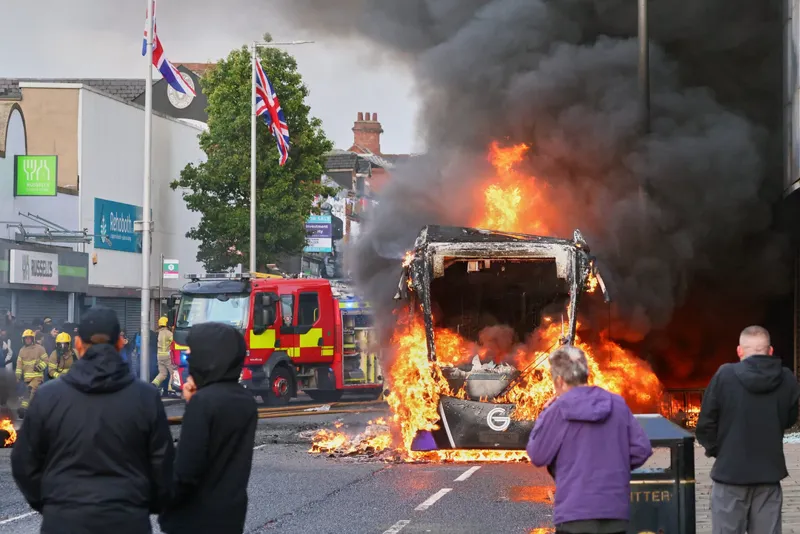
Cars and a bus were set on fire and families were driven from their homes after a stabbing in Belfast caused tensions to spill onto the streets.
The New York Times – Jun 10, 2026
Reported by Megan Specia
A night after Northern Ireland was roiled by violence in the wake of a stabbing attack, the police on Wednesday said they had fired water cannons at crowds gathered near Belfast, as the authorities ramped up their presence in the country.
On Tuesday, firefighters and emergency responders had escorted immigrant families from homes that had been set on fire in Belfast, and fears remained high of a repeat of that violence. Burning cars had blazed on the street, and a city bus was set ablaze by a group that appeared to be mostly young men, many of them masked, and roads elsewhere in the city were blocked.
By 10 p.m. on Wednesday, the disorder appeared more muted than Tuesday’s, with reports of some protests and items thrown at police officers.
Two police officers were injured in Tuesday’s unrest, described by the police as sporadic pockets of disorder across Northern Ireland. The violence came after the authorities charged Hadi Alodid, a 30-year-old Sudanese man, with attempted murder in a stabbing attack in Belfast on Monday night, prompting calls from anti-immigrant activists for protests amid heightened tensions in the United Kingdom over immigration.
[...]
Some of the most harrowing scenes on Tuesday night had played out in Belfast, where families had to flee burning homes.
Paul Doherty, a community worker and local councilor from west Belfast, described what he’d seen on Tuesday night as “absolutely appalling.” He said there were “mobs of people basically chasing people from their homes.”
“People were being terrorized simply because of the color of their skin or where they came from,” he said, adding that he met with and provided help to two women, one Sudanese and another from Somalia, and four children, who were forced from their home after an arson attack.
How Belfast knife attack became the latest far-right trigger event
The rapid spread of footage shows how social media is pivotal in enabling far-right agitators to mobilise internationally
The Guardian – Jun 9, 2026
Reported by Ben Quinn
Filmed at about 10.30pm on Monday night on a Belfast street, bystanders captured the moment when a man, believed to be a Sudanese asylum seeker, wielded a knife over another man he had pinned to the ground.
By Tuesday, the clip had become the latest transnational “trigger event” – in the mould of the Southport killings and the case of the murdered 18-year-old student Henry Nowak – as far-right activists from Britain and beyond seized on it.
Those playing a pivotal role in the spread of the footage on Elon Musk’s X included the far-right activist known as Tommy Robinson, fresh from a meeting this week at a sumptuous Moscow hotel with the billionaire’s father.
X eventually placed age-related restrictions and a warning on the video shared by Robinson, but by Tuesday afternoon it had more than 52,000 views, while full and uncensored versions were still easy to find across the platform.
Robinson posted details of planned demonstrations across Britain and Northern Ireland on the platform, which Elon Musk shared to his 240 million followers.
[...]
“It fits into the current trend of trigger events where something horrifying happens and is then attached to an existing narrative being pushed by the far right, with mass migration being promoted as the reason,” said Joe Mulhall, the director of research at Hope Not Hate.
“We saw this in Southport, Southampton with the Henry Nowak case as well as in Epping, with the anti asylum seeker protests there. The even bigger danger is when you have a number of such events in quick succession.”
We first began our series on the history of Combat 18 with Gareth all the way back in late January. After dropping the first two instalments, we decided it would be a good idea to take a break in order to give Gregk, Gareth and you, the listener, some respite from stories about flat-nosed geezers and peculiar wizards having Mean Girls meltdowns about one another via dot matrix printers.
The decision, quite out of the blue, to then pick the series back up and finish it two weeks ago now feels timely in the worst way possible. It was one thing to wake up on Wednesday, the morning after the final instalment dropped, to reports of riots (more accurately, pogroms) in the city of Belfast ginned up by far-right provocateurs in the UK and further afield.
When reporting then followed suggesting these actions were likely instigated, on the ground, by associates of Loyalist militant factions, it felt less like we’d hit a bullseye on the dartboard, and more like the dartboard had been running headlong toward us the whole time.
But then, there were reasons we had originally felt that the Combat 18 story was one worth telling — Will Browning’s lightning prose notwithstanding. Beneath the surface-level narrative of a pratfalling terror cell so bumbling it made the lads from Four Lions look like Danny Ocean’s crew, the story revealed a lot about the persistence of far-right movements within the British political scene.
Consequently, it was one which provided a lens through which to analyse and make sense of our own confrontation with the far-right in the present, varyingly providing both points of contrast, as well as uncomfortable resonances.
One distinction which immediately stands out when considering not only the events in Belfast this week, but the numerous other incitements to violence the British right has attempted over the past few years, is the vastly different way these factions, their political goals, and the means they use in their pursuit, are treated by British politicians and the media.
As we document in our series, throughout the post-war period, British society had been dogged by the agitations of far-right parties, particularly the National Front. Though the NF experienced the apex of its (lacklustre) electoral successes in the 1970s under the leadership of John Tyndall, the far-right party maintained a consistent presence in British life all through the ‘80s by way of street marches and public actions.
But as Francis Fukuyama’s often-cited (and more often misunderstood) ‘End of History’ thesis argued, the collapse of the Soviet Union and end of the Cold War sounded a death knell for the great ideological power struggles of the twentieth century, signalling a transition to universal free-market capitalism and liberal democracy whose perpetual ascension assumed an almost teleological character for both governing elites and their presumed-to-be natural electorates.
Such a state of affairs did not apply only to communism. However misplaced the energy may have proven to be in retrospect, the ‘90s was a brief decade in which all of the great ideological battles of the preceding century were deemed to have been fought, and settled.
Fascism, too, was treated as a dying ideology, and when it reared its head it was treated varyingly as a contemptible politics, as a risible anachronism, or perhaps entirely illegible.
When Serbian soldiers pursued genocidal campaigns in fragmenting Yugoslavia, their actions were confronted and halted, and their political and military leaders were put on trial. When Timothy McVeigh and Terry Nichols carried out the Oklahoma City Bombing attack in 1995, criminal investigators, politicians and the media were either incapable or unwilling to confront the duo’s white supremacist motivations, reflexively identifying Islamic terrorism as the prime suspect, at first.
When McVeigh and Nichols were finally caught, the former’s self-identification as a ‘lone wolf’ was taken at face value, and his likely connections to a sprawling network of white power militia groups were entirely ignored. By the time the deadpan British documentarian Louis Theroux arrived in the States to film a programme about neo-nazis in Southern California in 2003, the figures he encountered were implicitly treated as jokes; footnotes; non-entities.
The mainstream derision of fascist ideology and its adherents in the ‘90s pervades our story of Combat 18. The group’s foundation was deemed necessary by both John Tyndall and the group’s central figures because they had experienced persistent humiliation at the hands of anti-fascist activists. The reporting done by journalists at Searchlight magazine contributed to multiple television documentaries, broadcast on the mainstream ITV, dedicated to exposing neo-nazis on British soil. The book we used as our primary source was the product of persistent, committed efforts to monitor Combat 18 and its members, ensuring they were known quantities with nowhere to hide.
When Tyndall’s British National Party was taken over by Nick Griffin in 1999, and he spent the next several years attempting to moderate the party’s image and legitimise it in the mainstream, both his political peers and the media confronted him with an uphill struggle. Despite numerous attempted rebrands, the public were rarely allowed to forget what he was; and what he and his party stood for.
In 2009, Griffin finally secured a spot on Question Time, the BBC’s flagship political panel discussion programme, in which prominent politicians, journalists and public figures take and answer questions in front of a live studio audience.
The decision to platform Griffin attracted significant controversy, for obvious reasons. But the episode played out as the show’s producers and other participants likely expected it would; guests and audience members alike spent the hour ridiculing Griffin to his face and belittling his backwards politics, and he left the studio that night a diminished figure.
Compare and contrast with the treatment of far-right politicians in the UK and further afield in the years that followed. Nigel Farage made his first appearance on Question Time in the year 2000, as leader of the then-marginal UK Independence Party (UKIP).
At first, Farage made scant appearances on the programme, but in the year 2006, he was invited to appear twice. From that point onwards, he appeared on the panel with increasing regularity. Today, depending how you define terms, he is the most frequent 21st century politician to appear on the programme, having racked up 38 panel appearances since his 2000 debut.
A similar kid-gloves treatment has been given to Stephen Yaxley-Lennon, aka Tommy Robinson, aka ‘Tommy Two Names’, who first appeared on the political scene again, in 2009, as leader of the English Defence League, an organisation founded as an explicitly Islamophobic and anti-Arab — which is to say, racist — hate movement.
Robinson is a contemptible figure whose seedier proclivities are common knowledge in British discourse and, as Gareth stated in the conclusion of our series, he would have been perfectly at home in an organisation like Combat 18 or, for that matter, Nick Griffin’s BNP.
And yet in spite of this, since his eruption onto the political scene, Robinson has been allowed and enabled by the British press to launder his image through a series of unconvincing rebrands, before circling back around to the same ideological stance he began with, now obscured under several layers of chintzy ‘British Bulldog’ patriotism. To the extent he has shed his erstwhile openly Islamophobic positions (he hasn’t), it is because he has been able to offload that aspect of his messaging to mainstream British newspaper columnists, radio hosts, and television pundits.
Throughout the 2010s, Farage and Robinson unquestionably had the mainstream press to thank for their meteoric rises. The success of ‘Leave’ in the 2016 referendum over Britain’s membership to the European Union was many things. One of those things was the severing of Britain’s relations to its closest regional partners, and the supranational apparatus safeguarding many of this country’s fragile political and economic protections — hand-delivered to an ex-trader and alleged childhood public school nazi by a press which had been hand-holding his journey to that ‘upset’ victory for years.
But in the 2020s, those two, and right-wingers the world over, enjoyed an extra boost which has supercharged their political projects. Since purchasing Twitter in 2022, Elon Musk — the world’s wealthiest individual — has used his ownership of the social media platform of choice for politicians, activists, commentators and political junkies, to distort the discourse they consume, and by extension public discourse writ large, in favour of his personal policy preferences.
The result: the wholesale amplification, normalisation and legitimisation of exterminationist transphobia; privatisation; regulatory capture and degradation of the state apparatus; revanchist apartheid beliefs about racial hierarchies; forceful dissemination of Great Replacement conspiracy theories; foghorn-volume fearmongering about Islam as an existential threat to his people and the future for white babies; and so on.
What this hijacking of Twitter and the personalised algorithms which subtend it empowered Musk to do, was something his forebears, like the Sargents with their zines, or Nick Griffin on BBC primetime, could only ever have dreamed of.
Musk’s control of politics’ prime discursive channel empowered him to channel the hateful invective of Robinson, Farage and now Rupert Lowe to media consumers on an individual, and perpetual basis; delivered to them at all hours of the day as they sat on their commutes, ordered coffee, went for a shit. These actors gained a level and character of access to individual voters and political actors that would never have been attainable via paper sales or television appearances alone. Not only did he amplify the ideology of the far-right to degrees previously unseen in the modern era — he turned up the volume dials in people’s own spatial and psychological interiorities and, above all, he made it personal.
We already discussed the active role Elon Musk has been playing in seeking to shift British politics to the right in last week’s newsletter, so we won’t belabour the point. Regarding this latest escalation, it is worth remembering that when Musk spoke at Tommy Robinson’s Unite the Kingdom rally in September 2025 via videolink, he communicated two things: His desire for a wholesale change in the UK government, root and branch, and an implication that this could, would or should only be achieved through violence. Addressing his words to people he described as, “the reasonable centre, the people who ordinarily wouldn’t get involved in politics,” he said the following:
“My message is to them: if this continues, that violence is going to come to you, you will have no choice. You’re in a fundamental situation here.
“Whether you choose violence or not, violence is coming to you. You either fight back or you die.”
Both during that address and whenever he has weighed in on British politics since, Musk has continued to agitate against the Labour government and Keir Starmer specifically. The response from both Starmer and his government — and by extension, the British state — has been a strategy of wet-legged meekness. The degree to which Labour have avoided confronting Musk has been striking, even by the standards of a PM who reacted to that first Tommy Robinson rally by popping off to Emirates stadium to watch an Arsenal game and wait for everything to blow over.
Lest we forget, this is a government which has proven happy and willing to arrest pensioners and disabled people; to systematically deny transgender people their dignity and rights, and make a spectacle of doing so; to send its immigration Obergruppenführer Home Secretary out to advertise each performative degradation to the country’s braided carceral and immigration systems; and to circulate each of the party’s potential successors to lame duck Starmer on the airwaves to reiterate these lines, making obnoxiously clear to their supporters and detractors that, whatever their desires, any changes conceded will be purely cosmetic.
One can’t help but wonder, then, what it is about Musk that is making the government pull its punches. On this we can only speculate, but the machinations of Health Secretary Wes Streeting and his dogged endeavour to integrate the authoritarian tech firm Palantir into the NHS over and against all complaints and concerns is instructive.
For all the gawping and adulation for Musk’s exploits as a businessman, it is difficult to succinctly answer what it is he and his companies do; how they make money; whether they are profitable, and so on. This is because for over a decade and a half now, his central modus operandi has been exploiting complex economic, legal and regulatory mechanisms to conceal his companies’ oft-dodgy financial fundamentals within a Matryoshka doll of mergers, acquisitions and asset-sharing arrangements.
Simultaneously, Musk has then aggressively pushed to integrate his companies and their services into the functioning of the state itself; to burrow into the governmental apparatus, like a tick, which can then feed off the most durable entity in the economy there is, and ideally supplant in every way but in name.
This behaviour is most clearly legible in the case of SpaceX, which he has aggressively pitched as the free-market option for launching satellites into space in the hopes of replacing NASA. But the same logic can be traced in how he used his Boring Company and fatuous ‘Hyperloop’ transit system to undermine proposed high-speed rail lines in California until those plans were ultimately scrapped, leaving old-fashioned cars and his covertly subsidised Tesla autos as the only game left in town.
White nationalist and eugenicist commitments aside, this is also how you should understand DOGE, his Department of Government Efficiency, and its murderous efforts to slash US government expenditures on ‘unproductive’ activities like distribution of medicine and food in impoverished countries. Musk’s contempt for black and brown populations and women is matched only by his belief that he is the centre of the universe. Every penny not travelling in his direction is, ergo, wasteful expenditure. L'État, c'est moi. (Although in this instance, perhaps Ek is die staat would be more appropriate.)
As much as the Brits pride themselves as being distinct from the Yanks across the water, there is little daylight between them on this matter. Earlier this month, on June 2 (that is, one week before Musk helped to provoke pogroms on the streets of Belfast), Reuters reported that Britain’s Ministry of Defence has begun transitioning its operational military traffic to Musk’s Starshield, a supposedly more secure (and more expensive) iteration of his Starlink satellite communications system, which the British military has already adopted extensively along with other militaries.
You may remember Starlink from the early months of Russia’s war on Ukraine, when Musk revoked Ukraine’s access to the system on a whim at a critical moment in the war, reportedly due to personal fears that Ukraine’s actions risked inflicting “strategic defeat” against Russia.
It is therefore, in our view, not unreasonable to ask whether the real reason for Starmer et al’s intransigence in confronting Musk, as he openly foments pogroms, uprisings and perhaps worse on Britain’s streets, is because he is now so thoroughly embedded into one or several of the country’s crucial defence and security apparatuses that they cannot confront him without risking these systems being compromised. If this sounds like a hostage situation, then you might want to cast your mind back to our episode on Walter Benjamin and our broader ruminations on the nature and source of political sovereignty.
Starmer and the state might be apprehensive to pick a fight with Musk. Unfortunately, this is one of those scenarios where if you prove either unwilling or unable to pick that fight, then the uncomfortable reality is that you’ve already lost.
Back to the specific incident of pogroms erupting on the streets of Belfast earlier this week. You will recall from our Combat 18 series that one of that group’s primary sources of legitimacy in its early years was its links to the Ulster Defence Association (UDA).
As we covered in our series, the value of the Loyalist connection for C18 was both ideological and practical. For Charlie Sargent and Will Browning’s thug friends, militant Loyalism provided a slipstream they could ride in, legitimating their murderous hatred for Catholics, Communists and the Irish, which in their shapeshifting cosmology were often one and the same thing.
Associating with Loyalist factions on the mainland also plugged the group into arms-trafficking networks which they hoped could be put to use in their own political-military endeavours — and probably would have, if they’d ever had the attention spans to stop posting on Tumblr about one another and commit to Sparkle Motion.
What bears underscoring, in the wake of this week’s violence in Northern Ireland, however, is that Combat 18’s affinity for Loyalism went beyond mentality and materiel. In an interview published in VICE in 2016, the journalist Nick Ryan explains that the Sargent brothers’ vision of creating an Aryan separatist homeland on a Chelmsford council estate was explicitly modelled on the sectarian enclaves which crystallised around the Shankill and Falls roads in Belfast during the Troubles.
As Ryan puts it, Charlie and Steve “talked about some sort of paramilitary-style, street-based system, taking over various estates in parts of the country,” adding that “they often referred to Northern Ireland as their inspiration.”
In his own 1998 article which we also referenced, Ryan quotes directly from one of C18’s many banned dot matrix jeremiads, which puts this idea forward explicitly, stating the following:
“The inner cities are lost. We must realise this and take our only real option – converge as many of our people as we can in the Homeland area and gradually take control of it and run it on strict Aryan-only lines. One has only to look at the religious divides in Belfast to see that we can achieve our aim, the only difference being ours will be on racial not religious divides.”
On this note, however, it is worth bearing in mind that the reason the Sargents and their ilk turned to the Aryan Homeland strategy in the 1990s was because their original vision, of forced expulsion of all immigrants and non-white peoples from British soil, tout court, then seemed unattainable.
This, according to Steve Sargent, was largely the fault of white Britons themselves. In an issue of his magazine The Order, he warned his allies that the most dangerous group they confronted were white race traitors, do-gooders and those who wished to foster a multi-racial society. The Aryan Homeland was not the vision of a movement on the rise; it was a retreat.
This is a fact which casts the contemporary landscape of British politics in a different light. Today, mainstream parties like Labour and the Conservatives jockey against one another to prove who can be the most anti-immigrant, in the hopes of out-Reforming Reform.
For the past decade, Nigel Farage has steadily amplified his rhetoric about the immigrant hordes invading British shores, validated at every step by a political and media class which is reluctant to call bigotry for what it is. Now, Rupert Lowe’s new far-right party Restore Britain is openly promising to reverse so-called ‘mass immigration’ to the UK as a pillar of its narrow-minded policy platform.
A vision which was once abandoned by Britain’s most contemptible neo-nazi thugs is now the yardstick against which the majority of this country’s political parties now gauge and perform their credibility and authenticity. It is therefore worth asking, seriously, how it is that this country got to this point, and who got us here.
Because one thing can be said with certainty – it wasn’t Charlie and Steve Sargent.
Over the past week, it has been both sickening and tiresome to see political commentators and onlookers in the UK and further afield applauding the eruption of sectarian violence on the streets of Belfast as righteous, as though such actions have ever benefitted the people of Northern Ireland, whatever their race, religion, ethnicity or extraction.
As we stated clearly in our early series on the history of the car bomb, whatever political sympathies one might have, the ultimate consequence of the violence of the Troubles, for all concerned, was decades of crippling political, economic and social stagnation, hampering the prospects of the people of Northern Ireland in ways beyond measure.
As a result, anyone cheering on the eruption of such violence in Belfast, particularly those organised activists buoyed by an ascendant ethnonationalism on the mainland, wrapped in a Union Jack and disingenuously waving a Bible, only betray their own lack of genuine care and concern for the very people they proclaim to be championing.
More to the point, however, one must bear in mind that excerpt from Combat 18’s newsletter above; our episode on the Nazi jurist Carl Schmitt, and our repeated stressing that the fascist concept of the political is one which is both founded and feeds upon, is sustained by, and which ultimately drives toward nothing more than violence itself.
Fascism — which exists in a symbiosis with murderous, exterminatory nationalism, and venerates violence over and above all — does so because in the final analysis, whether it consciously knows so or not, it has nothing else to offer.
And as we look at the horrific scenes which unfolded in Belfast earlier this week, it is important to remember that these were not simply spontaneous eruptions of particular outrages in our own era, but the continuation of a project which has been pursued for decades. And when the heralds of this violence look at the destruction they have wrought on those streets, they don’t see what you and I see: They see utopia.
And if Labour, the British government, and indeed the rest of us don’t wake up to the full implications of that vision, then they, and Elon Musk, will get their utopia. And it will be us who will be left to revel in that glorious rubble.