
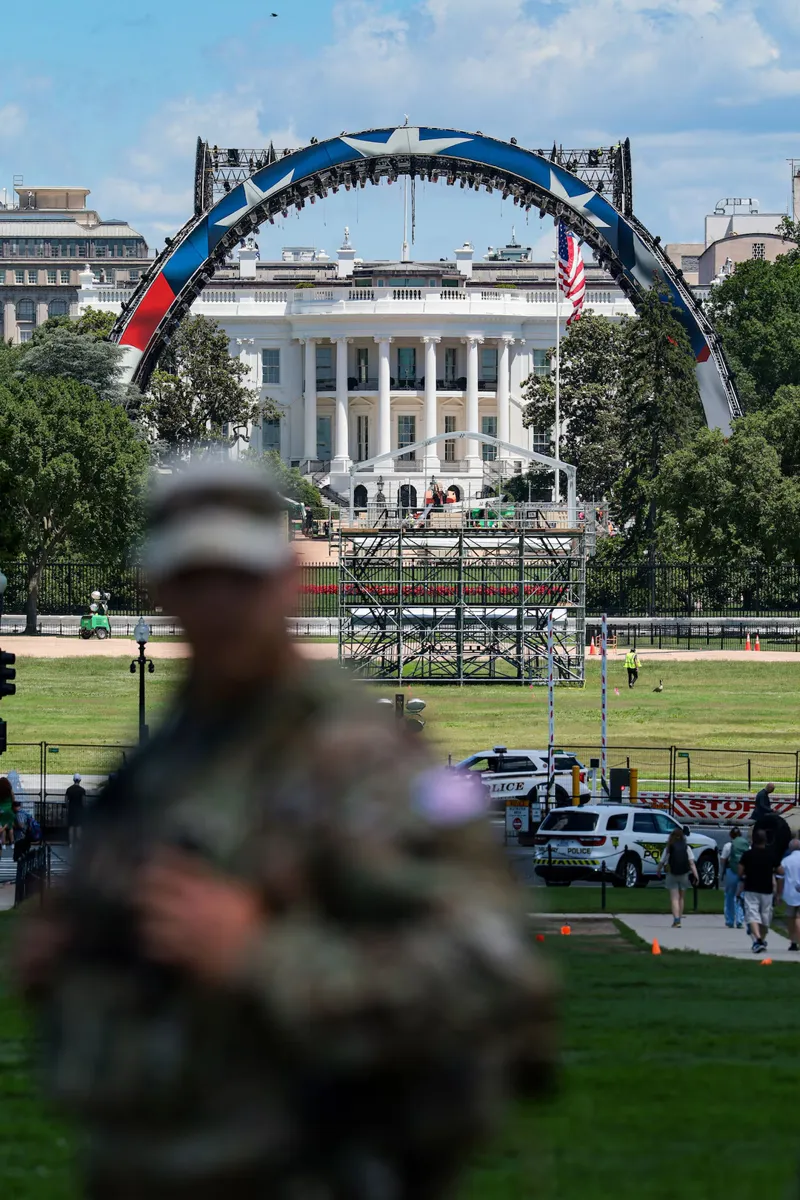


THIS WEEK IN VIOLENCE: Super Smash TV
2026, Week 22
This week, some light entertainment for you, in the form of recent developments surrounding the Trump administration’s planned UFC fight on the White House lawn as part of America’s 250th anniversary celebrations. Alongside some ruminations on fascisms old and new, and what happens when violence becomes both a society’s sole means and ends – even as mounting evidence suggests it isn’t particularly good at it. Like I said, light entertainment.
Pentagon recruiting troops to watch White House UFC fights, memos show
Internal messages reviewed by The Post stipulate that military personnel must pay for their travel and meet strict physical requirements to be eligible.
The Washington Post – May 29, 2026
Reported by Dan Lamothe and Alex Horton
The Pentagon is moving to recruit hundreds of troops to appear as spectators at President Donald Trump’s UFC cage-fighting event at the White House, and requiring those who attend to pay for their travel and meet height and weight requirements, according to people familiar with the matter and internal memos reviewed by The Washington Post.
The Defense Department in recent days has solicited volunteers across the services to attend the June 14 event in uniform. Officials are seeking junior enlisted personnel and junior officers specifically, according to internal messages that make clear travel costs will be “member-procured,” meaning neither the Defense Department nor the UFC intends to pay for their arrangements or accommodations.
[...]
One memo, circulated within the Air Force, stipulates that to be eligible, personnel “MUST MEET CURRENT WAIST-HEIGHT RATIO and current physical fitness standard.” Troops will be required to wear their short-sleeve dress uniforms, the memo adds.
Another message posted on a social media page popular with troops touched on similar themes, calling the effort to identify troops to attend the White House event a “quick-turn tasking.”
“Tickets must be distributed to genuine UFC fans, not solely to high-ranking DVs,” the message said, referring to distinguished visitors.
[...]
The UFC has long been popular with rank-and-file troops, with numerous active-duty personnel and veterans competing in its cage fights. Dana White, UFC’s chief executive, has said in recent interviews that about 4,000 people will be on the South Lawn, with “most of them” serving in the military. Thousands more people are expected nearby for a viewing party of the fights on the Ellipse, he said.
White, speaking to Time magazine recently, said the event will cost his company $30 million to stage and defended it as an act of patriotism.
“You can make anything political if you want to,” White told Time. “I love this country like anybody on the left loves this country. I love this country like anybody on the right loves this country. This is basically me spending a s---load of money to celebrate the 250th birthday of America, with America and the rest of the world.”
Trump has attended numerous UFC events in the past, and touted the White House competition in the Oval Office a few weeks ago while flanked by UFC fighters.
It’s going to be the biggest event we ever had,” Trump said at the time. “... The White House doesn’t really do athletic events for the most part.”
Where to begin.
You will remember from our episode on four fascist concepts when we discussed Walter Benjamin’s remark, in his essay on ‘The Work of Art in the Age of Mechanical Reproduction’, that fascism entailed the aestheticisation of politics; its reduction to a practice of images, affects, feelings and drives. This claim is made within a larger critique of the artforms of industrial modernity, particularly cinema and the moving image, and how observers of these artworks remain convinced of their own agency and freedom of action despite being reduced to mere spectators of dramaturgies whose unfoldings are fixed and predetermined.
Your mileage may vary regarding the veracity of Benjamin’s critique in its totality. But his suspicions would be affirmed, in some sense, by the political project of Adolf Hitler. At the time of the publication of Benjamin’s essay, the Third Reich was already two years into its twelve-year lifespan.
Taking the lead from Mussolini, Hitlerism supercharged that project’s valorisation of the aesthetic, exploiting both the spectacle of modern technology (cars, planes, machinery, bombs) and the modern technology of spectacle (film, radio and the press) to radiate the image – the feeling – of a movement which was totalising, omnipresent, and undeniable, both in Germany and beyond.
Was Adolf Hitler a visionary with a unique sense of and command over the potency of these new technologies and their political-aesthetic ramifications? Or was this simply a case of a particularly devastating self-licking ice cream cone? It’s questions like these which sometimes make analysing fascists so challenging. It’s easy to observe political projects and actors such as these and wonder what their secret sauce is. But then fascism is a politics of appealing to the masses through their most base, cruel and grotesque instincts – something these same actors excel at, because that is precisely the territory they inhabit.
Behind all the puffed up pomp and pageantry, roman columns and so on, Hitlerism was not a project which sought to understand and reach the masses. Rather, it was one which recognised that element of the cruel and sadistic which resides in us all, which for its leader is all there even is, and then taps into and amplifies those drives until nothing else exists for anyone anymore. Fascism does not seek to refine itself into the ideal product. It simply debases and sullies the entire social sphere until it mirrors the fascist interiority – pure slop which, in a world sufficiently defiled, appears indistinguishable from ambrosia.
In a word, whatever the qualities which made him a political and historical singularity, Adolf Hitler was not a genius. He was a pig who excelled in fascism’s one true purpose, which is to convince everyone that salvation can be found in the muck provided we all roll around in it together.
As is now abundantly clear, more than ten years into his total envelopment of the political sphere, Donald Trump is also an ignorant pig. During that time period, commentary has abounded comparing him to his historical precursors, and debates have raged over whether he, whether this, is or is not fascism.
These debates are complicated by the nature of fascism itself, which makes identifying it a fraught task. On the one hand, yes, fascism expresses certain tendencies and qualities which can be marked, compared and assessed.
On the other, it is an inherently dynamic and opportunistic politics, seizing on and making use of whatever surrounds it in its particular context and condition. Attempts to identify fascism by simple recourse to historical case studies is, to some extent, a fool’s errand, because the fascism of this time and place will never map onto that of another, even if the topography seems similar.
But even then, this is almost by the by, given by now well-trodden stories about Trump’s supposed admiration for Adolf Hitler; claims that he kept a copy of Mein Kampf on his bedside table; his admiration for strongmen, showmen, and figures who share in his belief that politics is and can only ever be a crude cocktail of spectacle and force. Whether or not Trump is, categorically, a fascist, one thing is clear – he certainly wants people to believe that he is, and to fear him accordingly.
Besides — and this is itself a very fascist tendency — it is not necessarily in his politics, ideology or rhetoric where the analogy between Trump and Hitler can be found so much as in his base, pig ignorance.
In the same way the Third Reich thrived on a spectacular synthesis of industry and image, Trump’s rise to fame rested on the twin pillars of real estate and television. This is a man who has always been personally obsessed with television and the stars who populate its screens; who knew how to use that medium to distract from his managerial incompetence and failing businesses. By the turn of the millennium, that distractive utility of television became the end in itself; why even bother with doing actual business, when you can just play one on television in perpetuity, vaccuuming up cash from suckers naive enough to forget that TV – yes, even and especially reality TV – is where people go to play a part?
Since returning to the White House in January 2025, it is clear that either Trump or the clique with which he now surrounds himself, are determined to both announce his authoritarian aspirations and make good on them. DOGE, his tariffs, his immigration crackdowns, the deployment of armed thugs in America’s streets, the deliberate invocation of those ominous images – purification, cleansing, camps – all seek to create an image which is unquestionable, and either compel you to submit or dare you to question it.
As the project entered year two, their hapless domestic project affirmed, the team branched out into the international sphere, seeking to ratify the truth of their worldview with a blistering flurry of foreign policy actions which would affirm brute force as both first mover and final determiner. Following the dubious success of their first hit & run attacks against Iran in 2025, Team Trump sought a repeat with their kidnapping of Nicolás Maduro.
Drunk on the feeling of his own success – or simply its projection – Trump then decided it was time to solidify his legacy by reaching for the Holy Grail of modern American chauvinism: taking out Iran. That project quickly unravelled, as many had predicted it would, when his politics of spectacle ran up against the cruel, uncompromising fact of material reality.
Stalled out, but undeterred, the Trump administration has sought to fabricate an image of victory in the Straits of Hormuz all the same, while hoping successes against a softer target might distract enough people from that reality. And so, as the US military flounders in another debacle in the Middle East, other ships and aircraft carriers are sent to encircle a besieged and beleaguered Cuba. Facts be damned: The men of violence are going to get that feeling back.
It is impossible to observe the various dramas unfolding around the White House – the actual building – and not ask oneself, “What are we doing here?” As Trump 2.0 has floundered both at home and overseas, many have observed how the man has responded by fixating on various vanity projects.
First his tumorous ballroom, then his so-called ‘Arc de Trump’. Plans for a spectacular combination celebration of America’s 250th anniversary, Flag Day and (yes) Trump’s birthday are spiralling as various entertainers pull out of the lineup, leaving just Vanilla Ice and Flo Rida as the day’s biggest names. And then, of course, there is the much-touted UFC Freedom 250 event, scheduled to take place around the back of the White House on that very same day.
That satire is dead because reality has outpaced it is now a well-worn observation. And so, there is not much to say about this event other than that it is another typically Trump situation in which metaphor and reality have collapsed into one another. There is little point in trying to elaborate at length on the event itself because it is exactly what it looks like. As I saw one individual put it on Bluesky, referring to the popular American combination restaurant-video game arcade, this is what America is now: The Dave & Buster’s country.
And again, as we have seen in all those other cases, the same retreat to aesthetics, and the provision of a comforting image of victory in its material absence, oozes. Having marshalled forces for scattershot military actions here and there, all amounting to nought, the Trump administration is now marshalling its most gorgeous soldiers to Trump’s Rumble in the Rose Garden so he, and they, and all of us, can indulge in the resplendent spectacle of watching pop culture’s most prominent TV tough guys perform feats of strength on America’s behalf.
In 1943, following earlier defeats in North Africa, fascist Italy faced near-certain defeat as Allied forces bombarded Italian cities with air strikes and mounted ground invasions, beginning in Sicily and moving northward up the boot. Supposedly, during this time, the Duce Mussolini, as all fascists do, retreated to aesthetics, lounging with his mistress and translating classic works of Italian fiction into German as both state and military collapsed around him.
Likewise, during Hitler’s final weeks in the Führerbunker, as the Third Reich, too, confronted total defeat, it is said that his circle continually shrank, until he spent most of his time with the architect Albert Speer, gazing wistfully over the giant model of Germania, the city he intended to build over the top of Berlin as a global capital – planned, now doomed.
Again, none of this is intended to draw crude or simple analogies between Trump and Hitler. As I said, whether the man is or is not a fascist, it is now clear that he aspires to the status of one, but — and this is perhaps the one truly impressive thing about the man — he is simply too thick, incurious, unfocused and easily-distracted to even pull that off.
Force and spectacle may be a cheap and simple cocktail, but the first component at least requires some degree of determination and focus to pull off effectively. Even then, this thing that we call politics requires more than that, hence why fascism always collapses under the weight of its own belligerence. But the second part? The spectacle? That’s comparatively cheap and easy. More importantly, it feels good.
In 2020, during the height of the uprisings surrounding the murder of George Floyd, David Roth wrote an essay for The New Yorker analysing Paul Verhoeven’s 1997 film Starship Troopers in the context of that “moment of American defeat.”
It’s a fantastic essay and I encourage you to read it in full (and, of course, to watch the film if you haven’t already). But in closing, I want to share a passage from that essay, which feels apt in this context:
For most of “Starship Troopers,” humanity, in every possible facet, gets its ass kicked. A culture that reveres and communicates exclusively through violence—a culture very much like one that responds to peaceful protests with indiscriminate police brutality, or whose pandemic strategy is to “dominate” an unreasoning virus—keeps running up against its own self-imposed limitations. Once again, the present has caught up to Verhoeven’s acid vision of the future. It’s not a realization that anyone in the film can articulate, or seemingly even process, but the failure is plain: society has left itself a single solution to every problem, and it doesn’t work.
Donald Trump didn’t empty American politics of everything but violence; he’s just what was left afterward. He is more an emblem of American defeat than its author. The world of “Starship Troopers” aligns with our moment in its wastefulness and brutality, and most of all in being so helplessly recursive. At the end of the film, the human survivors of the bug siege become the heroes of a bombastic military-recruiting ad. A splash of onscreen text cheers, “They’ll keep fighting . . . and they’ll win!” The second promise is extraneous. All that’s left to win is the chance to fight more, and to fight off the realization that the fighting itself has become the point.