


THIS WEEK IN VIOLENCE: Stupid Games
2026, Week 15
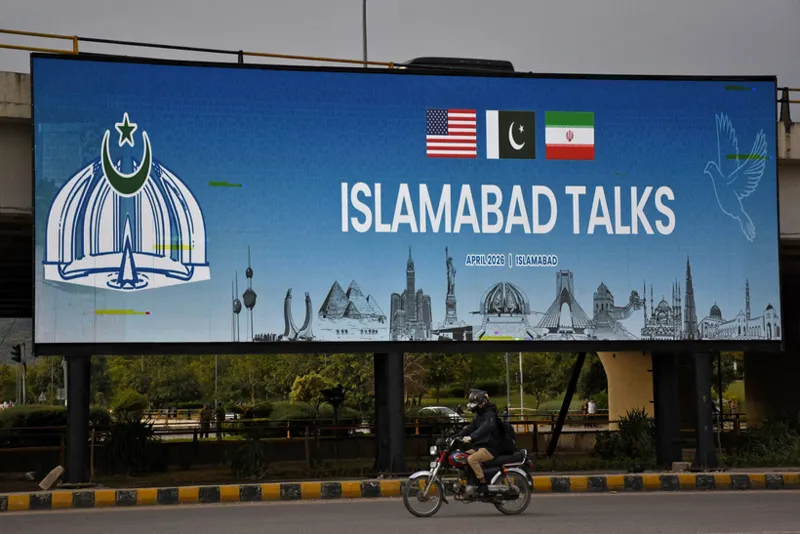
Earlier this week, following a series of posts on his Truth Social website which shocked and horrified all observers of good conscience, Donald Trump announced a tentative ceasefire with Iran and peace negotiations to be conducted in Islamabad, Pakistan.
At time of writing, those peace talks are now beginning, and what they produce is to be seen. For this week’s newsletter, we provide some commentary on a few aspects of the week’s developments, and some possible directions this conflict could now take.
JD Vance warns Iran against trying to ‘play’ the US in peace talks
The Guardian – April 10, 2026
Reported by Julian Borger and William Christou
JD Vance has warned Iran not to “try and play” the US at talks planned for Saturday in Islamabad, while Tehran said it would not take part until Israel stopped bombing of Lebanon.
The US vice-president made the comments as he boarded a plane to Pakistan for negotiations that could determine whether a ceasefire holds or the war on Iran resumes with grave implications for the global economy.
[...]
Mohammad Bagher Ghalibaf, Iran’s parliamentary speaker and the co-leader of the country’s delegation, said on X on Friday: “Two of the measures mutually agreed upon between the parties have yet to be implemented: a ceasefire in Lebanon and the release of Iran’s blocked assets prior to the commencement of negotiations. These two matters must be fulfilled before negotiations begin.”
[...]
Donald Trump fuelled the uncertainty by saying US forces were rearming and ready to return to the attack if the negotiations failed.
“We have a reset going. We’re loading up the ships with the best ammunition, the best weapons ever made – even better than what we did previously and we blew them apart,” the US president told the New York Post. “And if we don’t have a deal, we will be using them, and we will be using them very effectively.”
Later on Friday, Trump followed up his threats with a post on his own social media site declaring: “The Iranians don’t seem to realize they have no cards, other than a short term extortion of the World by using International Waterways. The only reason they are alive today is to negotiate!”
The Iranians and the Pakistani mediators say the two-week ceasefire agreement struck by the US and Iran on the night of 7 April included Lebanon. Trump and Israel’s prime minister, Benjamin Netanyahu, say this is not the case, and Israel has continued to bomb Lebanon in its offensive against Hezbollah, Iran’s closest ally in the region, even after Netanyahu said he was ready to start peace talks with the Lebanese government.
[...]
Trump has accused Iran of doing a “very poor job” of allowing oil to go through the strait, adding in an overnight social media post: “That is not the agreement we have!”
The oil price spike caused by the US-Israeli attack on Iran on 28 February, and Iran’s response by closing the strait of Hormuz to oil tankers and other shipping, is a direct political threat to the president before congressional elections in November.
On Iran’s 10-point plan and Trump’s ceasefire maneuvring
As we’ve already seen in multiple conflicts in recent years, particularly in Ukraine’s fight against Russia, the information space is as important as any other battlefield in modern warfare. Practical questions of whether your side is actually winning the war are one thing. Just as important, possibly moreso, is ensuring everyone believes you are winning. This has certainly been an increasingly important battle for Trump and Hegseth, particularly as consensus on the actual war has slowly turned against them.
Reporting in the New York Times from earlier this week claims that Trump signed off on the war following intense lobbying from Israeli Prime Minister Benjamin Netanyahu, who sold Trump a picture perfect, one-and-done regime change operation which promised to be a Venezuela redux.
In practice, quite predictably, Trump has been dragged into precisely the type of disastrous Middle East war-without-end that he supposedly rose to power opposing. And so, it’s increasingly clear that the big wet president wants out.
Earlier this week, Trump shocked the world by releasing a statement when he promised nothing less than the total destruction of Iranian civilisation – a course of action which, definitionally, would have been an open-and-shut act of genocide.
Miraculously, mere minutes before the US military was scheduled to begin bombarding Iran’s electrical grid and civilian infrastructure, he announced that he had received a ten-point peace proposal from Iran which was described as a ‘workable basis’ for negotiations. Here are those ten points which Iran laid out:
An American guarantee of nonaggression with Iran.
Iran maintains control of the Strait of Hormuz.
Ending the regional war on all fronts, including against Iran’s ally, Hezbollah, in Lebanon.
Withdrawal of U.S. combat forces from all bases and positions in the region.
Reparations to Iran for war damages.
Acceptance of Iran’s right to nuclear enrichment.
Lifting all primary sanctions on Iran.
Lifting all secondary sanctions on Iran.
Termination of all resolutions against Iran by the Board of Governors of the International Atomic Energy Agency.
Termination of all United Nations Security Council resolutions against Iran.
Rather than their eminent workability, most experts and onlookers have observed how these demands from Tehran are, in one word, maximalist. As maximalist, in fact, as the US’s own fifteen-point proposal from several weeks earlier which featured diametrically opposite demands.
How to make sense of what happened? With the economic fallout of Trump’s disastrous attack on Iran, including the shutdown of traffic through the Straits of Hormuz and choking off of supplies in oil, fertiliser and other vital goods, it is quite clear that irrespective of military might and the capacity to carry out airstrikes, the US does not have the initiative in this fight.
In a short period of time, Iran has made clear they have the power to grab the entire global economy by the proverbial cojones and squeeze very hard. There is also no illusion among any of those affected by this gesture why Iran is doing it, and who is to blame for the pain.
And so many are beginning to suspect that Trump’s genocidal bluster was a (horrifying) attempt to fabricate an apocalyptic showdown which was miraculously averted by the Iranians bowing to his madman bluster. That he sold it the same way a television network might advertise a prestige drama’s season finale, complete with prime time scheduling, certainly adds weight to the theory.
And that the thrilling conclusion entailed him buckling to Iran’s maximalist and unwavering demands — demands which have not changed since the war’s outset — gives the impression that, far from Tehran seeking to avert civilisational destruction, it was, yet again, the US President seeking a way to dismount after biting off more than he can chew.
On JD Vance’s attendance
If you ever wanted a sign that Trump is getting bored of his Middle East ‘excursion’, look no further than the fact that he’s sent his whipping boy JD to the peace talks.
That’s the more cynical take. In US politics, the Vice Presidential role is something of a poisoned chalice. Certainly, the job title conveys a lot of prestige — after all, it’s got the word ‘president’ in it — and offers a lot of opportunities for travel. But those trips are usually to do the jobs the president either doesn’t want to do or doesn’t want to be seen to be doing.
(See Vice President Kamala Harris being humiliatingly sent to Guatemala a few months into the Joe Biden presidency, not to offer a stern rebuke to Trumps’s border wall and draconian immigration policies, but to reaffirm them.)
Trump’s relationship with his own VP has not been much better. Last February, only weeks after being sworn in, Trump was asked by an interviewer if Vance would succeed him as leader of the Republican Party. Trump’s response was witheringly blunt: “No, but he is very capable.”
Days later, JD was sent to the Munich Security Conference to lay out the second Trump administration’s foreign policy stance. He delivered a whiny, hectoring speech which went down with that crowd like a lead balloon. In fact, it went so poorly that it was speculated that the decision to send Secretary of State Marco Rubio this year, a more capable statesman, was an attempt to smooth over some of the damage Vance had done the year before.
All of that said, there might be more pragmatic reasons for Vance’s attendance. Both prior to his selection as VP and throughout his tenure so far, Vance has made no secret of his anti-interventionist (or isolationist) foreign policy outlook.
You might remember the leaked Signal chats from March of last year concerning an imminent operation against the Houthis in Yemen related to their disruption of shipping routes in the Red Sea. In those chats, which took place just a month after his disastrous Munich speech, Vance was critical of the decision to intervene militarily in affairs which predominantly affected European trade, saying:
I am not sure the president is aware how inconsistent this is with his message on Europe right now. There's a further risk that we see a moderate to severe spike in oil prices. I am willing to support the consensus of the team and keep these concerns to myself. But there is a strong argument for delaying this a month, doing the messaging work on why this matters, seeing where the economy is, etc.
In more recent times, numerous leaks to various media outlets have taken pains to stress that Vance was critical of Trump’s decision to wage war on Iran from the outset. In POLITICO, for example — and remember what we told you about that news outlet last week — a piece was published barely two weeks into the war which described Vance as the ‘skeptical’ voice in the White House.
An unidentified Trump official is quoted as saying the following about Vance’s position on the war:
A second senior Trump official said “his role is to provide the president and the administration, you know, all points of views of what could happen from many different angles and, you know, he does that. But once the decision has been made, he’s fully on board.”
In other words, he, you know, didn’t want to do it, but, you know, now it’s happening he’s, you know, four-square behind it. Hi JD!
For most of Trump 2.0, the administration’s primary point-men for Middle East affairs have been Steve Witkoff, a real estate developer, and Jared Kushner, another real estate developer who also happens to be Trump’s son-in-law.
It was with these two eminently qualified individuals that you got the US military conducting a surprise bombing of Iran’s nuclear facilities during negotiations; Israel’s attempted assassination of Hamas leadership in Qatar through an illegal bombing attack on a residential compound; and the US and Israel commencing an all-out war against Iran following another series of negotiations, during which it is alleged the two real estate guys were out of their depth and had no idea what they were being offered with regards to Iran’s nuclear enrichment.
Supposedly Witkoff and Kushner are also attending these talks in Islamabad, but it’s probably fair to say they have maxed out their credit on any good faith the Iranians might have extended to them. The decision to send JD, who has made no secret of his opposition to this war, is hopefully intended to signal to the Iranians that the desire to cease hostilities is sincere.
Whether this is genuine, or just another attempt to bamboozle Tehran (and possibly even JD) remains to be seen.
On the Lebanon sticking point
Of the ten points Iran has put forward as the basis for peace discussions, two appear to have caused particular contention. One is the sixth point, regarding Iran’s right to nuclear enrichment. It has been claimed that a version of the proposal written in Farsi stipulates that the United States accepts Iran’s right to enrichment. Supposedly the English version of the proposal omits this key passage.
The other key dispute (from the outset) appears to be point 3, which demands an end to the war on all fronts, including against Hezbollah in Lebanon. The United States, including JD Vance, have stated this was never part of their agreement. This is hard to believe given that Pakistani Prime Minister Shehbaz Sharif, who negotiated the ceasefire, stated that it had been agreed hostilities would end everywhere, including in Lebanon, in his own initial announcement.
Israel, the primary and near-permanent aggressor against Lebanon, which has been conducting another stumbling assault on Hezbollah in the territories of Southern Lebanon where the group resides, also seems to have gotten the message. Repeating tactics they have used in Gaza when a cessation of hostilities approaches, it is claimed that shortly after the ceasefire was announced they struck over 100 targets in ten minutes, either trying to derail negotiations before they had even begun, or run the table before the clock ran out. Interpret as you will.
Practically speaking, for Iran to enter into peace negotiations with the United States at this point, without the inclusion of Hezbollah in Lebanon, is simply not tenable for Iran, either domestically or for its regional allies. Iran’s longstanding deterrence strategy has relied upon a network of allies such as Hezbollah, Hamas and the Houthis denying Iran’s enemies the opportunity to attack on a single front.
We have seen this strategy in practice, as well as its effectiveness, in this latest conflict. Last year, Hezbollah suffered severe losses following Israeli attacks which were believed to have vanquished the group. But almost as soon as the US and Israel began their assault on Iran, the group began launching rockets toward Israel from its own territory, opening up a second front much closer to Israel, forcing it to spread its forces and defences thin.
The simple fact is that Hezbollah provided vital contributions to Iran’s successes in this latest conflict, and has made considerable sacrifices over the past few years to safeguard its larger ally. Despite reductive summaries of the relationship between Hezbollah and Iran, the Shi’ite group is not a mere ‘proxy’ of Iran, but an independent militant group with its own interests and objectives.
The assistance and support it has provided to Iran over the years was rooted in a strategic calculus about mutual protection, as well as both military and diplomatic support. If ever there was a time for the cheque to come due, it is now. To abandon Hezbollah now, when the alliance has proven so vital for both parties, would be suicide. Expect this sticking point to sharpen for the Americans as negotiations continue.
On the sincerity of the peace negotiations
As stated at the beginning, this war has not gone in Trump’s favour. His approval ratings in the United States are already through the floor. Gas prices in some parts of the US have already doubled, and continue to rise – and if there’s one factor which is sure to turn voters against a President, it’s the price at the pump.
The midterm elections are fast approaching, and if it already looked as though the GOP was facing a wipeout in November, this disastrous war has only made things worse. It now looks increasingly likely that the Republican Party will lose control of both Congress and the Senate, handing effective legislative control to the Democrats for Trump’s last two years, reducing him to a lame duck and stopping the MAGA project in its tracks.
Not only that, with control of both houses comes the possibility that the Democrats might initiate impeachment hearings against Trump and/or criminal investigations of the President and his many accomplices in the administration, knowing that they have the votes to follow through. Whether or not the Democrats actually will decide to take action is a different matter. That they might be able to is enough to scare Trump.
On top of all of that, if there is one thing that we know Donald Trump pathologically cannot stand, it is being perceived as a loser. For all his bluster and attempts to make it seem as though he has retained the upper hand throughout this conflict, there can be no doubt that he knows he has been strung along by the Israelis and the hawks in his own administration into a war they had no idea how to execute, for which they had no theory of victory, and for which they now have no idea how to extricate themselves.
For all of these factors and more, there is strong reason to believe that these peace negotiations are occurring because Trump earnestly wants out – whether because he knows he fucked up, or simply because he is bored and wants to move on.
That being said, he is also a deeply unsubtle man with little tact, and has already begun loudly stating that the various forces he has arrayed around Iran are using this two-week downtime to rest, recharge, and reload. Reports continue to abound of various weapons systems and platforms being relocated out of other territories like Asia and the Pacific toward the Middle East, and America’s vital ally Israel is making clear that it intends to continue fighting on its own terms, whether to blow up any chance of diplomacy or simply because the country does not know any other way of operating.
On top of all that, there are now reports that thirty-plus countries, including the United Kingdom and France, have formed a coalition with the objective of reopening the Straits of Hormuz to normal shipping traffic, by force if necessary.
Of course, we should be optimistic and hope that positive things come from these negotiations, and that the US and Iran establish the basis for a lasting peace. Irrespective of what those two countries agree upon, events of the past month have fundamentally altered the balance of power in the Middle East and the security considerations each country has made, and will make in the future.
With any luck, the US and Israel will exit this saga with their standings greatly diminished, and we may begin to see a pivot by the Gulf Cooperation Council away from the US security umbrella, which has effectively turned them into protective buffers for Israel, and towards a more pragmatic, regional security arrangement which includes Iran and safeguards security and wellbeing for all.
On the other hand, given the US’s recent track record of stringing the Iranians along in preparation for another assault, there is also ample reason to be suspicious. UK Prime Minister Keir Starmer may insist right now that this is now Britain’s war. But if after two weeks, the United States and Israel blow up negotiations and shipping in the Straits are ground to halt, we may suddenly see a number of European nations with forces arranged in the region suddenly faced with quote ‘no choice’ but to assist the Americans and the Israelis in their murderous, illegal war of aggression.
As we wrap up writing, reports are coming out that US warships might be using the negotiations as cover to cross the narrow Straits under the cover of ‘mine-clearing’, but were allegedly turned back after receiving warnings from Iran’s armed forces. But hey, it’s not like Trump has a history of lying. Is it?