
THIS WEEK IN VIOLENCE: If You Want Blood…
2026, Week 14
This week, Foreign Affairs published an essay on a possible resolution to America and Israel’s illegal war against Iran, penned by Mohamad Javad Zarif, an Iranian diplomat whose career spans back to the ‘80s and who played a key role in the Iran Deal of 2015.
For this week’s newsletter, we take a look at Zarif’s essay – which we strongly encourage you to read in full – and provide some commentary on what he gets right and why, and also why neither Washington nor Tehran are likely to listen to him.
How Iran Should End the War
Foreign Affairs – April 03, 2026
Essay by Mohammad Javad Zarif
Iran did not start its war with the United States and Israel. But more than a month in, the Islamic Republic is clearly winning it. American and Israeli forces have spent weeks incessantly bombing Iranian territory, killing thousands of people and damaging hundreds of buildings, all in hopes of toppling the country’s government. Yet Iran has held the line and successfully defended its interests. It has maintained continuity of leadership even as its top officials have been assassinated, and it has repeatedly hit back at its aggressors even as they strike at its military, civilian, and industrial facilities. The Americans and the Israelis who started the conflict with delusions of forcing capitulation thus find themselves in a quagmire without an exit strategy. The Iranians, by contrast, have pulled off a historic feat of resistance.
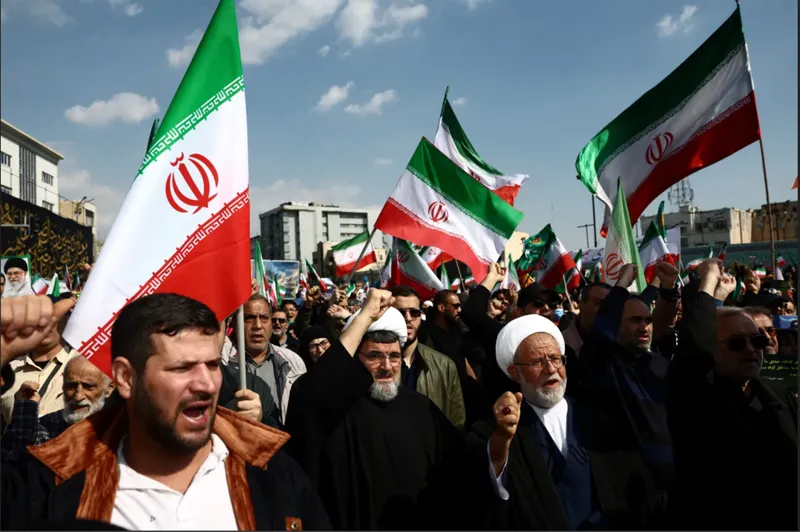
To some Iranians, this success is reason to continue fighting until the aggressors are adequately punished, rather than to search for a negotiated ending. Every night since February 28, large crowds of proud Iranians have gathered across the country to show their defiance by shouting, “No capitulation, no compromise, fight with America.” After all, the United States has proved that it cannot be trusted in talks and that it will not respect Iran’s sovereignty. By this logic, there is no reason to engage with the country now and offer it an off-ramp. Instead, Tehran should press its advantage, continuing to strike U.S. bases and blocking commerce in the Strait of Hormuz until Washington fundamentally alters its regional presence and posture.
Yet although continuing to fight the United States and Israel might be psychologically satisfying, it will lead only to the further destruction of civilian lives and infrastructure. These actors, desperate after failing to achieve any of their objectives, are increasingly resorting to targeting vital pharmaceutical, energy, and industrial sites and randomly hitting innocent civilians. The violence is also slowly drawing in more countries, threatening to turn a regional conflagration into a global one. And regrettably, international organizations have been bullied by the United States into staying silent in the face of Washington’s many atrocities, including its massacre of nearly 170 schoolchildren on the first day of the war.
Tehran, then, should use its upper hand not to keep fighting but to declare victory and make a deal that both ends this conflict and prevents the next one. It should offer to place limits on its nuclear program and to reopen the Strait of Hormuz in exchange for an end to all sanctions—a deal Washington wouldn’t take before but might accept now. Iran should also be prepared to accept a mutual nonaggression pact with the United States in which both countries pledge to not strike each other in the future. It could offer economic interactions with the United States, which would be a win for both the American and the Iranian people. All of these outcomes would enable Iranian officials to focus less on protecting their country from foreign adversaries and more on improving the lives of their people domestically. Tehran, in other words, could secure the new, brilliant future Iranians deserve.
Decoding US political media can sometimes be a task. While all news outlets ostensibly serve the readership writ large, whoever and wherever they are, some rely more on a symbiotic relationship with Washington D.C. and the halls of power than others.
Analysing any news article that appears in POLITICO, for example, should always commence from the questions: Who fed this story to POLITICO? Why was the story fed to POLITICO? And who stands to gain/lose from its publication? (This last question is often useful in answering the first.)
So it is with other, more prestigious publications, although perhaps to a more subtle degree. Foreign Affairs, which marked its centennial three years ago, emerged out of the think tank the Council on Foreign Relations, and is considered essential reading among the Washington foreign policy set, as well as members of congress, governors and other high-rollers with presidential aspirations.
Consequently, Foreign Affairs is one of those publications which operates with a consciousness that its output is read by powerful, influential people, and that what it publishes is therefore important. As a result, there are occasions when it publishes things for reasons beyond general audience interest.
The decision to publish an essay by Mohammad Javad Zarif at this particular moment is likely one of those occasions. For those unfamiliar, Zarif is a veteran of the Iranian political system, his career spanning all the way back to the 1980s, when he worked as part of the Iranian delegation to the United Nations, helping with early negotiations between the new Iranian government and the United States.
From 2002 to 2007, Zarif then served as Iran’s representative at the UN. Following the events of September 11th, the Iranian government and people extended sympathies to the United States. Candlelight vigils were held in the Iranian capital of Tehran declaring solidarity with the American people following al-Qaeda’s attacks on the World Trade Centre and Pentagon.
In the run-up to America and Great Britain’s illegal War on Iraq, Iran extended an olive branch to the West in the form of a so-called ‘Grand Bargain’, a sweeping set of conciliations offered by Iran in the hopes of normalising relations with Washington.
According to an original draft document from 2003, Iran agreed to foreswear development of so-called Weapons of Mass Destruction; cooperate fully with International Atomic Energy Agency (IAEA) monitoring regarding its domestic nuclear energy programme; cooperate with American aims of political stabilisation and establishment of a secular, democratic government in Iraq; cease its support for Palestinian militant groups from within its borders; pressure Hezbollah into demilitarising and transitioning to a political organisation; and sign on to a peace agreement floated by the Arab League in 2002 which proposed normalisation of relations between Arab and majority-muslim states in the region and Israel, plus a non-violent, diplomatic resolution to the Israel–Palestine conflict.
In exchange, Iran requested that the United States refrain from engaging in external regime change operations against the Iranian government; lift all sanctions imposed against Iran; recognise the legitimacy of Iran’s regional security interests and need for corresponding defensive capabilities; allow Iran access to peaceful nuclear, chemical and biotechnologies; and both work independently and collaborate with Iran to take stronger action against the MEK.
For those unfamiliar, Mojahedin-e-Khalq (MEK) or People’s Mojahedin Organisation of Iran is a syncretic extremist organisation which began as a student movement formed amidst the 1979 revolution. Initially, the group synthesised tenets of Marxism and Shia Islam. While that may sound attractive in theory, following the victory of the cleric class and establishment of the Islamic Republic, MEK’s political programme devolved to little more than supporting the overthrow of the Iranian government by the most violent and extreme means possible. Nowadays the organisation functions as a pseudo-cult around its leader Maryam Rajava, who currently lives in exile in France.
If this sounds a bit unfair, consider that the MEK’s primary backers in Washington D.C. today include former Republican House Speaker Newt Gingrich, former Trump Secretary of State Mike Pompeo, former Trump National Security Advisor John Bolton, and former New York mayor and serial woman-harasser Rudy ‘noun verb 9/11’ Giuliani. Consider also that during the 8 year war between Iran and Iraq which was triggered by Iraq invading the country, the MEK backed Saddam.
These are neither people, nor actions, which come to mind when one contemplates a lasting peace with Iran that would be tolerable to the Iranian people.
So, a set of proposals for normalisation of relations between Iran and the United States which were as ambitious as they were generous. (And which were also, allegedly, made even more amenable to the United States in a subsequent version amended by Zarif.)
Looking back almost a quarter of a century later, it’s hard not to think of the path not taken and the world we might be living in today had Washington taken Tehran up on the offer.
Unfortunately, the administration of George W. Bush was experiencing a sugar high from a perceived ‘Mission Accomplished’ in Iraq, and a few months earlier had designated Iran as part of the geopolitically incoherent ‘Axis of Evil’ grouping alongside Iraq, North Korea and Cuba. And so Tehran’s offers of detente were rebuffed.
Following his tenure at the UN, Zarif served as Minister for Foreign Affairs under Hassan Rouhani, Iranian president from 2013 to 2021. It was during Rouhani’s tenure, following the tenure of the more bellicose Mahmoud Ahmedinejad, that Tehran and Washington secured the Joint Comprehensive Plan of Action (JCPOA) or ‘Iran Deal’, which promised a warming of relations and loosening of crippling economic sanctions against Iran in exchange for greater external oversight and cooperation regarding Iran’s nuclear programme.
More recently, Zarif briefly served as Vice President for Strategic Affairs in the government of current President Masound Pezeshkian, elected in July of 2024. Zarif resigned from his post after just seven months, allegedly because Pezeshkian had failed to uphold promises to include more women, young people and ethnic groups in his cabinet.
All of which is to say that not only is Mohammad Javad Zarif both a capable and respected figure within Iranian politics both historically and contemporaneously, on both domestic and international stages. He is also a figurehead of the Reformist movement and perhaps an archetype of the kind of political actor the Americans proclaim to be desperately seeking in their quixotic carpet-bombing campaign against Iran.
Zarif’s essay in Foreign Affairs is therefore worth reading for a number of reasons. For one, that someone as conciliatory to Washington would commence an essay for the foreign policy blob with the (factually correct) declaration that, ‘Iran did not start this war, but it is winning it’ suggests such a claim is not so outlandish as to discredit the speaker, and so is not as outlandish as the Trump-Hegseth-Rubio clique would like the rest of us to believe.
Secondly, Zarif incisively identifies the actual field of battle on which this war is being waged – the economic – and lays out a potential pathway for peace which might resolve political and security concerns of the Iranian government on those terms. More on this point shortly.
Lastly, while Zarif correctly states that Iran has the upper hand in this conflict and so is able to translate Washington’s strategic failures into victories of its own, he also reaffirms a humanitarian impulse which should be core to the principles of anyone who identifies as left-of-centre; that prolongation of this war, whichever way, for whatever reason, will only prolong and exacerbate the suffering of innocent people both in Iran and, indeed, all around the world, that this prospect is unconscionable, and that a swift cessation of hostilities is paramount.
In the late 1870s, Friedrich Engels published a collection of essays which were later collated and published under the title, Herr Eugen Dühring’s Revolution in Science. As the book’s sarcastic title indicates, the essays were primarily a series of broadsides against the theories of one Eugen Dühring, who claimed to have arrived upon a totalising theory of socialism. Engels, ever the pugilist, set himself the task of correcting Dühring’s misapprehensions in a book so singular in its target that it is now popularly known by the more direct title, Anti-Dühring.
In one particularly engaging section entitled ‘Theory of Force’, Engels takes up a number of sections in Dühring’s writings in which he asserts that political relationships and the application of direct political force are the prime determining factors in any situation, with economic conditions being both secondary to and determined by the political. In a word, that the application of superior force and its victory determines the economic conditions of this or that social field.
Rebuking Dühring, Engels points out how this argument gets the arrangement entirely backwards. Rather, possession of the means of superior force to accomplish victory presupposes the establishment and development of economic conditions to achieve that superiority. A powerful bullet is effective only until an enemy is able to develop the armour to stop it, and the development of said armour spurs drives to develop a projectile which will penetrate it. Developments in targeting, such as with radar, drive countervailing developments to evade it, and vice-versa, and so on.
Vagaries and aberrances of actual-existing reality aside, this is a tendency which was largely borne out by the arms race toward nuclear weaponry up to World War II and the pursuit of economic superiority in order to develop a military edge between the US and Soviet Union during the Cold War. It is unlikely either power would have been able to maintain a parity of lethality during this period without the economic base to support that pursuit. It is also fair to say that it was the US’ superior economic position, more than its brute military superiority, which contributed to its ultimate victory against the Soviet Union in the Cold War.
Elsewhere in Anti-Dühring, Engels addresses a contention of Marx’s concept of dialectics, drawn from Hegel, according to which a sufficient change in quantity can produce a substantive change in quality. That, for example, once an individual has amassed a certain minimum quantity of money, they are then able to use it in ways other than mere purchasing of their means of subsistence, such as by investing it as capital.
Engels offers the useful metaphor of boiling water, wherein a sufficient quantitative increase in degrees of temperature eventually produces a qualitative transformation from water to steam.
Put very simply, the quantitative increase of a thing in number or degree will eventually produce a transformation in the substance of the thing itself. This is a dynamic worth bearing in mind with regards to not just America’s war against Iran, but emergent developments in warmaking and fighting that we are observing more broadly right now.
As far back as the First World War, military strategists have envisioned aerial superiority as the key factor which can not only determine the course of a war, but also achieve victory.
This was a logic which drove American aerial bombardment campaigns in Korea, Vietnam and the War on Terror during the Obama presidency, where it was believed that conflict zones could be safely stabilised from arm’s length with so-called ‘surgical’ drone strikes on target individuals and locations without recourse to ‘boots on the ground’.
It is also a logic which has been largely discredited by events during the First Gulf War, Iraq and Afghanistan, where US ground invasions either played a key role or proved necessary in achieving even a modicum of tenable stability.
Furthermore, it is being made a mockery of by the Trump administration’s current actions against Iran, with Trump and Hegseth crowing to their hand-selected D.C. press corps about all the targets they’re hitting from the air and the war’s subsequent success despite the fact that they have failed to produce any change in Iran’s governance structure and, if anything, appear to have strengthened Iran’s economic hand.
A related dynamic also appears to be unfolding in Russia’s war on Ukraine. The pursuit of aerial superiority in preceding decades culminated in the development of Unmanned Aerial Vehicles (UAVs) or drones, which floated the promise of aerial dominance without the risk of human lives.
So long as the US was the primary user of these weapons against irregular militias and the like in Afghanistan, Somalia and Yemen, this was perhaps a convincing proposition, but events of Russia’s war are more suggestive of another transformation of quantity to quality.
In the early months of that war, Russia attempted to achieve aerial superiority over Ukraine, only to have been thwarted by Ukraine’s proficient use of Stinger surface-to-air missiles to down Russian helicopters. Several years later, the war has devolved into punishing World War I-style trench warfare claiming thousands of lives.
The possibility of aerial superiority for either side, meanwhile, has been mooted (at least for the time being) by the very weapon which once promised its certainty: drones. In the years that have passed since they were first developed and deployed, the use of UAVs in combat, whether rudimentary or sophisticated in their design, has increased to such a degree that it has fundamentally altered the way in which war itself is fought.
Which gets to the insight of Zarif’s essay. As we covered in our recent episode on economic sanctions, the imposition of economic restrictions was historically envisioned as a non-violent means of coercing good behaviour from a target country. The belief in their dubious power was cemented in the UN’s devastating unilateral sanctions programme against Iraq in the early ‘90s.
(Lest we forget, these sanctions were not lifted until the US invasion of Iraq in March of 2003, and so, like air power, were evidently ineffective at producing their desired political outcome without an accompanying ground war.)
Though Washington has long indulged in sabre-rattling against Iran and its political leadership – assiduously referred to in all communications as ‘The Regime’ – it has, until recently, demurred on direct military confrontation with the country. This is in part due to the fact that war games exercises carried out by the Pentagon over the decades have repeatedly demonstrated that this was not a war the United States could win; that it was, in fact, one they would almost certainly lose. But hey, that’s what you get when you allow eggheads into your based military war machine.
Instead, the US has endeavoured to impose increasingly severe and unilateral economic sanctions against Iran with the hopes of starving the country (read: its civilian population) into submission, as it is now attempting in even more overt terms against the island of Cuba.
If sanctions were ostensibly intended to coerce good behaviour and cooperation from Tehran, this notion was thoroughly discredited by Trump’s abrupt withdrawal from the JCPOA in 2018, imposition of even harsher ‘maximum pressure’ sanctions against Iran, and turn to increasingly belligerent attacks against its political and military figures, beginning with the assassination of IRGC Commander Qasem Soleimani in January of 2020.
If sanctions could reasonably be claimed as an alternative to the regime-change militarism of the Iraq War, Trump’s approach removed any ambiguity. Economic sanctions were clearly understood as weapons in the arsenal of war, and were being used as such.
If Iran’s response to America’s overt military aggressions so far are anything to go by, then they appear to have understood the new terms of conflict even better than their aggressors. A sufficient change in quantity eventually produces a change in quality. Attempts to impose coercive force on another state through increasing numbers of economic measures will eventually induce a change in which the economic becomes a legitimate terrain of battle.
For many years, America openly used economics as a means of waging a silent regime-change war against Iran. Now it has chosen to escalate to a quote-unquote ‘actual’ regime-change war against Iran. And it appears that Iran’s response has been, “So be it, but we will fight on the same terms you established for all these years.”
This is what Zarif’s piece, in my view, gets correct about the path to peace between the United States and Iran. The incoherent belligerence and fascist machismo behind Trump and Hegseth’s decision to begin a war for which they apparently had no theory of victory and no strategy beyond dropping bombs like a child button-mashing in Tekken means the US will not simply accept military defeat.
That Iran understands the war launched against them by the US and Israel as an existential one means they will not cease hostilities without extracting clear, robust and unambiguous security assurances from their aggressors.
The United States and Israel’s repeated exploitations and betrayals of good faith diplomacy and negotiations in recent years – particularly and especially with Iran – mean that Iran is not interested in the sorts of agreements and peacemaking processes which are typically pursued through diplomatic channels. Following the Grand Bargain, the JCPOA, and repeated attacks on Iran during negotiations in recent years, Tehran has no reason to trust any American assurances whatsoever.
And so, if a resolution to the conflict is to be found, it is on the same plain on which the US initiated and escalated its aggressions against Iran, and on which Iran has subsequently responded to devastating effect.
Iran understands that it cannot defeat the US military, nor does it believe that it can speak with the Americans in good faith. But it understands that it can get the world’s attention and, indeed, inflict phenomenal hardship and suffering on US political leadership and their allies through the same means used against them for all these years: Economics.
Where Zarif takes thinking further is in how he connects this economic battle to the means of its resolution. With political, military and diplomatic means having been thoroughly discredited by the actions of the United States and Israel in recent years, there is no way Iran could trust any such measures as reconciliation.
If, however, the United States were to normalise economic relations with Iran, lifting its cruel and devastating sanctions regime against the country, allowing it to participate fully in global markets and providing financial reparations for the harms inflicted against it during this illegal war, that might provide the kinds of assurances appropriate to this new plain of war that Trump and Hegseth stupidly opened up.
Iran has demonstrated that it has the capacity to inflict massive economic harm against the world if it feels its sovereignty and security interests are threatened. Their reintegration into global markets would provide a clear signal that their potential in this area had been recognised, as well as the deterrent effect of the financial pain they can inflict upon their aggressors.
Zarif rightly argues how Iran’s devastating attacks against a nuclear-armed Israel demonstrates that the notion of nuclear weapons providing deterrence might be misguided. If the US is serious about preventing Iran from pursuing nuclear deterrence – even now, as America’s own stupid actions seem to demonstrate their necessity to Tehran – they would be wise to accept the alternative deterrence the Iranians already possess and are capably wielding – economic.
Nonetheless, as we said, that a figure like Zarif is now being published in D.C.’s favourite foreign policy publication, effectively declaring Iranian victory and providing a reasonable, common-sense and eminently Reformist way out for America is probably indicative of something: This is probably precisely the kind of person the Americans wish they were actually negotiating with in Tehran right now.
Indeed, a few years ago, Zarif quite literally was the man they were negotiating with. And then Donald Trump got elected. And now he and Israel are killing anyone in Iran who even sounds like Zarif.
Which gets to the other, more depressing reason why Zarif is now being published in Foreign Affairs. Because the very fact of this illegal war has thoroughly discredited the Reformist path which Zarif and others like him were attempting to chart for the past three decades. And so it is highly unlikely there is anyone in Iran’s current IRGC-dominated governance structure who is interested in hearing what he has to say.
This is, to be honest, a sad thing to contemplate. What is sadder is that it is unlikely this essay in a revered American publication will find many sympathetic readers at 1600 Pennsylvania Avenue either. So it goes.