

THIS WEEK IN VIOLENCE: Killstreak Inbound
2026, Week 10
Anger over White House’s Iran war video cut together with Call of Duty clip: ‘War is not a game’
Thursday March 5th 2026
Reported by Ariana Baio for The Independent
“The White House stunned social media users Wednesday when it posted a video mixing real footage of the missile strikes in Iran with footage from the video game Call of Duty, set to an instrumental version of Childish Gambino’s song “Bonfire.”
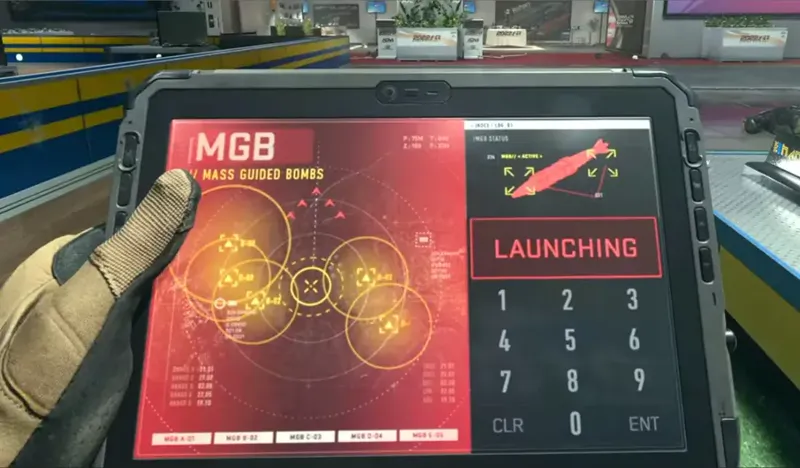
The roughly one-minute-long video, captioned 'Courtesy of the Red, White & Blue', struck an energetic and playful tone as it began with a sequence featured in Call of Duty: Modern Warfare III in which a player can activate a 'nuke'.
Real footage of the missile strikes, which have left more than 1,000 dead in Iran, is then cut together as the fast-paced and dynamic beat plays. At certain points, a voiceover from the video game cuts in to say, “We’re winning this fight,” and, “We’ve taken control.”
On Thursday March 5th 2026, the official X account for the White House posted a video of strategic missile strikes undertaken as part of their ongoing war with Iran, which was launched earlier this month. Actions which have resulted in the deaths of several key figures within the Iranian military, including Ayatollah Khamainei, alongside other senior government officials and the destruction of a number of strategic targets within the Iranian state.
The military actions—a joint effort between America and their ally Israel—has shocked the international community, and represented a further rupture in that Rules-based International Order we have spoken so much about in the previous weeks here on Blood Work.
While the war in Iran is still unfolding and the trajectory of the violence is yet to reach the peak of its arc, the Trump administration, or at least its posting wing, has been quick to capitalize on the shock and awe material that has been gleaned from its outset.
The White House account posted a short clip of various strikes curiously mixed with in-game footage from Call of Duty: Modern Warfare 3, specifically animations in which the player calls in a tactical nuke, a killstreak (awarded when other players are killed sequentially without dying).
In addition to the initial game footage there are also XP pop ups, a player map and hitmarkers, sound clips from the game, and a jaunty instrumental of Childish Gambino’s 'Bonfire'.
This comes as the latest addition in a series of US Government Departments using the language and visuals of videogames in order to communicate with their base of how cool and awesome they are at defeating their enemies.
In the past year alone we have seen the Pokémon franchise’s catchphrase “Gotta Catch 'em All” bastardised by the Department of Homeland Security in relation to their ongoing domestic terror campaigns against immigrants within US borders. An appropriation of the original Halo: Combat Evolved enemy faction The Flood soon followed.
For those who aren’t gamers or men in their 30s, The Flood are a hive mind bio-weapon which takes over all living beings in order to control and destroy worlds, initially designed by the Forerunners who… you know what, you get the gist.
A meme with the caption "Destroy The Flood” was posted to X late last year by DHS as part of their recruitment campaigns for ICE, I think you can see what the intended message was. It immediately caused an outcry online, most notably from the developers of the game. Marcus Lehto, the co-creator of Halo, described the post as “absolutely abhorrent”, and said seeing said post “makes me sick seeing Halo co-opted like this.”.
And so the precedent for this type of propaganda is not completely unfounded, horrible as it may be. But that is not to even mention the uh, complicated history, and present, that the Call of Duty franchise has had with the US military, and by extension government. But before we get into that let us first talk about the military, cultural relevancy, and the military industrial complex.
While the current administration’s use of memes, shitposts, and online lingua franca may be bewildering and garish in equal measure, the 'Iran x COD' video is a particularly obvious example of how the downflows of the state into culture revert.
Much like Wesley Snipes once said before he got done for not paying his tax; “Some motherfuckers are always trying to ice skate uphill.” As long as the entertainment industry has existed there has been an equally beneficial relationship between the state, and by extension the military, and filmmakers, producers, studios, etc.
These economies benefit each party in different ways. As an example let's look at the film industry and a particular newly founded Middle Eastern state in the mid 20th century. A film studio wants to adapt a best-selling book about the foundation of the certain country, and the violence and strife that it went through in order to establish itself.
The state may offer incentives such as tax breaks, funding, access to filming locations, military weaponry and infrastructure, and other such things. In the other direction, the studio gets a fuckton of cash, prime locations, permits, and many other things.
The state simply asks for a little bit of input, just a little bit, a morsel, nothing else, no other reasons. All that's left to do is to get a big name Hollywood star, and soon you’ve got a big blockbuster on screens and millions of bums in seats all around the world.
If you happen to be a film buff and are screaming at your phone, well done, you guessed it, that film is Exodus, starring everyone’s favourite sauce merchant Paul Newman.
Exodus was a massive hit, and for many an informative watch about the struggles in the foundation of the State of Israel. A little bit of help went a long way.
Then in 1986 a little movie called Top Gun would shift the dial once again. Top Gun was produced on a minuscule budget in the grand scheme of things when it comes to action movies, approximately 15 million dollars.
The film would have been prohibitively expensive to create without the military’s involvement.
With the total budget for the film being $15 million, this is an incredibly small figure when you account for the fact that a single F-14 Tomcat, the military fighter jet that Tom Cruise’s character pilots in the film, costs around $38 million. After allowing the military to modify their script, the DoD gave the filmmakers 24 F-14s, four aircraft carriers, access to a Naval Air Base, and nearly 48 other aircraft, all for just $1.8 million. Following the release of Top Gun in 1986, applications to the United States Navy increased by 500 percent.
This was a massive success for the Department of Defence Entertainment Media Unit, whose job it is to license military equipment, iconography, and locations to media productions, either for a fee or a percentage cut of proceeds, and sometimes a little bit of input into the script.
Although their disclosure of what productions they have been involved with and their guidelines you have to follow are not publicly available. There are some other examples of similar movies bolstered by DoD support, such as that godawful Battleship adaptation starring Rhianna.
A simple case of, 'You get your tanks and guns and battleships, and we get to have a little look at your script'. Seems pretty innocuous right? And this sort of relationship extends into video games too. First-Person Shooters, where you spend the majority of your time gunning down baddies staring down the barrel of your gun, also benefit from these economies of influence.
Much like the DoD, Arms manufactures get a slice of the pie too. You see when you see an M16, or Barrett 50 CAL, or a Desert Eagle in a game, it's because it's licensed.
Akin to Mickey Mouse, or the McDonalds Golden Arches, these weapons and their digital likeness are protected under copyright, therefore if you want to give your customers realism, you have to send someone in a suit to meet someone else in a suit, to draw up a contract to license the likeness of said weapons.
Again, similar to the DoD, the companies like to be portrayed in a good light, so deals are struck, and the good guys get a noble M4A1 and the bad guys get that sordid piece of weaponry, the AK-47, and EA, or Activision, or whatever games publisher or developer can get themselves a decent discount on the price of admission to the gun show.
Ralph Vaughn, a member of the Special Projects team at Barrett Firearms Manufacturing, the creators of the Barrett .50 caliber sniper rifle, which has become a ubiquitous feature of any modern first person shooter said In a 2019 interview with Eurogamer:
“We want to know explicitly how the rifle is to be used, ensuring that we are shown in a positive light… such as the ‘good guys’ using the rifle.”
A slight note here, many developers do create fictional facsimiles of famous guns in order to get around this, hence why the official mascot of Blood Work is now, uh, Martin Mole, and his trusty Desert Camel.
Videogames themselves have also been an influential tool for various militaries in and of themselves. With simulation games such as America's Army, a realistic simulation game developed in 2002, being a prime example of this. Initially designed as a twinned tactic of a recruitment tool and a training tool, it was used by recruiters to show potential soldiers that war is just as fun as Doom or Wolfenstein.
But Call of Duty itself is a unique kettle of fish. Initially a historical WW2-based shooter recounting battles such as the storming of Normandy, it eventually ran headfirst into the future with the first Modern Warfare installment. Simple representation of warfare was not enough, it had to be thrilling, like Top Gun, Rambo, or any other big box office hit.
Sometimes though, fact is more entertaining than fiction.
In 2007, Call of Duty 4: Modern Warfare included the mission 'Death From Above', which put the player in the gunner's seat of an AC-130 raining death from the skies on enemies rendered as simple white silhouettes, no bigger than ants.
With chatter flying back and forth between the flight crew about good kills, and how, “That one would make a highlight reel,” after you obliterate a group of enemy combatants, the mission is reflective of real life footage of an AC-130 mission declassified in 2006. An eerie feeling hangs over the proceedings with that thought in mind.
Similar reality reflecting in-game moments are peppered throughout the franchise, albeit with some 'creative liberties'. In the 2019 reboot of Modern Warfare, you undertake a mission in the fictional country of Urzikstan. You participate in an ambush of opposing forces along a singular stretch of road leading away from town that, “the Russians bombed during the invasion, killing these people trying to escape”.
To anyone familiar with history your ears may be perking up, this is a reference to the events in 1991, in which US forces in Kuwait bombed retreating Iraqi forces on Highway 80, alongside the occupants of any other vehicle, civilian or otherwise, that happened to be on the road.
This sort of revisionism is typical of the Call of Duty franchise, in which the actions of the righteous are glossed over in favour of good vs. bad narratives, or quite frankly whatever fits the story.
This is not discounting other strange instances of pointed plot points, such as the assassination of an Iranian military general who just happened to look like Qassim Soleimani, just to name one. What a coincidence.
But some would hand-wave these away as simply writers taking inspiration from the news milieu of the day, in the same way Rambo: First Blood took inspiration from a generation of disaffected Vietnam veterans returning home from a war that nobody wanted to fight.
This is not to mention the plethora of former military advisors that have a hand in sculpting the contours of the story, all in the pursuit of ‘realism’. Or even the fact that Oliver North, yes that Oliver North, Iran-Contra Oliver North, lent his voice and likeness to an installment in the series.
This is where the point becomes a bit more sticky.
Such grand narratives around the moral duty of the righteous to defend democracy, or Western Values, or whatever you’re having yourself, may be useful as entertainment, but they can also flow the other way.
Some Call of Duty developers, writers, and other staff have even upped their roots to go work for Uncle Sam. Dave Anthony, who was one of the lead architects of the narrative world of the franchise, took a job in Washington at the Atlantic Council after his tenure with CoD, consulting on the future of warfare.
And it is within this mire of military propagandising and 'OOH RAH' patriotism, that in the 2010s, a generation of gamers found themselves awash in the cultural hangover of the then seemingly unending Global War on Terror. The 20th century fears of reds under the bed had been replaced with a different kind of terrorist.
Video games, still suffering from the stigma of being just another toy for children to play with, were evolving then slowly into the multi billion industry it has become today. This metamorphosis from niche interest into a true cultural force that had captured the hearts and minds of men aged 13 to 30, gave videogames, the people who made them, and the people who played them, legitimitate influence in culture. At least online.
The early 2010s had an overabundance of secondary order gaming ephemera proliferating online, both on mainstream platforms such as YouTube, and in those dank, septic corners of the internet like 4chan. Standing head and shoulders above all other content was the simple art of the Call of Duty quickscope montage.
Now, please bear with me for a second, as I stare misty eyed into the middle distance as only a 30-year-old man who spent his teens playing Call of Duty multiplayer can, as I recount the feeling of hitting the perfect no scope on Shipment, or a 1V1 on Rust.
Quickscoping, or the act of shooting someone with on the faintest hint of looking down the optics of a sniper rifle in a multiplayer shooter, was an art unto itself.
It had its own culture, its own language, its own heroes. Players like ZzirrGrizz, IReapZz, or any other player with an excessive number of Zs or Xs in their username all uploaded highlight reels of their best kills to YouTube to be met with the fervour of teenage boys worldwide, myself included.
Contained within this community of electronic Chris Kyle’s was an elite set, MLG, or Major League Gamers. A group of gamers that were so good that they got paid to play Xbox. And with status, came memes.
Dank MLG Memes were sort of a primordial form of the frenetic TikTok shitpost edits that we see today. Overloaded with sound effects, flashing lights, references to memes du jour. A highly stylised montage of high performance gameplay, the best we had to offer.
Call of Duty at the time had a notorious reputation for toxicity within the community. Pre-game lobbies were filled with slurs of every type, in every language imaginable, all lobbed at targets with abandon at the hint of even the slightest transgression or weakness. Racism, homophobia, bigotry of any kind, it was all fair game, and it became the gamers language.
As the decade rolled on Activision, the publisher of Call of Duty, sought to try and clean up the image of the franchise and wipe away some of the grime accumulated on the controllers of grubby teenage boys around the globe, and started including more diversity within the games, and the people who made them.
This did not go well.
While I do not have the word count to go into GamerGate here, perhaps another time, in short campaigns of harassment were organised against anyone and anything that was deemed as a threat to the status quo within the gaming industry and the gaming community writ large.
The gamers were mobilising against any perceived threat against the order of things. The reds had been replaced by 'blue-haired feminists' who wanted to give Lara Croft non-conical breasts, or put black people in games based in historical settings.
The men, and it was almost universally men, saw themselves as under attack. Their hobby was being taken away from them, bastardised at best, or, at worst, dashed against the rocks of modernity, its entrails used for profane rituals to stop them saying the N-word before hitting a round of 'Search & Destroy'.
Their enemies transformed from screen to reality, and seemingly inexorably surrounded them. The puerile desires and fears of a generation of men who feel disaffected by the shifts in culture away from being expressly focused on them became an undercurrent of the political paradigm of the past decade and a half.
All of those boys and men who felt marginalised by the lack of ethics in videogame journalism or 'jiggle physics' in their platformers realigned their energy away from expressing it in multiplayer lobbies, and towards building a big gold monolith, a politics in their own image.
A politics represented in the form of a reactionary wave that refused to be told what they can and cannot say, to be forced to make space for others, to be forced to feign interest in those unlike them. A conclave of grievances unaddressed, a world once torn from their grip now returned to their palms.
Folded within the layers of this conservative croissant are an abundance of content creators catering to the misgivings of these groups. The incentive of the monetization of a rabid audience keen to see themselves reflected in the form of someone with a better kill-death ratio than them. This does not even cover the US military running its own campaign of troop Twitch streamers looking to engage with a predominantly young audience, or competitions like the Call of Duty Endowment Bowl where different military branches from around the world compete against each other.
All of those boys and men supposedly grew up and got jobs. Jobs made use of their unique set of skills in communicating in the codified terms of MLG memes and Quickscope montages, a language intimately understood by any teenage boy with an internet connection and a copy of Call of Duty: Warzone.
The military, the government, and any forces wishing to connect with a global community raised on the spectacle of Call of Duty, its competitors, or imitators, recognize in these gamers-turned-grownups, the skill to speak directly to those who understand what is being said.
And this is how we find ourselves here. Through the medium of 30-year-olds, much like former White House Digital Content Director Billy McLaughlin who spearheaded the Trump administration's memetic assault, using the Proustian reverie of their youths playing Call of Duty, to convey the visions of war. Watching the destruction of Iranian infrastructure, civilian or otherwise, and military instalments, with weapons familiar to any CoD player, in a format not dissimilar to the ZzirrGrizZ montages I watched in my youth, XP and all.