




THIS WEEK IN VIOLENCE: Pox Americana
2026, Week 9
It was a week which began with the eruption of violence in a country which has long been battered and beleaguered by the machinations of US empire. It ended in the same way, with another eruption, elsewhere.
For this week’s newsletter, we’re going to provide a little Blood Work commentary on these two eruptions. Perhaps one way of thinking about them in tandem is as two morbid outgrowths of the American imperial violence machine. Chronic and acute, all at once.
Cartel henchmen unleash violence after top drug lord killed in Mexico
BBC, Monday, February 23, 2026
Reported by Vanessa Buschschlüterand Ottilie Mitchell
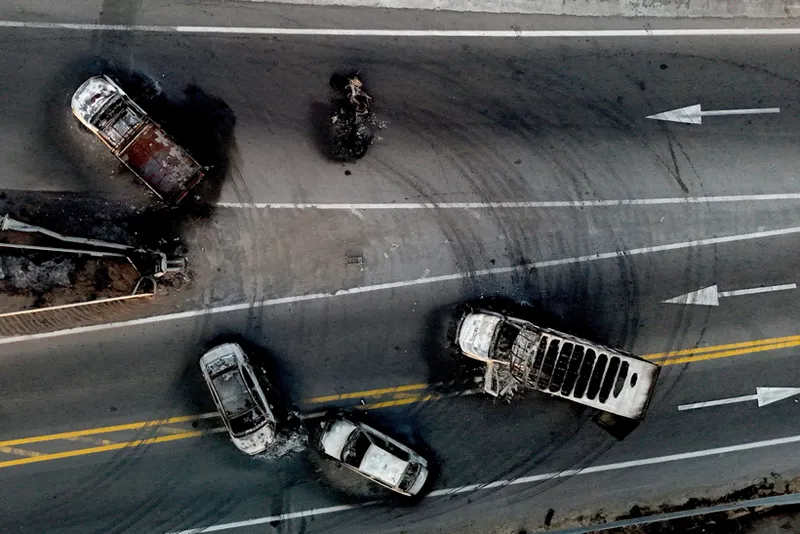
Members of the Jalisco New Generation Cartel (CJNG), one of the most powerful and feared criminal organisations in Mexico, have unleashed a wave of violence across 20 Mexican states.
They torched businesses and erected burning blockades in retaliation to the killing of their leader, Nemesio Oseguera Cervantes, better known as "El Mencho", who died in custody on Sunday shortly after being captured by Mexican special forces.
El Mencho, Mexico's most wanted man, was seriously injured in a firefight between his bodyguards and the military commandos deployed to capture him.
He died while the military was transporting him from the town of Tapalpa, in Jalisco state, to the capital, Mexico City.
[...]
Footage recorded by locals showed plumes of smoke rising above several towns and cities, including the beach resort of Puerto Vallarta, which is popular with tourists.
In Guadalajara - one of the host cities of the forthcoming Fifa World Cup - travellers at the airport could be seen running and crouching on the floor in panic.
[...]
The scenes that unfolded on Sunday reminded many of the violence that erupted in the state of Sinaloa after the capture of another notorious drug lord - Ovidio Guzmán López - in 2019.
The street battles between members of his Sinaloa cartel and the security forces were so fierce that the Mexican authorities decided to free Guzmán López, who is the son of jailed drug kingpin Joaquín "El Chapo" Guzmán, to prevent further bloodshed.
While Guzmán López was re-arrested in 2023 and extradited to the US, where he has pleaded guilty to drug-trafficking charges, retaliatory attacks by cartels have since become the norm following high-profile arrests.
In Puerto Vallarta, on Mexico's Pacific coast, tourists were told to shelter in place on Sunday.
Videos showed black smoke billowing from burning cars in several neighbourhoods, with one tourist describing the scene as looking "like a war zone".
When Canadian Premier Mark Carney acknowledged the reality of the rules-based international order at Davos a few weeks back — as a system in which middle powers acceded to US unilateralism in exchange for perks and privileges gleaned from living in its slipstream — his statement sent shockwaves around the globe.
One leader who welcomed Carney’s intervention was Claudia Sheinbaum, President of Mexico, who was elected in 2024 as candidate from the National Regeneration Movement or Morena. In a press conference days after Carney’s address, Sheinbaum characterised the speech as ‘in tune with the current times’.
It is hardly surprising that such an address would resonate with a Mexican leader. For far longer than most, Mexico has enjoyed the type of diplomatic relations the United States is now trying to impose upon the rest of the world.
Located as it is along the USA’s southern border, Mexico lives in the global political, economic and military hegemon’s shadow, and so is forced to enjoy the bitter fruits such a position produces.
Without dialing the clock back too far, we can think of the North American Free Trade Agreement or NAFTA, the agreement which established a trilateral trade bloc between the US, Mexico and Canada in the early ‘90s.
Intended to reduce friction in economic flows between the three countries, NAFTA did, arguably, contribute to increases in GDP and economic activity for its southern partner. The overall benefit of such an interweaving, long-term, continues to be heavily debated, north and south of the border, with both left and the right critiques.
One thing it did was to bind the Mexican economy to that of its much larger and more influential northern partner in ways that would produce distorting effects on the Mexican economy. It is believed, for example, that the agreement led to a massive influx of cheap, US-produced corn into Mexico, destroying many smaller farms in the latter country.
The tariff- and duty-free cross-border exchanges incentivised by NAFTA also led to the proliferation of maquiladoras around the US-Mexico border region – sweatshops, factories and other industrial facilities located in special free-trade zones which allowed the US to take advantage of lower wages and reduced labour rights to squeeze profits in manufacturing processes.
This occasionally produced some truly bewildering manufacturing zig-zags in certain industries like auto manufacturing, with individual components crossing both the US-Mexico and US-Canada borders numerous times before making their way into the finished product. (And yes, these itineraries then threatened to produce the reverse effect with the introduction of Trump’s tariff regimes in 2025, with each crossing of the border incurring a levy, compounded by each subsequent crossing. Go figure.)
The drawing closer together of the United States and Mexico’s economy also produced negative consequences in 2008, with Mexico feeling the shockwaves of the collapse of the US financial system far more severely than any other Latin American country.
The entanglement goes far beyond economic concerns. In his 2019 book Empire of Borders, journalist Todd Miller documents how, in its pursuit of an ideal of ironclad immigration security, the US border regime has expanded into a dystopian, distributed network in which the American threshold exists all around the globe.
This is particularly pronounced in Mexico and down through Central America. In America’s southern border strategy, Mexico is now expected to operate as either a first defence or last resort, interdicting migrants, refugees and asylum seekers on behalf of its northern neighbour, preferably before they even come close to setting foot on American soil.
This relation resonates and repeats all on down toward the Isthmus of Panama, where agents on every subsequent border are both implicitly expected and explicitly trained to operate their borders as satellites of the US-Mexico border operation.
But perhaps in no other area is the poisoned chalice of geographical proximity to the world’s largest economy more pronounced than in the quixotic War on Drugs. The function of America’s domestic legal apparatus around drugs and narcotics as a cipher for more abstract violence regimes of racialisation and maintenance of social hierarchy is no secret. It is scarcely different on the global register.
Combatting drug trafficking and, more lately, so-called ‘narcoterrorism’ has provided a convenient cover for perpetual US interventionism and covert meddling throughout Latin America.
The directive to quash drug economies in the US’s back yard is an impressively malleable cover provided one does not dwell too long on two issues. The first is that the US is one of the primary markets for cocaine. According to the United Nations Office on Drugs and Crime, North America accounts for over a quarter of global cocaine consumption. Combined with Europe, this rises to 50%.
The second issue is the role that the United States has historically played in sustaining cocaine cultivation and trafficking in Latin America on the production side, whether cooperating with cartels and traffickers on the ground through three-letter agencies in order to procure funds for other off-the-books operations, or Washington using its influence to elevate criminal figures to high political office or pushing for their release when later arrested. For more on that side of the story, read Maureen Tkacik’s excellent reporting on Marco Rubio and the broader D.C. apparatus’s longstanding ties to Latin American drug lords and trafficking networks in The American Prospect.
All of which is to say that for the United States’ vast, bloated and most of all lucrative security apparatus, of which law enforcement, border security, arms sales, surveillance technology, prison economies all form component parts, the destabilising effects of the drug market is the ultimate self-licking ice cream cone.
Destabilisation in producer countries in the southern cone as these lucrative illicit economies produce non-state organisations with the heft to challenge state power. Destabilisation in intermediary countries by producing violent contestation among traffickers and non-state actors for control of shipping routes. Destabilisation in the United States itself by producing domestic black market flows and incentives toward further securitisation, carceral expansion and policing crackdowns.
Both the illicit drug economy and the violent War on Drugs waged endlessly to defeat it have wrought immeasurable devastation on Latin America for decades. The latest instantiation of this nightmare which accelerated during the 21st century, with cartels armed to the teeth engaging in full-blown warfare both with each other and the Mexican state for control of territory and in some cases operating as de facto despotic governments of areas they control, is just the latest metastasis.
Videos of the carnage that has been unfolding this week in Jalisco state, home to Mexico’s second largest city, Guadalajara, went some way to capturing the grotesque, bifurcated world American drug policy and securitisation of the Americas more broadly has wrought upon Mexico and countries like it.
These smartphone-captured videos sweep over idyllic beaches lined with white westerners reclining on beach loungers, before focusing on columns of black smoke erupting in a nearby town, across the water. It’s hard to look at footage like that and not see them as models of the global apartheid America and its allies are both preparing for and bringing into being as the cataclysm of climate change approaches. Tiny little pockets of relative peace, comfort and security for those fortunate enough to continue to live ‘inside the wire’, while the horrors on the outside – many unfolding in service of that very relative peace – unfold with increasing proximity, reduced to spectacle.
On February 10th of this year, the New York Times published a piece by Emiliano Rodríguez Mega on the provenance of the Mexican cartels’ guns and ammunition. According to one General Trevilla Trejo, since Sheinbaum took office in October 2024, the Mexican state had seized over 18,000 firearms from the cartels, including grenade launchers, rocket launchers, machine guns, and large, bipod mounted rifles. Over 80% of the weapons seized originated in the United States.
On top of the firearms themselves, it was claimed that, since 2012, Mexican authorities had seized over 137,000 rounds of .50 calibre ammunition, rounds with a half-inch diameter, and which measure almost half a foot, end-to-end. Of these 137,000 rounds, almost fifty percent could be traced to a single origin: the Lake City Army Ammunition Plant, a US-government owned ammunition plant in Kansas City, Missouri, almost smack-bang in the centre of the continental United States, over 1000 kilometres from the southern border.
For as long as I have been alive, and longer still, American drug policy both domestically and internationally, has been a resounding failure. Since perhaps the start of the 2010s, it has become more acceptable to acknowledge this failure openly, both in political journalism and popular media. This is a positive development.
That being said, until and unless American lawmakers and citizens, as well as politicians around the world, and particularly in the Global North, are willing to be more frank and forthright about the position the United States occupies as both Alpha and Omega of global drug trafficking flows and the violence those flows produce – whether intentionally or unintentionally, or both – then we should expect to see many more smartphone videos of idyllic resort towns going up in flames as sunburned tourists sip from coconuts.
US-Israel attack on Iran: Tehran launches retaliatory strikes as Trump says ‘major combat operation’ under way
The Guardian, Saturday, February 28, 2026
Reported by Taz Ali and Rebecca Ratcliffe
What we know so far, as summarised by Callum Jones:
On Saturday morning, the US and Israel launched a series of strikes on Iran.
In response, Iran’s Islamic Revolutionary Guard Corps (IRGC) said it had fired missiles against US military bases in the Gulf.
Explosions were reported in Bahrain, Kuwait, the UAE and Qatar. One person was killed by shrapnel from an Iranian missile in the UAE, officials said.
Explosions shook the Iranian capital Tehran, where people reported seeing smoke rising from the district that includes the presidential palace.
Iran also launched waves of missiles at Israel, with blasts reported in the skies over Jerusalem. The Israel Defense Forces (IDF) said air defence systems were working to shoot down the “barrage of missiles” launched from Iran.
Israeli officials told the media that top Iranian regime and military leaders, including Iran’s supreme leader Ayatollah Ali Khamenei and president Masoud Pezeshkian, had been targeted in the attacks.
It is believed that Khamenei is not in Tehran and has been taken to a secure location, while Iranian media is reporting that Pezeshkian is safe.
The US president, Donald Trump, vowed that the “massive and ongoing” campaign against Iran would crush its military, eliminate its nuclear programme and bring about a change in government. “Our objective is to defend the American people by eliminating imminent threats from the Iranian regime, a vicious group of very hard, terrible people,” he said.
The Israeli prime minister, Benjamin Netanyahu, said the operation was to remove an “existential threat”.
Talks between the US and Iran on Tehran’s nuclear programme ended inconclusively on Friday, with a suggestion that further discussions would be held next week. Trump had said he was “not happy” with the progress of discussions.
As I am writing this newsletter on Saturday morning, this situation remains incredibly fluid and uncertain, and so it is difficult to speak with any certainty about what has happened or is happening or the immediate effects produced, let alone make prognostications about what will happen next.
As a top-line, I would encourage readers to familiarise themselves with Article 8 of the Rome Statute of the International Criminal Court, specifically the section covering the crime of aggression.
The Rome Statute defines ‘crime of aggression’ as “the planning, preparation, initiation or execution, by a person in a position effectively to exercise control over or to direct the political or military action of a State, of an act of aggression which, by its character, gravity and scale, constitutes a manifest violation of the Charter of the United Nations.”
‘Act of aggression’ is then defined as “the use of armed force by a State against the sovereignty, territorial integrity or political independence of another State, or in any other manner inconsistent with the Charter of the United Nations.
Such acts include, inter alia, the invasion or attack by the armed forces of a State of the territory of another State, bombardment by the armed forces of a State against the territory of another State or the use of any weapons by a State against the territory of another State, or an attack by the armed forces of a State on the land, sea or air forces, or marine and air fleets of another State.
Put simply, the actions carried out by the United States and Israel on Saturday morning constitute clear acts of aggression as delineated by Article 8 of the Rome Statute of the International Criminal Court, and therefore constitute war crimes.
The United States and Israel, using their typical penchant for lexical evasion, have sought to characterise these attacks as ‘pre-emptive strikes’ – that is, carried out so as to head off a pending attack by Iran which definitionally cannot be disproven because pre-empted. This is a line which has been used by the United States to justify its military unilateralism countless times throughout this century. It is regularly chewed up and regurgitated by their pliant accomplices in the media, both domestic and international, and so we should not expect things to be any different on this occasion.
Nevertheless, the concept of pre-emptive strike is a bullshit, made-up term intended to obfuscate and distract from the reality of the act itself – war of aggression. An illegal, criminal attack on a sovereign nation which was, at the time of the attacks, engaging in open and good faith diplomatic negotiations with the same country that then illegally attacked it.
Reports are now emerging that high-placed figures in the Israeli military and political hierarchy are boasting that these were attacks which were coordinated with the United States at the highest level and which both parties had been planning several months in advance. If this is the case then this is another instance of the United States exploiting international diplomacy and non-violent means of conflict resolution in order to provide cover for an illegal act of overt military aggression.
Regarding international reactions, it appears that British politicians are currently doing the Atlanticist two-step, acknowledging the illegality of the US and Israel’s actions in a descriptive manner while assiduously avoiding advancing to stating clearly that their allies are violating international law.
Speaking to BBC Radio 4’s Today programme, Labour MP Emily Thornberry Chairwoman of the Commons Foreign Affairs Committee said, “I don't think that there's a legal basis for this action. [The United States and Israel] were not under imminent threat, and so it's therefore difficult to see what the legal justification is."
Speaking to the same programme, Lord Peter Ricketts, a former UK national security adviser, similarly stated, “None of this, I think, is in any sense legal in a way that the UK would recognise. There was really no imminent threat to the US.”
These are statements designed to create the appearance of challenging US and Israeli criminality while actually entering a diplomatic holding pattern. In the ‘might makes right’ paradigm which Canadian Prime Minister Mark Carney identified in his speech at Davos, middle powers such as Great Britain allow the United States to carve out exceptions for the performance of extreme, overwhelming and illegal violence so as to enjoy the dividends of being a junior partner in such criminality.
Unfortunately, these strikes are likely to produce a number of negative repercussions across the Middle East and perhaps globally, depending on when or how Iran chooses to retaliate and against who or what.
A lot of heat was generated regarding that momentous speech by Carney a few weeks back. As I said at the time, however, it was less a challenge to the idea of asymmetrical power relations than it was an attempt to establish a firmer footing for middle-sized powers against an increasingly belligerent American Leviathan.
One other issue with Carney’s speech was this: Calling out the rules-based international order and the way it has been exploited and operationalised to grant the US license to immense criminality and gangsterism is one thing. Signalling some kind of break from this order for Canada or other so-called ‘middle powers’ is another thing. But these are declarations on which action or inaction will be dispositive.
My suspicion is that we are going to see numerous middle powers enter a similar diplomatic holding pattern over the coming days, as they wait to see how this latest act of American and Israeli criminality plays out, and whether it benefits them and their subjective interests. Starmer, Merz, Macron, Meloni, Carney, bin Salman, bin Hamad al Thani, and others.
If Iran ends up striking oil fields or destabilising tourism and business deals in Dubai or Riyadh, we may see more forceful condemnation from international partners. If things go another way and it looks as though the dust might peacefully settle, expect recursion to vague platitudes about Iran’s criminal regime and the need to prevent them from procuring a weapon – lest they commit the kind of criminal act of aggression we are all witnessing unfolding on our screens right now.
As I said, Carney’s speech at Davos generated a lot of headlines when it appeared as though he, and leaders like him, were finally turning away from a US empire which used the imprimatur of the rules-based international order to engage in increasingly unpredictable and destabilising criminal belligerence.
Given that, and given the clear illegality of this aggression against Iran, now would be a good time for Carney or any other politician or journalist who remarked on his declaration of the end of the rules-based international order to substantiate that assertion by condemning this lawless aggression by the US and Israel, but personally, I won’t be holding my breath.
But here’s the thing. If you want to drop the convenient fiction of the rules-based international order, and move toward building a new, alternative order, whatever your motivations, then at some point that will require you to pick up your feet, and step outside.
If, however, the leaders of the Global North are content to simply pantomime like they’re moving on from this criminal order whenever their immediate interests or spheres are threatened, then return to pliant acquiescence when the thug empire does something they ‘like’, then guess what: You’re still in the rules-based international order, and you’re not going anywhere.