






THIS WEEK IN VIOLENCE: SURGES, EMISSIONS, FLOWS
2026, Week 5
Following a few weeks in which the news has focused heavily on events which continue to unfold in Minneapolis and the broader United States, this week we’re shifting the focus to West Africa and the Middle East, to two conflict zones which still swirl and churn amidst the fallout of the 2011 Arab Spring, and the long first two decades of the twenty-first century.
At a time when the geopolitical stage appears to be trembling with anticipation at the emergence of the new—new rules, new alliances, new arrangements, new friends, new enemies—it’s easy to forget that in the world of war, conflict and violence, the old rarely goes away. More often, it simply falls into the shadows of popular consciousness, where it continues to morph and metastasise in the darkness.
And then, one day, when it’s almost forgotten, it announces its return, often in a form that few recognise – or maybe would just prefer not to. Call it blowback, or unforeseen consequences, or just the sad, sorry consequence of relative prioritisation in a world dictated by material forces and economic flows.
We call it Blood Work.
Islamic State claims attack on international airport and airbase in Niger
The Guardian, Friday, January 30, 2026
Reported by Eromo Egbejule
Islamic State in the Sahel has claimed responsibility for an audacious assault at the international airport and adjacent air force base in Niamey, the capital of Niger, according to the SITE Intelligence Group, which tracks jihadist activity and communications worldwide.
The attack, which began shortly after midnight on Thursday, reportedly involved motorcycle-riding militants who launched a “surprise and coordinated” strike using heavy weaponry and drones, according to statements released via IS in the Sahel’s propaganda arm, Amaq news agency.
The gunfire and explosions in the airport, which is about 6 miles (10km) from the presidential palace and Base Aérienne 101, a military base previously used by US and then Russian troops, hit at least three planes: one belonging to Ivorian carrier Air Côte d’Ivoire and two belonging to the Togolese airline Asky. A source at Asky said the airline staff were in their hotel away from the scene and remained in the city, with their passports still in the custody of the authorities.
Niger, which has been led by a junta since the deposition of the democratically elected Mohamed Bazoum in July 2023, has previously blamed the chaos on its neighbours Benin and Côte d’Ivoire, as well as former colonial ruler France, without presenting any supporting evidence.
In a statement aimed at Niger’s neighbours in the regional Economic Community of West African States and its former ally France, the head of the junta, Gen Abdourahmane Tchiani, said on national television on Thursday: “We have heard them bark, they should be ready to hear us roar.”
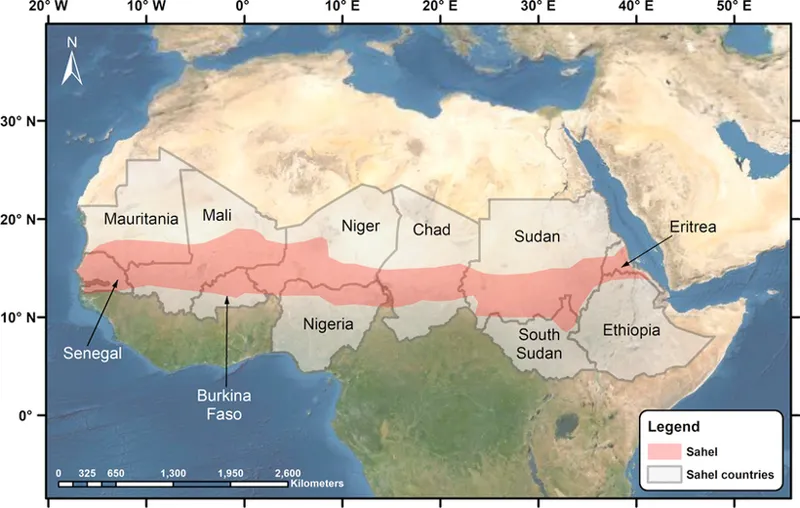
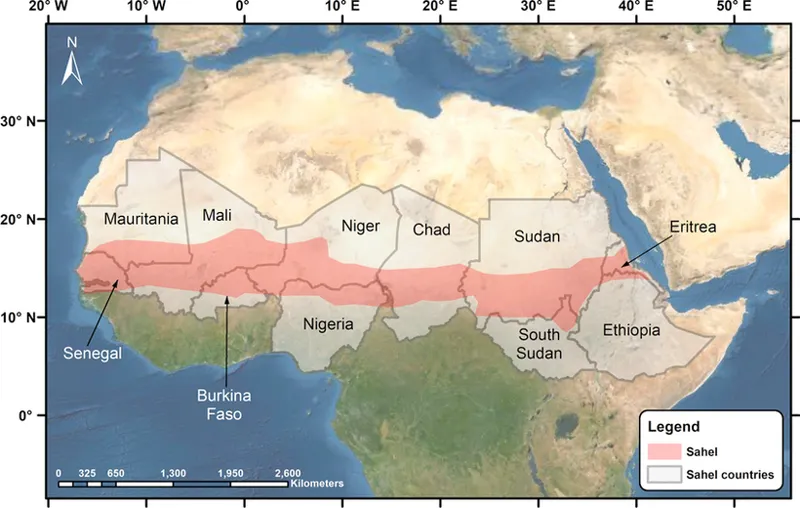
Spanning across the African continent from Senegal on the west coast to Eritrea in the horn, the Sahel is a vast region which demarcates the transition from the arid Saharan climate in the North to the more humid savannas in the South.
Criss-crossing borders and encompassing territories including the southern regions of Sudan, Niger, Mali and Mauritania, as well as northern parts of South Sudan, Nigeria and Burkina Faso, the Sahel is transitional in every sense of the word, and has long been rocked by instability and conflict.
Contributing factors are manifold, including longstanding poverty and economic uncertainty, weak and unstable local governments, and sectarian conflicts along ethnic and religious lines. All of these factors are then exacerbated by the degradations of climate change, producing migrant flows from the southern states northward in search of economic opportunity, which then produces ripe conditions for trafficking, extortion and other black market activities.
Although these issues have persisted for decades, it has been observed that problems in the Sahel were exacerbated by NATO’s 2011 assault on Libya. The result of that campaign—aside from the intended ouster of the country’s longtime ruler Muammar Gaddafi—was a massive influx of arms and weaponry into a country that was rapidly collapsing into an anarchic power vacuum.
Situated on a vast section of the North African coastline, Libya then became both a petri dish for proliferation of black markets and illicit activities such as slavery and human trafficking, as well as a gateway for transfers and flows in all directions – including flows of ideologies, and the arms with which to advance them.
The ascendancy of Islamic State of Iraq and Syria (or ISIS) in the early 2010s inspired the formation of numerous offshoots and sibling organisations in various places around the world, many of whose genuine connections to the original franchise were somewhat dubious.
Not that this was necessarily an issue for the OGs. Both deeply nihilistic and opportunistic, ISIS applies similar rules when claiming ownership over acts of violence and the people who commit them – happy to take credit for any and all proclaimed affiliates, provided the destruction is savage enough.
And though coverage of the Islamic State’s activities understandably focused on Iraq, Syria and the broader Levant, the effect of their ascendancy on the Sahel and West Africa has been equally devastating, if not more so.
Throughout the 2010s, numerous militant groups either formed anew or were reconstituted from extant militias in Islamic State’s image, creating groups like Jama'at Nusrat al-Islam wal-Muslimin (JNIM), an evolution of Al-Qaeda in the Islamic Magreb (AQIM); Islamic State West Africa Province (ISWAP); and Islamic State of Greater Sahara (ISGS), later Islamic State Sahel Province (ISSP).
Each group’s goals are varyingly the same as Islamic State’s, the foundation of a Salafist Islamic state within their respective territories of interest, and on this point, the franchise description is more than crude metaphor.
A quick Google of ISWAP or ISSP reveals slick logos which look as though they would be more at home on a slab of rock placed amidst a water feature outside a chic hotel than held aloft on a flag. These groups then, in turn, function as coordinating umbrella organisations for the various factions, divisions and allied groups operating within their areas.
Fast-forward to the 2020s, and while Islamic State’s influence has waned elsewhere in the world—the status of their dream of a Levantine caliphate is currently “down, but not out”—its West African siblings are proving much more successful, by which we mean destructive.
Following a series of coups d’état in Mali (2021), Burkina Faso (2022) and Niger (2023), the new rulers of those neighbouring countries pursued a series of measures framed as throwing off their erstwhile colonial shackles: Ejecting UN peacekeepers and French soldiers from their territories, and exiting from the Economic Community of West African States (ECOWAS), after those countries imposed economic sanctions and threatened military intervention. Perceiving their neighbours as puppets for French colonial machinations, the trio then formed their own Alliance of Sahel States to take security matters into their own hands.
Nobility of intentions notwithstanding, whether these nations and leaders possessed the legitimacy or capacity to undertake such a vast securitisation operation, without outside assistance, and with bristling relations with their neighbours, remains an open and legitimate question. Recent reporting suggests that this is not entirely the case. Irrespective of provenance, a power vacuum is a power vacuum, and when one emerges, manifold actors will try to step into it. According to a 2024 report, over 50% of global terrorism-related deaths in that year occurred in the Sahel region.
Fast-forward to 2025, one doesn’t have to think too hard to ponder how Elon Musk’s attempted shitlord dismantling of the administrative state at the beginning of Donald Trump’s second term will only have exacerbated this crisis. Though the domestic impact of the DOGE project appears to have been as dubious as Musk’s ability to manufacture cars that don’t spontaneously combust, this stands in stark contrast to the ease with which he was able to take a sledgehammer to outward-facing organisations like the Institute for Peace and the Agency for International Development or (USAID).
Thrown between regional unrest, ecological devastation, economic uncertainty, internal ruptures and many other destabilising factors, the countries which are criss-crossed by the Sahel have now had to contend with having what in many cases were crucial economic lifelines ripped out from underneath them. The legacy of Trump and Musk’s slashing of US aid and development programmes across the Sahel is now being measured in tens of thousands who will likely be killed by famine, malnutrition, or untreated disease.
Meanwhile, as the fallout of this economic devastation and the political voids and unrest it produces continue to ripple across the region, Donald Trump is ramping up his belligerent rhetoric against one of the countries affected by precisely those cuts: Nigeria. The reason? A failure to confront Islamic fundamentalist groups expanding their influence in that country’s northern Sahel region, which the Trump administration frames as a systematic persecution of Christians by the Nigerian government.
US abandons Syria’s Kurds, risking regional turmoil and an IS resurgence
The Conversation, Wednesday, January 28, 2026
Reported by Kamran Matin
The geopolitical fulcrum of this upheaval is US regional strategy. Shortly after becoming Nato’s first secretary general in 1952, Lord Hastings Ismay said the organisation’s purpose was “to keep the Soviet Union out, the Americans in and the Germans down”. In a similar vein, the US strategy in Syria arguably seeks to keep America afar, Iran out and Israel and Turkey apart.
In line with the Trump administration’s 2025 national security strategy, Washington has sought to block Iranian influence in the Middle East. Keen to shift the burden for overseeing the region’s security away from the US, it has also looked to withdraw US forces from Syria after al-Sharaa’s Hay’at Tahrir al-Sham (HTS) coalition of Turkey-backed Islamist groups toppled longtime dictator Bashar al-Assad in December 2024.
A strong HTS-led Sunni Muslim state that is hostile to Iran and its Shia proxies in Iraq and Lebanon, under Turkish tutelage and supported by the Gulf states, was deemed the best option. Yet diverging Israeli and Turkish priorities have complicated this approach.
US policy in west Asia has repeatedly generated blowback – from support for the anti-Soviet Afghan jihad of the 1980s to the 2003 invasion of Iraq and the chaotic 2022 withdrawal from Afghanistan. Abandoning the Kurds in favour of an anti-Iranian government in Syria risks repeating this pattern.
Domestically, it could embolden al-Sharaa to forcibly subordinate Druze, Alawite, Assyrian and other minority groups. This would reproduce a centralised state sustained by repression, like Saddam Hussein’s Ba'athist Iraq, and risks renewed civil war.
Despite repeated assurances from both the Washington set and the country’s leader Ahmed al-Sharaa, uncertainty regarding the stability of Syria’s future persists as al-Sharaa’s provisional government seeks to stabilise the country and consolidate power. In pursuit of this goal, they have reconstituted the Syrian Army, recruiting both from the numerous factions who participated in the country’s decade-plus long civil war—such as the Syrian National Army, the Kurdish-led Syrian Democratic Forces (SDF), and al-Sharaa’s erstwhile Sunni Islamist militia Hayat Tahrir al-Sham (HTS)—as well as soldiers from overseas.
In mid-2025 it was reported that Washington had given Syria approval to form an 84th Division of foreign-recruited fighters, which now operates in the area around Syria’s northern border with Lebanon. Troops in that 84th division now include former members of a group called JLM, a US-designated terrorist group which was previously aligned with Jabhat al-Nusra, as well as Uyghur jihadists from the al-Qaeda-aligned Turkistan Islamic Party, a Pakistan-founded Sunni nationalist movement which operates in China’s Xinjiang province and the border territories of surrounding countries and which was, until October 2020, proscribed as a terrorist organisation by the United States.
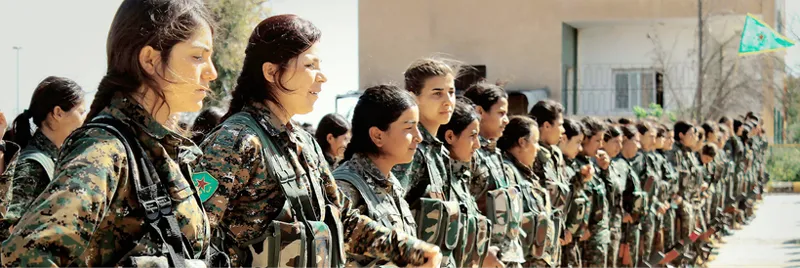
Every conflict has its winners and losers, particularly in a multi-front civil war whose factions, like the Sahel, criss-cross ethnic, religious, territorial and national divisions. In Syria right now, as has been the case so many times before, the losers appear to be the Kurds. Pursuant to their aspirations for an independent state spanning parts of Syria, Iraq, Iran and (the persistent sticking point) Turkey, the Kurdish-led SDF had exploited the civil war to carve out and secure territory in majority-Kurd parts of the North-East – and this, often at the instruction of Washington.
Now, following the Civil War’s tentative conclusion, a-Sharaa’s provisional government and the Syrian Army have been working to consolidate power, incorporating various factions into the regular forces and attempting to establish some degree of consistent, stable governance across the country’s territory.
Owing to their own political aspirations, the SDF has been a reluctant partner in this process, while the Kurds and other minority groups have been anxious about their safety in the new power structure. This is understandable, given that part of the power consolidation has been violent reprisals against Alawite communities, whose erstwhile loyalty to fellow Alawite Bashar al-Assad was interpreted as deep ideological commitment rather than passive appreciation of protection in a state in which they are vastly outnumbered, as well as other minorities like the Druze.
As the Syrian Army swept through North-East Syria, bringing the region under central control, the SDF is now estimated to have lost over 80% of the territory it once controlled, leading to a situation in which the Kurdish forces have been backed into a handful of cities such as Kobani, Hasakah and Qamishli – the first of these having been subjected to a fortnight-long siege which has worn already stretched public services to the bone as the SDF have sought to cling to what few cards they have left in negotiations.
The sad reality is that it is unclear if they have any cards at all. For many years, the SDF were responsible for a number of internment camps containing suspected members, sympathisers or supporters of Islamic State. Many of those internees have since been relocated to Iraq at Washington’s request, while the Syrian Army has taken control of others. Others, apparently, have escaped. Whether this is a consequence of negligence, an attempt by one or another side to introduce further instability for strategic gain, or possibly IS-sympathetic members in the new majority Sunni government releasing erstwhile allies and fellow-travelers is unclear.
The blueprint for governance that al-Sharaa is presenting to Washington—a Sunni Islamist political system restrained by openness to free-market capitalism and development opportunities by foreign investors—fits western interests as far as keeping Shia (and by extension Iranian) influence down while ensuring a stable, friendly environment for economic returns.
And as for Syria’s neighbours, Turkish President Recep Tayyip Erdoğan’s longstanding animus toward the Kurds is no secret. When Trump withdrew US forces from a region of Syria bordering Turkey in 2019, similar headlines abounded about him abandoning the Kurds to ethnic cleansing at the hands of the Turkish military. Now, with Washington desperate to keep both Israel and Turkey onside with regards to the so-called Gaza ‘Peace Plan’, broader regional politics, and the Ukraine-Russia war (for now), it seems that there is little the Kurds can threaten, nor offer, that will be able to alter proceedings in their favour.
Thankfully, on Friday, January 30th, it was confirmed that the al-Sharaa government and the SDF had reached an agreement which would secure a permanent truce between the two, which would see the Syrian Army taking control over contested territories, and the SDF being integrated into the army—as well as promises of civil and educational rights for Kurdish populations.
Whether these rights will be constitutionally enshrined and guaranteed, not to mention whether this peace will hold and some semblance of stability will be achieved, of course, remains to be seen. For now, the SDF are being forced to accept the best of a bad situation, and even then, the best isn't great. That being said, it could always get worse. And might still.
Ulez bomber: the retired electrician who turned bomb-making extremist
The Guardian, Saturday, January 31, 2026
Reported by Matthew Weaver
This week, at Woolwich crown court, [Kevin] Rees was found guilty of blowing up a Ulez camera with a homemade bomb. The explosion, a jury agreed, was likely to endanger life.
This dark turn is now being seen as a cautionary tale about how increasingly influential online communities, such as anti-Ulez groups, can radicalise even suburban pensioners.
Rees began tinkering with homemade weapons and explosive materials that he kept in his loft. At 6.45pm on 6 December 2023 he lit the fuse on a home bomb. It blew up a Ulez camera on Willersley Avenue, a residential street four minutes’ drive from Rees’s front door.
Shrapnel from the blast travelled 100 metres. It dented a van, blew out a car tyre, splintered a window frame in a child’s bedroom and damaged a wendy house.
“Any of us could have been hurt. It just shows that you don’t know what’s going on in individual homes when someone in a quiet household was making a bomb inside,” Sam said. “They’ve got a little Smart car, which would qualify for Ulez, so I don’t know why he did it.”
Thanks to all of the Blood Work listeners who, understandably, sent this story our way. For those unfamiliar with ULEZ, this Ultra Low Emission Zones, this refers to a large area enveloping all of central London and most of the outer boroughs, where cars which do not fall under the threshold of specific emissions standards are levied by a daily charge, enforced through the use of automatic number plate recognition (ANPR) cameras dotted around the zone’s perimeter.
As anyone who followed New York City’s recent low-level skirmish over a proposed congestion charge for bridge & tunnel commuters will know, measures which seek to improve the quality of life for urban residents at the expense of out-of-towners and motorists have a way of invoking the ire of red-faced ex-urban- and suburbanites for whom atomised automobility is the crown jewel of human liberty.
And so, as far as the specifics of this story are concerned, there’s not really much to say. It’s just a quite sad story about a 63-year-old from a middle-class South London borough feeling so incensed by a quotidian traffic toll that he felt driven to doing a little DIY low-level terrorism against an inanimate fucking object.
The story is perhaps revealing in other ways. For one, amidst talk of the need to censor online content and prohibit young people’s use of social media, it is interesting to read a story about a white, sexagenarian man comfortably plotting and carrying out a bombing attack within the perimeter of the M25, apparently radicalised by one or several of the many anti-Ulez pages which populate Facebook, presumably where aggrieved Britons discuss their shared disdain over ‘Sadiq Khan’s London’ while swapping AI-generated images of muslims riding on public transport, laughing; presumably about the terrorism they intend to commit, or perhaps at them, the Facebook group browsers, personally.
More concerning is the report that, on the Facebook groups in question, Rees is now being hailed as a hero and a quasi-martyr for the Anti-Ulez cause, with sympathisers arguing he did nothing wrong. Indeed, in protesting his innocence, Rees allegedly blamed his arrest on so-called ‘Facebook police’.
This is a useful insight into the bizarro world we now inhabit. People under the age of 40, many of whom enjoy very little material wealth, particularly the kind which affords political representation (i.e. home ownership), find their lives and livelihoods increasingly reduced to and dominated by computer and digital flows, where they desperately try to eke out a living while swimming against the currents of AI, crypto scams, data harvesting and panoptical surveillance seeking to further impoverish, disenfranchise and disempower them, all the while longing for a way to escape this nightmare and return to the real.
Meanwhile, the older generations, in or approaching retirement, who were fortunate to enjoy things like free higher education, right-to-buy mortgages at rock-bottom prices, and the opportunity to work and thrive in an economy of actual things which for the most part made sense and distributed some degree of prosperity, are now auto-radicalising on Facebook pages, apparently alongside even Conservative MPs, and channelling this rage into explosive performances of violent rage against the real world, oblivious to the concept of consequences.
And after the smoke has cleared, the dust has settled and the anti-terrorism police have presumably spun their yard and confirmed that they are not, in fact, a member of a political cell, but rather just the type of extremely normal British voter all three mainstream parties are currently working tirelessly to court, what will they do? Well, blame the keyboard warriors and woke oppressors on Facebook, obviously.
Poo-tee-tweet. So it goes.
Comments (1)
Thank you for this. Also this week in the Sahel, JNIM attacked a convoy of fuel tankers just as they had crossed into Mali from Senegal, which is the main supply line for the landlocked country. They have been keeping Bamako under somewhat of a siege by keeping fuel out as they now control most of the surrounding areas, after expanding west and south in the last few years. There is so much to discuss around violence in the Sahel. A long history of political violence that can be understood in relation to European expansion and enslavement. Broken promises of the postcolonial order. Western security cooperation policies that trained the junior officers responsible for the recent coups in Burkina, Mali and Niger. Very big questions about whether any power can exert territorial control over these landscapes - weak states on their own or with help from Russia, US or France. Collective memories of ethnic and sectarian conflicts. Informal economies, irregular migration, smuggling. Gold mining, from industrial Western interests to DIY camps in peripheral areas. Conspiracies that keeping the insurgency going allows local governments to profit from being the distribution points for aid...