
COIN All the Way Down: A Discourse on Counterinsurgency
We look at the history and philosophy of a doctrine so broad and plastic that even its theorists concede it might not mean anything at all—because if it doesn’t mean anything, then maybe it means everything.
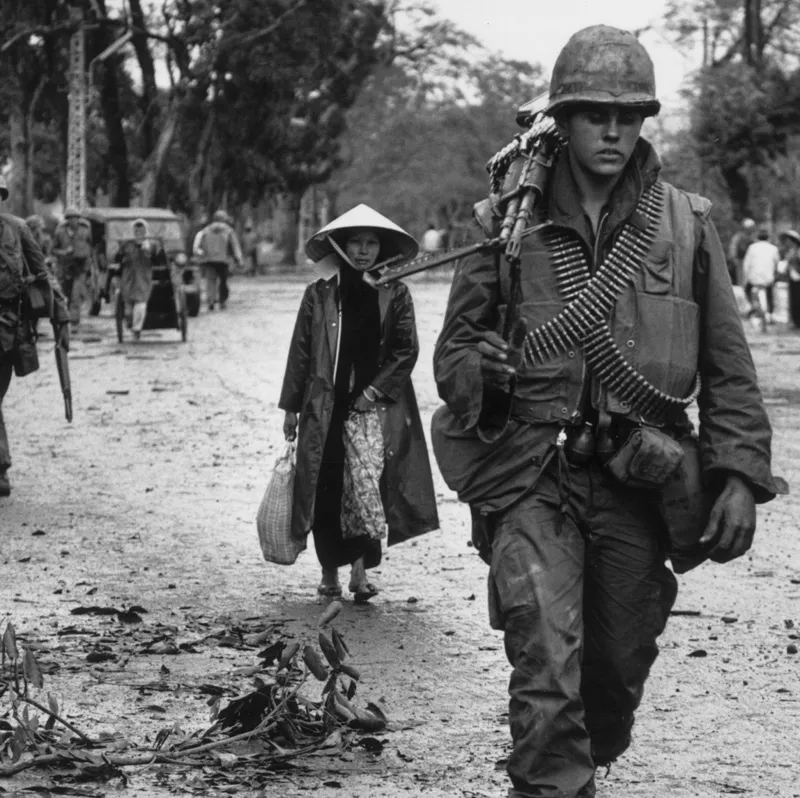
Image: American soldiers and Vietnamese civilians walking through the streets of Huế in Central Vietnam (Getty Images)
Blood Work is a Scam Goldin Production
This episode was produced by Thomas O’Mahony
Our theme song is ‘Dream Weapon’ by Genghis Tron
Our artwork is provided courtesy of KT Kobel
If you enjoyed this episode:
– Support Blood Work via Patreon
– Leave a rating or review on your podcast app
– Follow us on Bluesky / Instagram / Twitter
THIS WEEK IN VIOLENCE – FLORIDA RASHOMON
A few days ago, the United States knocked over Nicolás Maduro, Head of State of Venezuela, in arguably the most brazen U.S. regime change operations in the Western Hemisphere since the arrest of Manuel Noriega on the very same day in 1990. Everyone in the Trump administration agrees it was an act of bold, decisive leadership from America’s Commander-in-Chief – and yet no one can agree why it was done. This week’s newsletter takes a look at some of the competing justifications for the action from the mouths of America’s best and brightest.
Sources:
Peter Arnett (1968), ‘U.S. Destroys City To Oust Viet Cong’, Associated Press (published in The Stanford Daily, available at The Stanford Daily Archives
The British Army Field Manual Volume 1, Part 10: Countering Insurgency (2009)
Donald Frederick Butler (2009), ‘Why Foreign Counterinsurgencies Fail’, PhD Diss., University of Tennessee
Carl Von Clausewitz (1827), Two Letters on Strategy, available at ClausewitzStudies.org
Elbridge Colby (1927), ‘How to Fight Savage Tribes’ in The American Journal of International Law, 21:2
Gwyn Davies (2020), ‘‘I will lay waste your cities, and you will become a desolation’. Insurgency and counter-insurgency in Judaea’ in Small Wars & Insurgencies, 31:5.
Nick Estes (2019), Our History is the Future: Standing Rock Versus the Dakota Access Pipeline, and the Long Tradition of Indigenous Resistance
David Galula (1963), Pacification in Algeria, 1956-1958.
David Galula (1964), Counterinsurgency Warfare: Theory & Practice
Jan-Bart Gewald (1999), Herero Heroes: A Socio-Political History of the Herero of Namibia, 1890–1923
Greg Grandin (2019), The End of the Myth: From the Frontier to the Border Wall in the Mind of America
T. N. Greene (1962), The Guerrilla—and How to Fight Him
Laleh Khalili (2013), Time in the Shadows: Confinement in Counterinsurgencies
David Kilcullen (2006), ‘“28 Articles”: Fundamentals of Company-level Counterinsurgency’, available at Army University Press
David Kilcullen (2009), The Accidental Guerrilla: Fighting Small Wars in the Midst of a Big One
David Kilcullen (2010), Counterinsurgency
Stephen Kinzer (2013), The Brothers: John Foster Dulles, Allen Dulles, and Their Secret World War
Thomas Edward [T. E.] Lawrence (1917), 27 Articles
Vladimir Ilych [V. I.] Lenin (1906), Guerrilla Warfare, available at Marxists.org
Vladimir Ilych [V. I.] Lenin (1917), Imperialism, The Highest Stage of Capitalism
Mao Tse-tung (1937), On Guerrilla Warfare, trans. By Samuel B. Griffith (1961)
Military Review COIN Reader (2006)
Military Review COIN Reader II (2008)
NATO Allied Joint Doctrine for Counterinsurgency [COIN] (2011)
Report of the NSC 1290–d Working Group (1955), available at Office of the Historian
Steven T. Newcomb (2008), Pagans in the Promised Land: Decoding the Christian Doctrine of Discovery
Stuart Schrader (2019), Badges Without Borders: How Global Counterinsurgency Transformed American Policing
United Nations Charter (1945), available at UN.org
The United States Army/Marine Corps Counterinsurgency Field Manual [FM 3-24] (2007)
The United States Marine Corps Small Wars Manual [FMFRP 12-15] (1940)
The United States Supreme Court (1823), Johnson v. McIntosh, available at Library of Congress

Comments (9)
Coming late to the party, but great episode! I'd like to bring in Roxanne Dunbar-Ortiz' _An Indigenous People's History of the United States_ pg 57-76 where she posits that irregular warfare - incl slaughtering of civilians, burning houses and crops, germ warfare w smallpox etc - were the primary approach to dispossession that made settling possible. Dunbar-Ortiz herself draws significantly from a monograph produced at the Army War College in Carlisle, PA, called _The First Way of War: American War Making on the Frontier 1607-1814_. So over a century before Washington ordered the burning of Cherokee towns to create more living space during the war of independence, these tactics were regularized as the way to do war in a settler colony. Jill Lepore in _The Name of War_ also details how the Massachusetts Bay Colony used total war (ethnic cleansing) in King Philip's War against the Wopanaak in 1676. Also potentially interesting for this podcast, Dunbar-Ortiz highlights the critical role of Scottish Highland Rangers in the irregular warfare that removed indigenous people from the area, first with the promise that they could settle and occupy lands they helped to clear; but inevitably plantation capital would then push the Scottish settlers further to the frontier, repeating the cycle (enlisting Scottish descendants to expand the frontier with the promise of access to land) and creating generational rings of people originally colonized and dispossessed of their own land acting as the tip of the settler colonial spear.
If we link the need for settler colonies to the surplus labor created by the enclosure of the commons, then we've inverted the shape of the imperial boomerang of violence, or something.
I love everything about this podcast, but I must say: your source list is just *chefs kiss* I’m writing a (short) paper for my masters program this week on the connections between colonial treatment and exploitation in Africa and Nazi Germany in occupied territories. (Thesis undeveloped, sorry haha) Obviously I’m mentioning coin, though. It’s the second time I’ve found a secondary source thanks to you, and first time getting a primary source from you. So thank you so much 🙏 I’m a footnote girlie and you deliver 🥹
This tied together so many desperate understandings I already had in such a nice bow. Every layer I had already engaged with and made some small connections, but the throughline being made as you did.... its going to be on my mind for some time. Especally with the boomerang seemingly comming home to roost here in the US.
Incredible episode team.
Badges Without Borders 📈 Schrader’s next book comes out this year I think.
This is a fantastic episode! Keep it up! Also, what was that sound effect at the end?
Tommy Eddie Larry has hit the podcast Sincerely, I have no idea how to evaluate Lawrence’s impact on that part of the world, but he makes for a good biography.
Great comment lol