


THIS WEEK IN VIOLENCE: AUMF LAMF
Ho-ho-ho, Merry Blood Work!
Hello all, Gregk here with a pre-Christmas TWIV. The past few weeks of US escalation against Venezuela have been a real banner week for demonstrating just how versatile that Authorization for Use of Military Force 2001, passed in the immediate aftermath of the terrorist attacks of 2001.
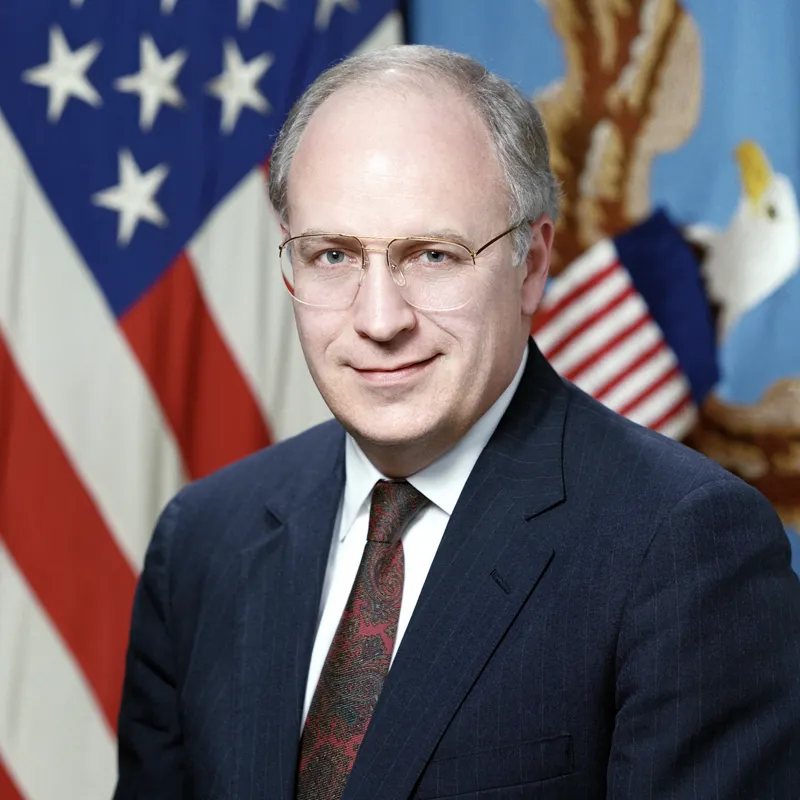
If you want to learn more about that resolution and the drama surrounding it, you can go back and listen to our episode about Dick Cheney. To recap briefly, the AUMF of 2001 was intentionally written incredibly broadly, granting the US President authority ‘to use all necessary and appropriate force against those nations, organizations, or persons he determines planned, authorized, committed, or aided the terrorist attacks that occurred on September 11, 2001, or harbored such organizations or persons, in order to prevent any future acts of international terrorism against the United States by such nations, organizations or persons.’
Granting the President authority to pursue endless retaliations against anyone suspected to be even tangentially connected to the 9/11 attacks, as well as to take whatever necessary measures to fend off any and all future pending terrorist threats, the 2001 AUMF is effectively a blank cheque for the United States to make and pursue endless global war.
Since its very-near-unanimous passage into law on September 18, 2001, the AUMF has never been rescinded, and so has been used by every US Presidential administration since to pursue unilateral military actions in dozens of countries around the world without any congressional oversight. You will often hear critical journalists and analysts of US military actions in the post-9/11 age refer to broader horizons of the GWoT as the ‘Forever War’.
The AUMF is the piece of legislation which demonstrates that this classification is more than simply rhetorical. It’s an authorisation so broad and loosely defined that it renders the problem of the square peg and the round hole moot; the hole’s aperture can always be widened, and virtually any peg can be hammered through. This week, I’ve picked three articles which demonstrate how liberally this mechanism has been exploited, and how dangerous that is for global governance.
Gk
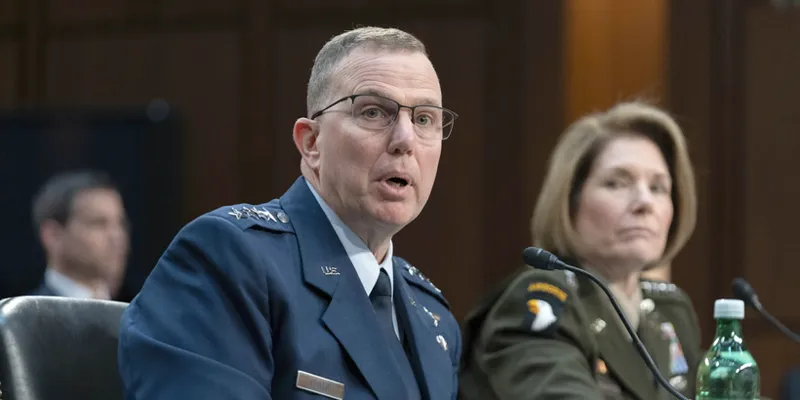
The Intercept – U.S. Military Willing to Attack “Designated Terrorist Organizations” Within America, General Says
16 December, 2025
Nick Turse
Gen. Gregory Guillot of U.S. Northern Command, a four-star general who takes his orders from War Secretary Pete Hegseth, made clear his position in testimony before the Senate Armed Services Committee last week. When asked about his willingness to attack DTOs within U.S. borders by Sen. Jack Reed, D-R.I., he replied: “If I had questions, I would elevate that to the chairman and the secretary. … And if I had no concerns and I was confident in the lawful order, I would definitely execute that order.”
[...]
“That is one of the concerns with the administration asserting that the President essentially has a license to kill outside the law based on his own say so,” said Brian Finucane, a former State Department lawyer who is a specialist in counterterrorism issues and the laws of war. “That prerogative might be wielded elsewhere — including inside the United States.”
If you’ve followed coverage of the Trump administration’s ramping up of crackdowns on migrants, asylum seekers and brown people, particularly in historically Democratic-run urban centres like Chicago and Washington D.C., you may have heard talk of the Posse Comitatus Act (a Latin legal term which roughly designates ‘power to form a gang’).
Without getting too deep into the weeds, it prohibits soldiers of the United States military from being deployed to operate within the territorial borders of the United States (with exceptions, always with exceptions). Historically, posse comitatus referred to the power of Sheriffs to assemble civilians for law-enforcement of peacekeeping activities – not federal soldiers. And so – in theory – the Act is intended to preserve that right of posse comitatus for non-federal authorities such as the States.
As stated, while numerous exceptions pertain to the Act (particularly in the area of intelligence-gathering and surveillance activities), it has managed to operate as something of a third rail in domestic peacekeeping. But it is in this light that the comments by the NORTHCOM general above should be understood.
Trump’s desire to serve in a Presidency longer than the legally-limited two-terms is widely known. He’s stated his interest in serving for a third term plainly, and as one conservative commentator remarked regarding his extensive renovations to the White House including planned construction of a gargantuan ballroom in the place of the East Wing, a man rarely makes adjustments like that to a house he plans on leaving.
Moreover, similar to Netanyahu’s prolongation of wartime conditions in Israel, Trump knows that the moment he is out of office he will face a deluge of criminal investigations and prosecutions, and so is incentivised to keep hold of his seat in the Oval Office. Again, a man doesn’t operate in such a flagrantly corrupt and criminal manner in public office if he expects he will at some point become vulnerable to prosecution.
Nevertheless, questions remain as to how Trump et al would effectuate such a circumvention of Constitutional Law. One route that both he and numerous advisers have been experimenting with going all the way back to the 2020 George Floyd Uprisings would be invocation of the Insurrection Act of 1807, which authorises the President to deploy the military domestically to quell uprisings which are a threat to the state.
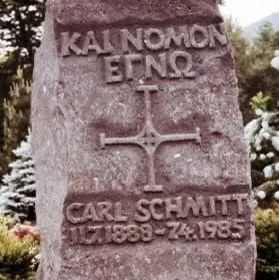
While not being nearly as broad as Article 48 of the Weimar Constitution, used a certain way, the Insurrection Act could serve as the first step toward creation of a larger State of Exception that Trump could then use to suspend elections and remain in office. This is not to be alarmist or hysterical, but frank. One of the problems with Trump is that while he is, himself, mostly an incurious and self-interested blowhard, a lot of people around him are nonetheless committed to him for the things he makes possible, and so even the most outlandish scenarios become a real potentiality in this arrangement.
And so, deployment of federal troops in the domestic United States is one part of the component. The other side pertains to that legal term of art, the ‘terrorist’. As I’ve stated many times before already, the beauty of the figurative enemy of the Global War on Terror is, like its counterpart in the War on Drugs, it is an enemy with no fixed object, able to be anywhere and everywhere at any time for any reason.
Granting, as it does, the authority for the President to bring the fight to alleged ‘terrorists’ wherever they are around the world, the 2001 AUMF has served as the pretext for US military unilateralism for nearly a quarter of a century now. The Trump administration’s attempts to designate drug-trafficking organisations (of dubious provenance) as terrorists through the absurd ‘narco-terrorist’ designation is, simply, an attempt to suture together domestic and foreign concerns in a way that collapses the distinction between ‘inside’ and ‘outside’ and, correspondingly, renders any possible delineation separating ‘police’ and ‘military’ actions moot.
It is, therefore, important to recognise that Trump’s desire to deploy federal troops to eliminate ‘designated terrorists’ within the United States is inseparable from his and Pete Hegseth’s invocation of a unilateral right to murder alleged drug-traffickers from Venezuela as an activity that falls below the threshold of war, functioning instead as some form of spectacular, murderous police action.
In his book Badges without Borders examining the historical ties between policing and military operations abroad and at home, Stuart Schrader argues that we should understand the line separating military counterinsurgency from domestic policing activities less as a hard barrier and more as a threshold of exchange; that “across the globe, counterinsurgency was policing. At home, policing was counterinsurgency.”
Trump’s escalation and further demolition of that line is simply the latest development in a process that was already ongoing throughout the twentieth century, and which was arguably accelerated by the latitude granted in the 2001 AUMF. Policing abroad, war at home.
NPR – Trump designates street fentanyl as a WMD, escalating militarization of the drug war
15 December, 2025
Brian Mann
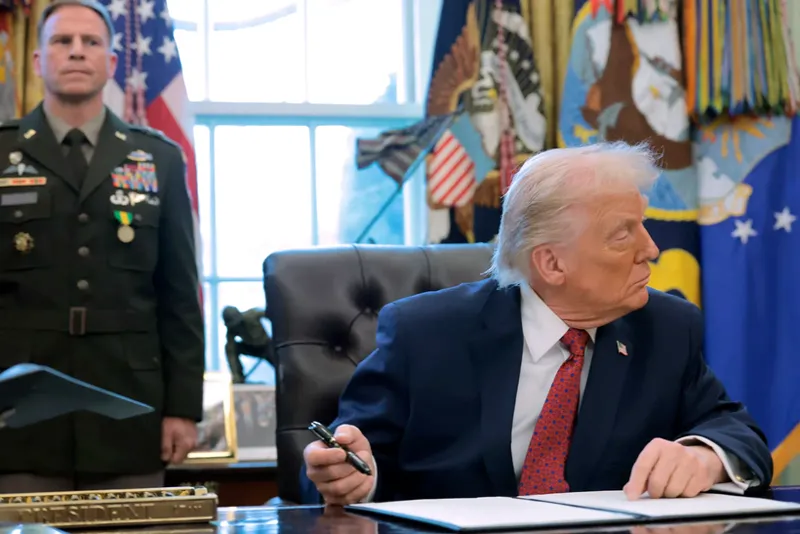
"The manufacture and distribution of fentanyl, primarily performed by organized criminal networks, threatens our national security and fuels lawlessness in our hemisphere and at our borders," the order declared.
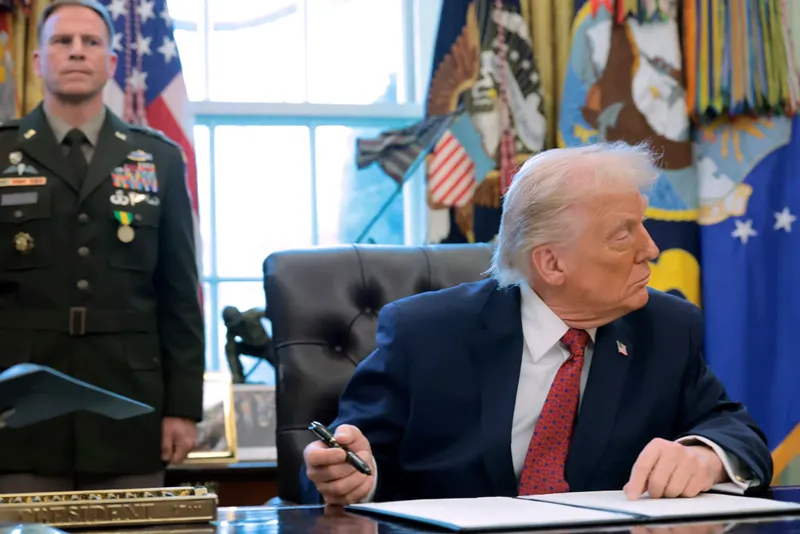
During an event in the Oval Office, Trump said the carnage fentanyl has caused in American families is worse than U.S. deaths in many wars.
"Two to three hundred thousand people die every year, that we know of, so we're formally classifying fentanyl as a weapon of mass destruction," Trump said.
[...]
Jeffrey Singer, a physician and an expert on street drugs at the Cato Institute, said people are dying from fentanyl in the U.S. because of widespread opioid addiction, not because cartels are deliberately weaponizing the drug.
"I don't know how you can equate smugglers meeting market demand and selling something illegal to someone who wants to buy it as an act of war," Singer said.
"Killing a drug mule has minimal effect on the flow of drugs, or the systems of criminal organizations," said Vanda Felbab-Brown, an expert on drug trafficking and addiction at the Brookings Institution.
[...]
According to Felbab-Brown, the street drug fentanyl, which accounts for the vast majority of U.S. drug deaths, isn't produced in Venezuela, or smuggled in boats being targeted.
"Whatever actions are taken in the Caribbean have no effect on fentanyl," she said. Cartels operating in the Caribbean region are heavily involved in cocaine trafficking, Felbab-Brown said, but much of that illegal product goes to countries other than the United States.
Operating from any standpoint resembling reason or logic, the designation of fentanyl as a Weapon of Mass Destruction makes absolutely zero sense. Setting illicit use aside, the powerful analgesic is legally dispensed millions of times every year to relieve pain from surgeries, cancers, trauma and manifold other medical concerns.
Furthermore, as stated both in our Monroe Doctrine episode and in previous TWIVs, there is absolutely no evidence connecting America’s illicit fentanyl problem – which, lest we forget, is a consequence of an opioid crisis caused by overprescription of drugs like Oxycontin at the behest of the marketing arm of the incredibly wealthy and all-American Sackler family – to drug trafficking boats real or fabricated in the Caribbean Sea.
As even the staunchly pro-imperial-meddling Council on Foreign Relations has acknowledged, the vast majority of illicit fentanyl on America’s streets is produced in either China or Mexico and, what’s more, deaths from synthetic opioids have already begun to decline from their 2022 peak, suggesting a ‘crisis’ which is already in remission.
The designation makes much more sense, however, if you understand it as yet another crude effort to capture the Trump administration’s belligerence toward Venezuela within the idiom of Iraq and the GWoT in which there [w/c]ould be no limits and all was permitted in the face of an immeasurable threat.
That the WMD threat was scarcely convincing the first go-around is hardly the point; what matters is that it ultimately ‘legitimated’ the US’ unprovoked and illegal invasion of Iraq with and to itself. This is the reality of America’s steady dismantling of International Law and oversight and replacement with what it refers to as the ‘rules-based international order’. The latter term neither refers to a supervising body, nor designates where this order might be enumerated, nor indicates who it is that enforces the rules. The elision is the assertion of power assumed to be taken as read: Order will be enforced by the US, and the rules are what the US says they are.
That it is widely acknowledged that the two genuine sources of illicit fentanyl are China and Mexico only underscores the farce of the Venezuela operation. Again, while it is increasingly being openly acknowledged that a war between the United States and China is coming, it is also recognised that the US is neither prepared nor equipped for such a confrontation. Hell, the effort to disentangle the relation between China as the world’s producer of first choice and the USA as its corresponding consumer of last resort is the battle that must be won before any other hostilities can commence. And so that particular, “Hey buddy, what gives?” is off the table for the time-being.
As for Mexico, while Trump has long floated the idea of deploying the US military to engage in a full-blown conflict with alleged Mexican drug cartels, a number of factors possibly make this a similarly hard sell. For one, America’s long history of territorial disputes and encroachment upon Mexican territory would arguably make the imperial dimensions of such an activity harder to mask.
Secondly, the US relies on maquiladoras – factories located in tariff-free Special Economic Zones on or around the border region – for the production of many of its consumer goods. Any hostilities against Mexico would likely have significant ramifications for US consumer access to goods like clothing, white electronics and the like, and so only worsen an inflation situation already exacerbated by Trump’s tariff regime.
Thirdly, however much many experts in the D.C. foreign policy ‘blob’ want to insist otherwise, it is an axiomatic fact that the violent destruction of war displaces regular people from their situated living arrangements, forcing them to flee and attempt to live elsewhere – internally or externally. In other words, war produces refugees.
Even if a majority of America’s multiracial population (of whom roughly 20% are Hispanic) could be convinced on the necessity of a full-fledged military operation against Mexico, it wouldn’t take long for the contradiction between a Trumpian commitment to airtight border security and the predictable manufacturing of a massive refugee crisis directly across its southern border to become apparent to the US public.
And so, instead, Venezuela is picked as a target, with spectres like ‘narco-terrorists’ and ‘WMD fentanyl’ fudged together to provide both an immediate pretext and then jimmy that pretext within the broad parameters of the 2001 AUMF (circumventing congressional oversight), in an insultingly lazy con-job which everyone can see is just the latest instance of the US brute-forcing its way toward the military operation it always already wanted to do.
Just four days ago, the United States congress voted on a Venezuela War Powers Resolution, put forward by Massachusetts Congressman Jim McGovern, which would have ordered Trump to cease all hostilities against Venezuela pending further deliberation and authorisation by Congress – as stipulated by the War Powers Resolution.
Indeed, a nice and necessary thought. But remember, the War Powers Resolution stipulates that it is Congress who must have ultimate approval over whether the President can declare war. That a member of Congress is having to put forward a Resolution to order the President to cease with a military action he has already unilaterally begun, only indicates how thoroughly broken the US political system already is, and how detached the US war machine has made itself from any and all oversight, both domestic and international.
New York Times – Trump’s Claim That Venezuela ‘Stole’ U.S. Oil Fields Touches Nationalist Nerve
17 December, 2025
Simon Romero
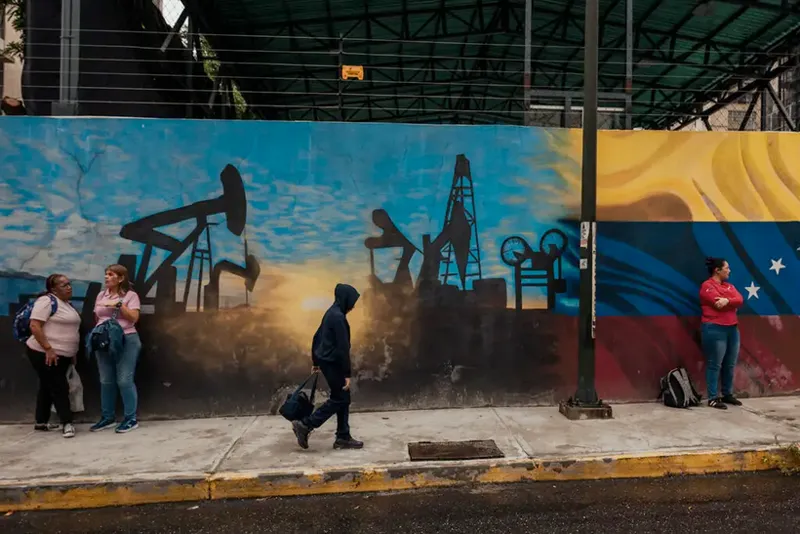
President Trump and his top advisers could not be more blunt in their claims: The United States created Venezuela’s oil industry. Venezuela stole American oil fields through nationalizations. Now, the United States wants those assets back.
[...]
Stephen Miller, a top adviser to Mr. Trump, seemed to express little regard on Wednesday for the oil nationalism that imbues Venezuelan politics, reflecting instead on an era when Americans wielded immense sway in the country.
“American sweat, ingenuity and toil created the oil industry in Venezuela,” Mr. Miller said. “Its tyrannical expropriation was the largest recorded theft of American wealth and property. These pillaged assets were then used to fund terrorism and flood our streets with killers, mercenaries and drugs.”
Another whirlwind moment for those of us old enough to remember the War on Iraq. During the ramp-up to that action, there were a number of Cassandras who challenged the mainstream narrative regarding Bush, Cheney and Rumsfeld’s designs on Iraq, arguing that the attempts to connect 9/11 to Iraq was simply a cynical redirect to focus the war machine on a resource-rich country that the US could plunder.
These critics were simply shouted down by mainstream commentators who buttressed the Bush administration’s, again, deeply cynical claims that their designs on Iraq were instead motivated by spreading democracy, women’s rights and liberating an oppressed people from dictatorial rule.
Two decades later, commentators from the same corners of the media space continue to carry out their duties. Unfortunately, however, it is in such moments that Trump reveals one of his few utilities, and also demonstrates why it is that so many of the mainstream political elite detest him so much: Because he says the quiet part out loud.
This week, when Trump further escalated hostilities against Venezuela by enforcing a naval blockade on ships leaving the country – officially and unambiguously an act of war – he justified his actions bluntly. “You remember they took all of our energy rights. They took all of our oil not that long ago. And we want it back. They took it — they illegally took it.”
It is this attitude toward Venezuela’s natural resources (as well as those of other countries in South America) which reveals the classic imperial attitude which has always underpinned the US’ proclaimed spirit of benevolent care and cooperation first expressed by James Monroe in his 1823 State of the Union. When US corporations are building oil refineries and other facilities, it’s all smiles and neighbourly conduct. It’s only when a country later tries to use its sovereignty to take control over resources beneath its own soil – which International Law recognises as rightfully its own property – that the attached strings begin to glisten in the light.
As the linked Times piece states, Venezuela’s oil nationalisation actually occurred in two phases. The first, in 1976, was peacefully negotiated to and acceded to by US producers over a longer period. The second, enforced by Hugo Chávez following his takeover of the country in 1999, was less of an ask, and more of an instruction.
Others are welcome to discuss the nuances between these two phases of detachment from US oil companies if they like. What appears more important is that Trump’s remarks eschew such distinctions: It’s ours, and we want it back. Again, on this brute claim, Nobel Peace Prize winner María Corina Machado, who in a live video stream to business executives in Miami, including Donald Trump, described a potential US invasion of the country she seeks to liberate as “a $1.7 trillion opportunity.”
Despite the open cynicism and opportunism of it all, there are those in the media and commentariat who will continue to insist, over and against all glaring evidence to the contrary, that Trump’s designs on Venezuela both are, and are about, so much more than what they glaringly appear to be on their face. As someone who lived through Iraq, this behaviour neither surprises nor outrages me in the slightest, nor should it you. When it comes to the imperial designs and resource-extraction imperatives of the United States war machine, the mainstream press and its functionaries are paid handsomely to be gullible suckers.
I, on the other hand, am not on their payroll. And I don’t intend to be a volunteer.
When Playing Nice Gets Boring
Lessons from Iran, 1953
In between preparing for my appearance on No Gods No Mayors this week and preparing this newsletter, my mind has been swimming in the history of US and British covert actions during the twentieth century and the indelible connection to extraction and imperial control of the world’s natural resources, particularly oil and gas.
If you’re interested in viewing something akin to a poetic analogy for what you are witnessing around Venezuela right now, the 2019 documentary Coup 53 by Iranian-British director Taghi Amirani is worth your time.
Examining archival footage including unbroadcast interview footage from a BBC documentary on the same subject from several decades earlier, the documentary uncovers damning evidence of the involvement of British intelligence in the 1953 military coup which toppled Iran’s democratically elected leader Mohammed Mossadegh, in collaboration with the CIA.
The origins of the coup? Mossadegh’s desire to liberate Iran from onerous arrangements with the Anglo-Persian Oil Company (now BP), which saw the UK taking the lion’s share of revenues from Iran’s rich oil reserves while the Iranians took a pittance.
Taking Mossadegh’s refusal to be bamboozled by Brits’ economic discussions, during which he repeatedly returned to the simple question – “Who will own the oil?” – it was decided he was too stupid and irresponsible to be trusted with his own country’s natural resources, and so a military coup was orchestrated which left Iran under the rule of the brutal dictator Shah Reza Pahlavi for twenty-five years, and permanently soured popular attitudes toward both Britain and the USA among the population in ways from which the country still has yet to recover.
As a preview, in 2026 I would like to do a series on Iran, beginning with Mossadegh and the coup and hopefully tracing the history all the way up to the Shah’s overthrow in the 1979 Islamic Revolution. For the time being, if you’re not familiar with why it is that Iran now harbours such firm hostilities toward the west, this documentary is a great place to start.
One side note: I am slightly sceptical of how Amirani centres himself in the uncovering of the information revealed in the documentary. The Iranian-American marxist historian Ervand Abrahamian (who appears in the documentary) has written extensively about the history of Iran throughout the twentieth century, and in his book The Coup, published some time before this documentary was released, he makes use of similar archival evidence. Iranians have a bit of a reputation for bombast and self-inflation, and so while the information presented is incredibly compelling, it might be worth taking Amirani’s narration of events with a grain of salt.
Enjoy!