







THIS WEEK IN VIOLENCE: FAFO-FI-FUM
Hey all, you know what it is, it’s your weekly Blood Work violence-in-review. This week I’ve got a trio of pieces about wars old, new and prospective which each, in their own way, tie back to this week’s episode about The Monroe Doctrine.
Perhaps we can think of them as reflecting the festering wounds of America’s most recent imperial project; the licking of wounds and casting around for a space in which to reassert itself, and the early nicks and scratches we’re already seeing as both the war machine and US consent manufacturing apparatus (brrrrrrr) leap a little too enthusiastically on the latest champion of peace, liberty and justice only to learn that she… well, just might not actually be very ‘bout it ‘bout it (shout out Master P).
We’ll get right into it, but I also wanted to let you know we’ve got another interview coming on Tuesday. It’s one I knew I wanted to do the moment the inspiration caught me, and it ended up turning out even better than I had hoped. I don’t want to give too much away, but if you’re interested in a conversation that begins with a brief history of the Ceauçescu government and his repressive security apparatus the Securitate, and ends with a partial (and entirely unexpected) explanation of why and how Keir Starmer got where he is and the function he’s there to perform, then you’re gonna want to listen.
So that's Blood Work 12 dropping this Tuesday at 6PM GMT.
But wait – there's more.
BLOOD WEEK
In lieu of a media take to conclude this week's newsletter, I've got some more Blood Work-related media to announce to you all. If you’re a fan of the sound of my voice (haha), then you’ve got a wonderful few days ahead of you.
Red Pepper – Propaganda of the Deed
First up, I was very flattered to have been asked by Red Pepper to contribute to their Key Words series, in which they provide short, snappy summaries of key terms and concepts for leftist politics. I actually wrote one a few years back on Neoliberalism which is worth a read, as it’s certainly one of the central bingo squares of Blood Work thought and analysis.
This time around, I was asked to expand a little on the history and philosophy of Propaganda of the Deed, the radical anarchist strategy that the best way to teach the masses how to make revolution was to show by doing. So if you’d like a quick little primer on the history of the concept and where it can be observed in our present moment, have a quick read – and thank you to the team at Red Pepper for the chance to contribute.
Lions Led By Donkeys
Secondly, on Wednesday, I’ll be appearing on Lions Led by Donkeys, a brilliant military history show which explores all of weirdest, wackiest, goofiest and stupidest chapters in warmaking and peacekeeping, hosted by the brilliant Joe Kassabian and Blood Work’s own Thomas O’Mahony. In keeping with the spirit of the show, I wasn’t told what the topic would be in advance, so I won’t be telling you. But if you’ve ever been curious about military operations named after world-beloved Italian staple foods, well, you just might want to tune in.
No Gods No Mayors
And then the very next day, on Thursday, I’ll be making an appearance on No Gods No Mayors, the brilliant political comedy podcast hosted by Riley Quinn and November Kelly of Trash Future (and Glue Factory, and Kill James Bond, and Well There's Your Problem) and the cartoonist and illustrator Mattie Lubchansky, to talk about a Brazilian mayor who sits on the unlikely borderlands of Blood Work and NGNM, with a political career packed to the gills with megalomaniacal aspirations, corruption, embezzlement, and political violence. It’ll be dropping with a PDF of my research and accompanying images if you’d like to take an even deeper dive into the Lusophone mania, so be sure to check it out.
New York Times – Overmatched: Why the U.S. Military Must Reinvent Itself
08 December, 2025
The Editorial Board
The assessment shows something more worrying than the potential outcome of a war over Taiwan. It shows the Pentagon’s overreliance on expensive, vulnerable weapons as adversaries field cheap, technologically advanced ones. And it traces a decades-long decline in America’s ability to win a long war with a major power.
[...]
Ultimately, a stronger U.S. national security depends less on enormous new budgets than on wiser investments. Spending heavily on traditional symbols of might risks shortchanging the true sources of American strength: relentless innovation, rapid adaptability and a willingness to discard old assumptions.
To be clear: The United States needs a stronger military primarily to deter future wars, not to start them. As we rebuild our military, we must pursue diplomacy with our adversaries. At the same time, we need to prepare for the worst. Deterring war is the first goal of any successful strategy to avoid protracted conflict, and we need to address our weaknesses before enemies look to exploit them.
This first in a series of opinion pieces published by the editorial board of The New York Times has provoked considerable ire from different circles online, and understandably so. Since Donald Trump assumed power for the second time at the beginning of this year, numerous news publications, media corporations and even law firms have made blatant overtures to his administration seeking to curry favour or stave off potential backlash for any activities they may have been engaged in during his interregnum.
Jeff Bezos’ Washington Post has effectively completely reconstituted its Opinion section to promote strictly right-wing, conservative and pro-capitalist viewpoints that harmonise with Trump et al’s conception of the world. CBS’ metamorphosis under the stewardship of soft-spoken reactionary Bari Weiss continues to unfold in a way that feels like the beginning of a slow-motion car crash.
As for The New York Times, their coverage of Trump 2.0 has garnered widespread criticism for their ironically liberal use of both-sidesism and passive voice to print headlines that won’t rock the boat with the man in the White House.
While outrage at the Times for their Quisling behaviour is, of course, righteous and entirely justified, it repeats an age-old misconception of the paper as a bastion of liberal and progressive values (a reputation it has certainly never disavowed) despite its actual record telling a different story – particularly when it comes to questions of American foreign policy and military actions.
And so, in the context of the U.S.’ aggressive military buildup in the Caribbean and ongoing provocations, all of which are obviously aimed at some sort of engagement with Venezuela ending in the ouster of President Nicolás Maduro, it’s understandable that a Times editorial piece advocating for a yet more muscular, heavily-funded and modernised military might scan as base lickspittle behaviour by a conservative news outlet (which it is).
But such a reading, in my view, neglects a worthy critique the piece makes regarding the U.S. military’s approach to R&D, procurement and grand strategy over the past few decades. For at least forty years, the United States has strived to fashion itself as a global Goliath, with more and larger aircraft carriers, more sophisticated weaponry, a higher military presence and greater command over the global infrastructures than any other country.
Unfortunately, in pursuing this path the U.S. forgot the other person in that Biblical story—David—and the way that battle ultimately ended. As Russia’s war against Ukraine and the broader proxy war between Russia and the West which both inhabits and contains the Ukrainian battlespace is demonstrating (for all involved), 21st century warfare is rapidly rewriting the terms of great power struggles in ways that might reveal all that expenditure and exertion on bigger, larger, grander arsenals a boondoggle.
Since the turn of the Millennium, America has been carrying a big stick but not treading particularly softly, allowing adversaries such as China to observe, absorb, and plan their own approaches accordingly. Now, the global hegemon finds itself in a position where, for all its expenditure, war game simulations reveal it to be consistently out-matched by China in a way that should raise alarm bells for the D.C. set and crowds to whom and on whose behalf the Times speaks.
Which is to say that, in my view, the piece’s diagnosis is (partially) correct: The United States military is in need of a massive overhaul regarding how it selects and procures research and development programmes and so on. It is also true that, like turning around an oil tanker on the open sea, effectuating this institutional change will be slow, arduous and incredibly costly.
Where the argument falls down, however, is in the argument that any power – the President, Congress, or the Military itself – will be able to effect this change without addressing the entirety of the capitalist underpinnings of the American war machine, root & branch.
The piece is correct to observe that, “An entrenched oligopoly of five large defense contractors, down from 51 in the early 1990s, has an interest in selling the Pentagon ever-costlier evolutions of the same ships, planes and missiles.” But this entrenched oligopoly of five large defence contractors was, in turn, America’s own making, and is an issue which is repeating itself across the American (and wider western capitalist) landscape right now; in tech; in real estate; in automanufacturing; and so on.
With the concentration of capital into an ever-smaller number of multi-billion dollar oligarchic concerns since the Reagan presidency, capital turned itself into a creature somewhere between a parasitic tic and a fattened sow, feeding off of the state and market without feeling any impetus or inclination to innovate or fend of challengers. The presidency of Donald Trump is the perfect backdrop against which to set this debacle. At the beginning of his presidency, amidst the tumult of his on-again, off-again tariff regime, Trump boasted about how a handful of close friends visiting the Oval Office had made millions of dollars making plays on the stock market as his erratic behaviour sent the tickers flying up and down.
The Purpose of a System is What it Does: The American war machine and lumbering way in which it bounds from one expensive boondoggle to another exists because this is the type of activity the American political-economic system incentivises. The Times’ editorial board can pearl-clutch about the need for a radically new approach as much as they like. But if they are unable to speak about the rot at the very foundation, they are unlikely to be impressed by whatever new structure is eventually built on top of it.
New York Times – Nobel Prize for Venezuelan Dissident Draws Criticism
María Corina Machado is being honored for her push for democracy even as she backs President Trump’s military buildup and aggressive campaign against Venezuela.
09 December, 2025
Genevieve Glatsky & Henrik Pryser Libell
Ms. Machado has firmly embraced President Trump’s military buildup and has publicly expressed her support for using force to oust the Venezuelan president, Nicolás Maduro.
She has also repeated debunked claims that Mr. Maduro manipulated U.S. elections, fueling accusations that she is amplifying misinformation to gain favor with the Trump administration.
[...]
Ms. Machado has also claimed that Mr. Maduro leads two drug trafficking groups the Trump administration considers terrorist threats and has used as justification for its strikes.“
[...]
But U.S. intelligence agencies, regional experts and other Venezuelan opposition figures say there is no evidence Mr. Maduro controls either group. While some Venezuelan military officers are involved in the drug trade, analysts doubt these activities add up to true transnational cartels.
Another case of ‘Play silly games, win silly prizes’, this time for the Nobel Peace Prize committee. The fellas over in Norway haven’t exactly had an easy ride this year. After all, Trump—who likes to collect trophies, accolades and titles the way a magpie collects shiny objects—had been expressing his desire to be awarded the Nobel very loud and clear in light of the many wars he has ‘ended’ this year. (The veracity of this claim is, would you be shocked to learn, questionable.)
There was no shortage of candidates for the prize this year. After the winner had been announced, a list of other nominees was released which included Pope Francis, UN Special Rapporteur for the West Bank and Gaza Francesca Albanese, the slain Palestinian child Hind Rajab, Imran Khan and even Elon Musk.
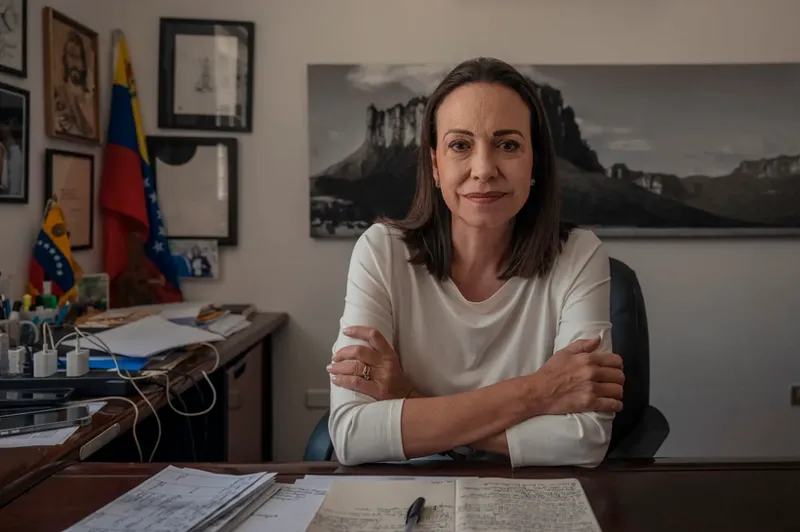
No doubt cognisant of Trump’s personal anglings (as well as his vindictive personality) and so not wanting to risk a selection which might be deemed impolitic, the committee went with the ‘safe’ bet of María Corina Machado, long-time opponent of the PSUV government of Venezuela (led first by Hugo Chávez and then Maduro) and seen by many as the figurehead of the movement for liberation of Venezuela from communist rule.
Less acknowledged in popular biographies is that Machado is a daughter of dynastic wealth – her father was a Steel industry magnate and her uncle Oscar Machado Zuloaga helmed Electricidad de Caracas, at one time the largest company in Venezuela – and that she has advocated forcefully for US military intervention in her country for decades. It is not an exaggeration to say that for the past two decades in Venezuelan politics, Machado has functioned as a proud and outspoken advocate on behalf of private business interests (including and especially those headquartered in the U.S.) in Venezuela.
Taking a macro view at the ‘Venezuela situation’ and America’s buildup toward military action, comparisons abound, most obviously both Iraq and Libya. Though it is clear that politicians in Washington have their hearts set on knocking over the Maduro government, it is unclear if anyone even cares, let alone knows or understands, what the likely consequences of such a destabilising action will be – whether achieved through overt military means or more covert methods, i.e. assassination. To repeat from last week, Elliot Abrams’ self-serving dreck in Foreign Policy magazine in which he promises war with Venezuela will be a yellow-brick road so long as Trump goes in all-guns blazing is simply the certainty one would expect from a squirrel in search of a nut.
Regarding Machado herself, however, the figure she immediately reminds me of is Ahmed Chalabi, Washington’s golden boy from the build-up to the War on Iraq whose Wikipedia page now helpfully introduces him as an ‘Iraqi political dissident’ and ‘convicted fraudster’. The son of a wealthy Shia family who fled Iraq following the 1958 military coup, Chalabi wooed D.C. politicos by playing all the notes Donald Rumsfeld’s infamous ‘Office of Special Plans’ wanted to hear, hyping up talk about WMDs and Saddam’s megalomaniacal plans, how the regime was begging to be toppled, and how Americans would be welcomed as liberators (and, of course, would be delighted to have Chalabi return from exile to be their new leader).
As we all know, things didn’t quite turn out that way. Almost immediately following the invasion, opinion polls revealed Chalabi to be one of few public figures with higher unfavourable ratings than favourable, and his relationship with the Americans soured. Soon, he was selling secrets to Iran and meeting with President Mahmoud Ahmadinejad to try and shore up his position by other means. Turned out beneath a thin layer of gold leaf, Chalabi was actually rather dull and self-serving.
Similar issues abound with Machado. As the US’ previous coup attempt[s] against Venezuela in the past decade (such as with the magnetic Juan Guaido) have demonstrated, for all the wishcasting for a glorious military coup to overthrow the Venezuelan government, there has been scant evidence that any of the US’ chosen dissidents actually command support among the populace.
Ideologically, Machado has been described as a hard-right conservative neoliberal in the vein of Argentina’s Javier Milei, and so the confluence of political beliefs and personal self-interest are very much hard-baked into the equation. For all the desire to laud her as a unifying figure of national resistance who will bind the Venezuelan people together once pesky Maduro has been dealt with, there is very little evidence that the adhesive Machado is offering will actually hold. Nor does anyone seem particularly interested in making the case.
It’s almost as if nobody cares, and that this grand project to liberate the Venezuelan people and put an end to the nebulous and incoherent Maduro narco-terrorist regime which bases its power on making money off of the American people by smuggling drugs to kill them—because killing your customer is every drug dealer’s ideal)—might actually be about much cruder concerns, such as Chinese encroachment on the South American continent, building a battlespace in which to test the next generation of warfighting technologies, and… well… crude.
The Guardian – A year after fall of Assad, a divided Syria struggles to escape cycle of violence
While country’s return to global stage has filled many Syrians with pride, domestically old grievances threaten efforts to rebuild the state
08 December, 2025
William Christou
For the global community, a pro-western strongman in Damascus is a breath of fresh air. After 14 years of civil war that flooded the Middle East and Europe with drugs, created the world’s largest displacement crisis since the second world war and allowed Islamic State to establish a caliphate, the world has been eager to unite behind the new Syrian president.
Sharaa gained power in part by capitalising on a weakened Iranian axis after Israel’s assault on Hezbollah in Lebanon prevented Tehran from saving its Syrian client, Assad. Sharaa has since managed to keep Iranian elements from re-establishing themselves in Syria, much to the delight of western capitals.
But at home, stalled transitional justice is fuelling renewed violence and deepening the country’s divides.
Four days of massacres perpetrated by government forces and other armed factions against mostly Alawite civilians on Syria’s coast in March and continued killings have left the religious minority feeling besieged.
Another massacre in July in which members of government security forces and tribal elements killed Druze civilians in the southern province of Sweida further put the country’s religious and ethnic minorities on edge.
There are certain subjects about which I find the hyperpolarising tendencies of online spaces alienating and unhelpful. The Syrian Civil War is one of them. After over a half-century of rule under Bashar al-Assad and his father Hafez before him, the Arab Spring set a match which signalled that the Assad dynasty had outstayed its welcome, and that the people of Syria wanted change. But the conditions in which this change would necessarily be pursued were far from fortuitous.
For one, Russia, the US, Israel, Iran and the embryonic Islamic State all sure to play their hand in attempting to shift the course of events. Further, the prelude of Iraq over the preceding decade had indicated that, owing to the geographic location and the oil nestled beneath the soil, whatever story unfolded was likely to be one in which blood was deemed as cheap as the territory and resources therein were treasured.
With both frankness and humility, the partisanship over Syria that we saw in certain corners of the Internet in the late 2010s fatigued me, because the longer I observed what I was seeing the more the situation appeared as one in which more than one thing could be true: Assad was a dictator and a butcher who was ripping his country to pieces to save his own power; external actors were surely exploiting the situation and doing their own part to tear lumps of flesh out of the country; but even if the latter were not the case, their absence would not resolve the fact of the internal revolt of a population against their leader, particularly with the festering wound of Iraq sitting across its longest land border.
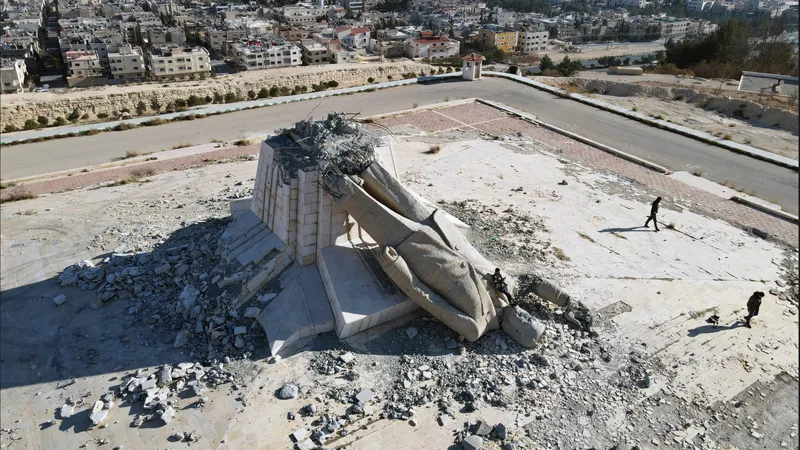
As in the war, so in the victory. The fall of Assad on 8 December, 2024, was surely a positive development for a country which had been beleaguered by war for over a decade. But those of us old enough to remember those images of Saddam’s statue being toppled in Baghdad on 9 April, 2003, are hopefully wise enough to know that the signifiers of a despot’s defeat are not coterminous with those of peace; that while victory is something that is finally achieved in an event, peace is something that must be continually made and remade in an ongoing process.
And so, in spite of the (righteous, if overly-triumphant) jubilance in the media, 8 December was never going to be a conclusive end. It was always going to be the start of something new. Amidst the eagerness to celebrate the fall of Assad was a conspicuous neglect to note that his overthrower was a hardline Sunni militant who had been a member of a group which had spent the better part of three decades campaigning across the Middle East to liquidate Shia muslims and other minority groups and create a Sunni Islamic caliphate across the region.
And so Ahmed al-Sharaa and his militia Hayat Tahrir al-Sham’s seizure of power in Syria had obvious, immediate implications for Syria’s sizeable Alawite population, from whom the Assad family were drawn and so who had enjoyed comparative privilege and career advantages during his rule, as well as other minority groups like the Yazidis and Druze who populate the country.
Predictably, violent reprisals against these groups reportedly began soon after Sharaa seized power, but because he allegedly instructed his men to keep things on the down-low. More importantly, he played all the right notes for the D.C. foreign policy set, opening discussions about rebuilding the country, attracting foreign investment and integrating the New Syria into global capital flows.
Cap that off with how the man whose one-time nom de guerre was Mohammad al-Julani, named for the Golan Heights, seemed conspicuously quiet about Israeli occupation of precisely that land and further encroachment into Syrian territory in recent months, it seems that many politicians and mainstream journalists were happy to avert their gazes, plug their ears and focus on the good things; sing when you’re winning. After all, a toppled statue makes for great television.
As the article linked above shows, however, Syria remains very much a question waiting to be resolved. And so without denying the righteous jubilance (and relief) of Syrians both in the country and diaspora who for the past year have been able to breathe and imagine a future once more, my heart remains very much where it has been for these past few years. Clowns and butchers to my left and right, stuck in the middle. Hopeful, but tired.