






THIS WEEK IN VIOLENCE – The 'Whatever' Doctrine
Hi all, Gregk here with another TWIV.
This week I’ve got an essay from a few years back which develops on the later themes in last week’s episode. If you enjoyed our little jaunt down the paths of desire to make sense of the fascist male and his peculiar relation to sex, you’ll love this essay by Nathan DuFord.
And then there are two more articles related to the Trump administration’s ongoing build-up to war against Venezuela. They’re of apiece with what I discussed in last week's TWIV, but will also tie into the themes of next week’s episode, dropping Tuesday. I’d actually been planning this next topic for several weeks, but then something happened a few days ago which made it more timely than ever, so it’s feeling incredibly serendipitous. Hopefully you’ll feel the same. Enjoy these pieces and some thoughts as a little amuse-bouche, and we'll see you on Tuesday at 6PM GMT.
Gk
Parapraxis – What Can Men Want?
So straight you’re gay
26 October, 2022
Nathan DuFord
Dangerously, extinguishing the potentiality of desire as desire of the Other’s desire places the far-right man into an implacable bind. He cannot tap into a sexuality as desire whatsoever. Desire for what is like oneself is queer; desire for what is other is queer. Desire itself is symptomatic of an unthinkable incompleteness for this subject. There is simply no route for human sexuality here, in either the restricted or expansive sense. Theweleit identifies this clearly in Male Fantasies, arguing that, for the fascist (or protofascist) man, sexuality is experienced more as an attack on sexuality itself rather than an expression of desire. The erotics of authoritarian desire are thus short-circuited, routed instead toward hatred for what is outside, destruction of the body of the other, and brutality toward difference. The rejection of a desire for difference, as a rejection of desire, full stop, can be read through all kinds of authoritarian urges to expel, exclude, or annihilate.
Thanks to the person who saw Andrew Tate’s comments about the gayness of heterosexual relationships and shared this old essay by Nathan DuFord regarding how the politics of desire function in the fascist imaginary, written in the context of similar remarks by neo-nazi Nick Fuentes regarding the ‘gayness’ of heterosexuality.
Professor DuFord draws from the same reference point as I did in my recent episode regarding the Fascist imaginary but, being far more sophisticated and I, they make a much more robust and compelling argument which I will not do the injury of trying to build upon here – I really recommend you simply read their piece yourself.
But I was particularly compelled by their argument regarding how, in the authoritarian mind, the acceptance of desire in any form betrays a need for pleasure or pain beyond the self (a lack), a desire for difference, betrays a fundamental failure of the authoritarian ideal of a complete and total subject, self-made, self-defined, self-mastered, but how this idealised subject without lack or desire is both driven toward nihilism because to be with out desire is to be toward death.
Further, the movement beyond questions of homo/heterosexuality toward homo/heterosexualism in a political idiom is incredibly compelling; to think of the authoritarian heteropatriarchy as opposed to the need for alterity and difference and so driven to a homosexualist politics in which insecure affirmation can only be sought and secured in the company of other men.
Anyway, if you enjoyed last week’s conclusion, this essay will very much do it for you.
Foreign Policy – How to Topple Maduro
And Why Regime Change Is the Only Way Forward in Venezuela
20 November, 2025
Elliot Abrams
Washington favors Maduro’s downfall, but its position lacks clarity and is not backed by the actions—including military strikes inside Venezuela—that would bring about the outcome U.S. officials appear to want. And therein lies the danger for Trump and his administration: that after a great deal of chest-thumping and a show of naval force aimed at Maduro, they will leave him in place. In that scenario, Maduro would emerge as the survivor who bested Trump and showed that American influence in the Western Hemisphere is limited at best.
Removing Maduro, on the other hand, would advance Washington’s interests, protect U.S. national security, and benefit Venezuelans and their neighbors. Regime change would result in reduced migration to the United States, less drug trafficking, more freedom and prosperity in Venezuela, and an end to the country’s cooperation with China, Cuba, Iran, and Russia, which gives countries hostile to U.S. interests a base of operations on the South American mainland.
Some of you may be familiar with the name Elliot Abrams from a heated exchange he had with freshman congresswoman Ilhan Omar (D-MN) while giving testimony as the United States special envoy to Venezuela in 2019.
During the exchange, after misidentifying Abrams as ‘Mr. Adams’ (Queen), Omar pressed him on his role in the Iran-Contra scandal during the Reagan administration, during which weapons were illegally sold to Iran in ordered to fund the Contras, anti-communist death squads who committed numerous atrocities throughout Central America with US backing and diplomatic cover.
Older readers may remember Abrams from the Iran-Contra affair itself and scandals such as the El Mozote massacre, in which the Salvadoran military murdered hundreds of civilians Mozote and surrounding villages, committing torture, executions, mass rapes and mutilations of bodies in their putative search for communist guerrillas. When pressed by Omar about his record in the international arena, Abrams characterised his achievements in Central America as a ‘great success’.
As I mentioned last week, so much of the Trump administration’s half-assed and ham-fisted build-up to full-blown military action against Venezuela feels like a deliberate insult. With Iraq there was a concerted, 18-month push to build paper-thin credibility and shallow international support for the military action Bush, Cheney and Rumsfeld always sought to pursue. (For the record, Abrams also played a role in that debacle as well.)
This time around, nobody even cares enough to provide any kind of internally coherent rationale nor present any compelling casus belli. Even the coinage of the absurd category of ‘narco-terrorist’ is just a flagrant (and again, lazy) attempt to roll America’s desire for a new war of aggression in South America into the (still in force) AUMF of 2001 against ‘terrorists’ responsible for 9/11.
Amidst this blistering deluge of ‘fuck you’ and ‘whatever’ foreign relations, Abrams’ essay in Foreign Policy feels like the cherry on top. Here is a man whose forty-year legacy in Washington D.C., working with and on behalf of the highest tiers of American foreign policy, has been nothing but a cascade of death, destruction, destabilisation and misery.
And so, who better to reassure the blob that the obvious consequences of a violent regime change operation in a country connected to the States by land won’t produce a refugee crisis (because ‘nuh-uh’); that the enemy is more dastardly than we know and that Venezuela is scarcely a country and more akin to a drug operation in a trench coat (because ‘why not’); and that anything less than a devastating campaign of military strikes inside Venezuela would be necessarily insufficient (because ‘go hard or go home’ – oh, and also, ‘fuck you’).
There can be no doubt that the Trump administration and Pete Hegseth’s Department of War are cruder, more vulgar and more drunk and thuggish than any US warmaking cartel in recent memory. But the continued reemergence of figures like Elliot Abrams to bang the drum of war with the same confident ferocity – their own catastrophic track records be damned – should serve as a reminder, both that it’s always been this way, just sung a little more in key, and that the conveyor belt moving from agitation to action largely runs on rails anyway.
Just because you can see their mouths moving out of time to the melody this time around, doesn’t mean they weren’t always lipsyncing.
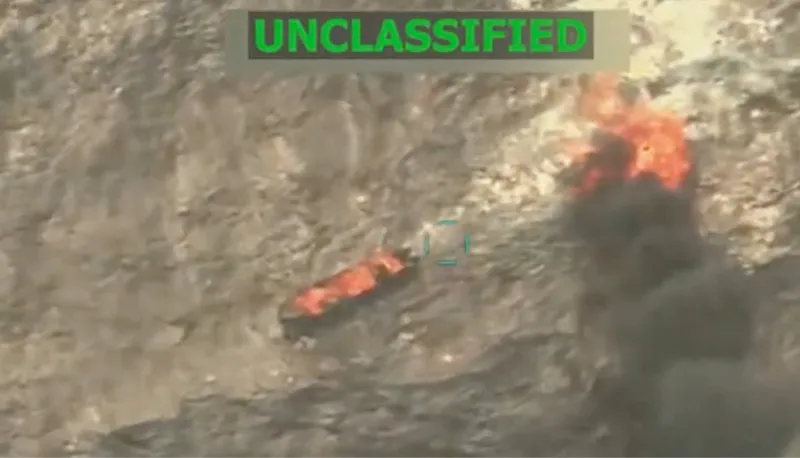
The Guardian – Experts urge release of boat strike video as US admiral denies ‘kill them all’ order
Democrat Jim Himes calls footage ‘one of the most troubling scenes’ he’s observed in public service
04 December, 2025
Joseph Gedeon & Christ Stein
Trump has defended the decision to destroy the boats, saying that those piloting them were guilty of trying to kill Americans. Hegseth said he didn’t see any survivors, explaining that it “exploded, there’s fire, there’s smoke” adding “this is called the fog of war”. A White House spokesman earlier this week denied that the defense secretary personally ordered that the vessel’s occupants be killed, and defended Bradley’s handling of the attack.
A total of 83 people have been killed across the 21 US military strikes carried out between early September and mid-November that targeted boats alleged to be carrying drugs. The campaign, which Trump has said is necessary to stop the flow of fentanyl and other illegal substances into the United States, marks a sharp departure from the previous US strategy of interdicting such vessels, and faces mounting criticism from legal and human rights experts.
Marcus Stanley, director of the Quincy Institute for Responsible Statecraft, said the strikes themselves constitute potential war crimes even before the killing of survivors. “You’re already talking about entities that don’t have any means of defending themselves,” he said. “This is a totally extrajudicial process. They’re simply destroying them and killing everyone on them without any judicial process whatsoever.”
In a previous episode I mentioned Jean Baudrillard’s The Gulf War Did Not Take Place, and his contention that the ‘true’ war of the First Gulf War was not the one composed of bombings, air strikes and devastation of Iraq, but the war for American eyes and imaginaries that unfolded on television screens, in the first military conflict which unfolded on 24/7 cable news as spectacle in motion.
A similar dynamic seems to be at play with the conduct of Trump and Hegseth. Both appear deeply invested in projecting the spectacle of authoritarian military strong men. Hegseth, in particular, seems captivated by a libidinal drive for war in a glossy, aesthetic sense. Both seem either disinterested or incapable of following through beyond reckless, impulsive actions befitting a man with dementia or a chronic day-drunk. Which fits.
One of the things that puzzles me about Hegseth the weekend cable news host as Secretary of War is a difficulty in discerning what his actual goal is. Does he really want war and full-blown military action? Or does he simply want the spectacle? Does he want the thing itself, or just to see it rendered on television in glossy 4K, preferably with his name in a chyron running along the bottom? Is the pursuit of the real just a means to the ends, which is the simulacrum of the real?
So far 83 people have been killed in these illegal bombings of boats in the Pacific Ocean and Caribbean Sea. To be clear, they are not really war crimes, because that would necessitate the reality of there being a war, where there is none. What they are, rather, are crimes against humanities, and simple, thuggish murders. Hegseth has sought to deflect from his obvious drunk, incompetent, loutish actions by blaming the ‘Fog of War’. Again, it would be helpful if he would be pressed on whether this means that the United States is actually at war.
Of course, we can choose to believe that there is a legitimate casus belli here, that the United States has concrete, credible justifications for wanting to go to war with Venezuela, but if that were the case then one would at least expect to see that reasoning consistently communicated in the media. But this is not happening. Trump’s various mouthpieces cannot decide whether this is a military or police action, whether these are drug dealers or people traffickers, whether they are connected to Maduro regime or not. Despite the claim that Maduro’s government is little more than a drug cartel, the Trump admin is loathe to tie these boats to him because that would imply the US is directly striking Venezuelan state actors. You can see the delicate tightrope the War Department are so deftly walking here.
US Senators and other lawmakers are now pushing for full-release of the video that allegedly shows the US military striking an alleged drug boat in distress perhaps forty minutes after it had already been hit. If the video shows that Hegseth ordered soldiers to deliberately strike and sink a vessel in distress, then this would be clear evidence that war crimes had been committed. While it is admirable and necessary for lawmakers to endeavour to find out what is happening in the Caribbean and Pacific right now, one has to ask whether any of these individuals understand what has really been happening in Gaza these past few years. This is Whose Line is it Anyway? As warmaking: the rules are made up and the points don’t matter. Even if wrongdoing is found to have been committed, to whom will the task then fall to make them stop?
One Wish
As I said in TWIV-1, I’m a firm believer in meeting a film on its own terms. In this spirit, I hadn’t entered into The Long Walk, the recent adaptation of Stephen King’s first written novel, with particularly high expectations.
The premise seemed simple enough, but trailers led me not to set my hopes any higher. Sure enough, the film is pretty paint-by-numbers. It drips with King’s familiar sensibilities, cookie-cutter characters, expository dialogue that tells more than it shows, a morality tale boiled down and concentrated to a stock-cube consistency.
Nevertheless, the film has a timely and well-articulated message about the power (and importance) of fraternal care and solidarity when trying to survive under an oppressive, dehumanising social order. David Jonsson, Cooper Hoffman and Tut Nyuot each give formidable performances that you can immerse yourself in more deeply than the tarmac-surfaced narrative might otherwise permit.
I admit to being taken off-guard by the ending, however, which left me with a lot to think about. Following on from Episode 3 on Walter Benjamin, I have continued to think about what that image of Benjamin’s speculated ‘Divine Violence’ might look like, a violence which de-expiates, exculpates, refuses the tarring of guilt nor the demand for compensation. The archetypal image I keep coming to is that of a group of the enslaved killing their master, burning down the plantation house, and walking away.
Without providing spoilers, I think there’s a way in which The Long Walk presents another possible image – or not. It’s an ambivalent ending, one which can be read a number of ways. But it certainly ends with a decision, one with which the character concerned appears happy, and so ready to accept the consequences thereof.
A fun little film. Worth your time if you haven’t seen it already.