





THIS WEEK IN VIOLENCE – Ground Zero
Hey everyone, Gregk here.
First off, on a personal level, I’d like to thank you for becoming a paid supporter of the show. Myself and Tom made the decision to start this project earlier this year due to our shared intellectual curiosity about this thing that we call violence, and the response we’ve received so far has been amazing.
But as a labour of love, it requires both love and labour, and your financial contributions mean that over time we will be able to dedicate more of our energies to the project, meaning greater rewards for you over time. Rest assured, our eyes are set to the horizon, and we have a number of things planned to share with you all once the time is right.
To begin with, I’m sharing the first of what is planned to be a weekly dispatch, shared exclusively with subscribers. THIS WEEK IN VIOLENCE will be a brief dispatch in which I share with you certain articles that have caught my attention that week with key excerpts and commentaries, as well as occasional, more philosophical musings on the question of violence.
For this first edition, I thought I’d share a trio of articles from recent weeks which all contain the same figure at their centre, in variegated forms – the mercenary. Each of these articles are absolutely worth your time if you haven’t already read them. And then, for dessert, a brief rumination on a 'warm bath' film that gripped me a different way on my latest rewatch.
I’ve been working on getting a guest on to discuss the topic of mercenaries, whether in general or particuarly contexts, but if you wanna get a squeeze, you gotta have the juice. So, please do keep sharing and recommending the show to friends so we can get clouted and start swinging for the fences.
Oh, and on a final note, if you hadn’t already seen, I was fortunate enough to make a guest appearance on the Trashfuture podcast on their premium feed this week, where we talked about weaponised Geoguessr, regional department store HEAT and an alternative utopian vision of security: ‘One Columbo for Every Home’.
So, check that out, and consider supporting TF if you’re not already a subscriber, and thanks to Riley, Nova, Hussein, Nate, Milo and the whole TF crew for having me on.
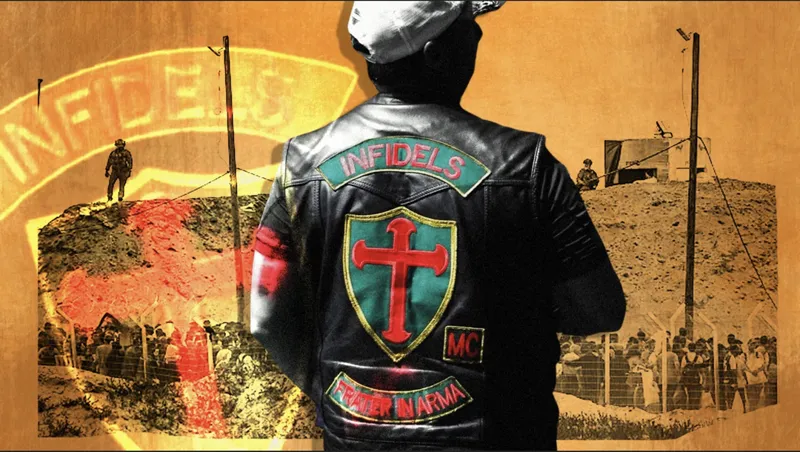
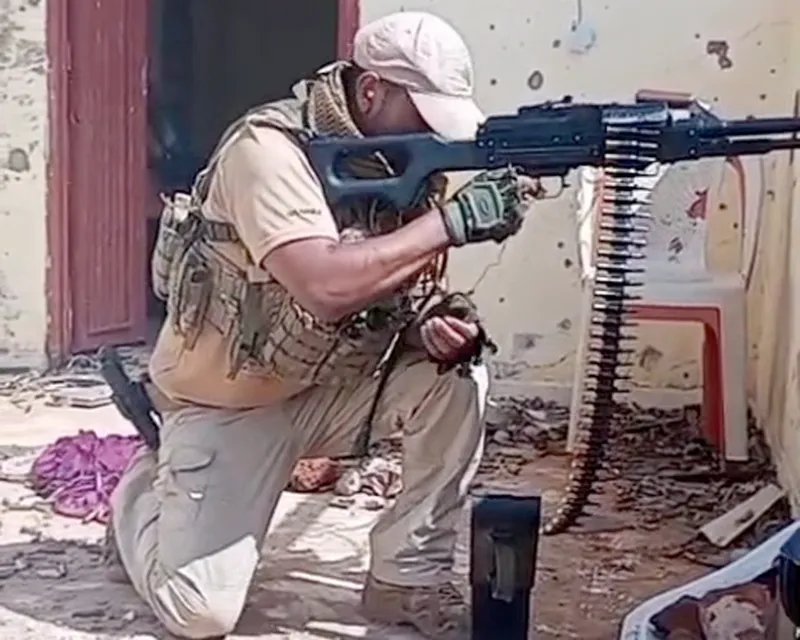
BBC – Anti-Islamic US biker gang members run security at deadly Gaza aid sites
10 September, 2025
Andy Verity, Tom Beal & Will Dahlgreen
[Joshua Miller, leader of a team overseeing security in Gaza] has the word "Crusader" tattooed across his fingers and "1095" on his thumbs. This is the year when the leader of the Catholic church, Pope Urban II, launched the first crusade, attacking Muslims as a "vile race". Mr Miller did not respond to requests for comment.
A post on the Infidels MC Facebook page selling "1095" hats says it signifies the start of the Crusades, "a military campaign by western European forces to recapture Jerusalem and the Holy Land from Muslim control". The "Holy Land" refers to the area mostly covered by modern-day Israel and the Palestinian territories.
Difficult to choose one section to pull from this article, let alone know where to begin. Since the early days of the Global War on Terror, mercenaries and private military contractors (PMCs) have become increasingly common among US-connected overseas security endeavours. It was the ambush and killing of four Blackwater mercenaries that served as the pretext for the extensive operation to capture the City of Fallujah from insurgents in 2004, during the early days of the Iraq War.
Mercenaries can produce a number of operational paradoxes depending on the situation and context in which they are used. For one, as private contractors as opposed to enlisted soldiers, they do not go where they are instructed to go so much as where they are incentivised to do so, be it financially or for other reasons.
As events that have unfolded in Gaza since October 7th 2023 have demonstrated, it is perhaps unwise to entrust the measured and responsible ‘pacification’ of a territory to a state military whose soldiers are motivated by revenge. With the onset of famine and malnutrition in the Strip earlier this year, it was perhaps wise to try to transfer responsibility for security and aid provision to a third party who might bring a more ‘neutral’ hand to the situation.
Apparently, however, no one in the US military apparatus tasked with sourcing and recruiting PMCs to work under the rubric of the Gaza Humanitarian Foundation stopped to ask: What kind of person would want to enter Gaza with a weapon given everything we’ve seen on our screens?
As a corollary to POSIWID, perhaps we can say that, occasionally, a combat situation is what it appears to be. For two years, Gaza has appeared as a free-for-all for the wanton slaughter of Palestinian men, women and children – many of them muslim. Perhaps we should not be so surprised that the GHF got the mercenaries the situation was advertising for.
The Guardian – ‘War is a business’: the Colombian mercenaries training Sudan’s child fighters to ‘go and get killed’
08 October, 2025
Harriet Barber & Santiago Rodríguez Álvarez in Bogotá
“If you enter at 18 and work 20 years, you’re not even 40 when you retire. You have 15, 20 years left of active duty time,” said Dickinson. “The support structure for the Colombian retired military is deficient, particularly compared to the offer that’s on the table from these organisations.”
But Dickinson also warns that the “ecosystem of private defence companies” is no longer limiting itself to retired soldiers. “Defence companies are increasingly recruiting those on active duty, from places where soldiers have a really hard time in difficult conditions,” said Dickinson. “They send WhatsApp pamphlets offering thousands of dollars a month.”
For several decades now, both America’s War on Drugs and attendant internal power struggles within Colombia have turned the South American nation into what might be called a mercenary factory. Owing to the multitude of paramilitary groups operating in the country, such as the ELN and FARC, as well as the numerous drug production and trafficking cartels with whom these groups are aligned or embedded to varying degrees – not to mention the dozens of right-wing paramilitary groups who both oppose and compete with them for territorial control – Colombia is a poor country in constant need of young, well-trained soldiers.
The result? A lot of able-bodied men with considerable military training and experience but whom the state that trained them cannot afford to employ for too long. Consequently, soldiers in their late 30s and early 40s are compelled to spend the next two decades making ends meet shopping their services out on a buyers’ market coordinated via Whatsapp group chats. And once you’ve found guys for a job, you know who to call for the next one.
And that’s how you get Colombian soldiers, who initially guarded UAE oil infrastructure during Saudi Arabia’s war on Yemen, stationed in El Fasher training child soldiers for the Rapid Support Forces (RSF), the Sudanese paramilitary group waging war against the Sudanese Armed Forces (SAF) in that country’s brutal, and bloody civil war, in which over 150,000 people are believed to have been killed, and millions of people displaced – with countless atrocities, massacres and war crimes committed along the way.
The UAE connection also possibly explains why it is that the RSF – who have been accused of many of the worst crimes during the conflict, including the use of mass rape against women and girls as a weapon of war – were found to be in possession of British-manufactured military equipment. Concerns have now been raised that the UK continued supplying military equipment to the UAE despite risks that it would be used to support a notoriously brutal faction in a conflict that is already horrifically bloody, and brutal.
As Carlos, a Colombian mercenary working for the RSF puts it, “War is a business.” As we said in our first episode, blood is a currency. The Sudanese Civil War is a horrific depiction of that currency in circulation.
The Guardian – Milan prosecutors investigate alleged ‘sniper tourism’ during Bosnian War
11 November, 2025
Angella Giufrida & Kim Willsher
Gavazzeni claimed “many, many, many Italians” were alleged to have been involved, without providing a figure. “There were Germans, French, English … people from all western countries who paid large sums of money to be taken there to shoot civilians.”
Gavazzeni added: “There were no political or religious motivations. They were rich people who went there for fun and personal satisfaction. We are talking about people who love guns who perhaps go to shooting ranges or on safari in Africa.”
The multifaceted and oft-overlapping conflicts that erupted across the former Soviet Bloc following the collapse of the USSR are some of the most shocking of the modern era – and ones which I personally hope to become better read on in time. That being said, this story is one that has shocked every individual with whom I’ve discussed it.
Despite our misgivings, mercenaries are a category of violence worker whose economic function makes sense. Wars need fighters, fighting isn’t appealing; some people are good at fighting and willing to do it for a price. Demand & supply/supply & demand.
The idea of wealthy western tourists who are not even necessarily militarily trained paying money for the opportunity to shoot civilians for bloodsport, however, is beyond the pale. That such figures can be captured in words by the ghoulish taxonomy of ‘sniper tourists’ goes to demonstrate how language functions as both our primary means of understanding and also a medium which perpetually fails us.
Indeed, the lexical aspects of this story are those which sit with me most. A ‘traffic of war tourists’; ‘Sarajevo Safari’; ‘indifference to evil’. When I shared the article with Thomas a few days ago, he honed in on the words used to name the charges that prosecutors in Milan were hoping to bring to perpetrators, which feel both grim and wholly insufficient: ‘voluntary murder aggravated by cruelty and abject motives’.
One has to look at the story of the Infidel mercenaries in Gaza and the sniper tourists in Bosnia and ask how much the two stories actually differ. In both cases, money has changed hands in the hopes that a life will be cut down through the barrel of a rifle scope. In the case of Bosnia, the cost was borne by deep-pocketed tourists. In Gaza, the Infidels were paid handsomely for their services. I’m left wondering whether the only difference is that nobody ever asked the Infidels if the experience in Gaza is one they might deem worth paying for.
Perhaps it is for the best that the question went unasked.
“We’ve known each other for centuries.”
An Interregnum, an American Century
CLIP – Shutter Island, 'Does your violence beat my violence?'
https://www.youtube.com/watch?v=A_jOoKtgCZs
I’m a big fan of movies. Good, bad, in-between, it doesn’t matter. I remember, maybe a decade ago, I heard a critic say you have to “meet a movie on its own terms”; that if you go into an Adam Sandler film expecting Citizen Kane, you’re bound to leave disappointed. But if you take Sandler’s faire for what it is, who knows? You might end up enjoying yourself (though, I concede, you are by no means obligated).
Martin Scorcese’s 2010 film Shutter Island is what I like to call one of my ‘warm bath’ movies. It’s comfortable, familiar, and unchallenging, laden with just the right measure of twists, turns, subversion and breadcrumb-trail storytelling that I can ease into it and watch it whenever and always enjoy myself.
Set in immediate post-WWII America with a traumatised veteran as its protagonist, the question of violence—both the role it plays in our world and society, and the profound psychological impact it has on both victim and perpetrator—are, of course, unavoidable.
But on rewatching the other day, I found myself drawn to another dynamic the film puts forward, one of two regimes; a struggle, an interregnum, a transfer of power. The war-scarred detective Teddy Daniels is haunted by memories of liberating a concentration camp; of coming across the camp’s SS commandant who lies on the floor of his office in a botched suicide attempt; of his unit lining up dozens of SS soldiers guarding the camp and executing them in a hail of rifle fire, an action which he describes not as ‘war’, but as ‘murder’.
Elsewhere, Dr. John Cawley describes another power struggle playing out at Ashecliffe Hospital between old-school advocates of the surgical solution, lobotomy, and the psychopharmacological. Between the two, Cawley advocates a third way – meeting patients where they are and seeking to understand them. Another character, a German named Dr. Naehring, could be said to represent a fourth, psychoanalytical perspective, remarking on Daniels’ ‘defence mechanisms’ when he is questioned on his immigration status.
Naehring’s presence as a distinctly German character in a post-war American context stood out on this latest viewing. The relation between the emergent American century and the European one which had been decisively concluded with the end of the Second World War is more pronounced in the film than the camp liberation subplot which explains Daniels’ psychological turmoil. Numerous aspects of the film point to a transfer of power between one regime of violence and another, and attendant questions of whether either are all that different, let alone morally superior or inferior.
In the film’s final moments, Daniels asks his ‘partner’, Chuck Aule, which would be worse: to live as a monster, or to die as a good man? In the context of the plot, we are led to believe the question concerns Daniels himself. In the haze of 2010 and the slow decline of American virtue during the wars in Iraq and Afghanistan, perhaps it really concerns America.
During my viewing, I was particularly caught by the scene linked above, a brief encounter between two ‘men of violence’. The prison guard, Ted Levine, is putatively dressed as a quintessential American lawman. At a glance, his pitch-black uniform, leather driving gloves and the distinctly-shaped badge on his hat are evocative of a different historical figure. It’s in this light that I found their conversation particularly haunting. Hope you enjoy.