
Lightweight
The 20 second clip (like the gif) can be found at the bottom as an attachment!
She filled out the entry form herself, at the kitchen table, with her tongue between her teeth and her glasses sliding down her nose, and she ticked the box that said LIGHTWEIGHT because she is four feet eleven inches tall and she assumed that was what the word meant.
You found out at the weigh-in.
The weigh-in was in a service corridor behind the venue, a folding table, two officials with laminated badges, a medical scale of the type that has a sliding brass counterweight and a beam that clicks. There were maybe thirty women in the line. Real competitors, most of them, brown as furniture with their hair already done and their gym bags at their feet, and the line moved fast because a weigh-in for the lightweight class is not usually a dramatic event.
Your girl stood in that line in a hoodie three sizes too big with the sleeves shoved up, holding her paperwork in both hands like a hymn sheet, and every thirty seconds she looked back over her shoulder to check that you were still where you had been the last time she checked.
"Is it okay that I'm nervous," she said. Not really a question. She had said it eleven times since the car.
You told her it was okay.
"Because I don't feel nervous in my body, I feel nervous in my hands," she said, and held them up, and they were shaking, and they were also the size of oven mitts and knotted from wrist to knuckle with cabling that moved when her fingers moved. "That's a weird place to feel it. Is that normal? Do you think that's normal?"
The line moved. She got to the table. She put her paperwork down, took off the hoodie, and handed it to you, and the corridor went quiet in a wave that started at the scale and traveled backward over thirty women in about four seconds.
You have gotten used to her. That is the thing you keep having to remember at moments like this. You have had two years of watching it happen at close range, one session at a time, and the arithmetic sneaks up on you until you are standing in a corridor full of professional bodybuilders and every single one of them has stopped talking.
She stepped up onto the scale in her beige posing suit and her socks and her round wire glasses, and the official slid the brass weight along the beam to the far end of the lightweight range, and the beam did not move.
He looked at it. He slid the counterweight back and moved the big weight up a notch. The beam did not move. He moved it up again. Nothing. He moved it up a third time and the beam finally lifted off its rest and floated, and he leaned over to read it, and then he stood there for a second not saying anything at all.
"Two thirty-one," he said.
The woman behind your girl in the line said something quietly in Portuguese.
"That's not right." The second official came around the table. "That can't be right. She's not five feet tall. Get off, please. Get off the scale."
Your girl got off the scale and apologized, and stood there with her paperwork clutched against the front of her, and the man knocked the counterweight back to zero and watched the beam settle and tapped it twice and told her to get back on.
She got back on. Two thirty-one.
"Two hundred and thirty-one pounds," the first official said, to nobody, in the tone of a man reading out a number that has personally insulted him. He looked up at her. He had to look up, even though she is four foot eleven, because she was standing on the scale platform. "Ma'am, do you understand the lightweight limit is one hundred and fifteen?"
"Oh." Her whole face went scarlet from the collar of her posing suit to the roots of her hair. She pushed her glasses up her nose with one enormous shaking finger. "Oh no. Oh, I'm sorry. I thought that meant, um. I'm very short. I thought it was for short people."
Somewhere back in the line, someone laughed and then immediately stopped laughing.
The second official was flipping pages. "She's over heavyweight too. Heavyweight tops out well under this. There isn't." He turned a page and turned it back. "There isn't a class."
"Can I still do it?" Your girl's voice had gone very small. She looked back at you over the shelf of her own shoulder with her eyes huge behind those lenses, and you have seen that exact expression on her when she has broken a glass. "I trained for it. I did a whole peak week. My coach wrote me a peak week and everything, I did all of it, I didn't even have the salt."
The officials looked at each other. Then they looked at her.
Then they looked, both of them at once and without meaning to, at her shoulders, because from the front, standing still on a scale platform in a service corridor with her hands folded politely in front of her, that was the part that had stopped being possible.
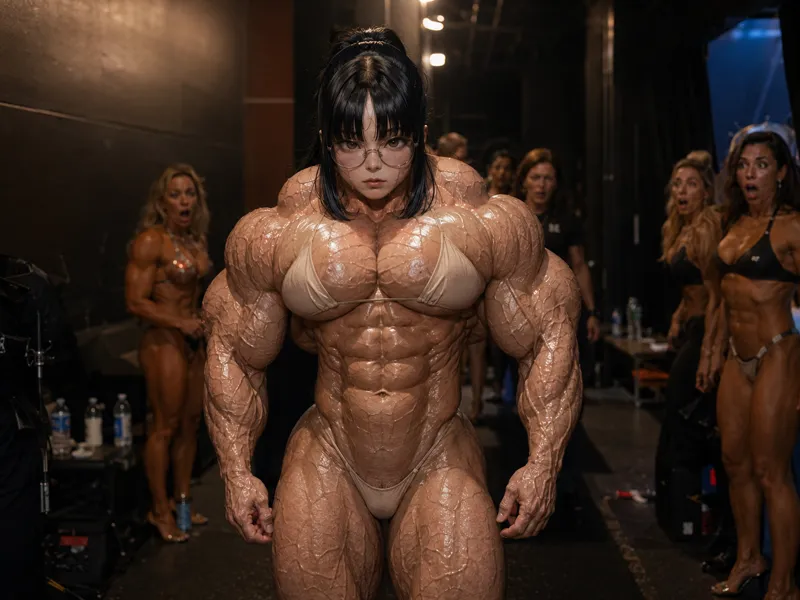
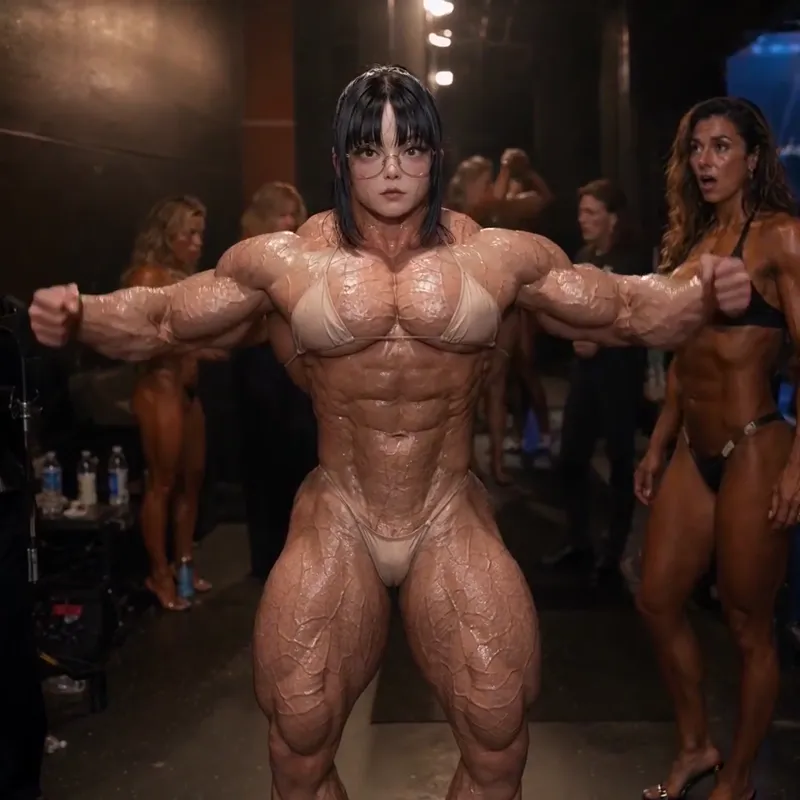
They sat on either side of her neck like two boulders that had been rolled there and left. Not slopes. Not caps. Spheres, one on each side, each of them bigger than her own head and shoved so high and so wide by the mass underneath that they crowded her jaw on both sides and left her small round face sitting in a socket of her own muscle. The overhead striplight came straight down on them and each one caught it in a hard white ring, and inside the ring you could count the separate heads: the front one bunched forward into a rounded plate, the middle one flaring out sideways past the width of her own hips, the rear one balled up behind and dragging the whole assembly further out still. The skin over them was not doing what skin does. It was too full underneath to lie flat, so the surface crumpled and folded over the crowded muscle beneath in a texture like packed sacking, and over that ran the veins, and over the veins ran the oil, and every single thing she had was shining.
She shifted her weight, embarrassed, and the entire structure rolled and reset and made a small leathery noise.
"Go through," the first official said. He did not write anything down. "Just go through. Somebody upstairs can figure out what you are."
Backstage was worse, because backstage had lights.
It was a long dark room behind the stage flats, hot as a laundry, jammed with folding tables and open bags and a pump-up corner full of dumbbells with the numbers worn off. The overhead cans threw hard orange light down through the dust. Past the black drapes at the far end you could see the cold blue wash of the stage, and hear a compere, and hear applause arriving in waves for the classes that had already gone.
There were perhaps twenty women in there. Genuinely, seriously accomplished women, oiled to a shine, most of them holding a pump, going through poses in front of each other with the loose calm of people who have done this thirty times. Two national-level competitors. One woman who had been in magazines.
You carried her bag in and set it down, and she walked in behind you, and the room did the thing the corridor had done, except slower and much worse, because backstage nobody has anywhere to look away to.
She stopped just inside the drape. She put her hands together in front of herself. She said, "Hi," to the room in general, in a voice you could barely hear.
Nobody answered her.
She came and stood next to you by the water table and immediately began the small nervous business she does when she wants to become smaller: shoulders forward, chin down, hands tucked in. It does not work. It has never once worked. Rolling her shoulders forward simply drove her chest into full relief, and her chest, in a beige competition bikini under those lights, was the single most disruptive object in the building.
There was nothing soft in it anywhere. Two enormous squared slabs sat across the front of her ribs and hung out over the line of her own stomach far enough to throw a hard shadow down onto the top row of her abs. Each one was deeper front to back than her head was long. The little beige top she had been so proud of, that she had picked out at the shop because it matched her skin and she thought that was clever, had given up entirely on its job and was simply lying across them, strained, a strip of fabric that had lost an argument. Where the two slabs came together they did not meet in a line. They collided in a canyon four inches deep with its own darkness in it, and the oil had run down into that canyon and was standing there in a bright seam. Across the top of each slab, at every breath, the striations surfaced in feathered ranks, dozens of hard lines all fanning inward toward that trench, and the skin over the whole assembly was folded and crumpled by the sheer volume packed underneath it.
She breathed and the two slabs rose against each other and something in her ribcage creaked audibly across four feet of room.
"They're all looking," she whispered.
"They are."
"Can I put the hoodie back on?"
"You cannot."
She made a tiny miserable sound and pushed her glasses up her nose, and then, because she is who she is, she picked up two of the water bottles off the table and offered one to the competitor closest to her, a tall blonde who had not blinked in some time.
The blonde took it. The blonde did not stop staring while she took it. The blonde then stood there holding a water bottle she had not asked for, looking at a four-foot-eleven woman in reading glasses whose forearm, at rest, hanging loose at her side, doing absolutely nothing at all, was thicker through than her own thigh.
The one who finally said something was the veteran.
You know the type on sight. Late forties, deep tan gone almost mahogany under the lights, curly brown hair loose down her back, black posing suit, and a physique that had obviously been built patiently across twenty years and defended in a lot of rooms. She had the calm of the biggest person present. She had probably had that calm since about 2009.
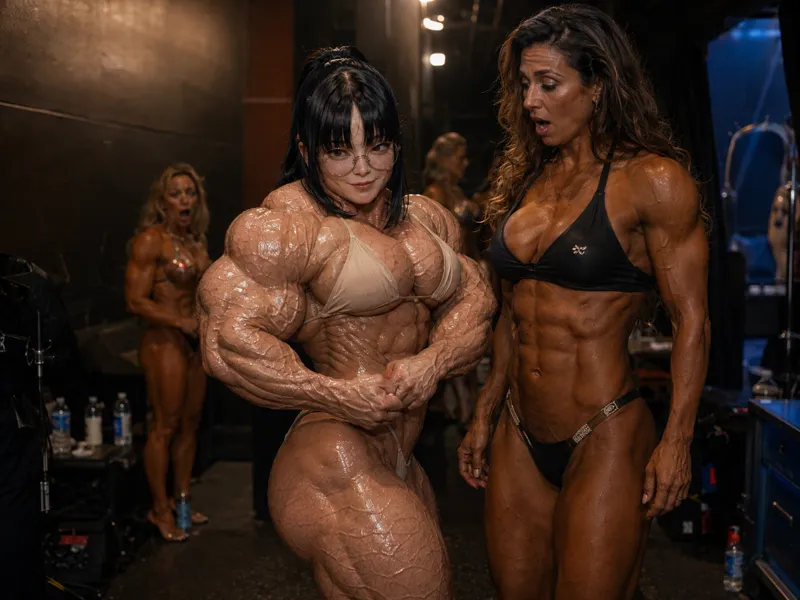
She came over with a plastic cup in her hand, looked your girl up and down for a long moment, and said, in an accent, "What class are you in?"
"Um." Your girl went red again. "They didn't. There isn't one."
"There isn't one," the veteran repeated.
"I put lightweight." Her voice dropped. "I thought it meant short."
The veteran looked at her for a second longer. Then she set the cup down on the table with the exaggerated care of a person putting down something they have forgotten they were holding.
"How long have you trained?"
"Two years?" It came out as a question. She looked at you to check. You nodded. "Two years. My coach does my programming. He does all of it, I just do what he writes down."
"Two years." The veteran's jaw moved. "I have been competing for twenty-two."
"Oh, that's amazing," your girl said, with total and obvious sincerity, and you could see it land wrong, because it was so kind and so unarmored that it was worse than anything else she could have said.
The veteran was quiet for a moment. Then she said, "Flex for me."
Your girl's head came around to you so fast her ponytail hit her own shoulder.
That is the part you want to describe properly, because in a room full of professionals, with a twenty-two-year veteran standing in front of her waiting, she did not flex. She turned and looked at her coach, and she waited, and she would have gone on waiting.
You told her to go ahead.
She raised her right arm and turned her fist in, and the room lost its footing.
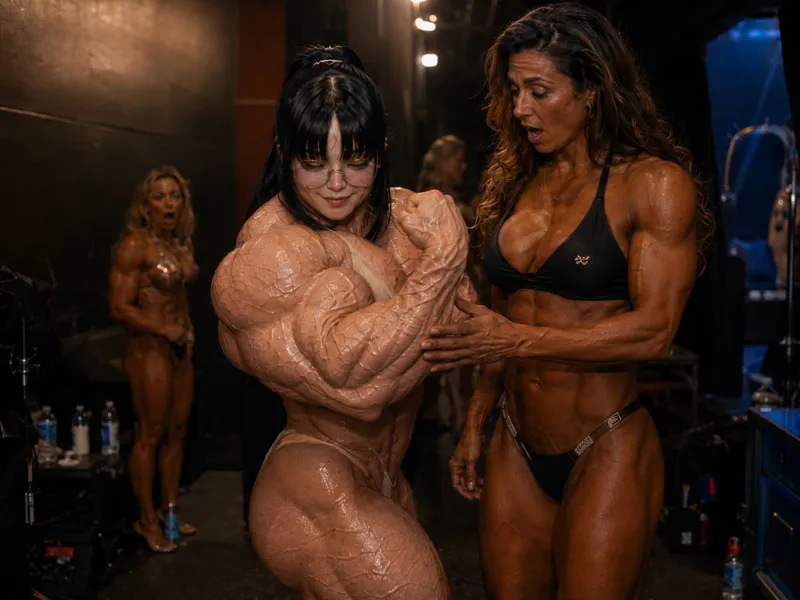
It came up off the bone the way a hill comes up out of flat ground and it kept going long past where any hill has the decency to stop. It rose past the line of her shoulder. It rose past the line of her jaw. The crown of it crested higher than the top of her own head, and her small round face was tucked in beside it behind those glasses for scale, so there was no possible argument to be had: the arm was bigger than the head. It was bigger than the head by a wide and obscene margin.
The peak split down the middle. A clean valley ran the length of the crown and divided the mass into two distinct heads, the inner one riding higher than the outer, one dome stacked on top of another dome, and as she tightened the squeeze the crest crowded forward and jammed against the meat of her own forearm and had nowhere left to go. It went anyway. The two heads shoved apart to make room that did not exist, and the valley between them sank deep enough to take three fingers.
The surface of it had stopped being smooth. There was so much muscle underneath and so little of anything else that the skin could not lie flat over it: it gathered and crumpled and folded across the belly of the arm in fine ridges, like a sheet pulled over furniture, and through those folds the striations printed anyway in hard bright cords, and the veins lay on top of everything else, one trunk climbing out of the forearm and forking at the base of the peak and running up both walls of that valley in ropes that stood a finger's width proud of her.
And at the top of all of it, that small tight fist, and the polish on her nails, and the glasses, and the shy pleased scrunch of her face as she peeked up at the arm she had just made.
The veteran said a word in Portuguese that was not a compliment and was not an insult.
She had lifted one hand halfway. She was not aware of it. Behind her, a woman in a black suit stopped mid-pose with her arms still up. Somebody knocked a bottle off a table and did not go after it. The blonde who had been given water was standing with her mouth open in a way she would have been embarrassed about later, if she had known.
"Sorry," your girl said, because the silence had gone on too long. She started to lower it. "Sorry, is that. Was that too much? I can do a smaller one."
"No." The veteran's voice came out wrong. She cleared her throat. "No. Keep it. Keep it there." And then, with a great deal of difficulty, because she was a person who had spent twenty-two years never once needing to ask this of anyone: "Can I touch it?"
Your girl said yes the way she says yes to everything, immediately and a little too eagerly, and held the flex.
The veteran put her hand on it, and that was the moment the whole backstage understood what it was looking at, because now there was a ruler laid against it.
Her hand was not a small hand. It was a hard, capable, working hand with a competitor's grip and twenty-two years of barbell knurling in the calluses. She laid it across the crown of the peak and it covered maybe a third. She had to move it twice to feel across the width. When she pressed, nothing gave. Not a millimeter, not anywhere, not the smallest yield anywhere under the heel of her palm, and you watched her lean in and press harder to check, the way you would test a wall you did not believe was load-bearing, and the arm simply refused her.
"Is it okay?" your girl asked. Her eyes had gone half shut behind the glasses. She was smiling, small and private and delighted, chin tucked, all the mortification of the last hour dissolving into something warm. "Am I holding it right? I can hold it harder if you want to feel it properly."
"Do that," the veteran said hoarsely.
She squeezed, and the peak grew under the woman's hand.
You watched it happen from three feet away. The whole mass pushed up into that palm and lifted it visibly, the crest climbing, the split at the top pulling wider as the two heads shoved further apart, the folded skin over the belly of it drawing tighter and smoother as the volume underneath came up to fill it. A vein that had been the width of a cord fattened into a rope and crawled up over the crown of the peak while a professional bodybuilder had her hand on it. Deep inside the arm something creaked.
The veteran took her hand away. She looked at her own palm for a second, then at her own arm, then at nothing in particular.
"You should not exist," she said.
"I'm sorry," your girl said, instantly, and meant it.
"No." The woman shook her head. She was almost laughing, and it was not entirely a happy sound. "No, I do not mean. You should not apologize for that. Never apologize for that." She looked past your girl at you, and there was something complicated in it, a professional identifying the person responsible. "You are her coach?"
You said you were.
"What is she going to look like in five years?"
You did not have an answer for that. Neither does anybody.
They did not know what to do with her, in the end.
A woman with a clipboard and a headset came backstage during the middle of the figure class and had a low conversation with two other people with clipboards, and then came over and explained, in the careful voice of someone delivering a decision made at a level above her own, that there was no class into which your girl could be entered, that the scoring criteria did not have a place for what she was, and that if she was willing, they would like to bring her out at the end of the evening, on her own, for a guest posing spot.
"Is that bad?" your girl asked, when the woman had gone. She was gripping the edge of the table. The table was making a noise. "That's bad, isn't it. That means I don't get to compete. That means I did it wrong."
You told her what it meant. That there were twenty women backstage who had spent between five and twenty-two years earning the right to be in a class, and the show had just decided that putting her in any of them would not be a competition, it would be a demonstration, and that they were going to give her the last spot of the night, alone, on the stage, with the lights on her and nobody standing next to her for comparison, because there was nobody in the building who could stand next to her.
She thought about that.
"So I'm not in a division," she said slowly.
"You're above all of them."
The blush came up her whole body this time. You watched it cross her chest and climb the crumpled skin of her neck and go into her face, and behind the lenses her eyes went bright and wet, and she took her glasses off and cleaned them on absolutely nothing, which is what she does when she needs a job for her hands.
"Okay," she said. "Okay. Um."
She put the glasses back on. She looked around the room, at the veteran retaping her heel, at the blonde still holding the water bottle, at all those hard-won brown bodies that would be up first, and then she came in close to you so nobody else would hear, and she got up on the balls of her feet, which brought her almost to your shoulder.
"I did the whole peak week," she whispered. "I did exactly what you wrote. Every single thing. And I came in bigger than the last check-in, I checked in the mirror at the hotel, my arms didn't fit in the sleeve of the hoodie this morning and they fit last month." Her hands had found each other in front of her. "Was it right? Did I do it right? Is this what you wanted me to look like?"
You told her yes.
She made a small sound and dropped her forehead onto the top of your shoulder, which is a considerable thing to have happen, and stayed there for a second, and every eye in that room was on the two of you and she had entirely stopped caring.
Then she straightened up, and pushed the glasses up her nose, and looked toward the black drapes and the blue light and the noise of a crowd she was going to walk out in front of alone.
"After tonight," she said, and her voice had changed. Still small. Not shy anymore. "When we're home. Can you write me a harder one?"
"A harder what?"
"A harder everything." She rolled her shoulders and the two boulders came up and the whole crumpled shining structure of her reorganized itself and settled, and she looked back at you with her chin down and her eyes up. "There's no division for me. So there's nothing to make weight for anymore, is there. Nothing to stay under. I could just." Her hands opened. "I could just keep going. Couldn't I."
Out past the drapes the compere was calling the lightweight class to the stage, and eight women went by, and every one of them turned their head as they passed her.