











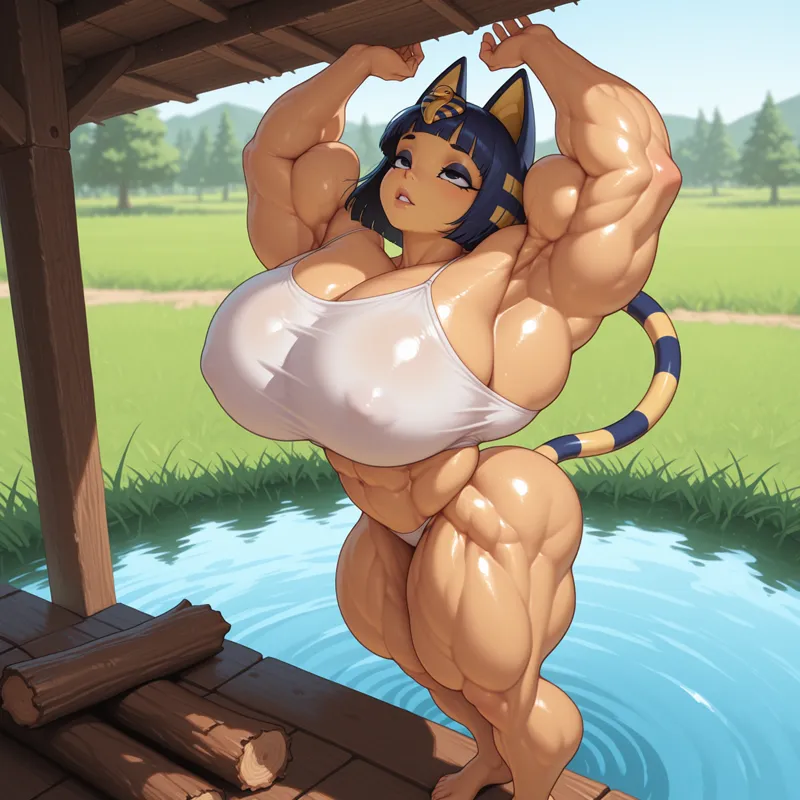
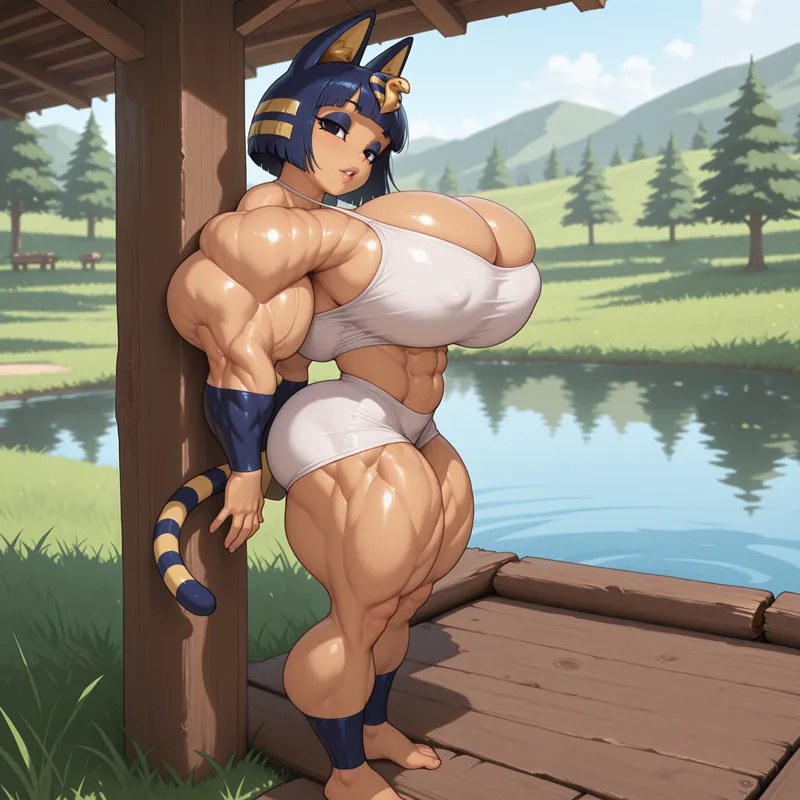

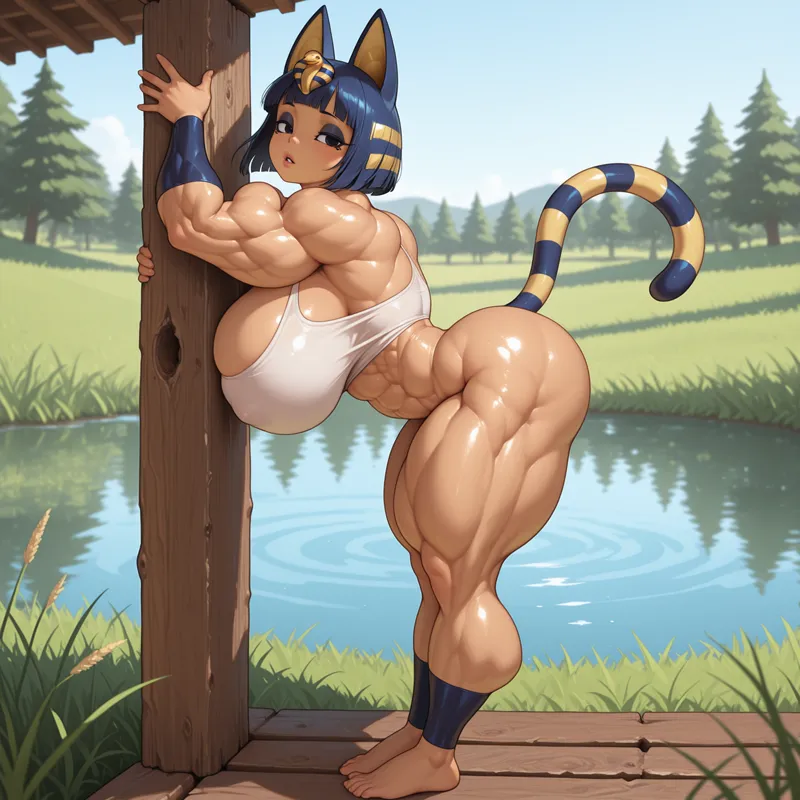

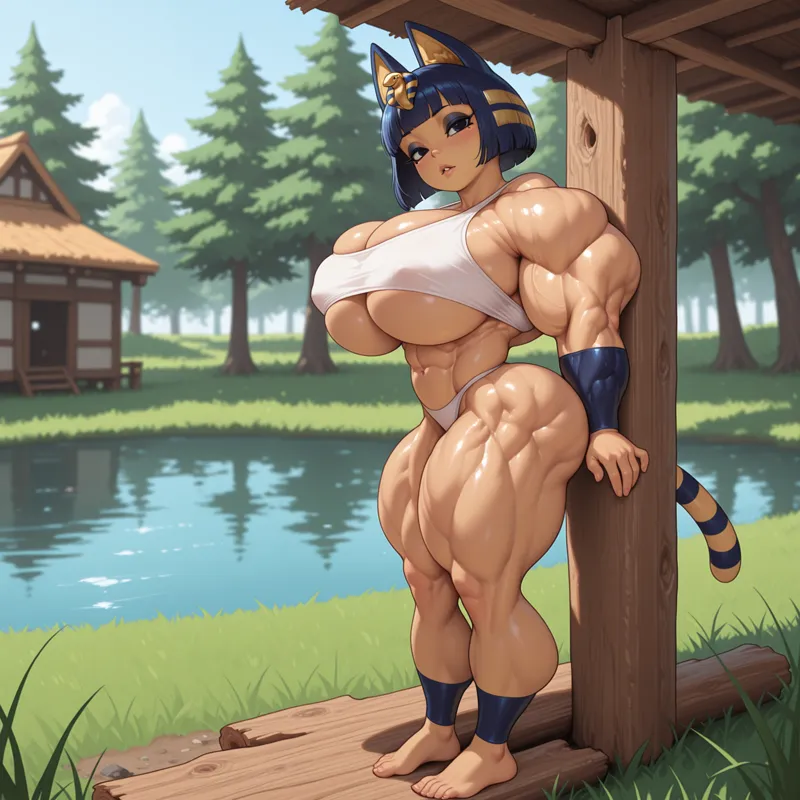
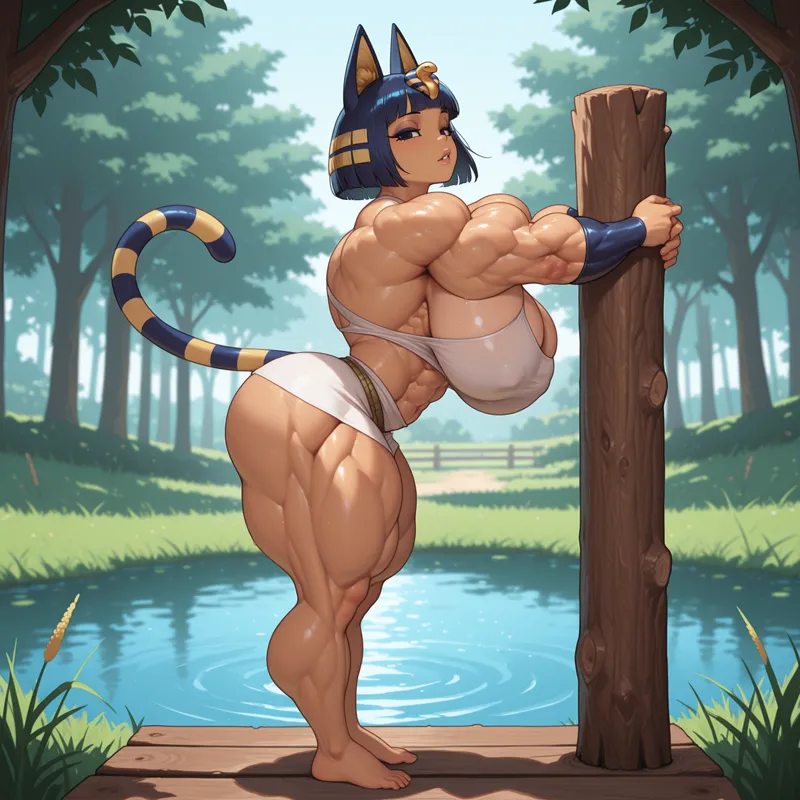
Ankha's move-In Day
The phone call came the way it always does, a little too cheerful, a little too late at night.
"Yes, yes! Wonderful news!" Tom Nook's voice had that particular warmth he reserves for moments when money has already changed hands. "A new villager has purchased the plot beside the pond! A cat, hm? Snooty type, so mind your manners. Goes by the name of... Ankha, yes yes. Moving boxes arrive tomorrow. Do give her the usual warm welcome, hm?"
You went to bed picturing the usual. You'd hosted cats before. Little round things, knee-high, stubby paws, big heads, the kind of neighbor who fits through a door with room to spare on every side and asks you to catch them a horse mackerel. A snooty cat meant a small fussy creature who would complain about your shirt and then secretly leave medicine in your mailbox when you got stung by wasps. You knew exactly what was coming. You had done this a dozen times.
The next morning, Isabelle's announcement had an odd wobble in it.
"Good morning, everyone! Today's updates. A new villager is moving in beside the pond... and, um. The movers have resigned. That's all! Have a wonderful day!"
The movers had resigned. You chewed on that the whole walk across the village, past the plaza, past the twins stocking shelves, down the slope toward the pond where the new plot sat staked out in the grass. There was a soft sound carrying over the water, rhythmic, heavy, like someone dropping sandbags in time. Thoom. Thoom. Thoom.
The moving boxes were arriving. They were arriving four at a time.
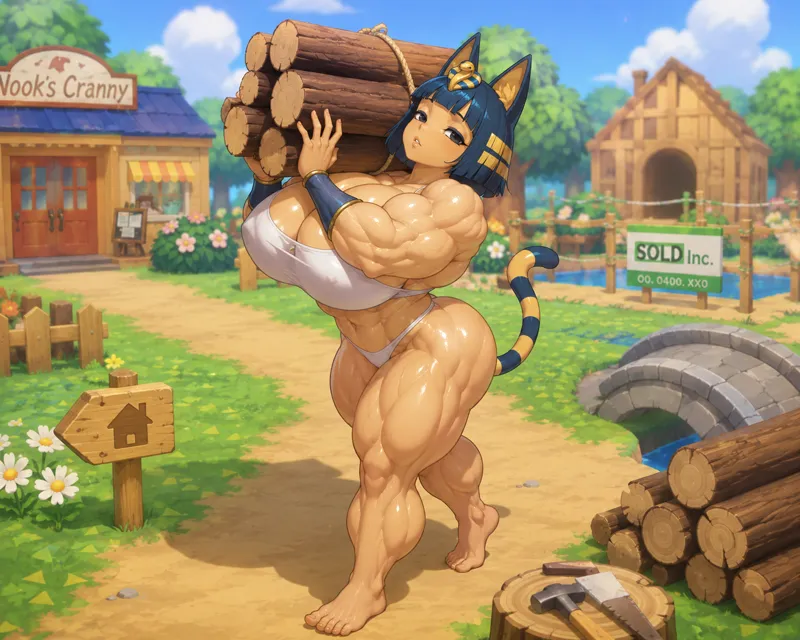
The stack came around the bend of the cliff first, six crates high, the kind of tower two movers would carry together at a shuffle, leaning back, complaining. This tower floated along at a brisk walking pace, and beneath it, where the movers should have been, there was one bare forearm.
That was the first piece of her you ever saw, and it was already too much. The arm wrapped around the base of the stack the way a dock post wears a rope, and it did not shake. Along the top of it ran a ridge of muscle thick as a mooring line, splitting into cords at the wrist, and beneath the honey-tan skin a single blue vein rode the whole length of it, calm and fat and unbothered, the arm of something that hauls stone for a living. The crates creaked. The arm didn't.
Then the stack tilted, and she looked out from behind it, and your entire understanding of the word "villager" quietly lay down and passed away.
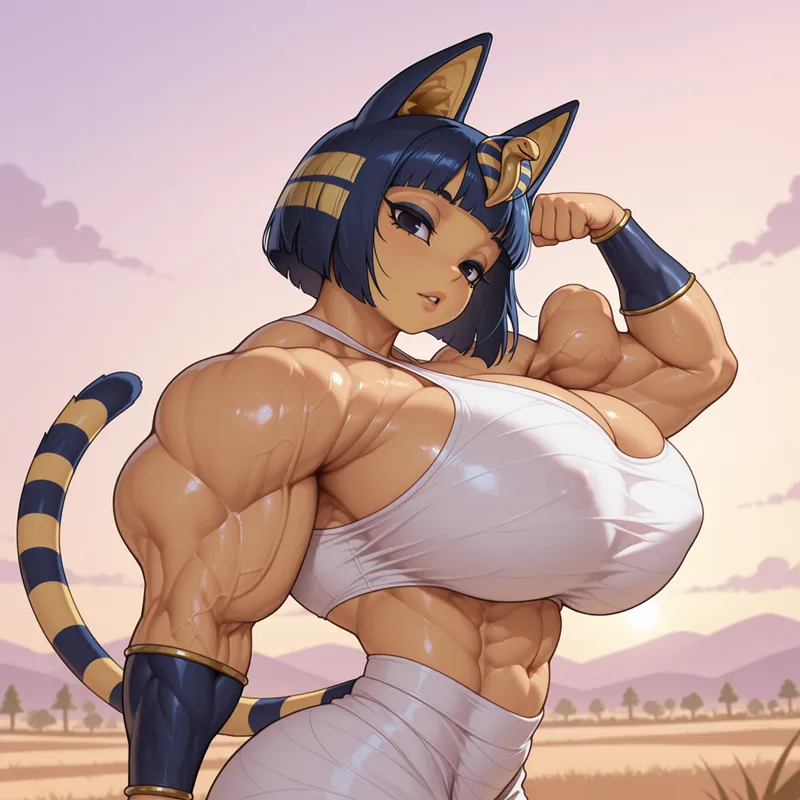
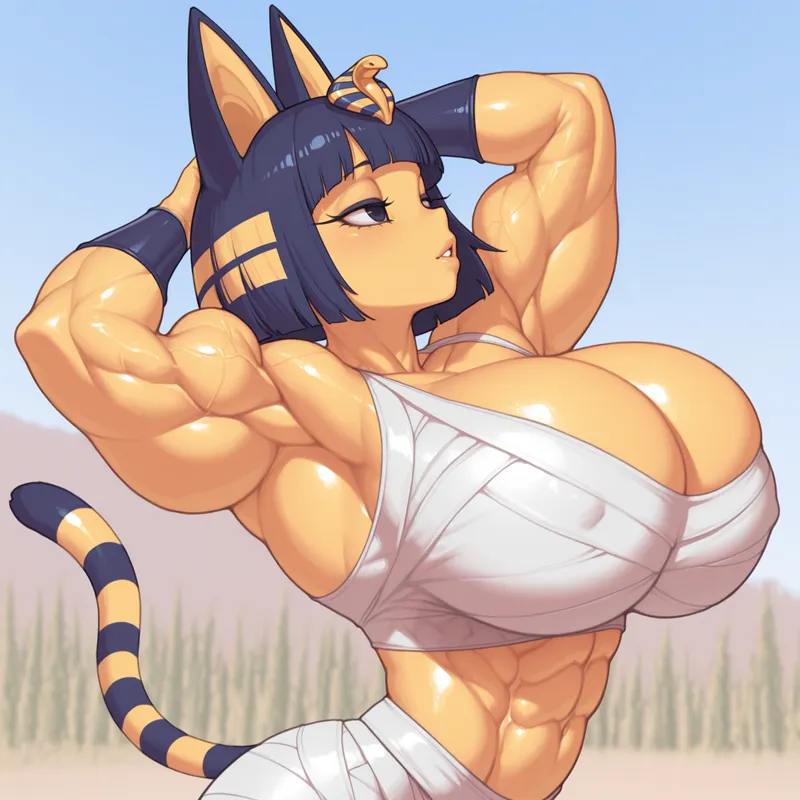
She was not knee-high. She was not stubby. She was a head taller than you and more than twice as wide, and every inch of the difference was muscle. The navy bob, the blunt bangs, the golden cobra pinned above her brow, the sleepy black eyes with their heavy painted lids, the little parted lips: all of that was exactly the snooty cat the brochure promised, delicate and regal and faintly annoyed. It simply sat on top of a body that belonged on the front of a strongman magazine from some much older, much stronger civilization. White wraps wound around her chest and hips like she'd raided her own tomb for sportswear, and they were losing an argument they had clearly been losing for years.
"You," she said. Her voice was low and flat and ancient, like a queen reading a grocery list. "You are the resident representative. Me meow." A pause. The tail behind her, blue and gold and striped, gave one slow interested swish that her face refused to acknowledge. "You are smaller than the brochure implied."
You said something. Honestly, to this day, you don't know what.
She set the crates down with a care that made no sense next to their weight, the stack of them settling into the grass without a bump, and straightened up, and that was its own event. Watching her stand was like watching a drawbridge raise. Her shoulders came up and up, and kept coming, each one a smooth carved boulder that shone in the morning light, packed so high and round on either side of her neck that the cobra pin nearly vanished between them. When she rolled one to loosen it, the muscle moved in plates, sliding over each other with a faint creak you could hear from six feet away, like old leather in a quiet room.
"The movers," she said, "were slow. I dismissed them at the airport." She glanced at the tower of crates, then at the staked-out plot, then at you, and the sleepy eyes narrowed one degree. "I require nothing further. Unless you wish to instruct me. Do you wish to instruct me?"
There was something underneath the flatness of that question. You wouldn't learn what it was until later. At the time you just pointed weakly at the plot and said the boxes could go anywhere, and she nodded once, gravely, as if you'd handed down a decree, and turned to the work.
You want to know what the whole village learned that morning, one muscle at a time.
Her back came first, because she turned around, and her back blotted out the pond. The wraps left it bare from shoulder to hip, and it was less a back than a landscape, two great slabs of lat flaring out from a deep central canyon of spine, wide enough that her arms had to swing around them when she walked. When she bent to lift the next stack the whole expanse spread wider, valleys opening between muscles you did not know had names, the surface rippling like water under wind, and the twins, who had come down from the shop with a welcome basket of peaches, stopped dead at the top of the slope. One of them dropped the basket. Neither of them picked it up. The peaches rolled the whole way down the hill and came to rest against her ankle, and she looked down at them, and said, "An offering," with complete seriousness, and kept working.
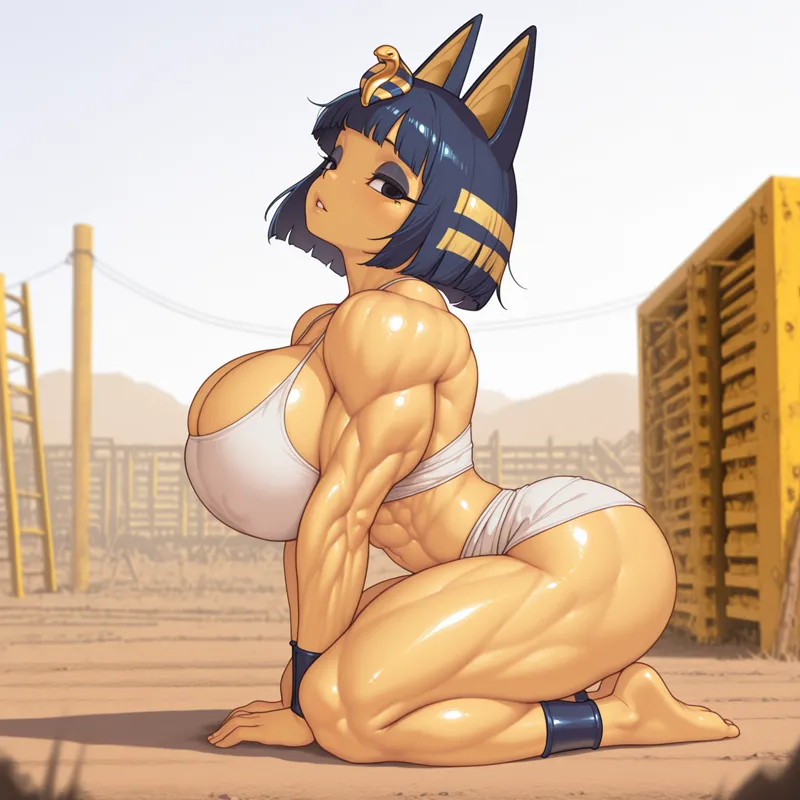
Her legs were the part that ended the village's morning entirely. She knelt at the water's edge to wash her hands when the hauling was done, settling back on her heels beside the little wooden dock, and her thighs simply took over the scenery. Each one was a single sweeping column of quad broader than your whole torso, carved down the front with long clean lines of separation, glossy with effort, so dense that when she shifted her weight the muscle barely deformed, it just moved, all of one piece, like something geological deciding to relocate. A villager walking a dog on the far bank turned around and walked the dog home. The dog kept looking back.
And through all of it, above all of it, that face never changed. Sleepy. Regal. A little bored. The delicate painted face of a snooty cat villager doing snooty cat things, riding around on top of a body that creaked when she breathed deep. That was the thing you couldn't stop staring at, the impossible arithmetic of her, the tiny hands at the ends of those forearms, the soft cheeks above that neck, the ancient bored elegance stretched over enough muscle to tow the entire village half a tile to the left.
By noon the house was up. Not the tent new villagers usually camp in, the actual house kit, the one that comes flat on a pallet and takes a construction crew a full day. She read the instructions once, held the main beam overhead with one hand while she considered the diagram in the other, and assembled the thing the way you'd assemble a sandwich. When the frame stuck, she encouraged it, and the encouragement went through the joint with a bang that scattered birds off the cliff. The finished house had a small golden pyramid over the door. She was very pleased with the pyramid. You could tell because she looked at it for four seconds instead of two and her tail did the swish again.
"Representative," she said, when the last box was inside. You were sitting on the dock by then because your legs had stopped being decorative some time earlier. She came and stood before you, and the afternoon sun came off her shoulders in actual glare, and she looked down at you with those half-closed eyes and delivered, in the same flat royal voice, the sentence that rearranged your entire year:
"I chose this village because of you."
You asked what that meant. She looked out over the pond.
"I read the brochure. It said the representative shapes the village. Decides where everything goes. What stays. What grows." The tail swished once, twice, entirely against orders. A faint color had come up under the paint on her cheeks, the first crack in the royal mask all day, and her voice, when it continued, was one shade less flat. "I am four thousand years old, meow. Pharaohs worshipped me. Empires carried my likeness on their shields. It was tedious beyond description." She turned back to you, and for a moment the sleepy eyes weren't sleepy at all. "No one in forty centuries has ever told me what to do. I have decided I would like to find out what that is like. You will decide things, and I will build them. You will point at problems, and I will pick the problems up and put them somewhere else. This arrangement pleases me. Does it please you?"
You managed a nod.
"Good." The mask slid smoothly back into place, but the tail was going like a metronome now, and she made no move to stop it. "Then instruct me. The rock by the waterfall that spits bells when struck. The trees that must be shaken. The cliffs your flimsy ladder disgraces you on. Assign me the heaviest thing this village has." She bent down, closer, and you realized her forearm at rest, propped on one colossal knee, was thicker than your chest, and that the fat calm vein along the top of it had begun, very slightly, to stand up prouder, as if the mere discussion of assignments was pumping her up. Knowing her now, it was. "And tomorrow," she said, quieter, almost, if such a word could survive contact with her, hopeful, "assign me a heavier one. I did not carry this body across an ocean to lift furniture once and nap. It requires more. I require more. The village is small, representative."
She straightened, all of her, the whole creaking royal monument of her, and looked down at you with the peaches still lying like tribute at her feet and the sun setting fire to forty centuries of muscle, and the last thing she said before walking into her pyramid was delivered exactly the way she'd said everything else, flat, ancient, final, except that her tail had curled into a complete and joyful question mark behind her:
"I will grow anyway. It would go faster with your permission. Sleep well, meow."
The door closed. The pond settled. Somewhere up the hill, very faintly, you could hear one of the twins still trying to explain the peaches to the other.
You walked home in the dark past the notice board, where tomorrow Isabelle's handwriting would announce, in her sunniest bureaucratic panic, that the money rock had been found in a new location, embedded, and that residents were kindly asked not to worry about it. And you found, somewhere between the plaza and your front door, that you were already doing the thing she'd asked. You were making a list. Boulders. Trees. The old bridge that sagged. Heavy things. Heavier things.
Something to be worthy of assigning her in the morning.
Comments (1)
This is great! Thank you!