


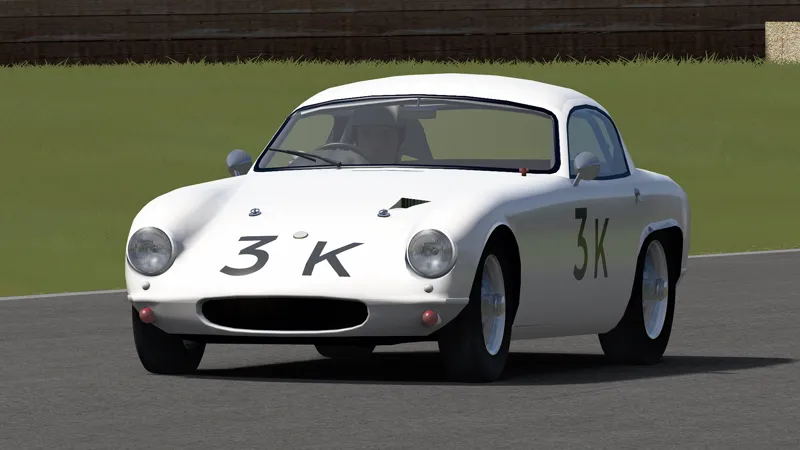
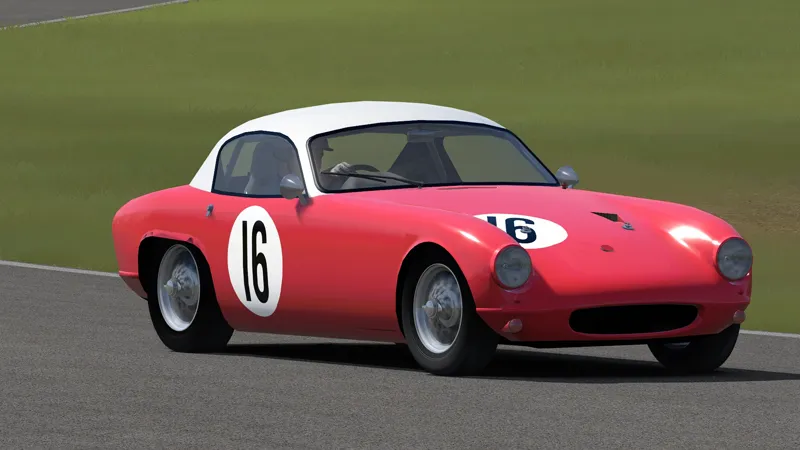
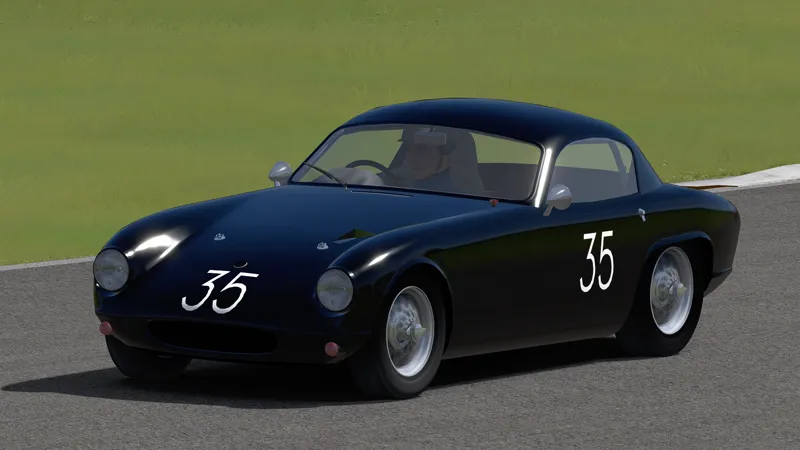

Lotus Elite Type 14 Works Appendix K
Lotus Elite Type 14 Works Appendix K (1960 to 1964)
Developed by Dream Sim and Changes by ABB to fit into Appendix J and K Racing in Australia in the early 1960s.
The Lotus Elite name has been used for two production vehicles and one concept vehicle developed and manufactured by British automobile manufacturer Lotus Cars. The first generation Elite Type 14 was produced from 1957 until 1963 and the second generation model (Type 75 and later Type 83) from 1974 until 1982. The Elite name was also applied to a concept vehicle unveiled in 2010.
Type 14 (1957–1963)
Lotus Elite (Type 14)Lotus Elite
Production1957–1963Designer
Peter Kirwan-Taylor
Body and chassisClassSports car (S)Body style2-door coupéLayoutFront-engine, rear-wheel-drivePowertrainEngine1.2 L Coventry Climax FWE I4[1]Transmission4-speed manualDimensionsWheelbase2,242 mm (88.3 in)[2]Length3,759 mm (148.0 in)[2]Width1,506 mm (59.3 in) [2]Height1,181 mm (46.5 in)[2]Kerb weight503.5 kg (1,110 lb)ChronologySuccessorLotus Elan
The first generation of the Elite or Lotus Type 14 was a light weight two-seater coupé produced from 1957 until 1963.
The car debuted at the 1957 London Motor Car Show, Earls Court, bearing chassis number 1006.[a] The Elite had spent a year in development, aided by "carefully selected racing customers" before going on sale.[6]
The Elite's most distinctive feature was its highly innovative fibreglass monocoque construction, in which a stressed-skin Glass reinforced plastic unibody replaced the previously separate chassis and body components. Unlike the contemporary Chevrolet Corvette, which used fibreglass for only exterior bodywork, the Elite used glass-reinforced plastic for the entire load-bearing structure of the car. A steel subframe for supporting the engine and front suspension was bonded into the front of the monocoque, as was a square-section windscreen-hoop that provided mounting points for door hinges, a jacking point for lifting the car and roll-over protection components.[7] The first 250[8] or 280[4]: p.86 body shells were made by Maximar Mouldings at Pulborough, Sussex. This body/chassis structure caused numerous early problems, until manufacture was handed over to Bristol Aeroplane Company.[6]
The resultant body was lighter, stiffer, and provided better driver protection in the event of a crash. Still, a full understanding of the engineering qualities of fibreglass-reinforced plastic was several years off, and the attachment points for the rear suspension arms were regularly observed to pull out of the fibreglass structure. The weight savings allowed the Elite to achieve racecar-like performance from a 75 hp (56 kW), 1,216 cc (1.2 L) Coventry Climax FWE all-aluminium straight-four engine while returning a fuel consumption of 35 mpg‑imp (8.1 L/100 km; 29 mpg‑US).[1] All production Elites were powered by the FWE engine, except for one that acted as a testbed for the newly developed Lotus-Ford Twin Cam engine. The FWE engine was derived from a lightweight (FW = Feather Weight) one-man-trolleyed water pump engine used for firefighting.[9]
The car had independent suspension all round with transverse wishbones at the front and Chapman struts at the rear. The rear struts were so tall, that they poked up in the cabin and the tops could be seen through the rear window from a car behind.[1] The Series 2 cars, the first 31 with Maximar and the rest with Bristol-built bodies,[4]: p.86 had triangulated trailing radius arms for improved toe-in control. Girling disc brakes, usually without servo assistance, of 9.5 in (241 mm) diameter were used, inboard at the rear. When leaving the factory, the Elite was fitted with Pirelli Cinturato 155HR15 tyres on wire wheels.
Download for Free
https://mega.nz/file/MiJXgToI#OCW0f3sF09sW0dUPHOzSb5SYddcKOAwUPNRVv9ypOx8
Comments (2)
Sim Dream
Thank you!!