
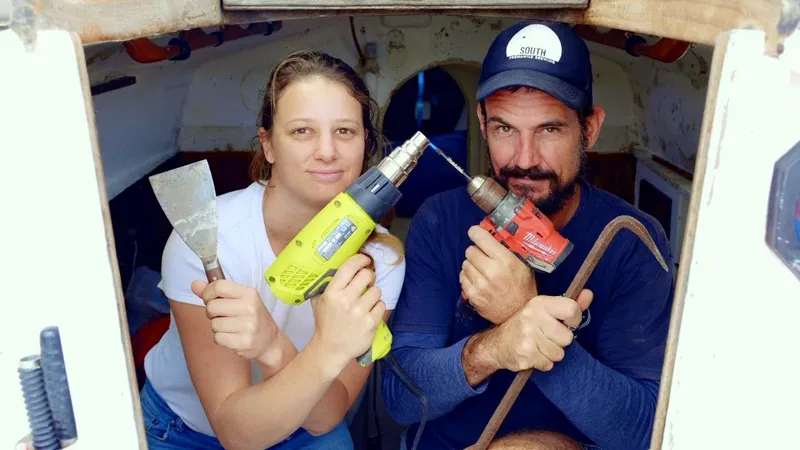
Demolition, Rewire and Forage - Episode 143
This week we move into our little home away from home to start Mirrool's interior overhaul. Troy takes the time to explain some really useful information regarding rewiring and battery connections and I get excited about some foraged Autumn goodies.
It was so amazing to be able to stay in the cottage while we worked on Mirrool's interior. We really want to thank you from the bottom of our hearts for your support so that we were able to do it financially.
With gratitude
Troy and Pascale
Demolition, Rewire & Forage - Free Range Sailing Ep 143 (YouTube)
Comments (31)
Troy, she looks like she’s been reborn! A lot of work has gone into it, and it shows.
Make sure you program which incoming calls ate announced by a Pascy giggle. It would be too incongruous to have a call from the tax department heralded by that tone of joy.
Uummm... we skipped through that beautiful pork roast recipe at the end! It looked amazing. Don't get me wrong, I liked and appreciate the wiring knowledge transfer Troy. And let me pre-order my 'Pascy giggles' ring-tone right now.!
Hi Chris. Pas here. The pork roast was just rub with lots of olive oil, salt and fennel seeds. Pop some cut up fennel bulbs on in either side of it to roast with it. After about 40 minutes at high temp pull out and then put the roast under the grill/broiler to get the crackling going. I also put some peeled chopped celeriac in the pressure cooker brought to pressure turned off, drained once the pressure valve released and then puréed with salt and cream. I served the pork and roasted fennel on top of the purée. The footage wasn't very good, grainy and bad audio si I didn't add to the film!
Hi Troy and Pascale. Thank you for a most informative video. Today I need to rewire my trailer because of the pesky corrosion. Do you find a need for dielectric grease on the exposed terminals? Will you be planning on installing a heater on-board to keep Pascale a little more comfortable? PayPal: do you get notified of PayPal deposits? Do they extract an exorbitant amount for service fees? I have made deposits to you and would like to continue if these little extras help you! Maybe just for a cozy dinner by the fire! Cheers!
Plenty of people use all sorts of fancy greased on terminals but Vaseline works fine too. As long as it excludes oxygen and water vapour. We won't get a heater because of the electrical draw is too much for our overstretched energy budget. At 2 amps/hour and more each starting cycle, we would have to find another 20 amps every day we ran it. We have a heater on marina power during refit and the rest of the cruise will be in warmer waters. The service fees are much the same along all of these money transfer and sponsorship platforms that we have looked at. Regardless, every cent we get is appreciated and goes a long way right now especially! Thanks Jim.
Nice video thanks
Great episode. I found a new tool to want -- I confess I've been guilty of "crimping" battery cable lugs with a set of hand crimpers and a sledge. (Also of heating up heat shrink with direct flame instead of my heat gun; I'll have to try to be more disciplined.)
There's a world of boats out there with sledge hammered terminal lugs but at $50 those crimpers are a very nice refinement! The only problem with a heat gun, is the wattage draw, making them impractical for 'at-sea' use. Finesse with a butane flame may always be a desirable skill...
Herr Lechner! My Opa would have been proud. Has a nice ring about it but I'm not sure if a standard lecture has phrases like "This looks a bit buggered." There is a Pascy giggle for nearly any occasion, especially so out on the water.
I think that I shall name my Canoe "Pascy Giggles"! It would surely be good luck :-). Thanks for another fabulous, fun and informative bit of video! You two are just so at home in your own skins that it doesn't seem to matter where you go, there you are! I love that and love you! ;-) Oh I also really enjoy Herr Professor Troy's lectures on the art of marine wiring. Very relaxing somehow!
I'm such a voice person..when I use to go to church, I would come in towards the end so I could seat myself right in front of the largest group of female voices to fully benefit from the singing... (I'm not stupid). Pascale please never be self-conscious about your beautiful gift; just know that your wonderful giggle- laughter will always be vastly appreciated, and is a positively fabulously infectious way to know all is well in the world! Something (especially now) we can all benefit from . ✍️)))
***Blushing intensifies
21:29 ❤️ X a million Yes, probably my favorite sound ever.
Great video! Had a few thoughts during this episode. 1. Troy, you remind me of the archetypical ship engineer, my father is my prime chief engineer and I've learned so much from him, and I see the same in you. The knowledge of all the inns and outs of mechanical and electrical stuff. 2. You do not use tinned cables for the batteries, is that because you trust the heat-shrink or that there is less risk of salt water ingress? 3. You mentions capillary effect on the wires. I've worked with marine winches the previous 2 years and I've seen sea water pulled at least 20m through wire, 3m height above. Wire was marine grade but the parts in the junction box where the water ended was not! Denzo tape fixed that leak. So I do really concur on your paranoia of weak and open connections. 4. Labeling wires. Working with marine winches and the insane amount of wiring required for modern high powered electrical winches you got to love wire labeling! And I think that every wire in a house or a boat or whatever should have a label describing what the wire or cable is and that it can be found in a wire schema. Thank you for bringing such great content to us!
You are very welcome! Regarding the battery cable, I looked for signs of corrosion but couldn't find any and I think its a combination of the battery compartment being dry (phew!) and larger cables not acting as effectively as a wick. Certainly, those poorly done terminal lugs had some pretty bad wire sprouting from them, but a cut just 30mm up the conductor revealed shiny copper again so I reused that cable after examining it along the whole length for nicks or damage and ensuring none of it showed signs of crush or distortion. That is quite incredible, the anecdote of the 20m run transporting moisture to ruin a junction box. Something I'll keep in mind! A very neat way of wiring labels is small square tags that just have a number. They come in pairs and are affixed at each end of a run. That really helps interpret complex schematics but I think Mirrools will be quite simple. I did see a boat where discarded bread bag clips had been used to label cables but it seemed a bit too inventive even for us.
I'm wiring my campervan this weekend, so this video was very timely! Helped me strategise wiring lengths, and what tools I'll need.
A heat gun really is superior to a bic lighter when it comes to heat-shrink ;) That trailer flex is very useful stuff. We run our positives from the switch board through that trailer flex and have all negatives from devices/lights going to a common bus located in the middle of the ship which is connected to the main negative bus by twin core cable, each conductor rated for the expected load. Running dual wires for every load from the board is messy.
As an engineer well versed in DC electrics I concer with Troy on every aspect of his electrical repairs and replacements. With Daydream I drew a diagram and took photos before removing all the wiring, switches and terminal blocks and binned most of it then set about cleaning, scraping and painting the inside of the hull before reinstalling all new boat wiring, switches, terminal blocks and lighting etc that could be done except for where I had earmarked alterations to the interior. I had to keep the boat alive if I needed to move to another private rented mooring! Now almost completed furniture I can transfer solar, batteries and fridge etc from my van and install in Daydream. You guys got it easy, I've had to live aboard, not many affordable cottages at Pittwater!
Now that is a tale of woe! We have moved aboard now but we just have to juggle living and cooking with varnishing. The rest of the work is in the stern or on decks apart from a few fittings and a little electrical. There is no better method than drawing a ships system to get it firmly in your mind. It was one of the first jobs I would do when I was posted to a new vessel, starting with the emergency steering and the lifeboats accumulator hydraulic circuit then adding more as time permitted. A really great way to find problems too.
Another enjoyable episode, thank you Pascale and Troy!
Incredible first refit episode! I really love your indepth explanations Troy. How much wiring did your end up turfing out and starting from scratch? Pascy, your gourmet expertise continues to bowl us all over! Delicious. How were the shops in the area? Hope we get to see some farmer markets and the like. Good onya!
Cheers mate! All of the wiring except the battery and alternator wiring has been condemned and those all have new lugs fitted and crimped properly. There is also nothing left of the engines wiring loom and I fitted mechanical guages for water temp and oil pressure as well as building a new excitation circuit for the alternator. We have our very own ship of Theseus going on! The food shopping is very good as there are alot of small goods producers and small scale farms here in Tassie. The dairy compares with some of the best to be found in Europe. Perhaps cold cows are happy cows?
Your refit setup with the wonderful cabin nearby, a place to store things, a shop, and even transportation, could not have been more perfect! I miss heating with wood, but the memories of that being our primary heat source include a bit of hardship. Somehow the positive memories dwarf the tougher ones.. That dinner at the end could not have looked more delicious! Mirrool's wiring looked a lot like what I found when I started what I though was some minor electrical work on my refit. I ended up ripping it all out and starting over. The first clue that I needed to do that was connecting a battery charger according to an assumption that a 4 ga wire running from the battery bank to the wire spaghetti encrusted buss being red would mean that was the positive buss, and the 4 ga black wire leading to the other buss would indicate it was ground. Seemed a reasonable assumption until the cabin filled with smoke! In addition to the color swap, that long thick wire was not fused! Thankfully the battery switch was nearby so I could switch it off before clamoring out for fresh air... Also thankfully, it was a much smaller gauge wire connecting the battery to the charger that caught fire, and not the 4ga! That was really just the start of what I found. Question: I'm considering some sort of inexpensive anemometer or maybe a weather station after experiencing a squall on the lake that left a very large impression on me. I'd love to know what the wind speed was and maybe been able to predict it's arrival. I have some weather spotting experience, but this was outside of my skills on the water, and came out of nowhere, with nothing even close in the forecasting... Reminded me of your "Caught out in 50 knots" episode, although my guess is it was more like 35 knot gusts in my case. But with no way to reef safely or strike sails (single handed and in a narrow channel, hanked on jib, etc..). Luckily, it passed after 20 minutes of scarily spilling all the wind I could while maintaining enough steerage to tack back and forth to stay off the shoals. All that to say, what if any wind instruments do your have on Mirrool? I can't remember seeing any.
Fire afloat! Our #1 terror. With regards anemometers, we only carry a Windex direction indicator at the mast head- no other instruments at all. As you say, had you an anemometer aboard, you would have had an accurate record of the wind that hit you but still no forecast that it would. The instrument for that is a nicely dialed in barometer which you keep a regular watch on every hour. Perhaps there are more sophisticated ones now where an alarm could be set for rate of change. That may have given you a more timely heads up. We have been been struck by a few short squalls as well and I usually ride them out if the wind arrives before any rain, knowing they will be rapid to pass but if they are proceeded by drizzle and build over some minutes, I take a more pessimistic view of the situation. You are definitely a master at extricating yourself from sticky situations; a valuable trait!
another fun, informative video. thank you
Our pleasure Jeff
Another fun video... I appreciate tagging along on your chores as much as your adventures! BTW, being from Minnesota where every winter has a stretch of -17C nights, and where I've had to start my truck once with -40C, I always get a laugh when I see "warmies" think they're experiencing cold weather. ;) I'll look forward to the progress on the refit. Cheers! Chris
Yeah, we often remark on how surreal it would be to us to visit a place that experiences 80 degrees of difference in temperature over a year. I vowed never to venture 18 degrees either side of the equator but alas, here we are!
Thank you Troy and Pascale. Loved both your contributions. I hope some day I can retrace my steps back here when I need to refresh my memory. A great little resource.
Thanks Vince. You know we'll be here for you if you do need some advice or help retracing your steps.