
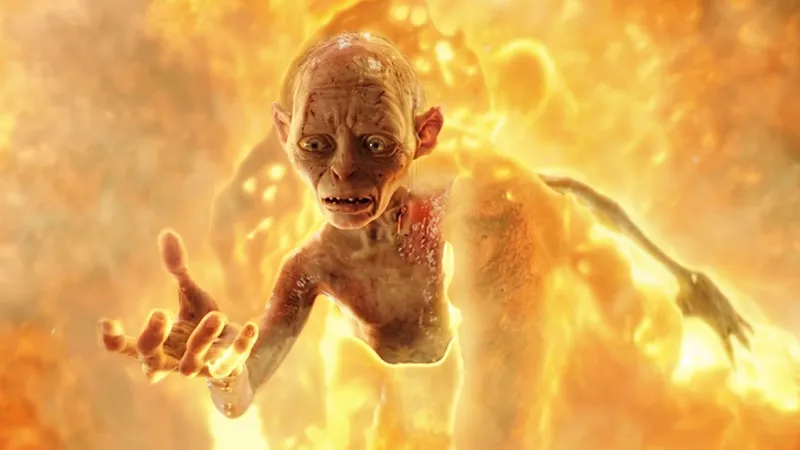

The Dark Moral Of Gollum's Tale
What is the moral of Gollum's story? To find out, I consult some of Tolkien's own written reflections on the character.
Comments (12)
I always loved that Gollum just slips into the fire because he was too ecstatic to pay attention to his feet. Especially as it is a miniature of the downfall of Sauron, a being so obsessed with order that he would erase and corrupt all of Middle Earth to change it into an order he can understand, only for this hyperfixation to blind him to tiny details outside of his perception.
Really excellent essay, maybe the best so far! Gollum's "providential" slip of the foot reminds me of Hamlet being "randomly" attacked by pirates and returned to Denmark. Things like that do happen, and good storytellers aren't necessarily cheating by employing them in their narratives.
It gets really interesting when you remember that NOTHING in a fictional story is "accidental" in the sense that everything was the author's choice.
"it may be that your purpose in life is to serve as a warning to others"
Great video, might be my favorite you’ve done. Gollum is my favorite character. When I first read the books as a kid I remember being frustrated when the second part of the Two Towers shifted the focus entirely on Frodo and Sam. As an adult though the dynamic between the three characters I think is the most interesting part of the story. More than interesting really, it resonates deeply in my own internal struggles. Gollum reminds me most of myself, or more specifically the kind of person I could become at my worst. Frodo is the protagonist undergoing this struggle directly, Sam the steadfast friend but outward observer. All in all, I think Jackson did a good job bringing this dynamic to life in a different medium. That scene on the stairs though is one that moves me to tears in the books and it just doesn’t hit as deeply in the films. Tolkien’s thoughts about alternative paths the story could have taken are really fascinating, and a good example of how an author really almost channels a story that wants to be told rather than forcibly crafting it. I know in earlier versions of the story he also considered having Sam sacrifice himself by tackling Gollum into the crack of Doom but he ultimately decided that this took the story to a darker place than he wanted. At the end of the day the moral of the story is that a hero is someone who does their best with the situation they find themselves in but none of us can really save the day. It was divine intervention that ultimately destroys the ring, all that the heroes could do was play their part and not lose faith. Gollum is a failed hero from the beginning, hence his susceptibility to the ring’s corruption. Frodo sees himself in Gollum though, he sees that before long he would become like him. Sam’s disdain for Gollum cuts deep, Frodo ultimately pities Gollum like Bilbo and chooses to believe that there is some part of him that could be redeemed. In the end he was right, Gollum did have a role to play. I think the message is that even the worst among us might be here for some greater purpose.
I agree - in a weird way Gollum is the most relatable character. I think it's because we all recognize our own internal struggles. And we all pull the draw of something that we want, but that we know is bad. It's just so universal.
I'm fascinated by that letter from Tolkien where he suggests a redeemed Gollum might sacrifice himself—with the Ring!—for Frodo's sake. That appears to run contrary to the influence of the Ring, or at least my understanding of it: that no one in possession of the Ring could willingly choose to destroy it (hence the need for the miracle of the slip). Sacrificing oneself to destroy the Ring, while not quite on the same level, does feel like a "Why didn't the eagles just fly the Ring to Mordor???"-esque loophole. What a find!
Figuring out how to end any good story is an almost impossible task. The way Tolkien resolved it for The Lord Of The Ring is flawless. It wasn't the greatest or bravest hero who saved everyone, but the most miserable and fallible creature - and he saved them by a tragic mistake. To remind us that we are not really in controll of anything like we pretend we are. As you point out, it is the small things that have the real power to make a positive difference and let good prevail.
There are some who’ve posited that Eru intervened at the end to “trip” Gollum into the fire, the same thought behind Eru guiding Bilbo’s hand in the dark. Personally I don’t think so. I could see Eru’s hand more with Bilbo than with Gollum.
While Eru had a hand in Gollum's end, it was also a consequence of breaking the oath he swore to Frodo. Like the oath of Feanor and other vows/promises, these acts of binding speech can affect reality in Middle-earth.
If you haven't read it, the 1937 Facsimile edition of the Hobbit is a fascinating experience. It is different in many ways. A friend of mine wrote a post about (mostly for roleplaying games) that I still refer to today. https://riseupcomus.blogspot.com/2017/09/1937-hobbit-as-setting.html
Very cool, I didn't realize it was so different. Might be its own video at some point.