

world building - metal eater
to supplement the programming and art updates on the game i'm making, tentatively called [the coiled sun], i've been posting world building articles. recently i've been doing some work on one of the technology-bearing species, the [metal eaters].
the following is compiled from several in-world sources.
[metal eaters]
+na4d28124◕
i have seen in +s3b0bee8c◕ a group of merchants with not a metal plate among them: but it is more common to see people clad head to toe in lapped metal, which can be mistaken at a distance for full plate, gleaming in the afternoon sun.
it is true that individuals can ingest scavenged metal with no harm, and that later, when they molt, they may employ these materials they have eaten in strengthening their carapaces.
+nd41a1604◔
listen to [Tharra], god of change, for [Tharra] speaks to us through the [metal eaters], the [kin of iron].
+n12f945◑
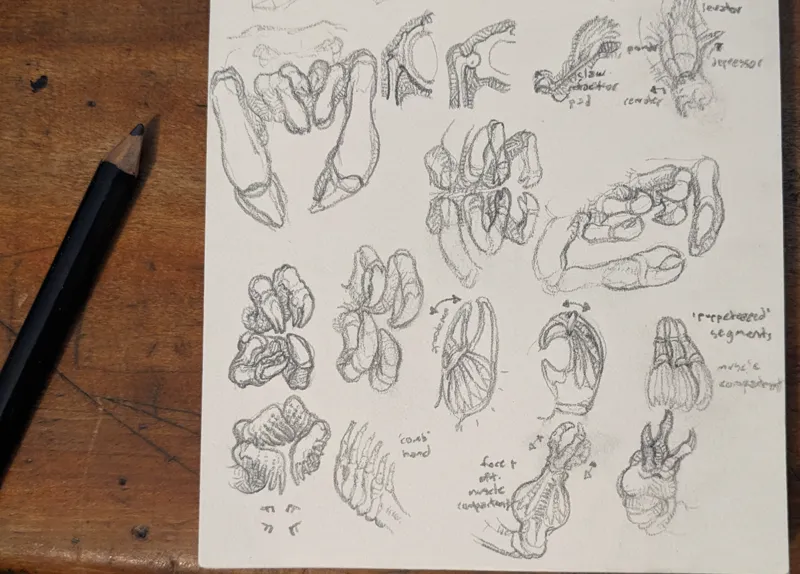
here in +l157aadc92◑ there lives a species of large jointed-legged beings. they are somewhat convergent with, but in many ways do not resemble, arthropods. they have six walking and six grasping limbs, and a flexible, tapering tail. those most often seen in the reach are around human mass.
the forelimbs are variable in configuration, but i most often see people with one pair of outer, large limbs (great arms) and two pairs of inner limbs held closer to the body (fine arms). great arms may be used for lifting, holding or rotating objects, etc., while fine arms are mostly used for tasks like detailed tool use and eating. specialized limbs for swimming, magic use, etc. are common but less present here, i am told.
the body is covered in plates, with a flexible material called featherscale protecting areas of high flexion. individuals periodically molt, shedding their old exoskeleton and secreting new armor via chitin-analog secretion. at such times, it's possible to naturally, or, i am afraid, via unregulated magic, change the configuration or size of one's body incrementally.
i shall list some common forms i have seen: an upright torso, like a human, but with six limbs, the a head a gleaming sphere of omatidia, atop a long serpentlike tail, the rear limbs reduced to scales; a broad-backed centaur, as wide as two oxen, with six muscular walking legs and a shortened tail, with the front of the body bearing the six forelimbs at a forward-facing angle; a columnar form almost like a human, but with four walking legs instead of two; a large, spread-limbed body like that of a crab, only taller, with enlarged great arms incurving, and great expanses of heavy plate, the tail topped by lapped metal scutes.
as far as i can tell, the "natural" shape is something like an eight legged silverfish, with a long, tapering, segmented tail, six locomotory limbs, two forelimbs, and four limbs which serve as mouthparts. i asked a [metal eater] weaverwoman if they had silverfish in their world, and she said "yes, here in +l157aadc92◑".
+nbfea6b8c◒
... in terms of metal content and makeup of the exoskeleton, as well as body plan, the uses to which you put your limbs. this is as much a matter of fashion, tradition, or individual presentation as pragmatism. in +ld2e39a3e◒ it's popular to contrast mirror-polished metal plates against dark, in stippled arrangements or patterns. members of the smiths' guild of +l1648747a4◑ traditionally grow one great arm much larger than the other. i myself am more concerned with my work as a scribe than fashion, so i keep myself fairly small, great arms no larger than the fine. but i do work regularly for the wealthy families of +l15788ef43◑, and so keep a few well-polished metal plates on my forehead and the backs of my hands.
if you work as a soldier or guard in a town for some time, you might wear the colors of your house. you might molt up in size or develop a more specialized, heavily armored body. but some great fencers are only of moderate size. a hexapodal mode is useful in certain situations: for robustness or efficiency of gait, little is better. serpiform bodies are useful for movement in confined spaces, and for momentary agility, if not speed. and bones may be comprised of various metals or sequences of metals, which yield different colors, properties, or degrees of protection.
featherscale
+nafa82b0c◕
made biologically by [metal eaters], featherscale is a lightweight, mail-like cloth of fine metal scales. it is highly flexible.
it can be removed from shed carapaces and reused. it's often traded or sold and is in use by a wide variety of species.
+n14dbc1c6c◒
featherscale naturally grows over flexible sections of the carapace between large plate, such as on the underbelly and at the joints. one can grow in such a way as to increase the portion of one's body which bears featherscale.
after removal through molting, featherscale can be hand-wrought in various ways, from simple tanning to enhancement with metal rings.
[metal eater] ingots
+n1750006d0◒
the rounded, oval ingot has a warbling, organic surface like an irregular pearl. it makes the metal feel almost alive.
secreted by [metal eaters] for storage or trade. considered an excellent material by many in metalworking and other professions.
they can be eaten and re-secreted to further purify them. one can do this functionally while eating nonmetallic foods, but any metals ingested may end up in the re-secreted ingot.
because of this, various cultures have developed practices to improve purity, including some combination of magic, particular diets, prayer, or fasting. repeated ingestion and re-secretion, aided by any of these, can produce very pure metal ingots.
+n1fca1fa79◔
the secretion of resource ingots is either an evolved or very ancient ability. there are, in the hills of +n2f1c0f315◔, ancient barrows where one may find caches of ingots which are said to be at the very least tens of thousands of years old, for they are beneath the deepest cellars of +n388416e2b◓, and it is fifteen thousand. one may find such ancient caches in many parts of the world, secreted in anaerobic caches underground or in caves.