



Updated (again): Fragmentation Envelope Add-on for Tacview
For those who might have missed it, over the past few weeks, I’ve been developing a debriefing tool for Tacview: a custom add-on that renders a worst-case 3-D bomb fragmentation envelope at detonation. This tool uses real-world data derived from open-source US aircraft manuals.
If you'd like a detailed view of what this add-on does, I encourage you to read the first two articles, which introduce the tool and outline the refinement of its original features.
I. Arming Delay Safety Envelope
Today, I am introducing a new feature directly linked to our previous discussions on bomb fuze settings, specifically regarding the arming delay. I call it the "Arming Delay Safety Envelope."
For those who need a quick refresher, you can access the full "Bomb Fuzes Guide" here, and review the practical discussion on arming delays with the GBU-12 here.
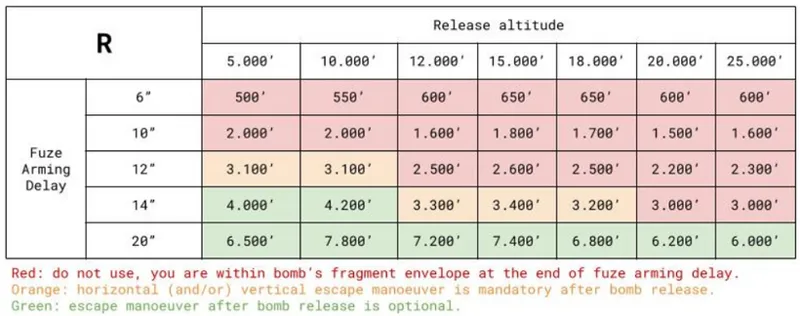
While this minimum arming delay can be computed manually, as we did in the past, resulting in the table below for a Mk-82 warhead, the add-on now automates this entirely.
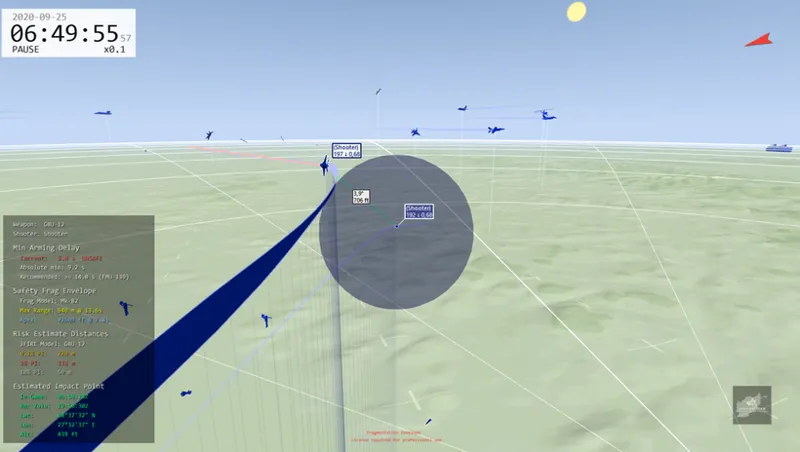
The "Arming Delay Safety Envelope" performs these calculations based on the exact trajectory you are flying, supporting altitudes up to 30,000 feet and encompassing all major warhead types. As shown in the image below, at the end of the arming delay, a "virtual fragmentation envelope" is generated. This computation accurately accounts for the bomb's velocity and its position relative to your aircraft at that exact moment.
Beyond simply assessing your current fuze selection, the add-on will also give you the absolute minimum arming delay required to stay out of the fragmentation zone for your specific flight path. Furthermore, it offers a recommended arming delay tailored to your selected fuze type. This recommendation includes a 1-second safety buffer above the absolute minimum delay and will automatically suggest the first available setting on your specific fuze that meets this criteria.
Immediately, you might ask: But how does Tacview know my DCS fuze settings?
You are entirely correct: DCS does not export bomb fuze settings to Tacview. Therefore, you will need to input the settings used during your mission manually.
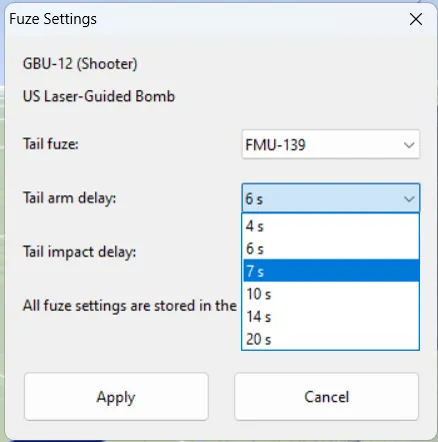
To make this painless, the interface is simple and accurately replicates the available DCS fuze settings for each bomb type. In the example below, the GBU-12 is restricted to accepting only the FMU-139 or FMU-152 as tail fuzes.
Once the fuze type is chosen, you can select your exact DCS arming and impact delays. For those who aren't concerned with granular details but still want to distinguish between airburst and impact detonations in Tacview, a convenient "Simple Mode" is available.
Important: Once you apply your fuze settings for a given .acmi file, a .fuze file is automatically created to store your selections. The next time you load that specific flight in Tacview, your fuze settings will load automatically, provided the file is present in the same directory. You can easily share this file with other pilots for joint debriefing purposes. Note that there is no manual "Save" option: clicking "Apply" handles everything automatically!
II. Upgrades to the Original Safety Frag Envelope
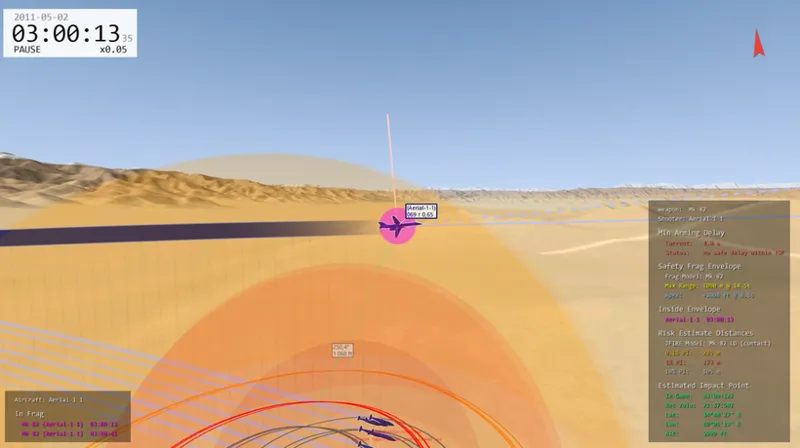
In parallel to this new feature, further refinements have been made to the original "Safety Frag" function. Any aircraft caught within the fragmentation envelope is now individually tracked. When an aircraft enters the hazard zone, a purple "bubble" highlights it for 5 seconds, making it immediately obvious who caught the frag.
This important telemetry is visible in both the bomb's dedicated legend (eg here: bottom right) and the aircraft's telemetry legend (eg here: bottom left).
Looking forward, my goal is still to transition toward full weaponeering accuracy. I intend to create a precise fragmentation model at impact that accounts for the actual fuze positions (nose, tail, or both) and their respective impact delays. Generating this dynamically within Tacview for the active bomb should be entirely achievable.
This deep dive into fragmentation physics might even pave the way (pun intended) for proposing a much-needed overhaul to the bomb damage model natively in DCS... Stay tuned!