




Updated: Fragmentation Envelope Add-on for Tacview
I'll try to summarize here main changes made to the Fragmentation Envelope add-on since v1.5.1. For those unfamiliar with the project: the add-on displays a 3D worst-case fragmentation envelope and probability-of-incapacitation (PI) danger circles for bomb detonations within Tacview, intended as an aid for advanced debriefing in DCS World.
It's important to understand that the fragmentation envelope computed here is a worst-case symmetric model. It assumes the bomb detonates with no speed on the ground, producing a spherically symmetric fragment cloud at maximum energy. Real-world detonations from a moving bomb produce an asymmetric "butterfly" pattern biased forward along the weapon's velocity vector. The symmetric model is therefore conservative: it will always contain the true hazard area, but it does not represent the actual fragment distribution. This limitation is perfectly coherent with the fragmentation envelope models used in official US Air Force documents, like TO 1F-4C-34-1-1 for the F-4 Phantom II.
I. Physics Model Validation and the BLU-109
Using open source weaponeering manuals for aircraft like F-4, F-16 or AV-8, I tried to identify the aerodynamic parameters enabling to closely match the published diagrams for Mk-81, 82, 83 and 84. The parameters that have been chosen, in terms of fragment size, drag coefficient and initial fragment velocity, result in modeled trajectories with less than 25 meter of error for all the warheads above. Using these aerodynamic parameters, it's possible to derive the fragmentation envelopes at any altitude, and not only at ground level.
During the same modeling process, I also studied the BLU-109, for which no public fragmentation data exists. The BLU-109 model is derived from the Mk-84 baseline, with physics adjustments reflecting the BLU-109's known characteristics: a case wall thicker than the Mk-84, hardened steel construction, and a lower explosive-to-casing mass ratio. Consistent with the Gurney equations that govern initial fragments speed, it produces fragments that are initially slower but heavier and aerodynamically more robust over range. The resulting model was cross-checked against the JFIRE PI distances for the BLU-109, the JFIRE being one of the only direct comparison that I was able to find.
II. PI Distances
Two points deserve an explicit clarification regarding the PI rings.
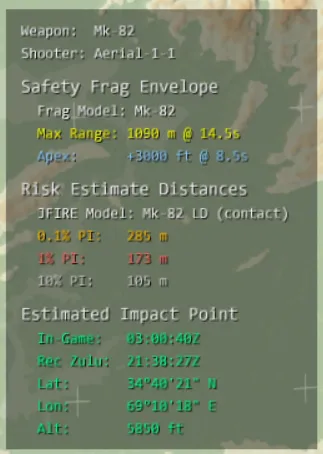
The 1% PI ring is an estimate. The 1% PI distance is not published in JFIRE or any other standard reference consulted. The value displayed is derived by interpolating between the published 10% PI and 0.1% PI distances, using the geometric argument that fragment density decreases with the square of the distance from the detonation point, as a direct consequence of fragments expanding over a sphere whose surface area grows as 4.Pi.r². This is a reasonable first-order model, but it does not account for factors like fragment velocity loss, aerodynamic drag, or tumbling effects at intermediate ranges. It should be treated as an estimate, not a certified figure.
Source discrepancies are expected and intentional. JFIRE 2007 used a generic fragment behaviour model applicable across weapon families, while JFIRE 2023 replaced this with weapon-specific data derived from updated test results, producing different, and generally more accurate, PI distances for many munitions. The add-on defaults to JFIRE 2023 data. For weapons not covered in the 2023 edition, it falls back to JFIRE 2007 data rather than leaving the weapon unsupported.
III. Expanded Weapon Coverage — Three-Tier System
I introduced a 3-Tier classification in order to represent PI distances and Frag Envelopes for more weapons that the ones using Mk-8X warheads.
Tier 1 weapons have full 3D envelope. Mk-80 series (Mk-82, Mk-83, Mk-84) and the derived BLU-109. This tier renders the complete 3D fragmentation bubble, the maximum fragment range ring, all three PI circles, and a precise impact marker at the detonation point. Foreign weapons having similar physical characteristics, like SAMP of FAB have inherited the same fragmentation model as their US equivalent.
Tier 2 weapons have PI rings only. A broad range of air-to-ground guided and unguided munitions for which JFIRE PI data is available but no fragment model has been created yet. This includes for example AGM-65 Maverick variants, or rockets. For these weapons, the add-on renders the JFIRE PI circles and an impact marker, covering the majority of air-to-ground engagements in DCS World without requiring a full physics model.
Tier 3 weapons have impact marker only. These are primarily the weapons where fragmentation is not the primary damage mechanism, with for example, anti-runway penetrators such as the Durandal. For them, there is only a simple impact cross on the terrain. This ensures that every relevant weapon release is visually marked, even where no PI data applies.
The tier is assigned automatically based on weapon type. When a weapon is not recognised, no marker is rendered and a log entry is written for diagnostic purposes. Don't hesitate to send feedback if you encounter unexpected results!
IV. User Interface Improvements
Several refinements have been made to the interface and its underlying logic.
The 3D envelope, PI rings, and impact markers can now each be toggled separately via the Tacview add-ons menu, allowing the display to be decluttered for specific training objectives.
The legend now reflects only the data available for the selected weapon type. A Tier 1 weapon shows all fields including fragment range and PI distances, a Tier 2 weapon shows PI distances only, and a Tier 3 weapon shows impact coordinates. Where a value is an estimate rather than a published figure (e.g. the 1% PI distance), this is flagged in the legend.
Note that detonation points recorded in ACMI files are sometimes truncated before the weapon reaches the ground, due to recording cutoffs or tracking loss. The add-on detects this condition, activated when the weapon is within approximately 40 m AGL or 75 m slant range of the terrain at the last recorded position, and extrapolates the terminal trajectory to the surface. This ensures that envelopes and markers are correctly anchored to the terrain rather than floating above it. Ground snap applies to contact-fuze weapons only. In the future, I'll try to let you enter detailed fuze settings, and we'll be able to distinguish between airburst weapons and recording tracks cut just above ground.
Conclusion
The symmetric model validated in this release enabled me to build the data foundation necessary for the next development phase. As explained previously, the primary objective is an asymmetric fragmentation envelope that accounts for the weapon's velocity and attitude at detonation.