




Cyrillic-101 for DCS MiG-29 Pilots - Head-Up Display (2/3)
The MiG-29 HUD, while clearly showing its age, remains a highly functional and distinctive component of the aircraft’s avionics suite. Its design reflects fighters of its generation, comparable in capability to the Mirage 2000, yet it is more advanced than contemporaries such as the F-4 Phantom, F-14 Tomcat, or Mirage F1, which typically feature simpler, more limited HUD displays.
Modern aircraft with ultra-wide HUDs and fully integrated multifunction symbology, such as the F-35 or Rafale, obviously surpass the MiG-29 in data density and presentation. Nevertheless, the MiG-29 HUD is notable for its integration of radar and sensor information directly in the pilot’s forward view, rather than relying primarily on head-down displays. Only the Rafale, with its “medium head-down” concept, offers a somewhat similar approach.
But in order to make the HUD interesting, we still need to be able to easily understand the target, navigation, and threat information...
The attached video illustrates this: the aircraft starts in close-combat mode with vertical scan, in IRST mode (ТП). The Launch Authorized (ПР) indication appears as soon as a target is acquired, along with missile launch cues. It's both a clear example of the HUD’s practical, combat-oriented design, and a proof that understanding the Cyrillic info is very achievable.
We'll start here with the HUD, before progressing to the more complex SPO-15 threat warning system.
I. General Description: СЕИ (SEI)
The MiG-29 HUD is part of what's formally designated as Система электронно-оптической индикации (Electro-optic Indication System). It is the primary interface for displaying targeting, navigation, flight, and sensor information generated by the aircraft’s avionics suite (СУВ/SUB).
We can note here that the letter "С" (S) will often designate the word "Система" (System). It's the same as for the "S" in S-300/S-400 family systems.
The SEI consists of three main elements:
Windshield Indicator (ИЛС / ILS): it's the main collimated HUD display.
Direct Vision Indicator (ИПВ / IPV): it provides direct line-of-sight instrument data for conditions of bright sunlight or glare. It can be considered as a Head-Down Display (HDD) on Western aircraft.
Image Formation, Synchronization, and Power Units: they are responsible for generating the symbology, ensuring timing accuracy, and maintaining display stability.
The SEI is an electro-optical, screen-based indicator system built around two cathode-ray tubes (ЭЛТ). As for Western HUD, the collimator head projects the CRT image to optical infinity, allowing the pilot to perceive symbology as if it were overlaid directly on the outside world. Displayed information includes symbols, indices, scales, counters, and data from radar or IRST (КОЛС/KOLS. Note that in that case the S stands for Stantsiya (Station), another common acronym for the letter "С" (S)).
We can note that the HUD integrates with a photocontrol device (ФКП/FKP) for brightness and contrast management, and a sunlight-limiting shutter on the HUD and optical filters on the HDD ensure readability under high-light conditions.
Here is the full list of the indications that we can find on the HUD (Source).
II. Weapon Types
On the bottom right corner, the HUD displays weapons information using Cyrillic acronyms and numeric codes, providing immediate awareness of the selected stores and their status. These cues are certainly already familiar to DCS players, especially the air-to-air weapons often encountered in BVR engagements.
The Р-27 / R‑27 series represents the MiG-29’s medium-range air-to-air missiles:
27Р (radiolokatsionnaya) is the basic semi-active, radar-guided, medium-range missile, (AA‑10A Alamo).
27ЭР (energeticheskaya radiolokatsionnaya) is the extended-range version of the SARH missile (AA‑10C Alamo).
27Т (teplovaya) is the IR-guided, medium-range missile (AA‑10B Alamo).
27ЭТ (energeticheskaya teplovaya) is the extended-range of the IR version (AA‑10D Alamo).
The R‑73 and R‑60 series cover short-range engagements:
73 is a highly off-boresight, short-range, IR missile (AA‑11 Archer).
60М (modernizirovannaya) is a modernized version of the older rear sector, short-range IR missile (AA‑8 Aphid).
The MiG-29 also carries unguided rockets for ground attack:
С24 (S‑24) unguided rocket are large 24 mm diameter rockets typically used for heavy blast or penetration against hardened targets.
С8 (S‑8) refers to 80 mm unguided rockets, usually carried in big pods for air-to-surface engagements.
С5 (S‑5) indicates 57 mm unguided rockets, intended for strafing or light attack against soft targets (not present in DCS yet).
For bombing operations, the HUD shows:
АБ (aviatsionnye bombovye sredstva porazheniya) for all bombs, including FAB, OFAB, or BETAB.
КМГ (konteyner malykh gruzov) for the cluster bombs.
These HUD cues integrate with other indicators such as launch authorizations, maximum and minimum ranges (Rmax1/2), and seeker mode indicators, giving the pilot a full understanding of the weapon envelope, engagement parameters, and type-specific behavior.
In practice, the MiG-29 HUD is well designed and combines immediate visual identification of weapon type, quantity, and readiness with range and targeting cues, enabling rapid, accurate decisions in both air-to-air and air-to-ground missions.
III. Other indications
Beyond weapons indications, the MiG‑29 HUD communicates a wide range of other information. These symbols cover navigation cues, radar/IRST status, IFF, ECM alerts and datalink commands. While some letters are familiar to Western pilots (R for radio‑altimeter, G for Glideslope, K for Course), others reflect legacy Russian conventions and operational logic (ПР, ОТВ, Г for Gorka, С for Svoy).
Understanding these symbols is important, and you have to note that many cues change meaning depending on flight mode, sensor mode, or datalink instructions, so interpreting them in context is essential for both air-to-air and air-to-ground operations.
Р (Radiovysotomer): radio‑altimeter. Indicates radio‑altimeter mode in use.
Г (Glissada): Glideslope. PRMG/approach glideslope indication and “GS Ready” annunciation. When displayed, the HUD will show glideslope deviation.
К (Kurs): Course / localizer. PRMG/localizer indication and “LOC Ready” annunciation. Shows lateral deviation for approach or navigation course guidance.
ПР (Pusk razreshyon): Launch Authorized. When ПР appears the fire‑control system has armed and authorized launch/release within current envelope: the pilot may press the trigger.
ОТВ (Otvorot): Turn‑away / Break-away. It's a datalink command to break off or execute a defensive turn.
Ф (Forsazh): Afterburner. Also a datalink command meaning “enable full thrust / accelerate.”
Т (Privod): RTB command. Another datalink command instructing pilot to home on a designated beacon or RTB (Return To Base).
! (Perenatselivaniye): Retarget (exclamation symbol). A datalink command to skip assigned targett.
Г (Gorka): Pull‑up command. It can be used in datalink modes, but it's also a cue to perform a half‑loop/pull‑up in CCRP.
С (Svoy): Friend. IFF positive or “friendly” indication from the identification system.
А (Ataka): Attack. Datalink attack command, or weapon system activation cue. It can mark laser designation in certain modes.
В (Vertikal): Vertical. It's a datalink command to execute a vertical maneuver.
АП (Aktivnaya pomekha): Active interference. Indicates active ECM detected (an emitter is jamming). Expect degraded radar performance and false/hidden tracks.
ПП (Passivnaya pomekha): Passive interference. Indicates passive interference (like chaff and flares)
РЛ (Radiolokatsionnaya stantsya): Radar. General radar mode indication, as opposed to IR.
ТП (Teplopelengator): Thermal direction finder (IRST). Indicates IRST/KOLS mode active. Useful when radar silence is required or for low‑RCS targets.
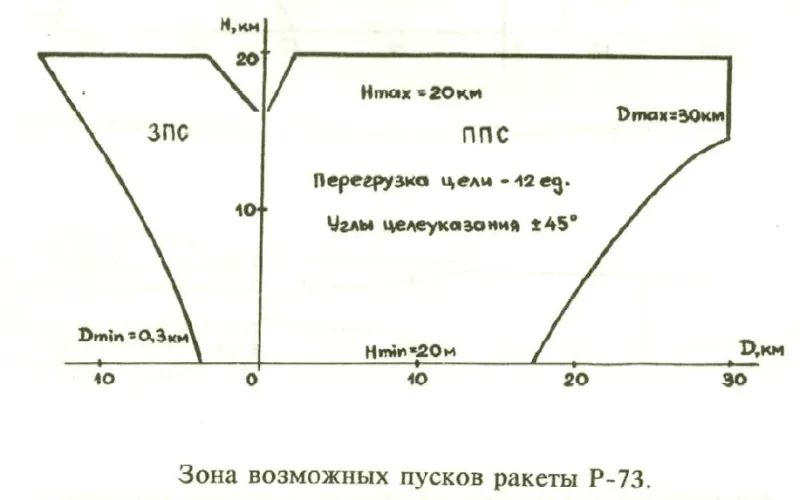
ППС (Perednyaya polusfera): Forward hemisphere. Indicates the emitter is in the forward half‑sphere (head‑on geometry). Associated with high‑PRF radar engagement logic.
ЗПС (Zadnyaya polusfera): Rear hemisphere. Opposite of PPS: emitter is in the aft half‑sphere (rear aspect). Associated with low‑PRF radar engagement logic.
Conclusion
The MiG-29’s Head-Up Display may appear simple by today’s standards, but it remains a remarkable piece of Cold War avionics. Once the Cyrillic alphabet becomes familiar, most HUD symbology feels intuitive, often mirroring Western conventions but expressed through Russian engineering logic.
As usual, you'll find attached a few Kneeboard pages summarizing this post.
In a next post, we’ll move from the HUD to one of the MiG-29’s most iconic systems: the SPO-15 “Beryoza” radar warning receiver. Its symbology, logic, and threat classification reveal the deep tactical philosophy behind Soviet air combat systems. I hope that as for me, its study will be an interesting example of Soviet and Russian air combat culture!
Comments (1)
DCS DCS World Affichage tête haute (HUD) f18