The Vietnam War, a conflict marked by rapid technological evolution and intense combat, revealed a disturbing and deadly problem: bombs exploding too early, and in several instances while still under the fuselage... This issue, which claimed the lives of many aircrews, forced the development of new fuzes, but not before more lives were tragically lost. I hope that after reading this post, you'll understand better the importance that the bomb fuzes play and that their correct set-up is first and foremost a safety for yourself.
Fully loaded USAF F-105D during the Vietnam War era.
The first known incident occurred on November 12, 1965. Captain William "Nasty Ned" Miller was flying a Republic F-105D on a mission over North Vietnam. His flight of four Thunderchiefs was still over Thailand, and his six 750-pound M117 bombs should have been safe. However, as Captain Miller approached a Boeing KC-135 tanker to refuel, the proximity-fuzed bombs exploded, killing him instantly. The issue was the M188 variable-time proximity fuze. These fuzes, designed during World War II, were supposed to arm only after the bomb was released from the aircraft. But one of them armed prematurely and as the F-105 closed on the tanker, the small radar beam from the fuze detected the tanker and detonated the bomb. The fuzes were then temporarily taken out of service to find out what went wrong.
As shown at the beginning of this video, the radio-altimeter low altitude warning can be triggered by the tanker during air-to-air refueling. It's not surprising that a proximity fuze is also reacting to the closing tanker.
In 1966, the 4525th Fighter Weapons Wing (former United States Air Force Warfare Center) at Nellis Air Force Base in Nevada was tasked with solving the problem. Captain John Morrissey led the investigation, conducting tests that revealed the cause of the accidents. He discovered that the proximity fuzes were designed for internal carriage by B-17 and B-24 bombers during World War II. The technical instructions for these fuzes dated back to the early 1940s. When used externally, they were limited to a maximum speed of around 200 knots. Obviously, F-105s typically carried these bombs at speeds of 550 knots or more during combat missions...
Captain John Morrissey during one of his tours in Vietnam.
Before the Vietnam War, the U.S. military focused on "mutually assured destruction" with nuclear weapons. This meant the development of modern conventional weapons was neglected and as a result, the U.S. Air Force’s fighters had to use old World War II bombs and fuzes because there were no modern alternatives.
"They (the WWII era bombs) were very old and had a problem with detonation if dropped any distance, even without fuzes installed."
Morrissey's flight tests with the M188 fuzes precisely identified the problem: the combination of high airspeed and the safety wire used to restrain the arming propeller caused the premature detonations. Normally, the safety wire was pulled when the bomb was released, allowing the propeller to spin and arm the fuze. But at the high speeds of the F-105D, the safety wire would sometimes vibrate and break, arming the bomb before it was released. Once the cause was known, the fuzes were modified to make them safer.
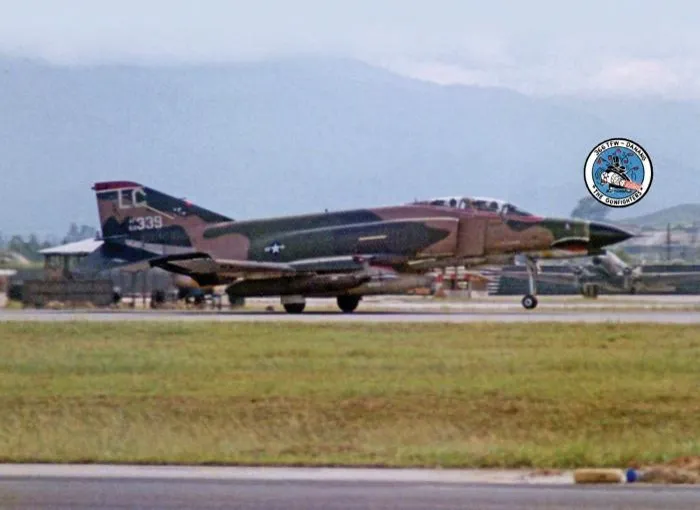
Unfortunately, the problem extended beyond one incident and one type of fuze. In November 1967, the F-4 Phantom-equipped 366th Tactical Fighter Wing at Da Nang Air Base lost eight aircraft and 16 crewmen in quick succession. At first, the losses were blamed on anti-aircraft fire but the wing's commander suspected otherwise. During one mission, as the lead aircraft released their bombs, crew members in the second element saw one of the bombs explode just below the lead aircraft, destroying both planes and killing all four crewmen. This revealed the cause of the unexplained losses: the new FMU-35 long-delay electric fuzes. Despite eyewitness accounts, higher headquarters initially dismissed these reports. However, the winf commander ordered subsequent missions to be flown with unarmed bombs, and the losses stopped immediately...
F-4E serial 68-0339 belonging to the 366th Tactical Fighter Wing.
In 1968, the Air Force tested the FMU-57 proximity fuze, designed to replace the old fuze that had killed Miller. Captain Morrissey, again, was assigned to lead the tests. The wing received 36 fuzes and because they were urgently needed in Southeast Asia, live munitions were used for testing. He had successfully made half of the flight tests when he was redeployed to Southeast Asia. Major Robert L. Chastain took over the tests.
On December 17, 1968, he resumed the testing with a two-ship flight of F-105Ds. Each aircraft carried six M117 bombs. The fuzes had a six-second safe-arm time to allow the aircraft to move away from the blast.His first pass was a dry run. On his second pass, his bomb exploded just a few feet below his aircraft, destroying it and killing him. Film footage showed the bomb exploding four feet below the bomb rack. After Chastain's death, the fuze was redesigned and finally entered service in 1973...
The sequence leading to Chastain's death.
Chastain Lane, next to Morrissey Drive, in Nellis. These names are a way to honor the pilots who lost their lives during test flights.
Since then, significant advancements have been made in munitions and fuze design. Modern electronic fuzes, like the FMU-152 Joint Programmable Fuze (JPF), use microprocessors and digital arming sequences. They eliminate the risks of premature detonation by using multiple safety barriers, encrypted activation codes, and environmental sensors. Self-diagnostics allow fuzes to conduct real-time health checks, identifying potential failures before deployment.
These innovations have significantly reduced accidental losses and made aircrews much safer. The harsh lessons learned in the Vietnam War have led to a new generation of safer, smarter, and more effective air-to-ground weapons. But it's not because the fuzes are safer that you should neglect a correct set-up... Know your attack profiles, and be able to select the most appropriate arming delays for each situation!