
Lessons from James’ RPG Art’s transition from per creation to subscription billing
As a reminder, in late January we announced that Apple has reinstated its requirement that Patreon move all creators on legacy billing models to subscription billing by November 1, 2026. If you are on per creation or first of the month billing, it’s important to start planning now. And you don’t have to navigate this alone - reach out to Patreon Support via your billing & payout settings for guidance on next steps.
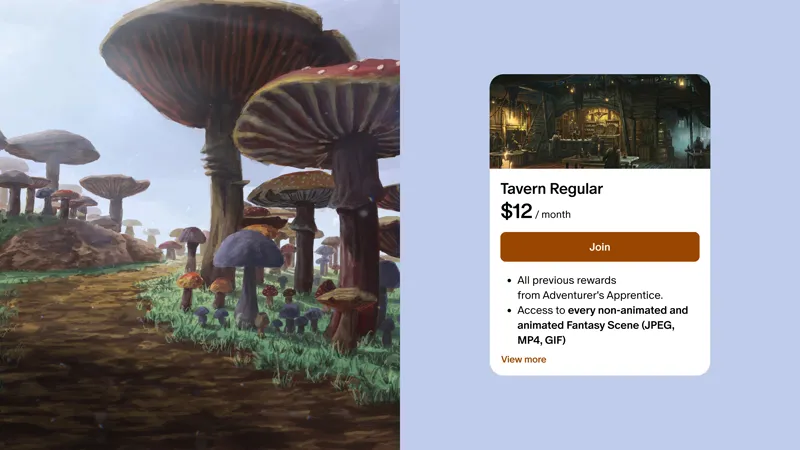
James' RPG Art creates immersive RPG location scenes for Dungeon Masters, releasing a new scene every week and offering a library of 300+ environments for members to use in their games.
Last year, the James’ RPG Art team began having internal discussions to move from per creation to subscription billing. Read on to learn more about how they prepared and the key lessons they learned along the way.
Why James’ RPG Art made the switch
James’ RPG Art had been hearing consistent feedback from members who felt confused by per creation billing or surprised by how charges added up over time. The team saw an opportunity to reduce this confusion and give members more consistency by moving to subscription billing.
However, the team was concerned about a potential drop in earnings. Would members cancel or have sticker shock with the higher monthly tier prices? One thing that helped them build confidence with their decision was running a survey that asked their community which billing style they preferred. Over 80% chose monthly. They also worked closely with Patreon's Support team, getting one-on-one guidance throughout the process. Having a dedicated partner to walk through pricing, tiers, and edge cases helped them plan the transition.
Here are the top three lessons they learned from their experience, along with resources to help other creators on legacy billing models prepare to make the switch.
Lesson #1: Capitalize on the moment
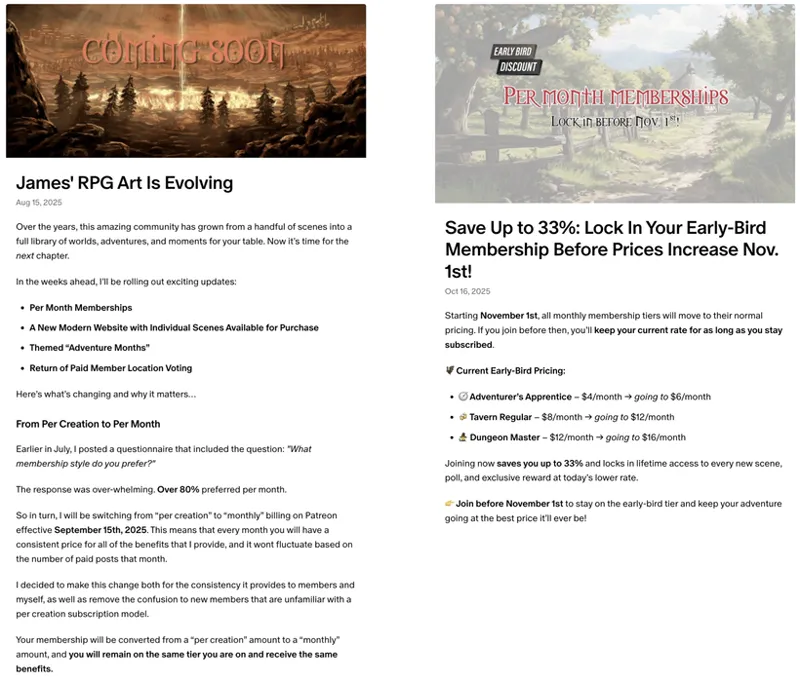
Instead of just focusing on the change in billing model, James’ RPG Art used the transition as an opportunity to announce exciting updates for their community
"We used the transition as an evolution, a change to James’ RPG Art. We did more than just change our billing model - we announced a revamped website, the return of paid member voting, and themed 'adventure months.'”
Lesson #2: Adopt a member-first approach to switching
They also focused on communicating to members early and reducing friction. They announced the update to their members a month in advance. They also reviewed their tier pricing to find a monthly equivalent that felt fair to members and sustainable for their business, landing on $6, $12 and $16.
They offered discounted pricing for members who joined before and during the first month of subscription billing. Then, utilizing tier repricing, which became available to them once they switched to subscription billing, they moved to standard pricing afterward.
Two example posts James' RPG shared ahead of making the switch to subscription billing. See posts: James' RPG Art Is Evolving and Save Up to 33%: Lock In Your Early-Bird Membership Before Prices Increase Nov. 1st!
Lesson #3: Evolve and adapt how you run your business
Once they switched, James’ RPG Art started using features only available on subscription billing, such as annual memberships and cancellation offers via Autopilot, and posting publicly to grow their audience.
“It's not a perfect transition to subscription billing and I don't think it ever will be. I think the best part about moving to it has been the few months after once everything has smoothed out - we now have 162 annual members and counting - this is our favourite part as it really helps with our LTV of a member. Especially after a few months you can start to see the power of Autopilot. To be able to have received an additional 109 new paid members and to have retained 15 members that were going to cancel anyways without any work on our part? It's awesome.” - James' RPG
Subscription billing has also given them more stability and a clearer view of their membership. Instead of managing per-post charges, pledge limits and members who sign up, download and cancel before the next charge, they can focus on monthly retention and churn. They’ve also now become more data-driven, regularly tracking metrics like lifetime value and average monthly pledge.
Additional resources to help with planning this transition
Explore step-by-step guides based on your billing model:
And if you'd like to see how other creators planned their transitions, communicated with members, and kept their businesses growing:
Why Knitty Magazine moved to subscription billing, and what advice she'd give to others
How Peter Hollens switched from per-creation to monthly billing
How WhatchaGot2Say keeps members around longer with subscription billing
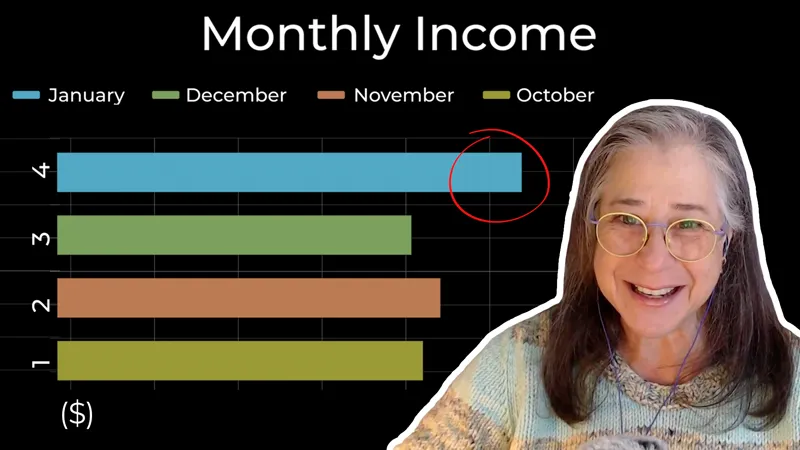
How Beneos Battlemaps increased earnings by over 25% with subscription billing
How Ill Gotten Games migrated from per-creation to subscription billing
📌 How helpful was this material? Click to let us know: 👍 | 👎

Comments (7)
Hi. I had submitted a ticket to support regarding an issue but I'm yet to receive any reply.
Thank you for the advice 💕
This is easier said than done, but thanks anyway for the advice 💯❤️
Hi chat!💬
Tut mir leid, der post. Hatte die Seite erst späterübersezt. Dachte wirklich den usern gefällt das Bild mit den Pilzen so gut, fand ich irgendwie lustig. Nichts für ungut.
Is it possible to create a sign-up link For patreon that bypasses the App Store on iOS?
Hey there, there isn't a way to generate a special sign-up link that bypasses the App Store. That being said, our checkout flow already features the web checkout option prominently. When fans tap the main button on your page (whether it says "Join," "Subscribe," or something else depending on your setup), they're taken directly to that mobile web checkout, which bypasses Apple's fees. So if a fan is signing up through the iOS app, you can direct them to use that same button, since it defaults to mobile web checkout rather than in-app payment.