
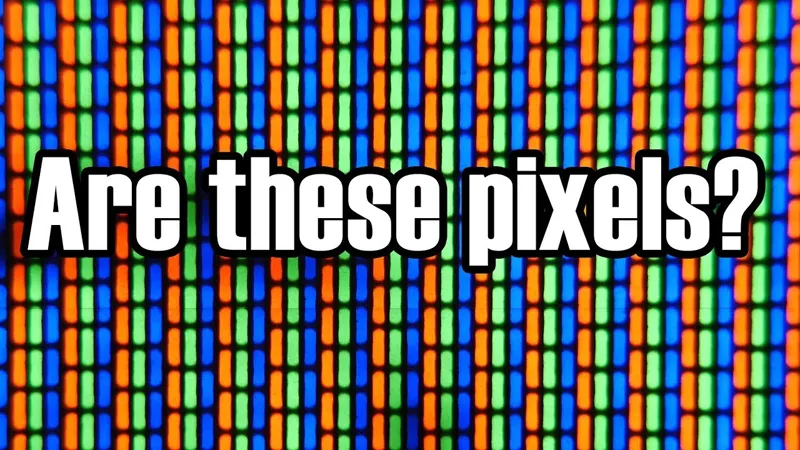
New video! These Are Not Pixels - Revisited
Welp, here it is! Thanks for your patience, everyone. I hope that this time around, my point is a little clearer...
Comments (14)
These are great videos, you clearly put a lot of effort into your production. The CRT was the last real vacuum tube in the average home (unless you could the magnetron in a microwave over), and now that it's all but gone, it's good to keep this stuff alive since it's part of our heritage. Keep up the good work :-)
Apart from anything else that was a major writing job! (Save those files, add a few graphics and diagrams and publish a book in a couple of years. Remember I suggested it first. :-)
This was my favorite video from you so far. The visual aids are great and really get the point across. Plus you actually managed to change my view on the topic. Great work!
While I felt like I *mostly* understood your point before, that part where you showed the tiny color crt compared to the larger one really made it click for me. Interestingly, modern digital video formats also make such a separation between "brightness" resolution and "color" resolution as most people can't really tell the difference if the color resolution is something like 1/8th of the brightness resolution. I'm sure you've seen that before when editing your videos, but it was really neat to see those two things click together.
Black & white snow is hypnotic. I am getting sleepy .... But seriously, you've given us the best explanation of how a shadow mask works that I've ever seen. Thanks!
Fun fact: some early ATSC decoders produced "digital" analog snow, since users know that snow means fiddle with the antenna
A bit that also made it clear to me in the close up footage was that some of the color groups were half lit on the vertical axis, which isn’t possible in a pixel, since the mask actually doesn’t align directly with the line of the beam, and some get hit on either the top or bottom half of the phosphor group.
I was going to make this point in the script, but I began to worry that it would conflict with my previous statement on the sub-sub pixels in the LCD panel. It started to get clunky to explain why those only bisect as a function of brightness and not position. You can easily see in the LCD that they follow the same pattern with a given brightness, but I worried it would negate the later point. I decided to just rely on people seeing the closeup of the CRT and figuring that out for themselves. Hopefully that works. Otherwise a followup followup will be needed!
It was a week or two ago I remember having this exact conversation with someone. They were trying to say a SNES was showing pixels, therefore the television also had pixels. My argument was that analog televisions don't speak in pixels, they speak in amplitude and time. When the SNES draws a pixel, it doesn't say "light up phosphors 1, 17, and 38", it says "show this modulated signal for 15ns at half bright intensity".
Wow, the production quality of this video is just... ridiculously high. Awesome graphics, demos, explanation, script, and execution. Great job!!
Thanks! It's amazing what a trip to the dollar store for some flashlights and a little bit of sharpie can do!
Wonderful job! Very easy to understand with that model of the shadow mask. Can't wait for the next one.
Another great video, and I laughed so hard at 12:28 because I'm a terrible person.
I had to go back and check what you laughed at! That was genuinely an unintentional double entendre.