

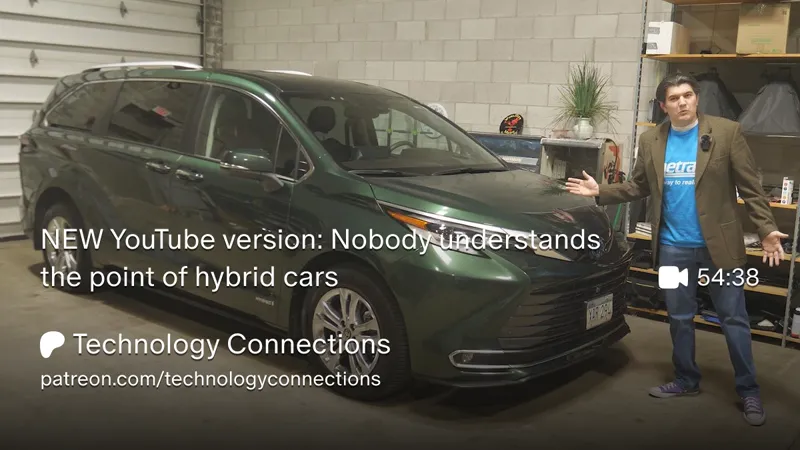
NEW YouTube version: Nobody understands the point of hybrid cars
THE YOUTUBE VERSION HAS BEEN REPLACED! With a possibly (?) better explanation on MG1/MG2 and a fixed typo on the metric conversion.
As I wrote in the replies here, while I'd have loved to have some animations even with a full-on demo rig like Engineering Explained recently used (and I'll be linking to that video in a card once I get all the fiddly bits done) the conceptual hurdles of what's going on are still pretty big. I hope this revised explanation (which starts at about the 38:00 mark) helps those of you who might have been confused.
and everything below is what I already wrote
So, this one's been in the oven for a while yet I'm still not super thrilled with some pacing things and other issues. This video is uncomfortably close to "making up a guy to be mad at" territory but that's because I'm tackling a lot of disparate misunderstandings all at the same time - I am somewhat worried about how it comes across here and would like your feedback in that regard.
As always, I wrote the script to be accessible for those who really don't know much if anything about the subject but there's always a risk I'm over-explaining things. And in this video, there's also a risk I haven't explained some things enough: if I had more time, I would probably have explored commissioning some animations of the Toyota hybrid system but A) I wanted to get this done soonly and 2) the only point I really want to make is "this is much more mechanically simple than you're probably imagining" so it was an opportunity I ultimately chose wasn't worth pursuing.
Anyway, captions are done! But I have two videos I'd like to release alongside this one: a sights and sounds video (teased here) as well as a silly "get over yourself. you want a minivan" thing for Connextras. That is already effectively finished and I was tempted to upload it here first as a teaser for y'all, but once I got into the edit for this I... changed gears.
Once the companion videos are done, I'll upload them here, too. Public release for all this will probably be Tuesday.
Thanks y'all
PS: A housekeeping note
This latest Patreon redesign has made the already pretty bad DM system even worse and a lot of unread messages from you are now effectively invisible to me. I have to go back through message history one by one to find messages I haven't responded to and it has been a slog because when I do respond, well suddenly my response puts the message thread at the top of the inbox. So please know I am doing that but it's taking me a while and things get buried in confusing ways I often miss. I hate it! If you've not gotten a response from me in like a month, please feel free to ping me so it shows up again, hopefully.
Comments (79)
Great video, except at 24:12 when you said "one of the things I'd like to unpack" and you didn't have footage of you unpacking something from the car... massive missed opportunity for comedy. Absolutely unwatchable!
i'm curious on the take for Nissan Hybrid "e-power" technology. Nissan seems to advertise it as series Hybrid and from what I've seen that's how it works; there is no connection between the engine and the main motor. But then again this video explanation (and the one from weberAuto) seem similar.
Interesting, due to all the misunderstanding I always thought that a hybrid was much more complex than a "burner" (as we call them in the German speaking world: "Verbrenner") or a full EV. Again: I like your subtle extra message with the public transport T-shirts ;-)
Great explanation and logic but I believe there is still an edge use case for SOME serial hybrids. For example, I need a pickup truck to haul various stuff around town - everything from lumber to landscape rocks to pulling trailers to all the "stuff" truck people talk about. However, around town I never put more than 50-100 miles a day on the truck. That really argues for an electric truck. I'm a cheap son-of-a-gun and I would LOVE to be able to plug my truck in and charge it at the house like I do my LiveWire motorcycle for WAY less than gas costs! However, and this is a BIG however, I also use this same truck for road trips and pulling trailers long distance (700-900 miles a day for multiple days) using the bed with a locking tonneau cover for a super trunk to securely carry all my and the family's personal stuff. On those long trips it really doesn't work to be stopping every 150 miles to recharge for an hour or more. Those times it makes sense to have a gas powered vehicle (e.g. serial hybrid) even if the efficiency isn't as great as a true parallel hybrid and you have to do some maintenance on the engine. Sooooo.... I'm really looking forward to the serial hybrid trucks that are coming out in the next 6 months to 3 years. I truly believe that for this use case it will end up being the best possible answer.
This is something that's bugged me about the announced Ram EV. I wish it was going to be made with an eCVT, but the announced plan is for a series hybrid. I assume that's because there aren't any existing eCVTs that are sized for towing, but I can't imagine that the engineering for a eCVT drop-in replacement for the existing Ram 1500's transmission would significantly add to the overall engineering cost. Perhaps the efficiency benefits of an eCVT over a series hybrid are outweighed by the efficiency penalties of an eCVT over a BEV drive train when the vehicle is going to be driven almost entirely on battery power.
I kind of expected to go through this car series without learning anything. Thanks for proving me wrong. I've always thought the whole point of hybrids was to keep engines in the speed sweet spot and to recover energy during deceleration. I never realized that the Atkinson cycle was so important.
Finally watched the connextras piece and.. no mention of the Kia PV5? Would love to hear your opinion on that. We need Kia to bring that over to the US asap!!
Great video! I didn't harbor so many of those hybrid misconceptions but I also didn't know much about how hybrids worked, and now I do! I got a little lost on the explanation of how MG1 and MG2 work together but eh, close enough - I get the gist and it's very cool! I bought a minivan back in the 90s and some people gave me shit about it. I'm sufficiently autistic that I didn't even realize they were "mom-mobiles" until this happened. I didn't care - it was super useful for moving either people or stuff.
Outstanding video. You should emphasize that many of the hybrids are NOT like Toyota! I'm in Western Massachusetts - one of the highest electric rates in the US, so no all-electric, nor plug-in hybrid. 2019 Prius owner. Bought new; and 63.8mpg since new. Like Arthur Clarke said, "magic...".
Do you know/can you find out the PID for the “Target Engine Power” data? I have a generic OBD-II reader but it doesn’t have that field.
Very good explainer. I had a 2007 and then a 2013 Prius. In that time Toyota really nailed it. I remember driving up some big hills in the Sierra Nevada mountains here in CA in the 2007 model, and as the traction battery juice dropped to nothing, the engine on its own was really weak and it was indeed a turd. But driving the same hills in the 2013 model they'd figured out somehow how not to run the battery flat, or something, and it was a completely different experience.
That whiteboard explanation helps! I presume that between MVG and the wheels, there's still a differential to account for different rotational speeds when turning?
There’s a pretty good video on Engineering Explained where he has a desktop-sized hand-cranked hybrid drive system from a Porche. https://youtu.be/dxmxIsoV_Xo
What are “the green stairs”?
Best guess: was the staircase at the Chicago museum with all the engine models green?
I absolutely loved the video, though I already had most of those concepts down. I'm still firmly of the mind that "a hybrid is pointless because you can't get energy from anything but gasoline", and the whole point of everything we should be doing today is to get people *off* of their gasoline addiction. You've done an excellent job - particularly in your recent ... "dishwasher guy talks about solar, and then goes nuclear" video ... explaining why internal combustion makes no sense anymore. I still have no idea how detached the majority of society must be, to be still going to car dealers and driving off in a car that has nothing more than an engine and maybe a high-load starter & battery for "start/stop" operation - which they promptly and fiercely/angrily disable so they continue burning ever-more gas. And then go on to complain about it. Like, I can't even find the end of that thread to start pulling on and explaining how wrong the mentality is. I hope the virality of your excellent hybrid explainer goes a long way to continue tearing down gasoline. edit to add: You *cooooulld* chop out that little dashcam video section between 21:23 to 21:38 and save us some driving OCD terrors, butttttt~~ :)
I was just constantly amazed at how every detail was smarter and more interesting than I had imagined. Every time I thought I had it down, along came another zinger. It was rapturous and made me terribly glad to have been already subscribed. Dishwashers and toasters, OK, but this is a whole other level. You only need to do one at this level in a year to hang onto your title.
I'm late to the party,here are my takeaways: the sibilance on your lapel mic in your garage was pretty hot and I wish you added a section about how the parking brake works, as well as the braking assist mode. Once upon a time it had a Civic much like yours and made my brakes fail coasting downhill into Park City, UT. Now I have a fancy schmancy prius and wonder how much of a headache could be avoided by shifting into brake assist and saying "NO" to cherry red brake pads.
FWIW I understood the original version just fine. And my takeaway was "holy crap, how do you come up with a design like this?"
https://youtu.be/dxmxIsoV_Xo?si=yqhWluCsbtmceRAL
I did, in fact, not understand the point of hybrid cars. Thank you!
As a former Prius owner who geeked out on them for the 7-8 years I drove it for a living and put almost 200k miles on it, they are phenomenally well designed. And because of how that hybrid system is designed, they're also insanely reliable for an internal combustion engine. Not as reliable and low maintenance as a battery electric, but way more than a normal internal combustion engine since they do away with so many of the complications and wear items needed for those to function. The first eye opening rabbit hole I fell down with it was when I read that the most efficient way to drive it was to drive it like it wasn't a hybrid at all. That was so counterintuitive to me that it just blew my mind, do I experimented to test that, and sure enough - not using the battery was the most efficient way to drive almost all of the time. The only exceptions were once I had learned it's operating characteristics well enough that I could leverage my knowledge of the terrain and upcoming driving conditions well enough to be better than its programmed guesses - and then I became a hypermiler. I learned SO MUCH from owning and driving that car and challenging my assumptions! Toyota is criminally underrated on their hybrid system.
A Doug DeMuro reference to kick things off. Quirky. And featured. Also, props for retaining Illinois's last decent license plate.
Great explainer. I learnt a bunch of new things (and I've done a video on the Prius). I would say that the part where you talk about MG1 and MG2 could really do with graphics explaining what you mean. I sort of got what you said, but certainly missed the details and I'm sure many others would find this all a bit confusing.
A while ago I ran across this interactive tool to visualize the Toyota hybrid system. http://eahart.com/prius/psd/
I really need an on-screen visual for the section discussing how the motors operate in the planetary gearset section
I am someone who thinks of themself as very knowledgeable about vehicles, mechanical devices, and electronics. I am very into both EV’s and classic cars, and own, drive, and work on both (I hope to build an EV converted classic someday). I have had a massive blindspot to hybrids. I have dismissed them as an unnecessary step in the evolution of the vehicle and therefore never bothered to learn much about how they actually work. Partly because I felt that they were adding complexity when we should be making mechanically simple EV’s. Now, while this video didn’t change my mind on that I did learn a lot and have more appreciation for at least the Toyota approach to a hybrid system. I have been watching this channel for years mostly just to agree with your view and maybe learn about some quirky old tech. This is the first video that has really challenged my opinion while also teaching me something I didn’t know and I appreciate that. Thanks Alec!
Oh and some car companies agree with you about pure petrol not making sense: Renault has said they will only be offering a choice between EV and “pure hybrid” (how they refer to self-charging hybrids) by the end of the decade - if not sooner.
I liked the comment about “EV mode” being a gimmick. Toyota apparently realised this and the owners manual for the 2016 Yaris hybrid I traded in for my R5 only indicated it for use when initially starting the car to be quiet out of consideration for your neighbours in the wee hours. In practical use it would turn on the petrol engine once the car got over 20mph, so yeah, good for getting to the end of your block. I would also use it to prevent the petrol engine turning on for as long as possible at long stoplights. I don’t really get the point of plug-in hybrids other than a salve for people with range anxiety, though. I mean if you can plug in at home why not just get an EV with better range? I know EV choice in North America sucks compared to RoW, but come on!
I got the Ioniq Plug-in back in 2019 because of snowboarding. My favourite nearby-ish hill was just within the there-and-back range of a Tesla Model 3 Long Range, if there wasn't a strong headwind, snow on the roads, and it wasn't approaching stupidly cold. There are no major roads or cities between me and it, and the only charging there is slow level 2. Still fine if I'm there for 3+ hours to justify the 4.5 hours of driving, but sadly just a few chargers that are only for paid hotel guests. Driving an extra 45 minutes out of my way would get me to a DC fast charger, but who wants to do that on a semi regular basis? The Ioniq made my work commute entirely electric (save for the fact Hyundai's design does require the engine to idle for winter heat, but at least it generates 2.5 kW back into the battery while doing it), while still letting me play in the winter time at my local-ish hill (the true locals are really tiny and boring) and those far beyond. It's a compromise car, delivering the best and worst of both worlds, but I tracked the gas and electricity consumption and did the math for the first four years (before my wife got her Model Y and polluted the consumption data from our charger), and the premium I paid for my choice paid itself off in less than three years with the savings versus my previous car. My situation was fairly unique, but I'm glad that the choice was available.
I'm sure it's good. I just don't understand most of the transmission and when you started going into MG1/MG2, even the gearset picture didn't help :D
Also "FARTS!!! FARTS!!!!" I am also known to call things turds :D
We had a 2011 Fusion Hybrid that got 27ish mpg. We just got a 2026 Kia Sportage Hybrid X-Line, that gets 35ish, depending on who's driving; more with my wife less with me. That seems pretty good for an AWD vehicle that size.
G'day Alec. You might be interested in this video from Munro Engineering on the BYD Shark hybrid system in the "truck" or ute as we call them in Australia. https://youtu.be/BSwH51GVE2k?si=PiHM3pARt-nVyGMu
So thoughts on Edison Motors?
Hey, I just started watching but I want to offer one correction very early on. 34 MPG US is 6.9 L/100 km, not 5.9.
I learned things despite my prior confidence. Over and over.
Just want to be sure you blur or obscure the license plates in some way!! There are sneaky ppl out there looking to steal your data 🫣
I watched, and as an avid EV/Hybrid/Train person myself, I’ve got a few notes. First off, a diesel electric locomotive can’t use a typical transmission. They’ve got a tiny rpm range, something like 700 rpm between idle and max, so the size and weight of a transmission for this capable of handling 5000hp and insane torque would be absurd. Electric conversion is the better and more fuel efficient option. DMU’s do use a transmission and direct drive the wheels, the airport train in Toronto being a perfect example, but we’re talking hundreds instead of thousands of horsepower. Second, I think you’ve a bit undersold how much efficiency is to be gained from regen braking and decoupling the accessory drive system from the engine. I have a 2025 Mav Hybrid, and the fuel economy is vastly better in the city, as with most hybrid cars. The electrics can maintain an easy 50mph between stoplights and gather a good portion of that energy back at the next red light. I got 49mpg with it the other day on city streets, not trying to hypermile at all. Cruising on the highway at 80 and it drops to a more normal 34-ish mpg, about in line with the 10% efficiency improvement the Atkinson cycle gets over the Otto cycle I would expect. At a given power requirement, such as a vehicle cruising steadily down the highway, an Otto cycle is marginally less efficient but that alone doesn’t explain the huge efficiency advantage hybrids have in city driving, and I wished you touched on this. Personally, I think it’s amazing that this Maverick hybrid gets the fuel efficiency it does while cruising the city streets. (While using Toyotas hybrid system as you mentioned, because ford and Toyota did a patent swap years ago to avoid stepping on each others toes)
Alec, you explain things in a way that allows me to understand what I'm going to be buying and why I'm going to buy them. I appreciate efficiency and reliable engineering and as a bit of a Toyota lover (for decades of dependability/repairability on their gas only systems) I'm feeling more comfortable with looking at hybrid options now. It's not something I can fix as easily, but it may be worth it in the long run, especially as our family grows with little ones. Although, I'm going to push my 2015 Corolla to the limit. At 200K the CVT is still rock solid and at 55mph or less, I can hold 40+mpg.
You are missing a big factor in the idea of a series hybrid an energy conversion. Running an internal combustion produces a lot of heat losses, so running an engine at full efficiency to charge the battery and then shut it off can potentially overcome the losses of the energy conversion. Especially if that engine will have to run at partial power to keep the car's speed. In the case of the 1st gen Volt the engine has a high compression ratio, I would suspect that it: 1) cannot run efficiently at low RPMs where detonation is worse, 2) needs to stops to cool down and avoid detonation. The bad fuel economy is probably because the engine is not an Atkison's engine and because the Volt is a quite heavy car.
Potentially can, yes, but in reality this hasn't been demonstrated yet. The main issue is that in a perfect world the engine load will always been in the efficiency band but that's not possible in the real world. So the best you could do is size the engine to run efficiently at some target load - and based on how the Volt would generate several more kilowatts than it needed to push the car forward when at moderate speed (you could see this happen with its info displays) I suspect this is how they were doing it. But really, the broader point I wanted to make (though it's not explicitly made) is that it's another one of those false choices! Toyota's been here the whole time with a setup which can work as either a series hybrid or a parallel hybrid - or I guess you could say they designed a series hybrid which accidentally is also a parallel hybrid.
Wow! Here I was thinking the point was regen braking this whole time!
I get people getting a bit lost with the MG1 / MG2 bit, but once it clicked that it was essentially operating like a differential, I didn't need to follow every bit of it to get that every kind of movement could be achieved using some kind of combination of the two. It probably helped that I had previously discovered this fantastic explanation of the differential (from the 1930s). https://www.youtube.com/watch?v=yYAw79386WI
Before watching this just figured I'd mention Jason Fenske's somewhat recent video (on Engineering Explained) demonstrating a simple, but comprehensive model of the Toyota (and Honda?) hybrid system utilizing two MG units. Also, your "get over yourself... comment above reminds me that Alex (NOT AleC) at Auto Buyer's Guide (formerly Alex on Autos) has a merch T-shirt with a decision tree to make auto buying easier. Basically no matter which decision you make the final answer is always "buy a minivan." Also also, cool to see you sporting the Metra T-shirt while emceeing a video about automotive tech.😃
Windshield wipers in the car wash! 🫣
I sure hope the captions include the barely-audible "Sorry" that you gave the truck you passed while headed for the on-ramp.
I'm glad I'm not the only one who heard it
You might get a bit of FLAC for the losslessly smooth jazz bit 😅
Good job.. I've been driving hybrids since 2001... well, until I got an EV. But yeah, I find it mind-boggling that every gasoline-powered vehicle on the road today isn't a hybrid. The cost difference between a hybrid and a standard gas vehicle (at least from a manufacturing standpoint) is not much different. Sure, you add a few extra parts, but you'll also getting rid of several parts too. So, it's kind of a wash. And hybrids, IMO, have a number of benefits beyond just the fuel economy gains. Although I do despise "mild hybrids" as those do not deliver a good experience, especially when they shut off at a stop light and a persons HVAC system stops working. But a real hybrid, IMO, is a better driving experience. Not only that, but the engines last much longer because they are always operating in that safe zone. They tend to not even leak oil because they don't get hot enough to damage the seals.
Yeah, the reduced wear on the engine is great. Combine that with not having a mechanical transmission and hybrids end up having way fewer costly repairs if you own them in the long term. I have 170,000 miles on my 2017 C-Max and I expect to drive it to be able to drive it to at least 250k without any major work on it.
Really interesting video, I had no idea how this worked. I don't think it came across as "making up a guy to be mad at," felt mostly informative with a pinch of snark. I would have liked to see some animations of the system but I can see why you didn't pursue them. I learn much better with visuals and was able to get it with your explanation alone.
"get over yourself. you want a minivan" YES!!! I have been preaching this for YEARS. When you call a plumber or an electrician, they don't show up in a truck or SUV, they use a van. Vans get work done. And the Toyota Highlander particularly earns my ire because it's bought by people that need a Sienna but want a 4Runner and then they buy a compromised unibody "SUV" that can't fill either niche as effectively. Death to the mall-crawling "SUV" and bring back the vans! Sorry, I just got way too hyped by that one snippet of text.
Very interesting. I wasn't aware of the type of engine / transmission in that hybrid, that actually makes a lot more sense. I had just written of hybrids as pointless compared to a pure EV.
Did you rent/lent the hybrid, or bought and own it?
Very good. But having an animation during the MG1/MG2 explanation would definitely make it even better!
Surprise Doug DeMuro video!
I can't recall the last time I've learned so much new information in a single hour. Thank you Alec. When I needed to replace my old grand caravan in 2016, I very much intended to replace it with a Pacifica hybrid as a dipping my first toe into the semi-electric transportation world. I know that there is probably at least a fair amount different between a Pacifica and a Toyota. But I'm now 10 years later astonished at hiw ignorant I was about what I was going to purchase. But Pacificas were nearly impossible to come by outside of California at the time as best I could tell. I was never even able to undertake a test drive. By the time I got to next vehicle purchase I went full BEV in 2022, and haven't looked back. But my conception of hybrid and plug in hybrids has been astonishingly wrong for an uncomfortably long time.
Not watcher yet... I have a lot of time for hybrids, particularly PHEVs. Batteries are expensive and the average car journey here is about 8 miles. It means average people can do 80% of their driving as a BEV with 20% of the battery capacity. I didn't know we could send DMs to creators on Patreon. I have learned something new.
I would question what the other 20% if driving you didn't mention is. It's often very possible that the rest could also be driving as a BEV if you replace all the gasoline components with more batteries. This is why I bought a BEV instead of a PHEV. A PHEV could do 80% of my driving as a BEV and 20% of my driving burning gasoline. A proper BEV can and is doing 100% of my driving as a BEV, no gasoline ever. Road trip? I'll either DV fast charge or rent a conventional hybrid.
Anyone else kinda get lost in the MG1-MG2 forest? Maybe I'm just off my game today but that section could use some more animation to visually show what you're talking about.
I don't think anyone has created a very good visual for this (and the demo rig Engineering Explained played with also didn't seem to help make it click very much) and that's why I decided to lean in on the demo with the cube. If you can imagine its wheels being motors instead of tires it may help, but even that's confusing because the motors (by virtue of being motors) can control their own speeds. It really is a very simple system _mechanically_ which is very confusing to work out how it fits together operationally. An animation would probably help to show how one thing slowing down causes another thing to speed up, but what's actually happen to make the one thing slow down is kind of hard to explain unless you already have a very good understanding of electric motor control
Small recommendation: crop the data logging graph view more aggressively. I'm pretty data literate but seeing the relatively small changes in battery percent even with your narration is tricky. Maybe expand the view of the raw numbers separately too? It just doesn't quite come across effectively to see the changes.
The scan tool does auto-scaling so it's not really something I can directly control that much, but I actually am hoping to make the subtle point of "the battery is not actually getting used all that much" because, well, that's the point!
Huh. I have a 2019 Honda Insight which does exactly what you say is bad - series hybrid, with a direct 1:1 transmission that is disconnected at lower speeds but engages at highway speeds, when the engine/wheel speeds can be matched. But on the highway, it cycles - fills the battery a little, then disconnects the engine and uses the motor for a while, back and forth. I still get 65 mpg at 55 mph, but now I'm wondering how much better that would be if the car just cut out the battery above 50 mph
Honda's system is... interesting. One of the many things I cut for time was that the *dumbest* decision GM made with the Gen1 Volt was equipping it with an off-the-shelf Otto-cycle engine and that's no doubt partly contributing to its unremarkable fuel economy. But its behavior really gave me the impression that the engineering team made some weird assumptions about how best to utilize the power output from an engine. So I have often wondered whether a complete powertrain reprogramming of that car could make it more efficient. It really seems remarkably bad for what it is - and it did operate essentially identically to Honda's system with a locking clutch which engaged at speeds over 70 MPH. But, if remember right, it didn't have the MPG cliff that Honda hybrids do at high speeds. In fact given that the clutch didn't engage until 70 MPH, it probably got a slight MPG boost from 69 MPH up to like 74. But I never drove the thing much faster than that so I couldn't observe it.
Feels like Honda, which is a distant second place but still is second place, needs to be mentioned. My understanding is the Honda’s system acts as a series hybrid until the two electric motors (one of which is directly coupled to the engine) can match speed at which time a clutch closes to switch it to parallel mode. The most recent version has two speeds for the parallel mode, perhaps patent expiration will allow the clutch to be replaced with the Toyota style coupling. Another thing not mentioned, the other reason the battery pack is not charged more is that regenerative braking needs somewhere for the power to go. One really weird thing to do with a hybrid is to take it down a very long hill. At first, it will use regenerative braking to control the speed of the vehicle. Once the battery pack is full, you will hear or feel your car doing things you never experienced it do before.
The Honda system was going to be mentioned but I cut it for time. I think what they're doing now is honestly just... not well-suited for the US market and all of our high-speed driving. They do seem to get very good fuel-economy out of it at lower speeds, so maybe the Rogue won't be as bad as I'm predicting it will be, but Honda's system really falls off a cliff once you're going above 65 mph or so. The point I'm making without saying it is that Toyota seems to have come right out of the gate with a system which isn't perfectly optimized for any one specific driving situation but which is decently optimized for *all* driving conditions. So I don't think they can be considered the best at any one thing but they have the most well-rounded system
Can someone explain the "taking the green stairs" comment? I feel like there's a reference I'm not getting and Google is no help
This is for people who have been to the Museum of Science and Industry in Chicago. I've heard they recently removed this, which is a huge bummer if true, but the green stairway (the main stairways are colored for navigation purposes) had a large assortment of different geartrains designed to do all sorts of wild things. Atkinson's original designs would have fit perfectly amongst all that!
Great video, I'm looking to buy a new car in the next couple of years and would love a video detailing the differences between traditional hybrids and plug-in hybrids. Edit: At the end of the video you basically answered my primary question about PHEV as I was looking at Toyota anyway. So, PHEV is preferable for someone planning on using their car for daily driving around town and commuting but if you're going to be using it mostly for long distance traveling a regular hybrid would be more fuel efficient because of the added weight. I am in the South so with the TVA we have cheap electricity so it's not a problem to charge the vehicle every night and if I sign up for my electric companies alternate rate plan where I can get cheaper electricity at night I could actually save money on my electric bill by charging during that lowered rate window
This is completely third-hand anecdotal evidence, but a friend of mine has a plug in and doesn't recommend it for her kind of commute. She drives about 40 miles one way highway for work each day, and she has no capability to plug in while it's parked there. She also needs to drive her kids around on the weekends for activities that are also only accessible via highways, so she does very little in-town driving. She says the electric battery runs out and the engine kicks in about 15-20 minutes in to all of her driving, and that's if she leaves the house with a full charge. Unless the plug in hybrid tech gets better soon, she plans to buy a traditional hybrid when the time comes to replace her current car.
Hybrids were a great stopgap until full electrics and PHEVs became widely available. I drive an EV and My wife bought a Toyota PHEV in August of last year. She still hasn’t used up the tank of gas the car came with (it does run the engine very occasionally just to ensure the gas in the system is decent).
A friend who has a PHEV has the same issue with not using up the gas, so they put STA-BIL fuel stabilizer whenever they add gas
Me, with a 2009 Toyota hybrid I've had since 2012: Interesting....
Oh gosh not Doug demuro 🙄 please don’t
I got flashbanged by this opening. Well done!
Nobody understand. Lol I'll have to check the vid out when I've got a min (or 55...)
lol. somehow didn't see that typo. i fix