
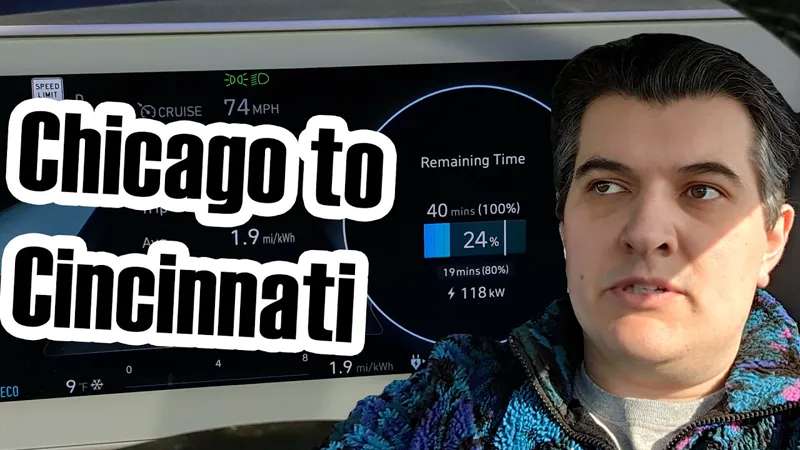
Another Connextras video on cold weather road trips
Hello again.
I've been sitting on this footage for a while and finally got around to putting it together. You'll notice I haven't released the video I just made yet - I might re-shoot that. I really didn't have my thoughts that well-organized but I'm glad to get some of your feedback re: level 1 charging and re-evaluating how useful that might be for you!
I will probably release these two together possibly tomorrow but that'll depend on whether or not I want to re-shoot the one I just made. I feel it's very timely given a lot of things I'm seeing across the internet so I do kinda wanna hurry but it's probably best that I give it a little more polish.
toodles
Comments (27)
Does it bother you that the speed offset can only be set in increments of 5, and you like to go 4 over like me? This bugs me very much on my ioniq 6. I cannot use it as a result, and it would be nice to
Just saw this video today. I got my '22 SEL about the same time you got your Limited. I also have had no trouble with it other than the 7 weeks I had to drive a rental Bolt EUV while we waited for a replacement ICCU. Which made me appreciate the fast I5 charging versus the poor Bolt. It is a little simpler than you describe to trick NAV into preconditioning, by now you've probably heard all of the permutations. I renewed 2/3 of Bluelink after they gave me a much better price for calling and asking - sort of like SiriusXM's ritual. I find the remote climate start and the other remote stuff almost worth it so there I am. Love your videos, esp. the long one debunking every myth about renewables and your well-reasoned rant on the backward policies of the current administrations. Thanks for all the videos!
I've never tried very hard to figure out how to make preconditioning work in my '23 Kona, but I really haven't noticed a lot of difference in DCFC charging time between winter (often below 0F in the Rocky Mountains) and summer over the same route. It's generally around 30 minutes from 20% to 80%. But my car only has a ?68kWh? battery
Hey, I really like this one. Cheers :)
We actually make the 1500 mile trip from Colorado to Pennsylvania (3000 round trip) each November for Thanksgiving. (Airline tickets are *really* expensive, and I don't mind the drive.) Our first year, the Ioniq 5 didn't have preconditioning yet, and that was rougher. But each year since, we've gotten it more and more down to science. I genuinely don't think it takes us longer than the trips we made in our previous ICE car. We use the A Better Route Planner app for planning these big trips. I highly, highly recommend it, and I recommend *against* picking the route yourself. It's really good at optimizing, such that most of our stops are only 5-12 minutes. Basically *all* are less than 15 minutes, with us charging every 2 hours or so. The car is waiting on us to finish eating, using the toilet, or whatever much more often than we are waiting on the car. We've also gotten really comfortable trusting the ABRP estimates and not wasting time over-charging. It's a 22 hour drive, so that kind of optimization actually makes a difference. We're also diligent about switching to the built-in nav system and making sure it knows we're heading to a charger when we're about 30-45 minutes out (depending on temperature), so the car does preconditions the battery, and we get full charging speeds as soon as we plug in. We're regularly seeing 230+kW speeds. We also made sure to download the map updates to USB and install those (at no cost) before our big trip this past fall. The new Ioniq model years also have that preconditioning button. 😕 We might try the new Ionna chargers along I-70 next year instead of I-80, where most of our stops are EA. We've also done the 500-some mile trip from our house to Yellowstone a few Octobers ago and stayed in the park, charging at the Old Faithful Inn.
lots of sandwich eating. ha! Love it. I recommend to folks doing a longer drive in their EV when using plugshare, you want to look for recent reviews on the chargers. If no one has said anything for months about it = risky.
We do a 3000 mile round trip each November, and I highly highly recommend A Better Route Planner for significant trips. It's very good at optimizing, such that almost none of our stops are more than 15 minutes, and most are 5-12 minutes every two hours on average. Which is about what stops were in our ICE car back when we did trips in that. We were already taking extra water refill, toilet, and leg stretch breaks, though.
Hair morph with Tom Scott begins.
As a recent (1 week ago) purchaser of a Subaru Solterra, I thought I'd weigh in with my expertise (insert arrogant, all-knowing guffaw). Yesterday I got back from my first "road trip". It was a baby road trip from Tampa to Orlando - I was able to make the entire trip with about 19% SOC/70 miles left, WHICH IS EXCELLENT! And i did this despite a lot of unexpected wind on the way back, and without even a destination charger in between. (A [redacted] Tesla driver was parked in the hotel's *ONLY* destination charger THE ENTIRE NIGHT). Once I got home, I plugged my level 1 charger in and I'm faced with.... 3.5 days to full. I have to tell myself this is ok - i have one place to *actually* be on Wednesday (which i could still make even if i didn't plug in at all) and i can easily do my various "go to the store, go get breakfast, go to home depot and stare at things and dream, etc" errands on 70 miles since i work from home. I live in a townhouse where my W/D is in the second floor of the unit, and the garage is a shared, semi-detached building with only 120 volts going to it, so to add 240 would require hiring an electrician to run the wire from the panel on the first floor, through the attic, and then to into the garage. Probably a couple thousand dollars. (this doesn't include the specter of "but you may need to increase your service's amperage" - 125 - since I'm in Florida, everything, stove, "furnace", water heater, is already electric) But i certainly see why people get concerned when faced with *days* of level 1 charging. I have a co-worker who has owned 3 different Teslas and even signed on to the wait list for BOTH the Scout pick up and SUV, so he's VERY into EVs, and even he was like "Well you're getting a level 2 charger right?" me: *my very-reasoned Technology-Connections-backed arguments why not*. "Sure, but you're gonna want to get a level 2 charger." As for the long distance tripping and pre-conditioning, most of my trips take place in the southeast, I'm curious how long it will take for me to see weather that requires it. The Solterra (of course) has on board navigation - You get a year of it for free and then it's $8 a month, i think. It does have a toggle to start pre-conditionining based on navigation , but there's a separate toggle to just turn on pre-condintioning. I'm not sure if it works or not because... it was 80 degrees. I'll say, it's in a TERRIBLE spot that requires you to leave the android auto interface and into a settings sub-menu to turn on. It would have been much better as something in the heads-up display OR A GD BUTTON, ON THE DASHBOARD. YES, you'll get dumb people who won't know what it means. YES, you'll get dumb people who will press it all the time. But we also have people who *never* get an oil change, *never* check their tire inflation, and only ever lease cars. (ok, the third one may be harsh) OH, one last thing - Hyundai lost my business (i'm sure they're weeping) because of their ICCU issues. I did a lot of anxious ruminating and research as to what EV I wanted for about week, and the Ioniq 5 looked *great*, but the ICCU thing IS STILL an issue with the 2026 models. I just couldn't do it, especially for my very first EV experience. They say it's a 1% issue, Consumer Reports says it's somewhere between 2 and 10% for Hyundais and Kias based on their surveys, and is *the* reason why they can't recommend it as a "Top Pick", despite it performing better than the Tesla Y in their tests!
My car (Skoda Enyaq 2021 iV 80) lacks automatic or manual battery preconditioning and it’s still perfectly usable in the winter. If you drive a full charge down to 20% SOC you can expect a 50-70 kW charge power. The main drawback is you can’t get good DC speed if you’re above 50%, you have to plan to charge pretty empty or wait a while. For our family, we need to stop to eat/breakfast anyway after 200-300km drive so we are not limited by range/charge speed even in winter. Getting from 80% to 100% when you realize you need to go on longer trip -25°C cold can take a while as charging slows down to under 4 kW after 90-95%. But charge to full after a drive is no problem. Practical range is abt 300-320 km in winter and 400-420 km in summer. But winter speeds are a bit lower, speed limits.
I like the level 1 charging angle for sure. You (not in this video but in general) are the person who made me stop to consider if I could buy an EV as a renter, which is entirely due to realizing level 1 charging is viable. A personal story, if I may, use it if you like: L1 handles my commute in 4 hours of charging (cursed car centric infrastructure where that's how short my commute is but there is no viable alternative to doing it in a car anyway). In the summer, I also work as a sports official, so I head to other places after my day job and use more energy than normal. Level 1 still works fine, because of the "not full charge today but enough and get the full charge later" example you gave. There were two weeks last year where I had to visit the furthest sports field from home/work 3 days in a row, and L1 would not have made up the difference. But you know what I did instead? I stopped at a public L2 (not DC fast charging even) station for 25 minutes on the second or third day. AND, because that stop let rush hour traffic die down, I still made it to my destination only *10* minutes later than I did on the other days. And those chargers were *free*. When people ask me what I think of making the switch (especially now) my response is "you can't afford not to." And I'm kicking myself that I didn't do it years ago.
We should get a secret handshake or something, those of us who bought an EV because Technology Connections videos assuaged our fears of EV buying. 🫱🫳👌🫰👉 or something like that 😉
You don’t even need to go all the way to 80% most times on road trips. You should only charge to the point that will get you to your next charge stop with 10-15% (or lower if you have the chutzpa to arrive at a lower State of Charge (SOC ) I aim for ~5% SOC at my next charging stop, but I know my car and take weather into account. The lower the charge you arrive at a charger the faster you’ll add miles. From 5% to 20% I can charge at over 1000 mph for the first few minutes. If I stayed at the previous charger ’til 80% instead of 65% that would’ve taken me, maybe ~10 minutes longer. The good analogy of how charging rate ramps down as the SOC rises, is thinking of the battery like a mall parking lot. When the lot is nearly empty, cars (ions) can easily/quickly find slots to park themselves in. But as the lot fills up, the ions have take a longer time to find a spot to land. The secret is to never fill the lot up any higher than you need to reach your next charger. The app I use is ABetterRoutePlanner.com (ABRP) with that app you can tell it what SOC buffer you feel comfortable arriving with. If you’re new to EVs, go ahead and set a higher Arrival SOC until you get confidence in your actual range estimates. Then, as you reliably arrive with more than 50 miles of range left when you get to your charger, you’ll begin to trust the range estimates and can spend less time at chargers just to overcharge what SOC you need to get to the next charger. Some times, in the upper midwest, the distance between chargers may mean that I need to charge to nearly 90% or higher, but often I may only need to charge to 50% to reach my next charger (especially for my overnight stops) You’d waste a LOT of time if you wait until 80% on those legs. The saving grace, if you miscalculate someday and would run out of charge before you reach the nearest charger 😳😬, rest assured that if you slow down, you can extend your range considerably. I’ve done it, and got off the interstate so I could safely drive 50 mph and have doubled my estimated range.
BTW… I’m admittedly a Lucid Guy. Using more of the bottom of your battery can save you a charging stop or two on long road trips (30 minutes to over an hour). I really wish Lucid would allow me to decide how much SOC I arrive at my charging stops with. I can’t rely on the Lucid Navigation because of that (it’s why I use ABRP) so I set a timer to remind me when to initiate battery pre-conditioning 20 minutes ahead of my charging stops.
7-year old Honda Clarity Touring still going strong with 90% capacity (55 mi range - 90% fwy at 60+, with a couple of hills). So Calif. Level 1-20A from the beginning. Have a Level 2 at work and home Apt. Having the ICE as a generator makes it livable where my max commute is 120 mi round trip with 2 big hills on fwy speeds. I’d easily repeat, as I manage to find a 120VAC outlet somewhere no matter where I am.
Honestly, where you try to address skeptics or people with a lot of range anxiety, I don't think it would land the way you would like. You optimize things that they can't or don't want to be bothered with, including things like checking for reasons why a station might be out. But I don't think very many of those people will be watching this video, so it might land better with people who are actually just curious about this as a logistical matter and want to learn.
I liked the video but this was exactly my take. Technically interesting, fit for Connextras, but likely would do little to carry the point ”it’s not so hard”. I’m EV driver myself (Finland). Your cold weather is pretty mild. In my experience, 18 kWh/100 km consumption can grow to 30-35 kWh/100km in -15..-25°C. Basically same as towing in the summer. Heating the car plugged in 11 kW at home before trip makes huge difference as I don’t have indoor garage, otherwise lose 10% SOC before you start at -25°C. Yes, our 3~ 230V 25-35A grid connection standard makes EVSE for suburban houses pretty easy.
When you go on foot hikes are you often going uphill both ways?
Cant keep hearing Shelbyville without thinking of The Simpsons
Me too and I've driven past it (and the one in Illinois! Not at all confusing!) several times
THIS vehicle has made me realize there's a function to the "climate" option in the Polestar app. If you wake up before a road trip and your car is on a L2 charger, you can tell it "get warm plz" and it'll pull the bulk of the energy for heating from the grid. I had only considered the case where you're leaving work in the summer and don't want to roast.
To be honest the Connextra being a bit unpolished makes it super charming
I have an extremely specific situation where my car collects dust for 3 weeks a month while I'm driving an 18 wheeler across the country. Will EV batteries have any problems with that? I'm concerned about the battery pack being damaged by sitting idle in the 8 month long summers I get in the south. If I can find an apartment with EV charging, I'm seriously considering a Rivian R3 or an Ioniq 5, and that's my only hang up.
There will be some battery drain when parked. Some vehicle brands are better/worse than others, but all of them use power when parked. Security systems, remote access, battery management systems, clocks, etc. use some power. Three weeks should be no problem if you charge to ~80% before you leave, but 8 months would be pushing it in even the most efficient model. If I had to leave mine for that long I’d find some way to plug into a standard 120v outlet (level 1) These outlets are common in parking decks and can sometimes be found even in open lots that have light-posts throughout the lot with standard plugs in the base. They’re the kind of plugs that diesel pickup trucks often use in freezing temperatures to power block heaters. For an EV they're like trickle chargers, only adding 4-5 miles of range per hour. If you can get permission from your apartment manager to plug into one of these for months at a time when you’re away long term you’ll have no problem with any model EV on the market.
You're really spoiling us lately.
Something you mentioned in your last video was the Nissan leaf had a problem with battery cooling. It made me wonder what they preform like in places like Arizona? I'd reason the cooling system would simply end up reducing your range, but protect your battery? Or is the battery health worse in extremely hot locations?
The leaf until this yeah didn't have active thermal management for the battery. It was a problem.