






🔋 OP15 Weekly Power Rankings - May 21st🏴☠️
📊Access the Full Stats Dashboard: https://stats.tcgmatchmaking.com/
日本の読者の皆さまへ
記事の英語版の下部に、日本語訳を掲載しております。
いつも応援してくださり、本当にありがとうございます。皆さまのご支援に心より感謝いたします!
Meta Overview
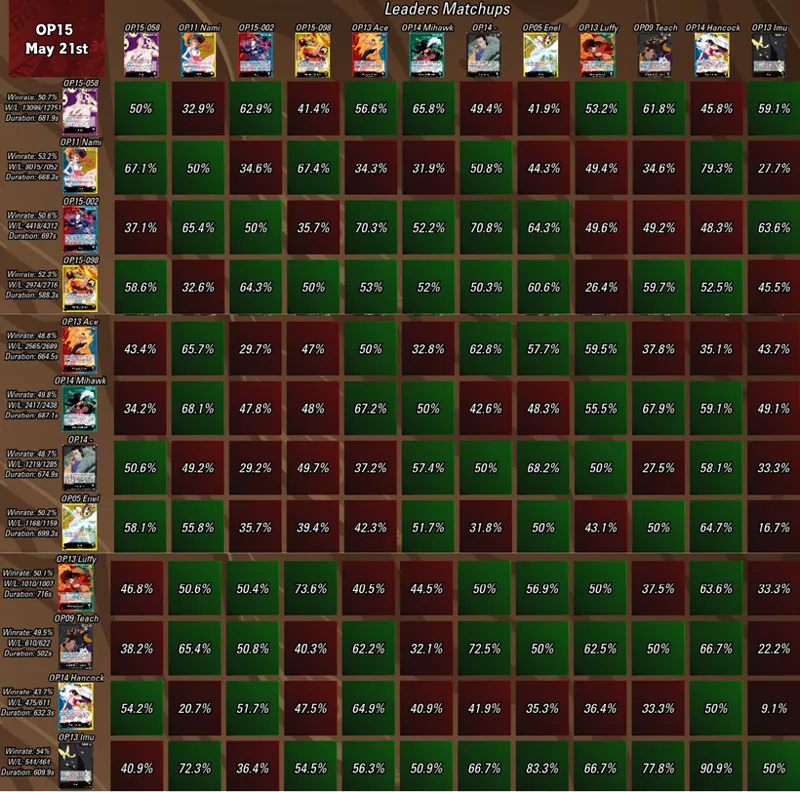
This week’s overview focuses on 1B+ ranked ladder data, offering a clearer look at how the OP15 meta develops at the highest level of play. With a larger and more competitive sample size, the results highlight how optimized decklists and stronger matchup knowledge continue to shape the format.
At this stage, the top of the meta has become very well defined, with only minor movement occurring within the rankings themselves. Purple Enel and Blue/Yellow Nami continue to stand above the rest of the field as the two strongest decks in OP15. Even as players experiment and adapt across the wider meta, these archetypes remain the benchmark for consistency, efficiency, and overall performance.
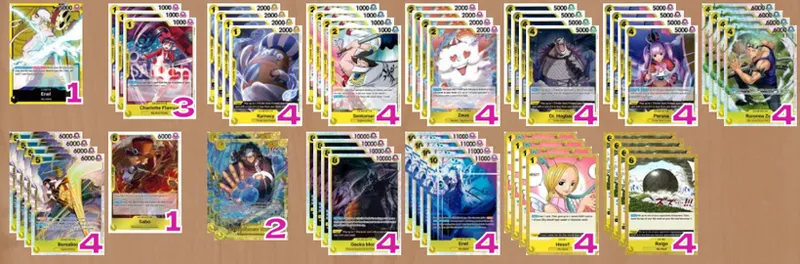
1. Purple Enel
Purple Enel claims the top spot this week—and the gap between it and the rest of the field continues to widen. The deck combines one of the highest play rates in OP15 with an elite win rate, supported by a matchup spread that remains favorable into most of the format.
What truly separates Enel is the way it bends the traditional DON!! curve. Rather than progressing upward naturally like most decks, it stabilizes around the 6 DON!! breakpoint and maximizes that position through ramp and cost manipulation. This allows the deck to maintain tempo while deploying powerful effects far earlier than opponents can comfortably answer.
At this point, Purple Enel is no longer just one of the best decks in the format—it is actively shaping how the rest of the meta is being built and approached.
2. Blue/Yellow Nami
Blue/Yellow Nami continues to establish itself as one of the most complete decks in OP15. Its blend of control, efficiency, and resource management makes it extremely difficult to pressure effectively at any stage of the game.
Recent support from EB03 and OP15 has greatly improved the deck’s consistency. Its sequencing is smoother, its draws are more reliable, and it can apply pressure without overcommitting resources, making it one of the hardest decks in the format to punish.
Even after recent ban adjustments, Nami remains one of the strongest-performing decks into Purple Enel while continuing to post excellent results across the broader field.
3. Red/Blue Lucy
Lucy has quickly emerged as one of the most impactful new leaders introduced in OP15. With a high play rate, strong results, and a flexible overall game plan, it has already secured a place among the format’s top-tier strategies.
Its Dressrosa-focused shell leans heavily on Events, giving the deck a pacing and structure that feels distinct from much of the field. While Event-heavy strategies can often struggle with resource efficiency, Lucy compensates through strong filtering and draw power, allowing it to maintain value deep into longer games.
The deck heavily rewards sequencing precision and matchup knowledge, and even many of its weaker matchups remain competitive thanks to its overall flexibility.
4. Yellow Luffy
Yellow Luffy excels at converting defensive pressure into long-term advantage.
The deck naturally develops wide boards while forcing opponents into awkward and inefficient trades. Once it establishes momentum, it can quickly close games through powerful Rush threats like Luffy.
It performs particularly well into decks such as Purple Enel and Red/Blue Lucy, making it one of the strongest counter-meta choices currently available. However, its matchup into Blue/Yellow Nami remains a major weakness that continues to limit its overall ceiling.
5. Imu
Imu retains many of the strengths that made it successful in previous formats, rewarding disciplined play and efficient resource management.
The deck applies steady pressure while controlling opposing threats and scaling efficiently into the late game. Its consistency and punish-heavy playstyle make it a reliable option for players who value stability and precision over volatility.
While it may not dominate matchups in the same way as the very top decks, Imu continues to perform well through strong fundamentals and a balanced matchup spread.
6. Red/Green Luffy
Red/Green Luffy continues to carve out a role as an aggressive, tempo-oriented strategy capable of ending games quickly if left unchecked.
Its early-game pressure remains one of the deck’s biggest strengths, allowing it to overwhelm slower strategies before they can fully establish their game plans. The deck performs well into much of the field overall, though Red/Blue Ace remains one of its more difficult matchups.
With continued optimization and refinement, Red/Green Luffy still has room to climb further within the meta.
7. Green Mihawk
Green Mihawk continues to post strong results, though it remains more matchup-dependent than many of the decks ranked above it.
In favorable pairings, Mihawk can completely dictate the pace of the game through efficient board control and sustained pressure. However, maintaining that same level of consistency across the broader field has proven more challenging.
As a result, Mihawk is less reliable as a blind ladder pick, though it remains extremely dangerous in the right hands and under the right meta conditions.
8. Yellow Enel
Yellow Enel has steadily grown in popularity over recent weeks, evolving into a far more refined and competitive archetype than earlier versions of the deck.
Recent yellow support has significantly expanded the deck’s toolkit, improving both flexibility and consistency across multiple matchups. The return of Raigo has been especially impactful, giving the deck access to premium removal capable of stabilizing difficult board states and swinging momentum in critical moments.
These additions have helped transform Yellow Enel into a much more complete strategy overall. It has also started posting strong results into Purple Enel, making it an increasingly attractive option in the current meta environment.
9. Red/Blue Ace
Ace remains one of the most fundamentally sound decks in the format. Its 6K Leader immediately pressures opponents, often forcing them to commit counter resources earlier than they would prefer.
From there, Ace transitions into a highly controlled mid-game, leveraging small tempo advantages and efficient sequencing to steadily stay ahead. The deck does not rely on explosive turns or flashy interactions—just consistently efficient play and strong fundamentals.
That reliability continues to keep Ace firmly positioned as one of the benchmark decks of the OP15 format.
10. Blackbeard
Blackbeard enters the top 10 this week after showing strong early performance into several top-tier decks, including Nami, Ace, and Lucy.
While the current sample size remains relatively small, the early results are promising. Its resilience and ability to disrupt key strategies give it a unique position within the developing meta.
Although overall results are still somewhat inconsistent, the archetype feels more underexplored than fundamentally weak. With continued refinement and optimization, Blackbeard has the potential to rise significantly in future weeks.
Conclusion
As OP15 approaches the later stages of its format cycle, the meta has become increasingly refined and clearly defined. Purple Enel and Blue/Yellow Nami remain firmly established as the two decks to beat, consistently separating themselves from the rest of the field through their efficiency, stability, and overall matchup spreads.
At this stage, major breakout shifts are becoming less common, with most movement occurring through optimization, tech choices, and targeted counter-meta strategies rather than entirely new archetypes emerging. Decks like Yellow Luffy, Green Mihawk, and Yellow Enel continue to succeed by attacking specific portions of the field, while Red/Blue Lucy has solidified itself as one of the format’s strongest additions.
With the format nearing its end, player familiarity and matchup knowledge are now playing a larger role than ever. Most top decks are highly optimized, meaning small decisions in deckbuilding, sequencing, and adaptations are often what separate strong performances from average ones.
Decklists
Purple Enel:
1xOP15-058
4xOP12-071
4xOP15-061
2xOP15-066
4xOP15-067
4xOP15-071
3xOP12-063
2xOP10-067
2xOP07-064
2xOP15-060
4xOP15-118
1xOP13-076
4xOP15-075
4xOP15-076
4xOP15-077
4xOP15-078
2xOP05-077
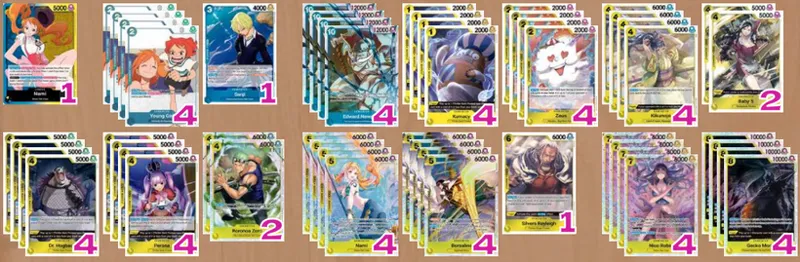
Blue/Yellow Nami:
1xOP11-041
4xP-096
1xOP15-047
4xOP13-042
4xOP14-102
4xOP11-106
4xOP06-104
2xOP12-112
4xOP14-110
4xOP14-111
2xOP15-113
4xEB03-053
4xEB04-058
1xOP14-108
4xEB03-055
4xOP14-104
Lucy:
1xOP15-002
4xOP15-014
4xOP15-040
4xOP15-052
4xOP15-053
4xOP15-048
4xOP15-046
1xOP13-042
4xOP15-019
4xOP15-021
3xOP15-020
2xOP10-059
4xOP15-055
4xOP15-054
2xOP10-060
1xOP15-056
1xOP15-057
Yellow Luffy:
1xOP15-098
4xOP15-108
4xOP05-106
4xOP11-106
4xOP15-113
3xST29-009
4xEB04-058
4xOP05-105
4xOP12-099
4xOP15-114
4xOP15-119
4xOP15-109
3xEB02-052
4xOP15-116
Imu:
1xOP13-079
2xOP05-082
4xOP13-086
3xOP13-092
2xEB01-046
4xOP13-083
4xOP13-089
4xOP13-080
4xOP13-091
4xOP13-084
4xOP13-082
1xOP11-097
4xOP13-096
4xOP13-098
4xOP14-096
1xOP05-097
1xOP13-099
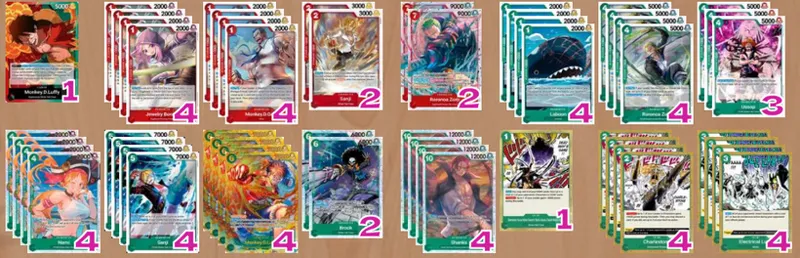
Red/Green Luffy:
1xOP13-001
4xEB04-002
4xOP13-016
2xST21-003
2xEB04-007
4xOP15-035
4xOP13-037
3xOP14-022
4xOP14-031
4xOP13-027
4xOP13-118
2xOP15-032
4xOP13-028
1xOP12-037
4xOP05-038
4xOP08-036
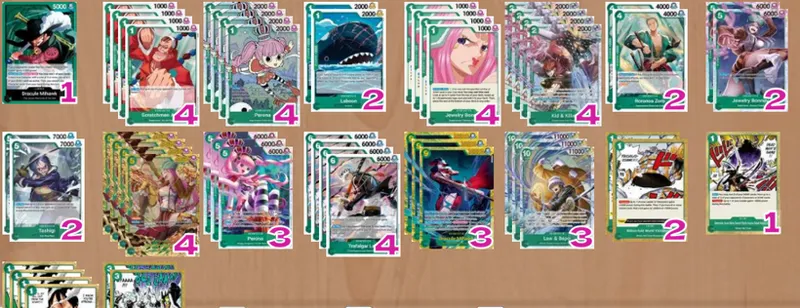
Green Mihawk:
1xOP14-020
4xEB01-015
4xOP12-034
2xOP15-035
4xST02-007
4xST24-002
2xPRB02-006
2xOP07-026
2xOP12-031
4xOP12-118
3xOP14-033
4xOP13-031
3xOP14-119
3xST24-004
2xOP06-038
1xOP12-037
4xOP13-040
2xOP08-036
Yellow Enel:
1xOP05-098
3xEB01-056
4xOP14-102
4xEB04-053
4xOP11-106
4xOP14-110
4xOP14-111
4xOP15-113
4xEB04-058
1xOP12-100
2xOP12-119
4xOP14-104
4xEB02-052
4xOP15-117
4xEB01-059
Red/Blue Ace:
1xOP13-002
2xOP13-007
4xOP13-016
2xST23-001
4xEB04-007
1xOP09-118
4xOP13-043
4xST22-002
1xOP08-040
4xPRB02-008
4xOP13-054
3xST22-010
2xOP07-051
4xOP08-047
4xOP13-042
2xOP14-018
1xOP05-019
4xST22-015
Blackbeard:
1xOP09-081
4xOP09-089
4xOP09-095
4xOP11-083
4xOP09-090
4xOP09-086
2xOP10-086
4xOP09-083
2xOP09-084
4xOP10-082
3xST27-003
4xOP09-093
4xOP09-096
3xOP09-098
4xOP09-099
日本語を読んでくださっている皆さん、いつもご支援ありがとうございます!
今回、翻訳サービスを利用して記事の日本語版を掲載していますが、まだ完璧ではない部分もあるかもしれません。
これから数週間かけて、より自然で読みやすい翻訳に改善していきますので、どうぞよろしくお願いします!
メタ概要
今週は、1B+ランク帯のラダーデータをもとに、最高レベル帯でOP15環境がどのように発展しているかを分析していきます。サンプル数が増え、競技性も高まったことで、最適化されたデッキ構築や高度なマッチアップ理解が、現在のメタをどのように形成しているかがより明確になっています。
現段階では、環境上位はかなり固定化されつつあり、順位変動も小規模なものに留まっています。紫エネルと青黄ナミは、依然としてOP15環境における二大トップデッキとして君臨しており、他のデッキが調整や研究を進める中でも、安定性・効率性・総合パワーの基準となり続けています。
1. 紫エネル
今週のトップに立ったのは紫エネルであり、その差はさらに広がりつつあります。OP15でもトップクラスの使用率を誇るだけでなく、非常に高い勝率を維持しており、多くの主要デッキに対して有利なマッチアップを持っています。
このデッキ最大の特徴は、従来のDON!!カーブを大きく歪めている点にあります。多くのデッキが自然にDON!!を伸ばしていくのに対し、紫エネルは6DON!!帯を中心にゲームを構築し、ランプやコスト操作によってその領域を最大限活用します。
その結果、相手が十分に準備できる前に高影響力の効果へアクセスしながら、テンポを維持し続けることが可能となっています。
もはや紫エネルは「強いデッキ」の一つではなく、環境全体の構築やプレイ方針そのものに影響を与える存在となっています。
2. 青黄ナミ
青黄ナミは、OP15において最も完成度の高いデッキの一つとしての地位をさらに確立しています。コントロール性能、リソース管理、効率性のバランスが非常に優れており、どのゲーム段階でも効果的にプレッシャーをかけることが難しいデッキです。
EB03およびOP15による新規カードの追加によって、デッキの安定性は大幅に向上しました。ドローやシークエンスがより滑らかになり、リソースを無理に使い切ることなく圧力をかけ続けられるため、環境内でも特に咎めにくいデッキとなっています。
規制後であっても、紫エネルに対して優れたパフォーマンスを維持しており、その他の環境デッキに対しても安定した結果を出し続けています。
3. 赤青ルーシー
赤青ルーシーは、OP15で登場した新リーダーの中でも特に大きな影響を与えている存在です。高い使用率と好成績、そして柔軟なゲームプランによって、すでに環境トップ層へ食い込んでいます。
ドレスローザを軸とした構築はイベントカードへの依存度が高く、他の多くのデッキとは異なるテンポ感とゲーム構造を持っています。
通常、イベント主体の戦略はリソース効率に課題を抱えがちですが、ルーシーは優秀なフィルター能力とドロー性能によってその弱点を補っており、長期戦でも継続的に価値を生み出せます。
プレイ難度は高く、シークエンスやマッチアップ理解が重要となるデッキですが、その柔軟性によって不利対面でも十分戦える性能を持っています。
4. 黄ルフィ
黄ルフィは、防御を長期的なアドバンテージへ変換する能力に優れたデッキです。
自然に横展開を行いながら、相手に非効率なトレードを強要し、一度主導権を握ると、ルフィなどの強力なラッシュキャラクターによって一気にゲームを終わらせることができます。
特に紫エネルや赤青ルーシーに対して強いパフォーマンスを見せており、現在の環境では非常に優秀なメタ読みデッキの一つとなっています。
一方で、青黄ナミとのマッチアップは依然として厳しく、この点がデッキ全体の上限を抑えている要因となっています。
5. イム
イムは、過去環境で成功を収めた要素を引き継いでおり、丁寧なプレイとリソース管理を求めるデッキです。
継続的な圧力をかけながら相手の脅威を処理し、終盤に向けて効率良くスケールしていきます。
極端に有利なマッチアップを押し付けるタイプではありませんが、安定感と対応力に優れており、堅実なプレイを好むプレイヤーにとって信頼できる選択肢となっています。
6. 赤緑ルフィ
赤緑ルフィは、依然として高速テンポ型アグロとして存在感を放っています。
序盤から強い圧力をかけられる点が最大の強みであり、相手がゲームプランを整える前に押し切る展開を得意としています。
全体的な対面性能は良好ですが、赤青エースは引き続き苦手対面の一つとなっています。
構築やプレイの最適化が進めば、さらに上位へ食い込む可能性も十分残されています。
7. 緑ミホーク
緑ミホークは引き続き好成績を維持していますが、上位デッキと比べるとマッチアップ依存度がやや高いデッキです。
有利対面では、効率的な盤面制圧と継続的なプレッシャーによってゲームテンポを完全に掌握することができます。
しかし、その強さを環境全体で安定して発揮することは難しく、ラダーでの万能性にはやや欠けます。
それでも、適切な環境読みと高い熟練度があれば、非常に危険なデッキであることに変わりはありません。
8. 黄エネル
黄エネルはここ数週間で使用率を大きく伸ばしており、以前よりも洗練された競争力の高いアーキタイプへ進化しています。
近年の黄色サポート追加によって、デッキの柔軟性と安定性は大幅に向上しました。特に《雷迎》の復帰は大きく、厳しい盤面を立て直し、一気に流れを変えられる強力な除去として機能しています。
これらの強化によって、黄エネルはより完成度の高いデッキへと成長しました。
さらに、紫エネル相手にも好成績を残し始めており、現在の環境では非常に魅力的な選択肢となっています。
9. 赤青エース
赤青エースは、依然として環境内でも特に基礎性能の高いデッキです。
6,000リーダーによる圧力は非常に強力で、相手に本来より早い段階でカウンターリソースを使わせる展開を作り出します。
そこから中盤以降は、小さなテンポ差と効率的なプレイを積み重ねながら優位を維持していきます。
爆発的なコンボや派手なターンに依存せず、堅実なプレイと高効率だけで戦い続けられる点が、このデッキの大きな強みです。
その安定感によって、現在もOP15環境を代表する基準デッキの一つとして位置付けられています。
10. 黒ひげ
黒ひげは今週トップ10入りを果たしました。ナミ、エース、ルーシーといった上位デッキ相手に良好な初期結果を残しています。
現時点ではサンプル数こそ少ないものの、そのポテンシャルは非常に期待できるものがあります。高い耐久力と、相手のキーカードや戦略を妨害できる点が、このデッキ独自の強みです。
全体的な安定性にはまだ課題が残るものの、「弱い」というよりは、まだ研究不足なアーキタイプという印象が強く、今後の最適化次第ではさらに大きく評価を伸ばす可能性があります。
総括
OP15環境も終盤に差しかかり、メタは非常に洗練され、明確化されつつあります。紫エネルと青黄ナミは依然として二強として環境の中心に位置しており、その安定性・効率性・総合的なマッチアップ性能によって、他のデッキとの差を維持し続けています。
この時期になると、完全に新しいデッキが台頭するケースは少なくなり、主な変化は構築調整やテックカード、特定対面を意識したメタ読み戦略によるものへ移行しています。
黄ルフィ、緑ミホーク、黄エネルのようなデッキは、特定の環境デッキを狙い撃つことで結果を残しており、赤青ルーシーも環境上位として完全に定着しました。
環境終盤ということもあり、現在はプレイヤーの理解度やマッチアップ知識がこれまで以上に重要になっています。多くのトップデッキはすでに高水準で最適化されているため、細かな構築判断やプレイシークエンス、対面ごとの調整が、最終的な結果を大きく左右する環境となっています。