
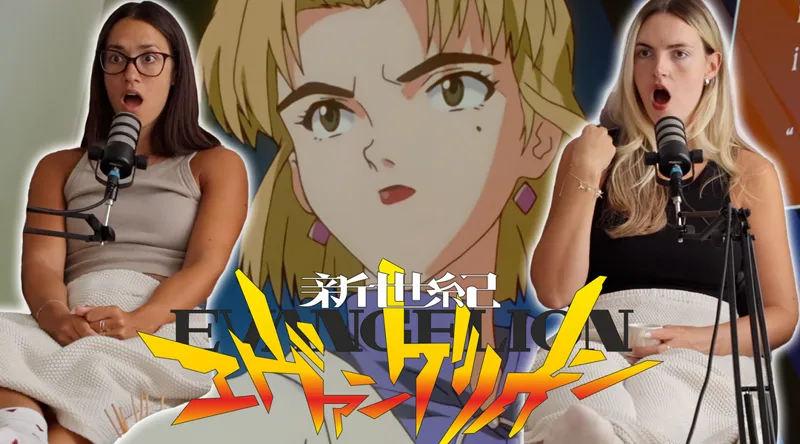

Neon Genesis Evangelion Episode 13 Reaction
Comments (23)
The next episode shows that the authors have production problems (money+time) but they find inventive solutions to tell their story anyway. You already saw glimpses of this, with repeated scenes or static/lingering shots, but in ep14 it's more apparent.
The money thing is a myth and has been debunked numerous times by people who worked on Evangelion. Maybe it's just me but I feel like even if something is wrong with production, or in the case of live action something is going on with the actor or director, why not just let the reactor have the authentic experience so they can digest the story instead of having to think about other issues. Either way, at least wait until they have seen and posted the next episode. What's the point in saying this now?
high iq discussion
Btw since the next episode is *mostly* recap, would it be possible for us to get a double drop?
They never drop two reactions at once. You can recommend watching the next two episodes in a single sitting if that is your suggestion but new episodes of short animes usually are only released once a week
Back in the 90s when it was considered dystopian to let an ai make increadibly important stretegic decions.
No more fun!
Are you guys using Serializd? Milena give us your profiles right now
No mention of parkour Kaji?
Still haven’t caught up on Eva reactions I just wanted to pop in a say is that Lola in anime form on the thumbnail it looks exactly like her
“How do Magi’s decide who wins” - they don’t. They vote on issues, and are designed with human dilemmas in mind - Scientific curiosity and rationality is set to always argue and debate with motherly and womanly instincts. At least 2 out of 3 have to agree for anything to pass through. When Baltasar offered self destruct the first time - Caspar and Melchior denied. As per Bible - angels (messengers) are functions of God.
Btw, someone made a real MAGI system using GPT, Gemini, and Claude AI https://www.youtube.com/shorts/SL5TSM-X8Mk
I'm watching the show at the same pace along with you guys, and here are the biblical references I've noticed up until episode 13. Neon Genesis Evangelion means "Gospel of a New Genesis" in Greek, Genesis being the name of the first book of the Bible--"In the beginning, God created the Heavens and the Earth," etc. Magi is the name of the three wise men who followed the star to give gifts to baby Jesus. Melchior, Balthasar, and Casper are the traditional three names of those wise men. Adam is the name of the first human God created. NERV's logo uses a fig leaf. When Adam and Eve were first created, they were naked, but after eating the fruit from the tree of knowledge of good and evil, they realized they were naked, and became embarrassed. Because of that, they hid their naked bodies with fig leaves. In Antarctica last episode, they referred to it as a "dead sea," which is associated with what happened after the cities of Sodom and Gomorra were destroyed by God for being sinful, and Sodom being especially sexually sinful. There are also a bunch of pillars of what looks like salt, which Lot's wife was turned into after trying to flee Sodom. I think these last two might be connected to the recurring theme of sexuality and nudity. They also refer to Original Sin, which is basically the idea of all humanity living in a state of sin because of Adam and Eve separating themselves from God and eating from the tree. Also, in episode 9, Asuka refers to the divider between her and Shinji as the "Wall of Jericho," and claims it will never fall, which is ironic because in the Bible, God destroys the Wall of Jericho. In episode 9, Rei is reading from a Bible, the parable of the prodigal son, which is about a son who asks for his inheritance early and wastes it on superficial/sinful stuff, and afterwards, begs his father to let him work for him. The father accepts the son and proclaims that he still loves him as much as his older brother and he forgives him. The older brother is annoyed by the fact that the father is showering the younger with affection when the older never received anything like that, but the father said it's because the younger was lost and found. I think this parallels Shinji, Rei, and Shinji's father.
Lola is correct. It was a scene earlier in the episode she was thinking of. Ritsuko tells Misato "I didn't really like my mother that much".
somebody PLEASE HELP ME, guys, i'm BEYOND confused here, they watched episode 9 then jumped straight to 13? i was looking up pluribus and stumble on the same problem they watched episode 4 then suddenly episode 6, where's 5? am i using this app terribly wrong or there's a problem on the playlist or something? i can't find these ''missing'' episodes anywhere somebody PLEASE SAVE ME, thanks in advance
They are not missing. If you type “Neo” on their search bar then episodes 9,10, 11 and 12 should appear.
The scene in Episode 1 where Unit-01 protects Shinji is a bit different than how Milena remembers it. If you want to rewatch it, it's at 17:40.
13 episodes down, 13 to go. Bittersweet to realize we've passed the half-way mark (not including the movie, hopefully!)
Yeah so almost everyone working at Nerv has either dad or mom issues.. or just fucking issues in general lol is like a requirement to work for this company. The day that AI can successfully replicate the personality of a human, that’s the day that I will be afraid for humanity itself.. that’s like entering to sci fi territory but hey.. you never know nowadays. What I love about this anime is how deep you are going into these themes…again as a kid I wasn’t able to grasp these ideas but as an adult is definitely more eye opening how mature this anime was for its time.
I love this episode. An angel in the form of a nanomachine virus is the most abstract we’ve had thus far, and proves they really can take any and every form of life. Ritsuko is a character that hasn’t been mentioned in this reaction series thus far. She’s actually one of my favourites, and there is a lot I’d like to say about her character, but later in the series. This episode is unique in that the NERV tech team are the ones who save the day, specifically Ritsuko, instead of any of the three pilots, who are left floating in their pods in the lake the entire time. There is no ‘action’ in this episode per se, and yet I think the show, with its technobabble, music, and pacing, makes this a very memorable and an intense digital battle. Also, in the discussion, there’s been a couple mentions previously of the episode 1 scene where Unit 01 activated without a pilot and who it protected. As a recap, the debris fell from the ceiling, and Unit 01 reaches its hand out to cover Shinji from the danger. Gendo is on the opposite side of chamber, behind the glass of the observation room, and smiles when this happens, but the Eva did not protect him from anything, and he was not in any immediate danger.
I love the shot at the end of the episode of the pilots' entry plugs floating in the lake, almost forgotten about in the chaos of the angel invasion.
This episode really hits home how much variety the show has with the monster of the week format. Every Angel is so different in design, in the physical danger they pose, and in the emotional conflict they provoke. It's a monster requiring teamwork in one episode, it's a microbe requiring dispassionate hacking prowess in another episode.
Hi my comments and easter eggs about this episode: This episode introduces the Eleventh Angel, Ireul, probably the strangest Angel so far because it does not initially appear as a giant creature at all. The Angel exists as countless microscopic units capable of forming colonies, adapting extremely quickly to environmental changes, and eventually behaving almost like a biological computer. The name of the Eleventh Angel, Ireul, originates from Yrouel, an obscure angel recorded in older angelological literature and later included in Gustav Davidson's 1967 A Dictionary of Angels, where Davidson writes, "Yrouel, angel of fear. The name Yrouel is found inscribed on amulets worn by women during pregnancy." That maternal association is especially interesting in an episode centered so heavily on Ritsuko and her relationship with her mother Naoko. But as I have already mentioned several times before, Evangelion mainly uses its religious and esoteric references for symbolism, atmosphere, and worldbuilding rather than as a consistent theological system. The concept for the Angel was proposed by animator Mitsuo Iso, who later recalled asking Hideaki Anno, "What if we had an Angel like The Andromeda Strain?" Anno liked the idea, and Episode 13 became Iso's first credited screenplay, although his original material had to be substantially condensed. This also connects to something I mentioned back in Episode 10, where the containment operation involving the Eighth Angel reminded me of The Andromeda Strain. The Andromeda Strain is a science fiction novel by Michael Crichton, the author who later wrote Jurassic Park, and follows scientists trying to understand and contain a microscopic extraterrestrial organism inside a research facility. That influence helps explain why Episode 13 feels much more like a biological containment thriller than a normal Eva battle. The English title "Lilliputian Hitcher" references the tiny inhabitants of Lilliput from Jonathan Swift's Gulliver's Travels. The episode's molecular biology terminology is unusually deliberate. Central Dogma is the name of the main section of NERV Headquarters, but it also refers to the central dogma of molecular biology, according to which DNA stores genetic instructions, RNA carries a working copy of those instructions, and proteins are produced from that information. Modern biology has shown that the way cells regulate and process information is much more complicated than this simple model suggests, but it remains a useful basic framework. The Pribnow box is a short DNA sequence in bacteria that works like a "start here" signal, helping the cell know where to begin copying a gene into RNA. Sigma factors are proteins that help the bacterial transcription machinery recognize those starting points, while a polysome forms when several ribosomes, the cellular structures that build proteins, read the same RNA molecule at the same time. All of these concepts deal with biological information being stored, recognized, copied, and used, creating a clear parallel with computing. The episode extends this through the similarity between biological and computer viruses. A biological virus invades a host and exploits its cellular machinery, while a computer virus enters a digital system and uses that system against itself. The Angel gradually crosses between those ideas, beginning as a microscopic biological contaminant and becoming computer-like enough to infiltrate the MAGI. It is interesting that Gendo also orders the Evangelions launched to the surface without waiting for their pilots and specifically gives Unit-01, Shinji's Eva, top priority, even saying that the other two units can be sacrificed if necessary. As I already mentioned in a previous comment, the MAGI are named Melchior, Balthasar, and Casper after the traditional names of the Biblical Magi, the wise men who visit Jesus in the Gospel of Matthew after following the Star of Bethlehem and bring gifts of gold, frankincense, and myrrh. Interestingly, the Gospel itself never gives the Magi names or explicitly says there were three of them. Melchior, Balthasar, and Caspar became their traditional names later in Christian tradition. In Evangelion, these names first appeared during the Eva-00 activation test in Episode 5, and Episode 11 later explained that Tokyo-3 is administered through the three interconnected computers using majority rule. Episode 13 now explains why there are three of them. Ritsuko says, "You can sure feel the creator's personality, can't you?" Misato initially assumes that Ritsuko created the MAGI, but Ritsuko explains that their basic theory and mainframe were developed by her mother, Naoko Akagi. This also gives new meaning to Ritsuko's earlier comment during maintenance, "As usual, mother's in good shape, but... Is it just me getting older?" The system uses the Personality Transplant OS, technology capable of implanting a person's personality into an organic computer so that it can think. Naoko divided her personality among three aspects of herself, the scientist, the mother, and the woman. Ritsuko explains that these aspects struggle with one another and that Naoko deliberately preserved these "dilemmas of human experience" rather than creating a perfectly consistent artificial intelligence. What initially seemed like three independent computers voting is therefore actually a system built around the internal contradictions of one person. From a Freudian psychoanalytic perspective, I think this division can also be read in parallel with the superego, ego, and id. Melchior, representing Naoko as a scientist, resembles the superego through discipline, rules, rational control, and ideals. Balthasar, representing the mother, resembles the ego as the mediating and reality oriented part concerned with preservation and practical needs. Casper, representing Naoko as a woman, parallels the id through desire, emotion, sexuality, and impulses that resist purely rational control. Read this way, the MAGI transform internal psychological conflict into an actual computer architecture, with different parts of one personality negotiating with one another. Once the Angel reaches the MAGI, Ritsuko realizes that its capacity for constant change can be turned against it. When Gendo says, "The end of evolution is self-destruction. Death itself," this should not be understood as a literal biological principle. Instead, the line can be read through Freud's concept of the death drive, in which life contains tendencies that ultimately move toward dissolution and death. By this point the Angel has become computer-like enough to interact directly with the MAGI. Since Casper is the last MAGI not completely taken over, Ritsuko uses it to reverse hack the Angel and upload what the episode calls a "self-destruct promotion code." Once the Angel evolves into a computer-like system capable of infiltrating the MAGI, that same compatibility allows Ritsuko to counter-hack the Angel through Casper. Ritsuko quietly says "Thanks, Mother," making the technological climax much more personal. Her feelings toward Naoko mirror the same division built into the MAGI. Ritsuko explains that since she is not a mother herself, she cannot understand Naoko as a mother. She respected Naoko as a scientist, but as a woman she says directly that she hated her. Science therefore seems to be the aspect of Naoko that Ritsuko can understand most easily, since she can understand her mother's programming and computer architecture more comfortably than she can understand her mother as a person. That is why the image of Ritsuko physically entering Casper works so well. Casper specifically represents Naoko as a woman, the aspect of her mother that Ritsuko says she hated, so Ritsuko is literally entering the part of Naoko with which she has the most conflicted relationship. At the same time, the enclosed and organic appearance of the space can be read as womb-like, creating an overlap between Naoko as a woman, Naoko as Ritsuko's mother, and Ritsuko's attempt to understand her from within.