
The Right Anti-Roll Bar Setting
Lower is not faster or is it?
Traditional advice when it comes to anti-roll bars:
Lowering the front anti-roll bar creates oversteer.
Lowering the rear anti-roll bar creates understeer.
While this is true, there's much more to it, and the effects on the car vary depending on different settings.
The anti-roll bar setting on the front of the car is affected by the car’s rake (front and rear ride height difference).
Toe values will also have an effect.
Low settings on a Ferrari 296 can still be stiffer than high values on an Aston Martin.
Aerodynamic stability needs to be considered with low anti-roll bars.
Low values increase body roll (loss of responsiveness).
High values overload the outside tires during cornering (reducing tire grip efficiency).
Use the anti-roll bar together with bump stop ranges, wheel rates, and bump stop rates to determine how much roll your car has.
The anti-roll bar functions as another spring on the car, along with wheel rates, bump stop ranges, and bump stop rates (rubbers).
The number one advantage of anti-roll bar changes is that they don’t affect the aerodynamic balance of the car.
So, what does it do then? A lower anti-roll bar setting allows for more tire contact on the axle. When the car leans in a corner, the outside wheel takes most of the load of the car. With a lower setting, the inside wheel takes up a bit more of that load.
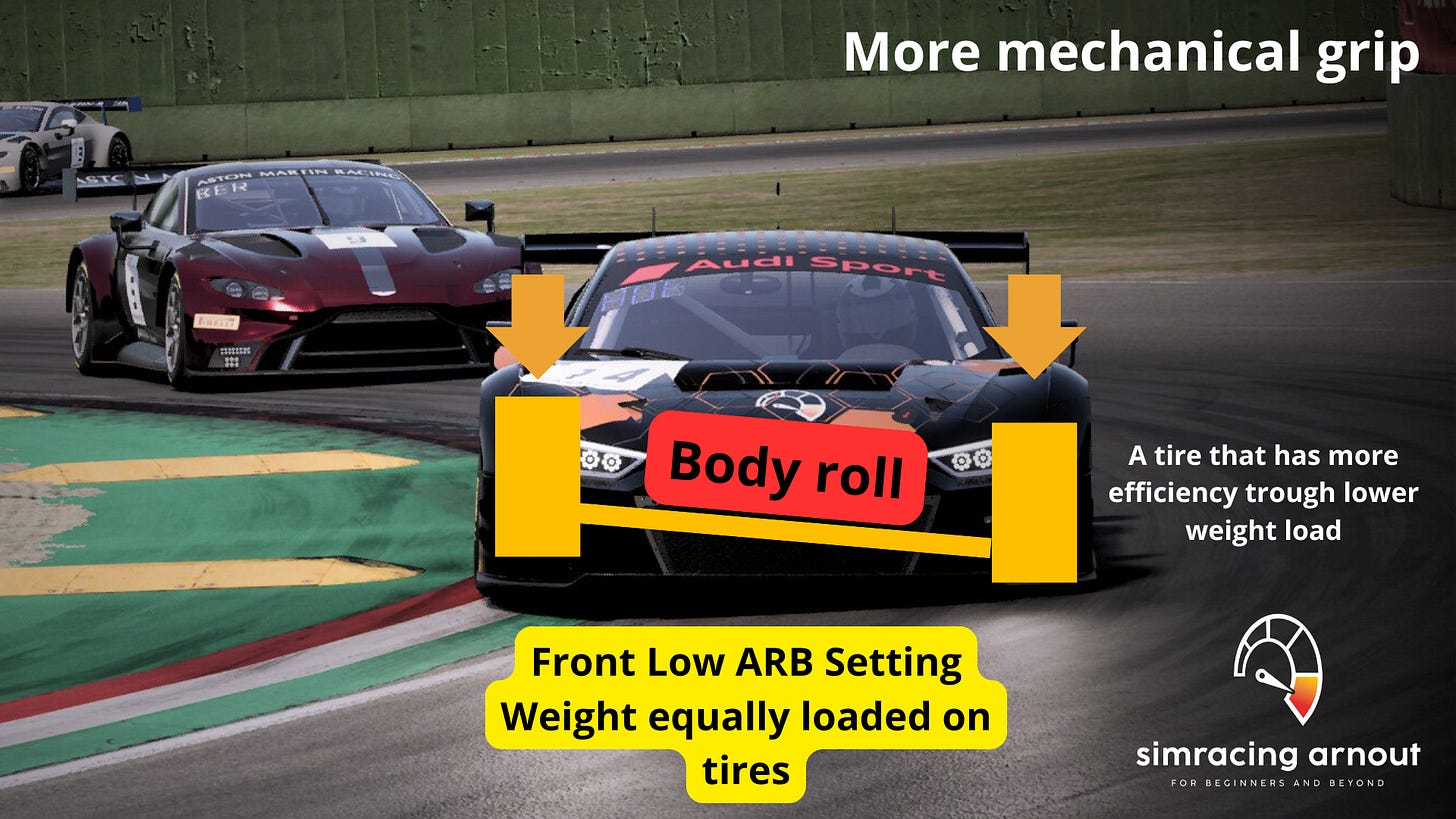
When this happens, the outside tire is relieved of some of its load, meaning both tires on the axle work more efficiently, creating more traction and grip on the front.
Great! Should we just use the lowest settings on the front and back for the best lap time?
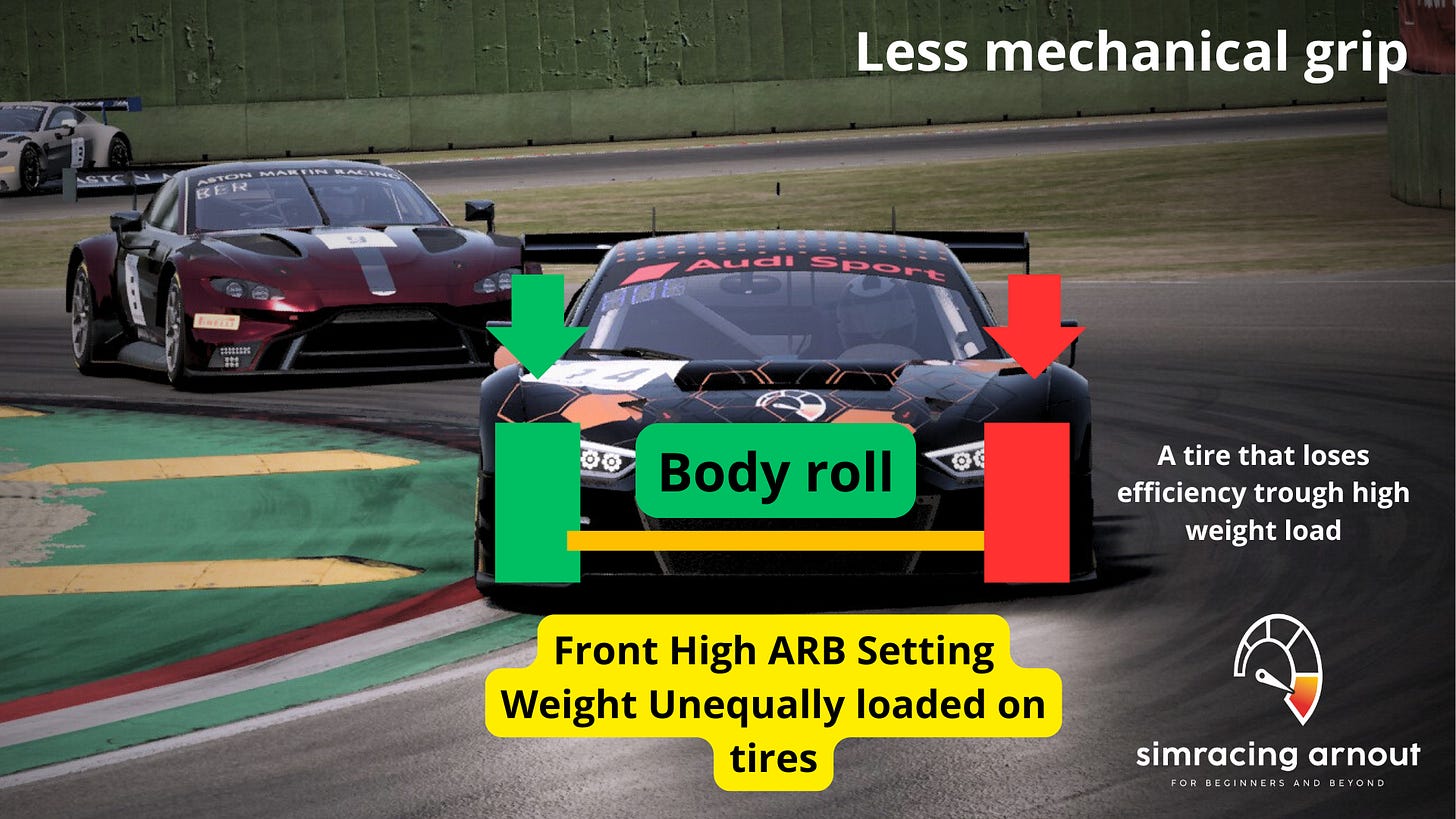
Not really. Low values make a car sluggish and unresponsive. It can also be harder to save in an oversteer situation, and excessive chassis roll caused by low anti-roll bars can make fast corners, where downforce is high, more challenging.
This is especially true when you have a soft front anti-roll bar with long bump stop ranges at the front. The front splitter may end up at an angle in corners, disrupting airflow under the car and affecting aerodynamic efficiency. This is something to consider if your track has many fast corners.
Do you have a great car setup but struggle in fast corners and can't figure out why? Try increasing both the front and rear ARBs by one click and see how the car behaves.
Max stiffness on the front ARB and the softest setting on the rear ARB—does that actually work? Is a particular chassis so weak that it can twist like that? I’m not entirely sure, but it makes sense not to min-max them.
I’ve found that with the Ferrari 296, you can get away with low values on both the front and rear. On the other hand, the Aston Martin performs well with a higher front anti-roll bar, with something like a 75% front to 25% rear ratio.
If you missed it, I added 2 new setup packs on the Patreon store for the Ford and the 922. check them out if interested.
https://www.patreon.com/simracingarnout/shop
P.S. I’m currently writing this on my holiday. It’s hard not to think about sim racing, lol.
Cheers,
Arnout