
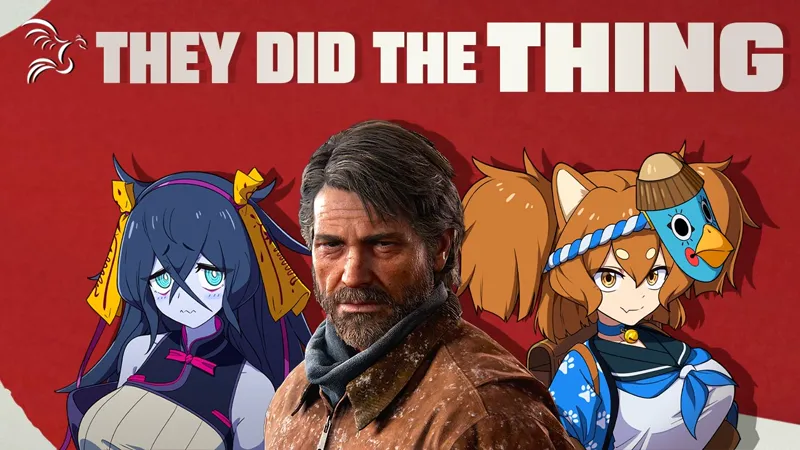
Homura Hime and The Last of Us Do That Special Thing
There’s a thing that games can do, which I like a whole lot, that I’m not sure any other form of media is capable of achieving.
The latest video essay from KC Nwosu.
Homura Hime and The Last of Us Do That Special Thing (YouTube)
Comments (9)
Excellent video KC 🫡 I remember Yahtzee saying he likes Nine Souls because protagonist has his own agenda you have no clue about or you even might disagree. Used wrongly it can be very corny, but used right can leave everlasting impact. While people debate about Last Of Us (I am not fan of the story), I can't deny writers setting out in both games to make players disagree with actions of characters. It might fall flat for other reasons - like overdoing you get torture sad porn, but I am fascinated by this story telling technique and yes, only games can do that. Meta mea culpa tracks, I like this.
I felt this a bit in Armoured Core VI. I wanted to help the rebels, but your can't until later. I guess in that case, it helps you feel like the MC. Trapped in crappy line of work, with the only choice being to complete the job. So it's cool when you actually do find secret hidden choices. There's a weird slightly different phenomena to this in the Deltarune fandom as the game explores the relationship between player and player avatar, and the player chooses bad actions, but still attributes them to the game/avatar. Maybe that's what's going on. I actually think we just wanna 'see everything', and the logic is 'we wanna see it, and the game wants us to see it, so even though we're choosing the bad route to see it, actually it's the game forcing us to do the bad route, otherwise we couldn't see it.'
I loved how Spec Ops The Line did it. I hated how Last Of Us did it. Spec Ops' chaos and absolute collapse actually makes sense for the madness and sheer desperation of literally every character on screen. If they'd talked it out the situation could have been resolved from the start, but no one was capable of conceiving that option (thus the player has no options available) Last of Us's logic leap from "There is something in Ellie that we don't understand" to "We definitely know that we have to kill her to cure everyone" is insane, and purely used to shoehorn a situation where Joel is pushed over the edge. Joel's actions don't actually bother me. It is the fact these supposed scientists are willing to take their one specimen of immunity and kill her on the assumption that it will work perfectly (like killing the golden goose to get all the eggs). It is such bad writing that completely pulled me out of the experience, retroactively making me feel like the whole game was a waste of time.
To me the choice is the important thing, so I don't sweat the logic. Maybe the TV show did it better, where they know getting the substance requires extraction from Ellie's brain. I can't imagine a scenario that accounts for a more measured approach by the fire-slies that would work dramatically in a story sense. Is Joel just suppose to hang around while they run preliminary tests? It's like when people complain that Rose is a bad person because there was plenty of room on the door for Jack. The actual problem is that the prop for the door was too big. The point is that Jack let himself die so Rose could live.
Minor terminology pitch... Selective Moral Dissonance... We as players can select our moral stance that creates a dissonance with the interactive experience If not no worries but helluva video KC 🤌🏽🤌🏽🤌🏽
Obligatory mention of Spec Ops: The Line :)
Meta Mea Culpa. Will be using that, going forward. Shadow of the Colossus springs to mind for me. The first colossus tried to kill me the moment it saw me, as did the second and third, and I didn't feel bad about taking them down. But by the time I reached the tenth colossus, I was mentally exhausted. I'd finally noticed that these shadows I was absorbing were physically changing me, probably not for the better. And this solitary, quietly beautiful creature burst from the sand and floated through the sky above me, making no move to attack, posing no threat. And I finally realized . . . I might not be justified in what I'm doing. I may be the bad guy, here. The game doesn't give you a path to *not* fight the Colossi. But still, on some level, I know I made the decision to hunt that peaceful creature down and destroy it for my own purposes, purposes I couldn't really say for sure were good. It's stuck with me ever since.
Great video. I think part of why this works so well is that you always have the option to stop playing & stop the story at a that point. This is especially true when it happens at the end of a game. You can stop playing last The Last of Us before killing the doctors & have a full narrative arc of Joel either didn't really change as a person or did but was willing to trade his surrogate daughter for all of humankind. Or Prince of Persia (2008), you can choose stop before you cut down the tree, you can choose to let Elka have sacrificed herself to save the world instead of cutting down the tree and undoing Elka's sacrifice and dooming the world. But you're choosing to continue to keep playing & take those actions which adds to the cognitive friction that makes this so great. Shout out to Spec Ops: The Line which still feels like the game that did this the best
I feel Last of Us part 2 would have been a better example. You can't make a cure for a fungal infection the way they were talking about in the game. They could kill a thousand Ellis and not be any closer. So he's closer to morally right than he is wrong for saving her because she would have literally been killed, her brain cut open, for absolutely nothing.