
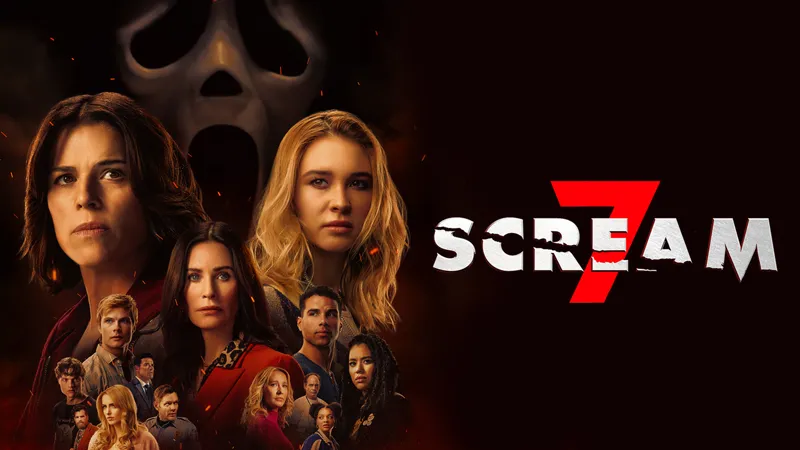
[COLUMN] Scream 7 Doesn't Just Hate Itself - It Hates Its Audience | by Darren Mooney
Note: This piece contains spoilers for the new Scream movie, which is in theatres this weekend. It will spoil everything - the identity and motive of the killer or killers, the presence or absence of nostalgic cameos, even the amount of violence. If you’re looking for a quick review: I did not care for it. I didn’t care for the last film in the series either. It’s indulgent and self-aware in the worst ways, using that self-awareness to justify an incredible amount of cynicism. It’s very bad. Which is a shame, as a big fan of the series.
Scream is perhaps the definitive Gen X slasher franchise. With original writer Kevin Williamson returning to co-write and direct Scream 7, he takes that idea to its logical extreme. True to the spirit of Gen X, Scream 7 is so deeply “meta” that it is cynical about its own cynicism, a horror movie that radiates contempt for the very idea of selling out while spending most of its near-two-hour runtime shamelessly selling out. It would almost be admirable if it wasn’t so smug and self-satisfied.
At its most basic thematic level, Scream 7 is openly antagonistic towards the nostalgic desire to turn Scream into a long-running mega horror franchise. The film opens with one of the series’ trademark “meta” murder sequences, with superfan Scott (Jimmy Tatro) taking his girlfriend Madison (Michelle Randolph) to the house owned by serial killer Stu Macher (Matthew Lillard), a location which served as the setting of the climax of the first and fifth films in the series, both titled Scream.
The house has been transformed into a gaudy tourist trap. There are outlines of the various bodies on the floor. There are movie posters on the wall. There is an animatronic model of the iconic killer Ghostface. As part of the experience, there is even an immersive phone call testing the guest’s knowledge of horror franchise trivia. It’s tacky and tasteless. As with the warehouse at the climax of Scream VI, there is a sense of the Scream franchise building a monument to itself.
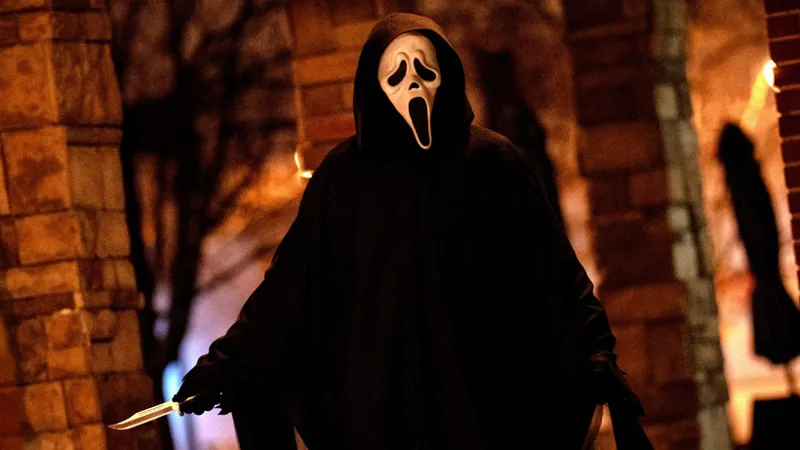
However, Scream 7 radiates a certain amount of contempt for this idea. Scott is an idiot. The prologue aligns much more closely with Madison’s perspective, who sees all this as dumb and pathetic. When the killer eventually materializes – the “real” Ghostface swapping themselves out for the mannequin – they douse the house in gasoline and set it aflame. They burn down the legacy of the original Scream. The tagline for Scream 7 is even “burn it all down”, a clear statement of intent.
Williamson has form here. Williamson has drifted in and out of the series since its launch, but the two prior sequels in which he was involved had a similarly frustrated energy. Scream 2 mined a surprising amount of pathos from the notion of retraumatizing survivor Sydney Prescott (Neve Campbell), reducing her to a perpetual victim for the pleasure of screaming crowds. Scre4m was in some ways about the millennial experience of being suffocated by endless Gen X nostalgia.
The two sequels between Scre4m and Scream 7 – confusingly titled Scream and Scream VI – seemed to at least make some gesture towards integrating that Gen X nostalgia into a more modern framework. It introduced a new cast, a new set of protagonists and largely bumped the existing regulars into the role of mentors and advisors. It still wallowed in nostalgia, to the point of bringing back original killer Billy Loomis (Skeet Ulrich) as a phantom advisor, but it was at least a little novel.
The fifth film also had the extreme good fortune of landing a once-in-a-generation cast of up-and-coming actors, including future Wednesday star Jenna Ortega, reliable final girl Melissa Barrera, Yellowjackets regular Jasmin Savoy Brown, king of the geeks Jack Quaid, charisma personified in Mason Gooding, and future Best Actress Oscar winner Mikey Madison. Coupled with a reasonable critique of contemporary fan culture, that gave the film enough juice to overpower its nostalgia.
However, Scream VI ran into a couple of problems with keeping the revived franchise on the rails. The studio declined to meet star Neve Campbell’s fee, so it became the first entry in the franchise not to feature the scream queen. It also lacked any real “meta” hook, becoming a weirdly nostalgic take on a generic slasher movie, shifting from California to New York City and dulling the slasher franchise’s edge. Think of it as Ghostface Takes Manhattan. Still, it was also massively successful.
It seemed like Scream 7 would continue in this vein, effectively completing a rebooted trilogy headed by Barrera and Ortega, albeit with Happy Death Day director Christopher Landon stepping in for directors Matt Bettinelli-Olpin and Tyler Gillett. However, Barrera was fired after she made pro-Palestine comments, Landon dropped out in the midst of the chaos that followed and Ortega excused herself, initially citing schedule conflicts with Wednesday but later claiming it was “all kind of felling apart.”
So, with no stars and no director, but with a franchise that was still profitable enough to mandate a sequel, Scream 7 was painfully and expensively willed into being. The studio reportedly paid Campbell $7m to return as lead, with Courteney Cox paid $2m to return in a supporting role. Williamson stepped in to rewrite the script and to take the director’s chair. It is no exaggeration to argue that Scream 7 was a movie conjured into being by the sheer will of the market.
The above account of the film’s production offers a more coherent and legible explanation for what happens on screen than any plot summary could attempt. Scream 7 returns to California to focus on Sydney, who is now married to local sheriff Mark (Joel McHale) and trying to figure out how to talk to her daughter Tatum (Isabel May) about her past. Once again, the villains are fixated on Sydney. A large part of the villains’’ motivation is anger over Sydney’s exclusion from Scream VI.
In keeping with that opening scene, Scream 7 is openly and consistently critical of fan entitlement. It is eventually revealed that the killings are being masterminded by Sydney’s neighbor Jessica (Anna Camp), who is an obsessive fan of Sydney, having read and internalized Sydney’s self-help book from Scre4m and who is openly resentful of Sydney’s reluctance to be the protagonist of yet another slasher killing spree.
Thematically, there is a consistent emphasis on the idea that Sydney has been reduced from a person to an object. Tatum complains that the only way that she can actually engage with her mother is through the books and films that have been made about her. Tatum’s drama teacher George Willis (Tim Simons) complains that Tatum is too “timid”, defining her by her relationship to Sydney. Tatum is not allowed to be her own person, because everybody will always be talking about her mother.
More broadly, Scream 7 is built around the suffocating culture of contemporary nostalgia. Early in the film, Jessica and her accomplice Marco (Ethan Embry), a former Google engineer, post videos using generative artificial intelligence to resurrect Stu Macher, the killer who was crushed by a television in the first Scream movie. Williamson is playing with the long-lingering fan theory that Stu survived Scream, with fans even speculating that he would be revealed as the mastermind of Scream VI.
This frustration occasionally spills over into outright anger. There are several points where Williamson tilts Scream 7 into outright parody. Lucas Bowden (Asa Germann) has his skull impaled on a craft beer tap, leading to a punchline where beer and blood flow through his mouth. Playing on the classic “you have to shoot them in the head” logic of the series, Sydney and Tatum empty so many rounds into Jessica’s face that her skull literally flies apart because there’s no kill like overkill.
Around the midway point of the film, after one the killers targets Sydney and her family in their home, that killer is crushed by a jeep that careens into the movie from out of frame. The door opens and familiar characters Gale Weathers (Courteney Cox), Chad Meeks-Martin (Mason Gooding) and Mindy Meeks-Martin (Jasmin Savoy Brown) pile out. It is a sequence that very obviously parodies the absurdity of this sort of fan service, as returning characters literally crash into the movie.
Scream 7 demonstrates a certain passive-aggressiveness towards Scream VI. Not only does Jessica insist that it “doesn’t count” because Sydney was not in it, Gale repeatedly points out that Sydney was right to sit it out. Williamson has no real interest in Chad and Mindy, the only two characters he inherits from Scream VI, basically writing them as new characters. While Scream VI deserves any criticism thrown its way, it feels like the least Williamson could have done is to make a better movie.
All of this would make it feel like Scream 7 should be classified as part of the recent trend of self-loathing sequels, typified by movies like Saw III or Joker: Folie á Deux. These are franchise films willed into being by the economic calculus of Hollywood, with no reason to exist, produced by creators well aware of the meaninglessness of it. These are films that radiate contempt not just for their own existence, but also for the systems that created them.
There is nothing inherently wrong with this. Scream 7 is self-evidently a creatively bankrupt concept from its inception. Williamson is a smart enough writer to understand this, and has mined that tension to great effect in both Scream 2 and Scre4m. Watching Scream 7, it is possible to imagine a version of this that might work, Williamson aggressively torching his own creation from the inside, reducing a self-aware reinvention of the slasher concept to an indulgent self-parody.
The problem is that Scream 7 lacks any real courage of its conviction. It cannot follow its ideas to their conclusions. There is a pervasive cynicism hanging over the movie. It wants to both do the crass vulgar commercial thing and get credit for critiquing the crass vulgar commercial thing. It wants to mock and ridicule the excesses of fan culture’s reptile brain impulses, while also indulging them in the most condescending and patronizing manner possible.
Scream 7 understands that bringing back Stu Macher would be lazy and indulgent hackery. So it constructs an elaborate narrative framework that allows it to bring back Stu Macher and critique the cynicism of Stu Macher. The climax features cameos from previous actors in the franchise using that generative artificial intelligence plot device, from David Arquette to Laurie Metcalf to Scott Foley. It might ostensibly be critiquing such nostalgic wankery, but it also celebrates it.
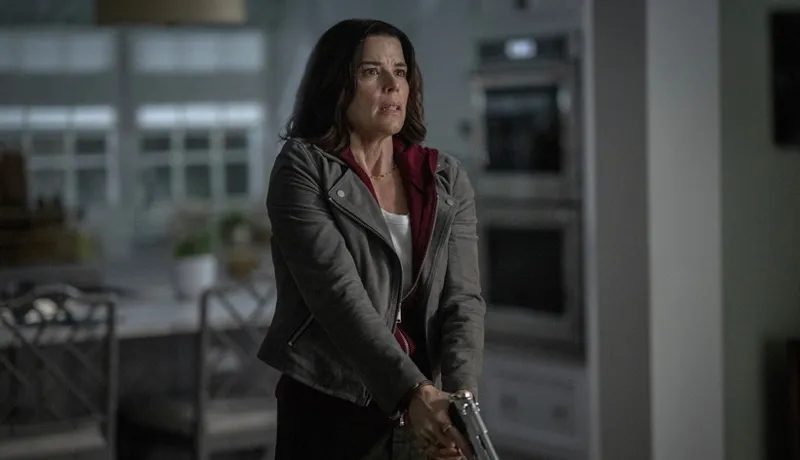
As much as the film is thematically about the emptiness of this sort of repetition, there is a recurring sense that Scream 7 is both openly contemptuous of the worst impulses of modern franchising and cynical enough to satisfy them anyway. There are several recycled beats from earlier films, such as an attack at a theatrical rehearsal evoking Scream 2 or a faulty garage door evoking a key beat from the original Scream. Tatum spends a lot of the film wearing Sydney’s leather jacket from Scream 2.
Similarly, Scream 7 understands the limitations of a fandom that cannot let go of their favorite toys, making them the villains of the film. However, it also gives them exactly what they want, allowing Sydney to be the badass slasher movie heroine that Jessica wants her to be. For all the film makes it clear that Willis is an asshole for defining Tatum by her relationship to Sydney rather than as her own person, the film builds to Tatum defining herself as “the daughter of Sydney fucking Prescott.”
This is the unresolvable tension at the heart of Scream 7, a nostalgic and indulgent narrative framework that drives a movie openly contemptuous and mocking of nostalgic indulgence. To give credit where it is due, Williamson is an incredibly smart and savvy writer. This tension is not accidental. He knows what he is doing, serving regurgitated reheats to an audience he assumes will eat it up.
Williamson’s previous sequels were contemptuous of the larger machinery of pop culture trapping viewers in endless cycles of nostalgia. Scream 7 is the first time that it feels like Williamson is openly contemptuous of his audience. Perhaps, given the box office projections, he is right to be. Scream has always been a meta franchise, a snake eating its own tail. Scream 7 asks the important question: at what point does a pop culture ouroboros become a franchise human centipede?
Comments (15)
Not gonna lie; these articles by Darren are the main reason that I support Second Wind. Top notch media analysis for movies and television that I probably won't ever watch, but nonetheless deepen my understanding of the wider media landscape.
I just pretend that Scream, Scream 2 and Scream 4 are the only ones.
A man after my own heart! (I don't mind "5cream.")
Good question at the end there Darren
Bleak, though!
I’m honestly just glad this sad, stupid debacle is over with. Congrats to Paramount for setting a dumpster on fire and then pushing it into theatres. I guess.
Well, it's going to make enough money that they're just gonna keep making these things.
It's kinda poetic that the movie that has one of its actors fired for standing up for human rights couldn't stand for anything on its own.
(Stroking my chin) "How... poetic."
I wonder if Paramount and Kevin Williamson are genuinely pissed that Fun World still own the rights to Ghostface and this movie is a big “F you” to them.
Ha! I do think Williamson is working through two competing feelings, the first of which being the fact that this thing is still going and will probably outlive him and the second being that he really likes being paid lots of money. (And, honestly, no shade. Money is important.)
I'd really love if the formatting on these headlines could change. They are all so similar and so structured to hit SEO stuff that they feel like chatGPT writing them. Not trying to be a dick or anything but this one in particular reads like gen AI output to a T. They all are "[NAME OF MOVIE] is [buzzword thing] that [common internet phrase]" and it doesn't make me want to read the article.
We don’t have to worry about SEO at all on a paid platform. This is a normal title structure, not really sure what’s buzzwordy about Darren giving an opinion in the title to hook you into the article.
What a great review/essay! Sometimes DM's columns dig a little too deep into themes or issues of movies that don't always warrant that level of analysis for my taste (part of me wonders what the point is but they're still fun to read). I'm sorry that Scream VII sucks but this seems spot on, is worth a read, and is a good reminder that I don't need to catch up on the later Scream sequels after all. Thanks as always!
Ah, I think even bad movies merit some level of consideration. I did write about "Nightswim", after all!