
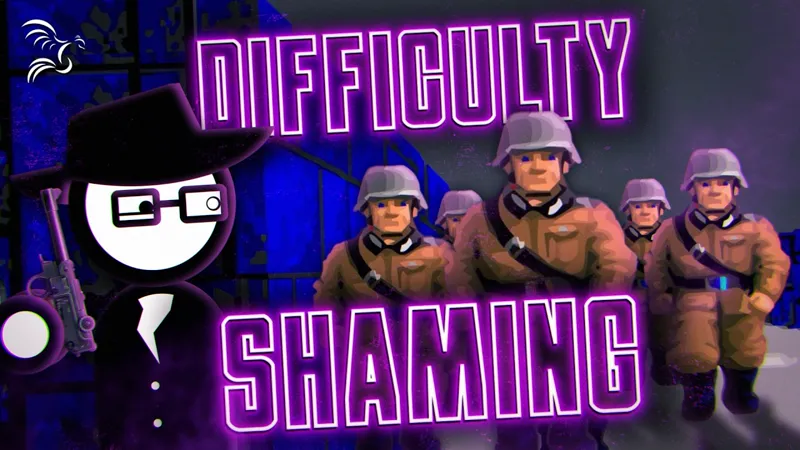
The Best Kinds of Difficulty Settings | Semi-Ramblomatic
This week on Semi-Ramblomatic, Yahtzee takes a look at selecting the right kinds of difficulty settings.
The Best Kinds of Difficulty Settings | Semi-Ramblomatic (YouTube)
Comments (13)
Suddenly remembered the difficulty settings of Goldeneye 64 being almost unique; they would add more required objectives on higher difficulties, while on the lowest one you generally just needed to get to the end of the stage alive.
In my view, adaptive difficulty is the worst option of all. It denies both people who want easy mode, and people who want difficulty, from their preferred playing style. Not having a difficulty slider at all is genuinely a better option.
I remember Path of Neo would make you play an enemy combat gauntlet before it would let you choose a difficulty, but even after you finished the game you still had to unlock the extra difficulties by going through it. Interesting idea and it wasn’t that easy to unlock the hardest one.
I always thought of RE4's approach as not adaptive difficulty but adaptive regeneration. Please someone correct me if I'm wrong, but it seemed to me that it just tweaked how much ammo and other goodies you got such that no matter your performance in previous encounters the next encounter remained somewhat tense and resource scarce. This to me is simply a return to the core conceit of clearing the slate that we had in old discrete level-based design (eg: Goldeneye), but retaining the narrative flow of a continuous structure. Also a neat panacea to hoarders. In a weird way, it dovetails nicely with Yahtzee's previous comments on Yoshi's Story vs SMB, or character action games; RE4 is a game that doesn't grade you on degrees of success but rather just asks whether or not you crawled over the finish line.
Funny you should mention DOOM, I recently started that for my first time, picked the middle difficulty setting, got a few stages in without any massive problems, got killed on the fourth stage, blinked, thought for a bit, said "no" out loud to myself, turned on God Mode and blasted my merry way through the remainder of the evening's murder spree without a care in the world. Was I doing it wrong? Possibly, but I was having a better time than I believe I would have had otherwise.
Possibly one of the extreme levels of having design changes by difficulty is the original Star Fox (or as I knew it, Starwing) having three completely different sets of stages. They even have implications of being different strategic approaches, though oddly enough the direct counterattack is the easiest one.
"Painkiller" gave us "Daydream" down to "Nightmare"
I think some of the RE games keep an eye on how much ammo, healing items etc. you have. If you are running short they are more likely to drop. This helps to keep the tension up.
The difficulty settings in the original Deus Ex were Easy, Medium, Hard, Realistic.
Couple of things: You’ve previously said that, for example, dark souls shouldn’t have difficulty options because the knowledge that it can be done easily cheapens the experience. Surely this could be extrapolated to games besides Dark Souls. As for difficulty options being “settled law”, in a vacuum, I agree. It is better, all other things being equal, for there to be good difficulty options so as many people as possible can enjoy a game. That’s just good business. However, game development is a zero-sum system. Time/money/manpower spent ensuring difficulty settings or even other accessibility systems is time that is not spent on parts of the game that aren’t that. That’s just how resource allocation works. Personally, I’d rather have the game be top-tier for the vast majority of people and unplayable and frustrating for a minority of people than quite good for everyone. Of course, that’s only really a factor if the difficulty settings or other accessibility features have effort and care put into them. If they’re phoned in then that’s fine.
I really don't think it's a "zero-sum system" in that sense. Genuine difficulty settings are more so a part of the core game design than simply an amount of work that can be done or not done at some point. It may absolutely be true that designing a game to have difficulty options may sometimes have a negative impact on other aspects of the design, and it may absolutely be true that it sometimes involves a lot of work e.g. extra level design, but I think that varies strongly from game to game. Let's also keep in mind that Yahtz has done game development himself, so I'm sure he is already aware of the extra effort on some level when he makes his statements.
I've always felt that two difficulty options were perfect - the "Intended" one that the game's mechanics were built around, and the "Story" option for those who just want to relax. Though the Guardians of the Galaxy game had an interactive difficulty menu so that you could tweak certain attributes to your desired levels.
For a brand new game I appreciate the "Developer Recommended" notation on a difficulty setting. I trust that they have a philosophy on how their game is best experienced while still giving us choices.