
[COLUMN] Avatar: Fire and Ash is a Biblical Epic for a Secular Age | by Darren Mooney
Note: So, Fire and Ash was the Mooney Family Christmas Cinema Trip this year. It went over quite well. It’s also maybe the first Avatar film to actually grow in my estimation on rewatch, in large part because I was able to watch the entire film being aware of the third act scene that I discuss in the opening paragraphs. Having a sense of the shape of the movie as a whole made individual choices feel more cohesive on rewatch. Be aware that this piece will contain spoilers for Fire and Ash. And the Bible.
There is a very interesting scene that occurs in the third act of Avatar: Fire and Ash, sandwiched between the two gigantic climactic set pieces.
Neytiri (Zoe Saldaña) and Spider (Jack Champion) have just rescued Jake Sully (Sam Worthington) from the human forces on Pandora, mere hours before he was due to be executed by firing squad as a traitor to the human race. The three characters are on their way back to the coastal settlement that they call home, hoping to confront the massive whaling fleet led by General Frances Ardmore (Edie Falco) and Captain Mick Scoresby (Brendan Cowell) as they lay siege to the native Tulkun.
Following a near-death experience early in the movie, Spider has become symbiotic with the planet of Pandora. He is able to breathe the planet’s air without a mask. His lungs have been colonized with mycelia, which convert the planet’s atmosphere into oxygen. Spider is the first human who can live on Pandora outside airlocked environments. Naturally, this makes him an existential threat to the Na’vi. If humans can harvest that mycelia, they can colonize Pandora en masse.
Earlier in the film, Neytiri had suggested that it was necessary to sacrifice Spider for the greater good, to take his life to protect the inhabitants and the culture of the world that he called home. Jake had rejected that suggestion out of hand, refusing to even consider it, particularly in light of the recent loss of the son that he and Neytiri share, Neteyam (Jamie Flatters). However, at the climax, having just narrowly escaped humanity’s clutches, Jake reconsiders.
Jake leads Spider into the forest, carrying a sacrificial knife with him. He guides Spider to a clearing, and prepares to slit his adoptive son’s throat to protect the planet of Pandora and the spirit that resides in it known as Eywa. As multiple reviews have pointed out, the sequence has very overt parallels with “the binding of Isaac”, a biblical parable in which God demands that Abraham sacrifice his son Isaac. Like Isaac, Spider ultimately gets a last minute reprieve. Jake cannot do it.
It is a very strange sequence in a very strange movie. A large part of the appeal of the Avatar films is that for all that they are crowd-pleasing blockbusters, they are also deeply idiosyncratic movies from the imagination of director James Cameron. Coming where it does in the narrative, and existing in such sharp tonal contrast to the big spectacle around it, the near-sacrifice can still feel a little jarring. However, it also becomes something of a key to understanding the movie as a whole.
The Avatar movies are firmly rooted in James Cameron’s worldview, a strange hybrid of science-fiction militarism and hippie environmentalism. There is a decidedly 1980s and 1990s California vibe to the films. This vibe is personified in Spider, a dreadlocked white kid appropriating Pandora’s indigenous culture that asks the very pressing question, “What if Tarzan was a surfer?” It’s Spider who is the focus of Fire and Ash, and who gets to deliver the closing line, a good-natured “no shit!”
This carries over into the films’ spirituality. The Na’vi live in communion with the planet Pandora, and they worship a god known as Eywa. However, Eywa is not some absent deity. It is a tangible force in the world of Pandora, as real as the Force is in the world of Star Wars. Na’vi biology allows the species to connect to each other and the planet, and the planet has formed something of a rudimentary world mind known as Eywa.
True to James Cameron’s worldview dating back to The Terminator and running through his filmography, Eywa is a matriarchal figure. She is known as “the All-Mother” or “the Great Mother.” Eywa is an active force in the original Avatar. In Avatar, a floating woodsprite convinces Neytiri to spare Jake’s life. Before she dies, Grace Augustine (Sigourney Weaver) tells Jake that Eywa is real. At the climax, Eywa sends the planet’s wildlife to help the Na’vi repel the human invaders.
Part of what is so interesting about Fire and Ash is that the movie is decidedly more ambivalent about Eywa. It does not doubt Her existence, but it does question Her righteousness. Fire and Ash is a sprawling movie with a lot of plot happening in it, but the film’s central thematic preoccupation is the question of what it means to live in the world knowing that God has turned Her gaze away from Her children. As Cameron put in press, “Well, what happens if Eywa abandons you? What happens if your mother abandons you?” Most of the characters navigate this question in various ways.
In some cases, it is literal. Kiri (also Weaver), the mysterious child born from Augustine’s Na’vi avatar, longs to communicate with the Great Mother as other Na’vi do. However, she finds herself continually rejected. As human scientist Doctor Norm Spellman (Joel David Moore) explains, Eywa has erected “a firewall” to keep Kiri from feeling the spiritual bond that every other Na’vi has with Pandora. Every time that Kiri tries to commune with Eywa, she is forcibly cast out.
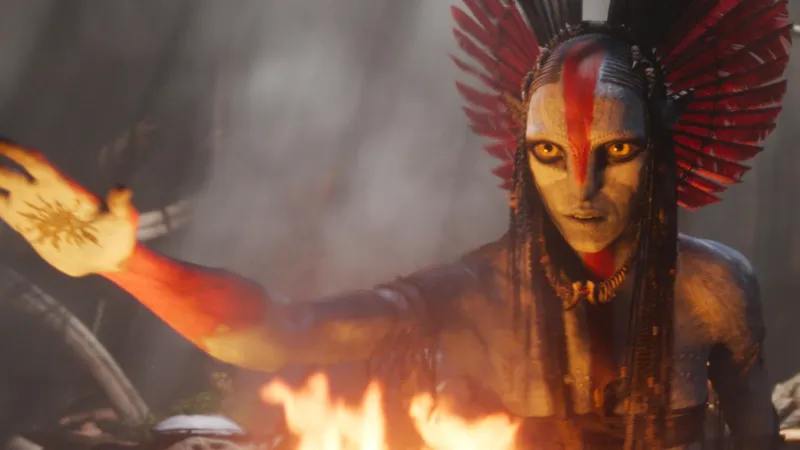
The villainous Varaang (Oona Chaplin), the leader of the violent Mangkwan clan, might empathize. Varaang was only a child when her tribe was devastated by a random volcanic eruption that left them homeless and starving. Eywa did not come to their aid, forcing Varaang to lead her tribe as pirates, scavengers and raiders. Her tribe rejects Eywa’s teachings and the harmony of life on Pandora. As she warns her fellow Na’vi, “Your Goddess has no dominion here.”
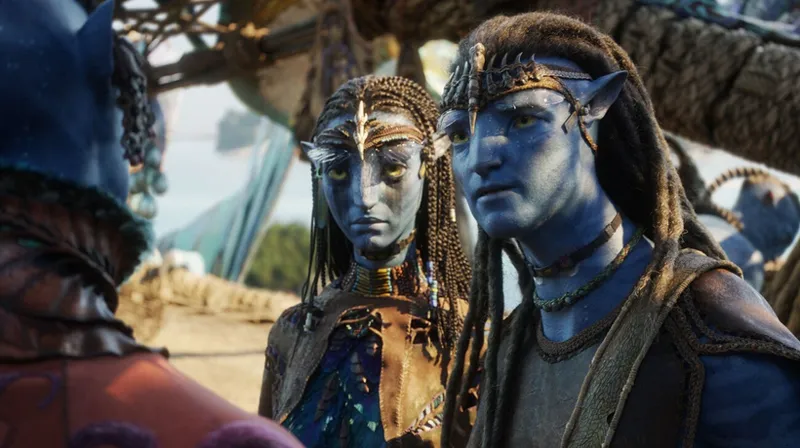
Other characters face a more abstract crisis of faith. In keeping with recent films like 28 Years Later or Hamnet, a large part of Fire and Ash is about the struggle to deal with unimaginable grief as Jake and Neytiri mourn the loss of their son Neteyam at the climax of The Way of Water. Jake rejects the label of Toruk Makto, the savior of the Na’vi people, believing that only bloodshed can follow such a title. Neytiri retreats into her faith and her belief.
Early in the film, Jake lashes out at Neytiri in frustration. He cannot understand how Neytiri would still worship a deity that took the life of their eldest son. Neytiri responds angrily, pointing out that she has lost everything over the past few years: her family, her home, her son. “All I have is my faith,” Neytiri pleads with Jake. Fire and Ash seems to question whether that faith is ultimately well-placed. Is Eywa deaf to the plight of Her followers? Does Eywa even care about Her own survival?
After all, it is Eywa who gives Spider the ability to breathe on Pandora. In doing so, She jeopardizes the entire planet by offering humanity a pathway to finally colonize the world completely. For all the New Age spirituality of the Avatar franchise, there is something very Old Testament in how Eywa forces Jake to consider sacrificing Spider to save his adopted home. There is a palpable anguish and despair to Fire and Ash that was not present in the previous two films.
It is possible to look at Fire and Ash as a modern spiritual successor to the classic Hollywood biblical epic, movies like The Ten Commandments or Ben Hur, gigantic crowd-pleasing spectacles infused with a certain spirituality. It is perhaps notable that religious cinema does appear to be making a comeback, as demonstrated by the box office performance of The Chosen, Mel Gibson’s looming The Resurrection of the Christ and even the animated film David playing in cinemas against Fire and Ash.
More broadly, Cameron’s Avatar movies perhaps occupy the same cultural space that those biblical epics held during the 1950s and 1960s, a monument to the power and the spectacle of maximalist crowd-pleasing cinema as smaller, edgier and more ambitious films like One Battle After Another, Sinners and Weapons represented a new emerging wave. Of course, this sort of trend is only really obvious in hindsight, but Cameron’s Avatar films feel elegiac for a certain kind of Hollywood movie. They are the culmination of something, the last gasp. Where else is there for spectacle to go?
In some ways, the film’s spirituality makes sense in the larger context of contemporary pop culture. There have been a spate of recent blockbusters preoccupied with the fear of a spiritual absence at the heart of contemporary culture, from Guardians of the Galaxy, Vol. 3 to Fast X to Barbie. However, it might also reflect something more personal for Cameron as a filmmaker. Fire and Ash is dedicated to producer Jon Landau, who had been Cameron’s producing partner for over three decades.
The loss was devastating. “I have lost a dear friend, and my closest collaborator of 31 years,” Cameron announced on news of Landau’s passing. “A part of myself has been torn away.” At the launch of Fire and Ash, Cameron insisted that Landau influenced the film, that “his spirit infuses all the Avatar films and we all, when he passed — it was a blow. It was a shock. And it was not lost on us that we were making a film about how humans process their loss and their grief.”
In some ways, Fire and Ash feels like the kind of movies Ridley Scott made around the time of the passing of his brother Tony: Prometheus, Exodus: Gods and Kings, The Counsellor, Alien: Covenant. These were bleak and cynical works that were often about an absent or malicious God, who was capable of tremendous and mysterious intervention that was largely horrific or alien to the humans caught in its path. Fire and Ash is nowhere near as dark as those films, but it shares some DNA.
Of course, Landau died of cancer in July 2024. By that time, Fire and Ash had finished filming. Still, Landau had been living with his diagnosis for at least a year and Cameron has been candid that a significant amount of Fire and Ash – particularly large portions of the third act – was effectively rewritten in postproduction. Weaver was preparing for reshoots in May 2023. The general messiness of Fire and Ash compared to the previous two films suggests a film radically altered late in the game.
James Cameron has never been a particularly subtle filmmaker, but there is a certain poetry to his writing. In the film’s opening narration, Neytiri and Jake’s surviving son Lo’ak (Britain Dalton) notes that Neytiri prays most frequently during the planet’s eclipses. In the darkness, she prays knowing that the light will return. Lo’ak sets up the metaphor of the eclipse – a rather literal “dark night of the soul” – in the first act, only for Cameron to literalize it at the climax.
In the gigantic third act battle, the Na’vi repel the human invaders as the sun shines, only for the tide to turn dramatically in the invaders’ favor during the eclipse. However, the light ultimately returns and the good guys triumph. Kiri is able to commune with Eywa. In an acknowledged reference to Stanley Kubrick’s 2001: Space Odyssey, a film that (in true Cameron style) the director loves but does not like, Kiri glimpses a version of the Goddess that evokes the Starchild from Kubrick’s classic.
Eywa turns Her gaze towards Her children. Kiri is granted spiritual communion with the wildlife of Pandora, in confrontation with the human colonists who would destroy them. However, even then, Eywa remains a decidedly Old Testament God of wrath and violence. “Go to the Sky People,” Kiri instructs the planet’s wildlife. She promptly elaborates. “Kill them. Kill them all.” The brutality that follows provides an interesting contrast with the franchise’s otherwise largely New Age sensibility.
This jagged spiritual thread running through Fire and Ash grants the film an edge that is largely lacking from Avatar and The Way of Water. It’s a meaner and darker film, its thoughts and structure less organized, but themes somewhat richer. It’s a movie about how God is truly alien.
Comments (12)
My favorite part is right before the almost-sacrifice, when spider keeps saying he needs to pee, over shots of running water. I believe the meaning hidden in this scene is that you are safe to run to the bathroom and skip the rest of the scene.
That does sound like an interactive Multiple Choice Option scene.
Just want to point out that I had "bible film" on my bingo card for what might be a big US genre after superhero movies! But bible allegories never went out of style, and while I'm still looking for good alternative Christmas movies beyond Children of Men, 8 Mile defnitely is an Easter Classic.
Ha! I mean, I think the safe bet is "video game movies" in the short term. But who knows? (There is an argument that literally biblical movies - "David", "Sound of Freedom" - are gaining ground in contemporary mass media, though.)
This was one of the most boring films I've ever sat through. The only plot-point of any importance was Spider's lung transformation, and it felt like every scene around that was just a rehash of the first 2 films.
I agree it's the least of the 3, but I think the villains are pretty entertaining.
But isn't the attempted message completely undermined by the Avatarian god bring completely real? Their attitude to their god will be entirely different to ours, because they don't _need_ faith.
I don’t think so. Christians believe that God is real and - all the time - ask why God turns His face away or doesn’t intervene. Exploring that question in a universe where God is real (or something close God is something close to real) just bypasses the cheap and easy answer to that question - God turns away because God doesn’t exist. That’s a dramatically and philosophically inert answer that bypasses the actual existential struggle. As an agnostic, I think it’s perfectly valid to ask what it means, if one believes that God exists, to struggle with what God allows to happen. (To be fair, I think it’s also worth stressing that Eywa is a very New Age version of God. Does She act like an individual? Does She have a will? Or is She just an anthropomorphised expression of shared consciousness? I don’t know watching the film that Ewya knows who Kiri is, who Jake is, who Neytiri is. That is still a leap of faith in the franchise’s religious framework. That God is knowable and relatable, that God has intent.)
A spoiler alert for the Bible made me chuckle. Great article, as usual.
Thank you!
Weird. To me it was the dumbest storytelling I have ever seen, even competing with Rebel Moon.
Each’s own and all that!