
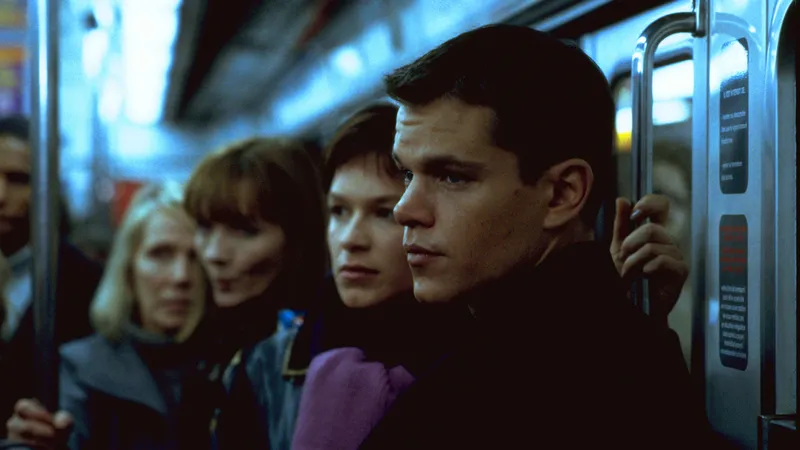
Retrospective: The Bourne Identity
The Bourne Identity captures a strange moment in the history of espionage. The Cold War is over; the War on Terror is creeping into sight. America has defeated its external enemies. Capitalist realism is the law of the world. With no great adversary after the fall of the Berlin Wall, America is forced to gaze at its own awful reflection, trapped in a solipsistic prison of its own making.
And always obsessed with the labyrinth of American life, Tony Gilroy loves starting in the middle of a story. His protagonists often enter the film at a point where events have already begun unfolding at a drastic pace. Suspense is generated by the amount of information the main character has or doesn't have. At the beginning of The Bourne Identity, Jason Bourne has possibly less information than any protagonist in cinematic history. When Matt Damon's character is fished out of the Mediterranean with two bullet holes in his back, he has no memory of his life or who he is. He has to extrapolate his identity from his actions and abilities. Bourne's early scenes are intercut with sequences in Langley where C.I.A. case officer Alexander Conklin (Chris Cooper) tries to hunt him down.
Bourne discovers that he's a piece of technology — one of the CIA's copious murder weapons. Regardless of how he wound up in that position, the movie establishes that anyone without any memory of their life, without any context except their own conscience, would be horrified to learn that they're an assassin. The second sequel complicates this in rich and interesting ways, but in The Bourne Identity, Bourne's moral choices based on what he knows are fairly delightful. One of the only classic paranoid thrillers of the 21st Century.