
You're No Fun Anymore: Brazil (Love Never Dies Version)
A year ago, I interviewed a 20-year-old Palestinian-American woman in Midtown Manhattan during a Free Palestine march. We sat on the steps o
A year ago, I interviewed a 20-year-old Palestinian-American woman in Midtown Manhattan during a Free Palestine march. We sat on the steps of Moynihan Train Hall, me with a digital voice recorder in my hand, Maryan — that was her name — with a mask on her face. Protesters marched past us on Eighth Avenue, flanked by NYPD officers. At the top of the station’s steps, an aging rabbi decried Zionism as a rebellion against God.
I was there as part of my senior project, the last step to getting my journalism degree after eight years in college. I’d had to restart the project recently after my initial pitch — a story about mass surveillance — fell through. So I spent that day running around Midtown, frantically trying to interview protesters, occasionally stopping to sit down and cry.
Nothing that happened that day, though, was as dramatic as what Maryan told me about the party that changed her life when she was four years old.
“I lost most of my family on Eid,” she said. “The IDF came into our party and shot everybody. My father, my cousins, my uncles.”
Maryan survived because, at four years old, she knew how to play dead. Her mother survived because she’d gone to fetch some olive oil.
When I spoke to Maryan, she was living in a shelter system. She and her mother had become estranged after her mother’s marriage to an abusive American secured their citizenship but split them up.
Maryan spent years in foster care. She told me she hoped to start a family and land an apartment one day. I don’t know what’s happened to her since that protest.
I thought of Maryan immediately when I rewatched the opening scene of Brazil, where the Ministry of Information’s security troops smash into the Buttles’ apartment at Christmastime, to the terrifying accompaniment of jingling Yuletide bells, seizing her father, stuffing him into a bag, and ultimately carrying him away to his death. Later in the movie, I thought of her again when Buttle’s widow screams at Sam Lowry, crying “what have you done with his body?” It reminded me of myself on that cold December day in Manhattan, and not in a flattering way.
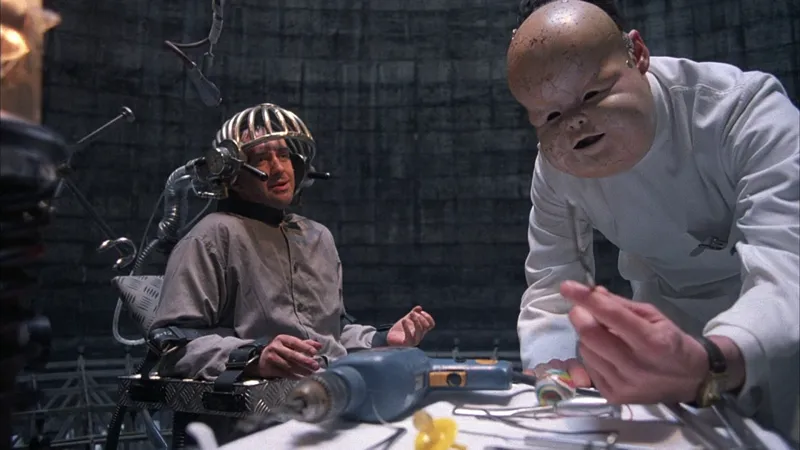
The catalyst in Brazil, Terry Gilliam’s masterpiece about the universal art of delusion, the implicit violence of capitalism, the banality of good, and the sociopathy of the information economy, is a bureaucracy’s accidental murder (by deliberate torture) of an ordinary family man over £31.06. Unlike the villains in Gilliam’s previous movies, the Ministry of Information isn’t just a cabal of old sticks-in-the-mud whose crimes are being generally unpleasant old shits. The bureaucrats of Brazil are a montage of 20th Century evil, combining the Third Reich, American plutocracy, and the British Civil Service (as well as — possibly — the IRA, if you take it as read that the Ministry is responsible for the terrorist bombings). Their crimes are little fuckups that destroy lives, the same way that McKinsey spreadsheets can decide if a Saudi journalist lives or dies. The apparatus that creates those “mistakes” has to be sustained by murder and torture by nice ordinary people like Jack Lint, played by Michael Palin in his most terrifying performance. Gilliam knows what he’s doing when he has Michael Palin say “I don’t want to be involved in savoury” after torturing someone on Bring Your Kid to Work Day. The banality of good indeed.
Brazil is set in a world where an alternative to this bureaucratic state capitalism has already been preempted. Protagonist Sam Lowry, whom Jonathan Pryce plays as a screwball comedy protagonist with delusions of grandeur, dreams of fighting the Ministry when it gets in the way of his fantasies. But he’s a decidedly individualistic thinker, more interested in his own liberation than assisting the people around him. While he’s shaken by Mrs. Buttle’s breakdown, Sam doesn’t seem particularly interested in righting the wrongs beyond that point. He turns his back on the Buttles and continues his quest to stalk a woman and get laid. Sam Lowry’s idea of heroism is a futile individualist fantasy, more about fulfilling boyhood dreams than having any impact on the real world. It’s a rebellion, but not a terribly far-reaching one.
Sam Lowry seems like Terry Gilliam’s first attempt at a self-critique. In Jabberwocky and Time Bandits, Gilliam was happy to attack modernity and all its vices, and watching him do so was great fun (well, at least in Time Bandits). In Brazil, Gilliam takes aim at his own escapist tendencies. A dreamer who’s bored with the established order? Terry Gilliam knows who he is; there’s a reason all of his protagonists match that description. His greatest personal objection to The Way Things Are is just how boring it is. But by rooting Sam Lowry in an unspeakably evil world, Gilliam admits that malaise is useless. In a way, it makes things worse. Sam Lowry has a core of decency, but he lacks any kind of social awareness. He consistently gets the people around him hurt — something that’ll become quite relevant to Terry Gilliam when we get to The Adventures of Baron Munchausen. Sam’s attempt to save Jill’s life ultimately leads to her murder. Possibly the only person whom Sam genuinely helps is Kurtzmann, but who knows? Maybe Kurtzmann gets tortured to death offscreen for mishandling a refund check. When Sam hears “what have you done with his body?”, he’s forced to face the evil he’s complicit in. But he doesn’t face that evil in a way that materially improves anyone’s lot. Ultimately, Sam’s fight against the establishment is just a part of his narcissistic fantasies. The director of Time Bandits understands himself.
That failure of politics is on full display in Brazil’s treatment of women. The female characters are either set dressing, gross old ladies trying to be sexy, or objects to be stalked and fantasized about. Sam Lowry’s sexuality embodies an agency that none of the female characters have. Regardless of the shortcomings of Kim Greist’s performance (she seems to be acting in a different movie than the rest of the cast), she’s given the thankless task of trying to turn the victim of Sam Lowry’s stalking into a human being. The movie parses that this is exactly what Sam is doing; Jill’s reactions are normal human ones. But ultimately Brazil treats Jill as the object of a treasure hunt, a reward for Sam whose murder is a tragedy for his penis. The misogyny here isn’t just a property of Brazil; it’s thematically pivotal.
There are the shortcomings of Brazil in a nutshell. When I heard Maryan’s story on that winter day in Manhattan, I realized just how stupid my little thesis project was, and frankly how pathetic all of my life problems seemed. Yet I kept pursuing my stupid little dream of becoming a journalist, not unlike how Terry Gilliam’s Brazil pursues Sam Lowry’s dream while more interesting people suffer around him. It’s futile, silly, and infuriating — a perfect Terry Gilliam movie.