
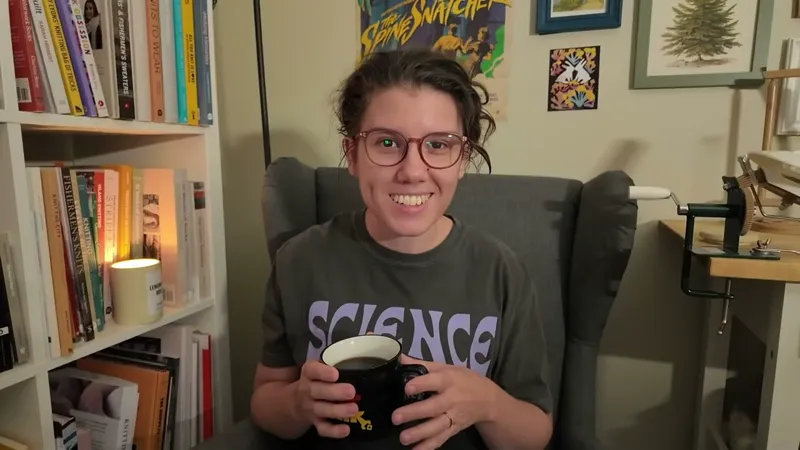
How to re-educate adults
Happy Friday!
Comments (43)
you are the rason im going back to college haha
I'd like to push back slightly on the idea that interruptions are always ego-driven. For many, interjecting is actually a vital learning mechanism. Visual-spatial learners or those with auditory processing differences often need to vocalize their thoughts to effectively process and retain information. Beyond ADHD or other neurodivergent considerations, the act of teaching itself is incredibly complex, which is why so many educators burn out within their first year. Framing adults as "unteachable" risks creating a hostile, exclusionary academic environment that makes the already difficult task of returning to education feel unnecessarily painful.
Not to mention how incredibly hostile graduate education has become to adults because of academics obsession with youth.
Shouldn't all adults learn some basic level of scientific literacy and education to aid in detecting bullshit? e.g. Explaining how no-goodniks lie with statistics or misrepresent data would be a good start. Or simple guides like in Language Awareness a chapter titled "Propaganda: How Not to Be Bamboozled," by Donna Woolfolk Cross. I mean, because essentially we aren't looking to make every child a physicist, just fewer adults that are fooled. I really enjoyed this video.
I thought the Silicon Life video was a banger (in the "Top 5" [if I had a list, which I don't {but it stands out in memory}]) despite its 'life will NOT be silicon' negative title. Learned a lot about C and Si bonds and oxides, the triple-alpha process and Fred Hoyle... just off the top of my head. Funny and informative. BTW: sparkplug video is also probably in the hypothetical Top 5 :)
I gave my big brain father this book: Immune: A Journey into the Mysterious System That Keeps You Aliveby Philipp Dettmer (Kurzgesagt fame). He rejected it because it has pictures in it and that makes it not serious. He passed it on to my scientifically illiterate 83 year old mother, and she LOVED it. Not because she was able to learn and retain information on the immune system, but because it opened her eyes to how blindingly complex the subject is, and how much we know about it
This subject reminds me of my Intro to Biology course. During genetics we started discussing GMO crops like BT corn, and golden rice. Two literal textbook examples of genetically modified organisms at the turn of the century. This was the first time I encountered a real world example of people dying because of scientific illiteracy and misinformation. In this case African villagers had been convinced genetically engineered Golden Rice, which contained life saving Vitamin A, was inherently bad or dangerous because of genetic modification. I mean it sounds bad right? Genetically modified crop, what will it do to 𝘮𝘺 genes? This is a serious issue, science illiteracy kills people and sows distrust in society. Post Script: I think this was an elaborate ruse to get me to upgrade my Patreon membership. It worked. The book club roped me in first though.
I can't help some shameless self promotion. I wrote an article on my blog about the pros and cons of using LLMs and had a pointer to one of Angela's videos: https://www.michaeldebellis.com/post/working-with-llms It doesn't relate to the topic all that much, I just want to get the traffic on my blog into double digits. But it is kind of relevant because that is one thing I find amazing about LLMs. I can have deep discussions with ChatGPT on topics from quantum theory to interpreting Moby Dick. Of course (since I work in AI) I know that it isn't really a discussion but to be honest several of the threads were more interesting than the conversations I have with most people in the real world with about 3-5 exceptions. For example, I was thinking about Kant's distinctions between Analytic/Synthetic and a-priori vs. a-posteriori truths and how they relate to modern ideas from Chomsky and people in Evolutionary Psychology. I raised the issue with ChatGPT. To me this is AI. It's not just telling me what I want to hear, it is clarifying some very complex ideas in a way very few people I know can: https://chatgpt.com/share/6a2cd381-a714-83e8-8837-516adf968490
Yup. You betcha, Michael! Not that AI optimists aren't evil. But it is what it is, not what we wishfully don't want it to be. Your article is excellent!
Having taken a class at my local community college as an middle-aged adult, the only downside is the awkwardness of it. I walk in the first day and they start asking me questions about the exams and homework for the semester, and it takes me a minute to realize that they are assuming I'm the instructor. And then the actual instructor has everyone introduce ourselves, tell everyone what year they are, what major, etc. After a bunch of "Freshman, I don't know yet" type answers, there's me trying to explain I have a MS in Computer Science and am just there to take a Spanish class or two.
Obligatory XKCD: https://xkcd.com/386/
Is this one not going to be on Nebula?
If its just a little chat like this no, if I make a whole video I put them over there. These can be audio only that's the distinction I make in my head idk.
Yeah, I really agree time is a huge constraint. I took basic mechanics and E&M in college, have dabbled a bit in quantum mechanics, but it wasn't until I took a course that required me to do hundreds of hours of calculations and studying that I made actual progress. It really opened my eyes to just how much time and effort and practice problems it takes to learn. I have a whole new respect for math/physics majors now. It takes a lot of time and effort! I also think its hard to learn as an adult due to social pressure. My experience is that "learning physics" or "studying" is a very uncommon activity for a non-student (and costs a lot of time/money), so people ask a lot of questions about it, especially "why" questions. They often expect I have an ulterior motive. For example, that I'm doing this for my career, or to monetize it in some way. They try and convince me that I'm wasting time/money. I used to get very embarassed answering those questions. Now I mostly ignore those comments from other people. If "I'm a student" doesn't work, I repeat something like "I think its cool and I'm having fun" until the questions stop. In the fall, I'm planning to work through "Physics from Symmetry" by Jakob Schwichtenberg. I'm excited.
I agree that 'first principles' is really about asserting a 'genius' affectation that Musk and co. want the public/their audience to buy. I think that it's important that Angela said that Einstein did a 'first principle' proof, implying that those who do that are like Einstein, and secondly, that in order to do a 'first principles' demonstration, you really can't do it without knowing a lot of things to begin with. 'First Principles' implies that you know nothing and build it from the ground up, but as Angela said, you don't build it from some kind of purely ignorant blank mind, but one which has been primed, taught, and conditioned to have the mental tools to perform this feat. In fact, for any kind of science that deals with the every-day experiences, people have deep biases and intuitions about how the world already works. The documentary "A Private Universe" produced by the Annenberg Learner in 1987 demonstrates this directly. A tabula rasa approach to science and math education is easier and more ego-soothing for teachers and curriculum planners, and on the face of it 'correct' in that people who don't know the subject can't answer the questions right. However, for people getting the questions wrong is not the same thing as having a blank mind when asked a question, or simply becoming a random answer generator. People have biases and intuitions about how science and math works that precedes formal education and is something that influences how people understand the world afterwards into adulthood, especially outside the formality of modern testing. I think these biases and intuitions are partly revealed by the form and nature of popular science communications. Angela's own intro was highlighting the common narrative tropes for 'science communication' that she felt tired and often counterproductive. I feel that science communicators develop/socialize themselves into an intuitive sense of what their public knows and what it doesn't, how else could you have the conveniently short contradiction-of-popular-knowledge videos. But I feel that if science communicators want to make meaningful progress on adult science education, it should really start by carefully mapping, and exploring, how adults see/understand the world and science/math facts/ideas within it. I especially think that adults will cling to and try to reconcile their old understanding with a new one, creating a mish-mash of ideas that ends up continuing to be more wrong than right. In the end, I think that more effective ways to learn come through conversation and curiosity with the person learning. Tabula rasa based education can be seen as more efficient, because theoretically you can just talk at a hall full of students and they soak it all up, but I think that if we really want an improved public scientific understanding then a more interactive and conversational style is needed so that these intuitive biases and intuitions can be exposed and examined. I still agree with Angela in that many adults shouldn't need to have a thorough understanding of science, but a good study of how adults understand science/math topics/ideas would also highlight the which current ways that people understand our world make the most problems. I think that there definitely should be an exploration of the popular intuition of how common biology works, but it would also be hard given how much profit is made in obscuring anything objective in this subject in the first place. In the end, I come to a similar conclusion as Angela, I suspect that 'educating' adults, or modifing science communication, wouldn't be something like emphasizing certain 'unknown' facts, but probably look more like improved media literacy and political awareness. https://video.alexanderstreet.com/watch/a-private-universe
This is tangentially related by I am an adult and I learned something recently. I wanted to recommend a recent game I played "The Message from Deep Space" to you all. It's a game where you are tasked with figuring out how to interact with an alien meteorite that broadcast radio waves. It's amazing what you can derive starting from universal constants and gradually building on top of it. Slight spoilers: For example it made me really understand chemistry, because I literally had to in order to communicate with that thing.
First, I would never blame adults for their bad habits. You can have the best scientific mindset, you can be the most honest and curious and open minded individual in the whole wide world and in many circles and in many groups they bully and punish you exactly for your excellence. If you run 100 meters in 9.7 seconds then you are a champ and if you run it in 12 seconds then you are a bum, which exemplifies how mad our world is. After a certain age you are on your own and you need to find ways to survive so people naturally end up with maladaptive strategies, which diminishes the state of the things even further, especially if they truly internalize those and they are proud of them ... and I'm not free from that. I also had to develop many bad habits just to stay afloat. But I still would be somehow more strict about education. The big underlying theme of the whole Enlightenment is that knowledge, freedom and love are the three sides of the very same thing and I always felt that's intuitively true. Hindrances and failures in one area are deeply affecting the others. So while I accept people are interested in different things and Einstein's relativity is not for everyone, in the same way as Old Norse literature or playing piano is not for everyone, I don't think the subject matters that much. The point is facing reality, coping with personal failures, growing and retaining natural curiosity. Unfortunately living in a society is more about doing practical work, therefore our education is rather functional and intellectual pursuits exist mostly as niches and weird hobbies and suspicious extravagances - but that's why we will fail in the long run. Education should be about finding a way out of our dark age, which weaponizes material comfort and ignorance against the human spirit.
I really agree about The Enlightenment. I'm very far to the left on most political issues, especially for the US. But one thing I hate is the way many left academics criticize The Enlightenment as just "rich, old, white men". The ideas of the Enlightenment are the foundations for liberal values. The fact that people like Kant, Hume, Paine, etc. happened to all be white men was a factor of the sexist, imperialist culture that dominated Europe and the US. The core ideas are still valid and far better than a lot of the incoherent babble that passes for scholarship from Postmodern thinkers.
I have some family members who refuse to get vaccinated and I really don't know how to de-program them on things like that, or how to get old people to care about climate change. They don't need to know the technical science behind it but they should understand why it's important, is that more about media literacy than science?
I'm dating myself but they used to have health PSAs about basic nutrition or dental hygiene during Saturday morning TV cartoons. Also heard a marketing guy talk about how they got state funding to put anti-DUI PSAs above bar urinals: this was usually the last stop guys would make before they'd do some drunk driving, and they'd have to look at it. So basically you'd want this basic info where adults would be forced to see it, especially where they might be about to make a terrible decision. Since so much bad info is pushed via social media and most people are addicted to it, maybe have those "please eat some vegetables" PSAs there
Scientific consensus is PSAs are ineffective, by & large. We're still doing them bc what else? There's a shortage of other ways that are at least as effective. IOW, after we discount preaching to the choir effect.
5:53 "I don't want to psychoanalyze people" - said moments before, and moments after, psychoanalyzing people. And honestly? Good for you, Angela. It takes real discipline to not want to do something this thoroughly, for this long. And yet. Heroically. She perseveres.
Hank Green has drama?
How did you learn knitting?
At 13:45 or so, it feels like this is the crux of the problem. You mention flat earthers in the same sentence as people who believe in trickle down economics or that taxing billionaires is bad. The problem is that to most people *the people telling you to vax or that climate change is real are the same people who are telling you that taxing billionaires is bad and that making the rich richer is good*. The problem is not « how do we teach people science » it’s « let’s stop arguing for science by explaining to them that the institutions and pharma companies are full of great expert people who can’t possibly be incentivised to do bad things ». Because banks are full of monetary experts, the IMF is full of economics experts, the schools are full of people who believe that colonialism was not that bad actually, lots of great scientist armies exist working for the military industrial complex to gleefully slaughter brown children from Iraq to Gaza, etc. Let’s stop pretending that since there are scientists at the NSF and FDA, that means that we can trust these people to just make the right decisions. Institutions can, and largely do, suck. The solution is not to get people to trust institutions blindly, that way lies hell. We can’t trust scientists any more than we can trust anyone else. It’s entirely legitimate for people to care about institutions being transparent and prove to them that their incentives are not misaligned. The way Fauci is reflexively defended by « pro science » people when this guy is obviously following completely skewed incentives, and has demonstrably lied to people *deliberately just to protect himself and his institution from scrutiny* is driving me nuts. This is not how we restore faith of people in scientific institutions.
I'm right with you right up until Fauci makes you nuts. I mean, trying to restore faith in science (and expertise in general) is a thing, yes. But I don't think not doing things like Fauci did re: COVID is as high as 1% correlated to solving that problem. Bad experts are a huge problem that we have approximately 0% handle on. I'm as flummoxed by it as you are about Fauci. The fact remains that I don't have a better answer than being informed & listening to expertise, but with an odor of salt. I'm both pro-masks & pro-vax, of course. My brother & a dear friend who's near genius are morons for not vaxing. But there ya go.
Maybe when I'm slightly less busy and the kids are older, I'll go back to school to study math as a non-degree student. Thanks for the encouragement. EDIT: For now, I'll read a few text books and take it easy.
I always get to learn something in your videos! But the real reason I watch is because you are funnier than all the other smart physicists. Please run for president. Please.
Get all the question posing teer members to only suggest questions that build a Collier for Congress video repertoire.
This video just showed up in my Instagram feed, and I think it speaks similarly about your thoughts (on education) https://www.instagram.com/reel/Dbv_IVgvAj-/?igsh=MXU5ZzlmcnUzbWF4aw%3D%3D
Thank you Angela. Really got me going. Thinking of working from first principles, please consider a short series on adult pedagogy (andragogy or similar, I suppose, to avoid the literal oxymoron). I'm sure I'm not the only subscriber who would love to hear more from you on the science of adult education, and maybe how teaching and learning practices have shifted over the years. Starter for ten: on Sunday it's what we call homiletical, whereas at work it's "see one, do one, teach one"! Apologies for the somewhat dense lingo - always happens and may sacrifice accuracy for precison in what I'm getting at.
I'm going to go out on a limb here. I would guess that most Dr. C's followers had at least some part of school that we enjoyed. I worry that for a very large part of the population in the US, school was mostly not enjoyable. How we old people learn is one thing (and a very interesting thing), but I feel another important question is why we old people want to learn. Sadly, because we equate moral worth with academic success in grade school (and far worse, that academic failure is evidence of a bad person), I feel a lot of adults either don't want to learn - they had bad experiences in school - or think that the people with academic knowledge are not trustworthy - because the were certainly not nice. Im sorry, Im ranting. I know me, I will probably delete this in a day or two. But thanks for getting me going also! :)
This was my suggested topic, cool! I'll admit when I wrote "from first principles" I did basically mean "from the ground up". It's a phrase I've seen thrown around so much that I didn't know it is popular with tech bros or even that it originated in physics. I'll disagree a bit with the idea that adults uninterested in Science shouldn't have to learn it. Especially when it comes to something like the example you used with vaccines. I think having a baseline knowledge of how they work and what they do is important to hopefully prevent the slippery slope of "I vaccinate my children but I don't know why" to "I'm not going to vaccinate my children".
Although I agree that the ultimate goal is to have people trust organizations if experts (not everyone can be an expert), how we achieve and maintain that isn't trivial. As dumb as the specific forms a lot of institutional mistrust takes in modern society, I recognize that people (correctly) feel that they have little agency in how their lives or the broader society around them function, which leads to general skepticism. In my mind, the discussion is really about how we can shape society so much that, for example, people experiencing a pandemic can be empathetic about what the process of addressing a pandemic is like and how difficult it would be to abuse one's position to harm people at scale without it becoming widely known. I think some of that's gotta be exposure: knowing people who work in some part of that process, knowing the sheer number of people involved (and thus how many people would need to be deceived or complicit), etc. Some of it probably has to be broader and more ingrained from a young age, though (i.e. cultural disposition we structure society to instill). I can't find it after a few minutes of trying (search engines sure are great now!), but there was a niche 20th century architectural project one guy(?) did for a handful of schools in Russia(?) where the goal was to design rooms such that all of its functional components were exposed and invited the children to think about how/why they functioned. This meant the construction of the walls/floors but also air ducts, pipes, etc. I don't recall how effective anyone ended up seeming that attempt (probably not terribly since it didn't see wider adoption), but I've always thought the idea probably held a kernel of something worthwhile. If, for example, it was standard for teenagers to spend one summer working in some infrastructural job that is both important to lots of people but which the overwhelming majority of people never directly interact with, I think that'd do a lot toward fixing this issue in a way that's probably pretty robust against future issues of this kind. People would come back after summer, sharing with their friends the diversity of their experiences, and they'd each start to grasp the sheer complexity and scale necessary for modern society to function. We could also just make sure people have the resources they need and aren't functionally enslaved, though. That'd probably work too in that people would be a lot less paranoid about others acting against their interests. But solving that problem probably involves people understanding the complexity and scale of labor anyway imo.
Yabbut. I mean, people felt deeply that their Peace Corps changed them. Me, I've come to doubt how sticky their lessons in life were for them in the long run, in their day-to-day lives. Life keeps teaching us lots of things. Mostly, we manage to not learn all that much.
people is okay to lean from, it is respect and good
There is such a thing as a trustworthy authority figure because "top down" from knowledgeable
One way to understand how much to learn is if the ergonomics is feasible. Also, what people say can certainly be harmful, out of ignorance or stubborness.
I've noticed two major issues that lead to resistance to learning. One is ego, and it mainly affects school kids: when you're trying to learn and ask questions, that can make you look ignorant and *gasp* uncool. And the way to avoid this social disaster is to act like learning is useless, which flips things around and makes ignorance cool. And the other issue is convenience: if learning about the environment makes you realize you should drive less, or fly less, or eat less meat, or put solar panels on your roof, or get shots, all of that is a huge hassle, and it is just way more convenient to stick your fingers in your ears. Or drag Anthony Fauci into a show trial and punish him for doing his job, rather than acknowledging that all the annoying things he said were actually important, and it's people like us who suck for refusing to listen.
I would suggest ego is a major barrier of adult education as well. I know plenty of people on the conservative side of the fence who will acknowledge the need to fund social programs when you present it sans politically charged language, but the moment it sounds like a ‘liberal handout’ they reject the idea as a criticism of their worldview vs an idea on its own merits. Anti-intellectualism is always, at least in part, an ego-protective response, and recognizing that is an important step in combating it.
Aye; there was pressure to do all this damage prior to Reagan, but he made it happen. =(
I do not know much about the USA in that time. However, in an attempt to be compromising, I will point out that the Berlin wall fell during Reagan's presidency. I wonder how much domestic and foreign policy contend with each other for success?
You reeducate an adult by inconveniencing them.