
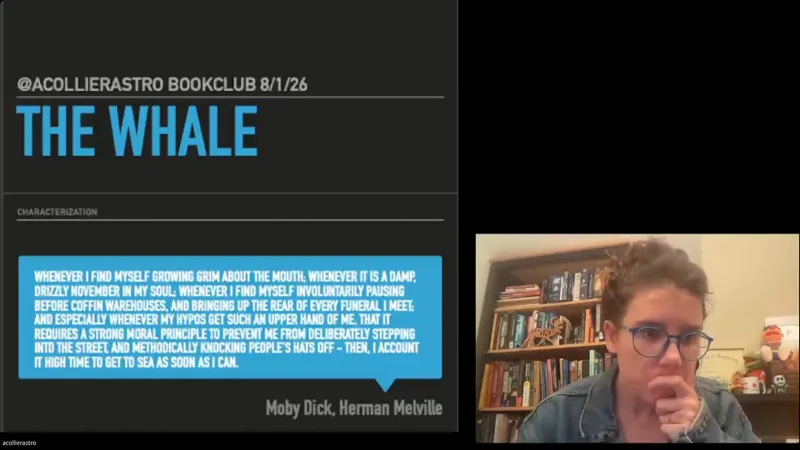

Recorded Live Video: acollierastro goes live
Comments (7)
This was fun to watch. I really am enjoying reading the book. One of the major themes that I'm getting is the question of free will. Ahab is obviously obsessed, but it seems like the other main characters are also to some extent driven by motives and circumstances. It's fun to think about while reading. The language is difficult but I think that makes me slow down and pay attention to each sentence. Thanks for doing this.
Sorry for the blog-length post. The livestream generated a lot of thoughts, and I think (hope?) they're worth sharing. I've been thinking about Angela's comment that the whaling industry in the book made her think about coal mining and the societal pressure for men to sell their bodies. It didn't resonate with me at first because I don't think the economic or social motivations are really the same for workers more broadly as they are for our two primary characters (Ishmael and Ahab), but she also mentioned how boys/young men she grew up with were set on shipping to Iraq as they left high school, something I think middle millennials from any poor/working class environment will relate to. That led me to have some sprawling thoughts on the matter and how Moby Dick does or doesn't talk about the various facets of these realities, and I thought I'd share them here. Broadstrokes spoilers on my interpretations of theme from the full book as well as some major plot points to follow. I'm a Southerner, but I grew up in the swamps rather than the mountains, so coal mining is always something I only knew about secondhand, primarily through labor-related stories, be it Blair Mountain (which happened where my high school band director grew up) or the Warrior Met strike in Bessemer a few years ago, where over a thousand union members were looking out for each other for almost 2 years while fighting for a fair contract. I've been reading Beth Howard's memoir "Song For A Hard-Hit People". Howard's a xillenial organizer who was a child growing up in Eastern Kentucky throughout the 80s and 90s, and the first section of the book focuses on her youth, how every man she knew worked in coal, the economic precarity that came with that after the unions had all been busted, and how boys she had grown up with were eager to enlist after 9/11, in their early 20s. There are men present in her community who match Angela's framing that whaling invoked for her: men selling their bodies in extreme conditions to bring back good pay for their families at the expense of their health. However, there were also the type of men in her life that every person who grew up in poverty will unfortunately be all-too familiar with: people playing societal roles that are expected of them but that they were never actually suited for and maybe never desired, and harming those around them (directly or indirectly) as a result. To be more concrete, her coal miner father never wanted to be a dad, and after being forced to settle down and work, he was physically abusive to his wife and also abusive to himself (via heavy substance use). Forced into this role he never wanted for himself, he sought escapes from it in increasingly destructive and harmful ways, and I think that parallels well not only with young men being rallied to patriotic wars (promises of glory, adventure, and societal approval, conveniently in the form of removing yourself from normal society as you come into adulthood) but also with Moby Dick's framing of whalers, and both Ishmael and Ahab in particular (albeit in different forms). Ishmael constantly talks up the virtue of being a whaler. It is very important to him that we not only recognize the economic value of the whaling industry but also its necessity to society and that being a whaler is extremely difficult and demanding and thus worthy of praise. But how does that rallying first chapter actually present our narrator? He's not drawn to whaling; he's drawn to the water, feels compelled to seek it out. And does he feel compelled toward whaling because it serves society or will afford him financial security? No, he seeks an escape because he's filled with ideation on death. Ishmael is a person who feels unable to exist within normal society and so must find an escape from it. In glamorizing this brutal, dangerous work that spends his physical form, he can adopt a pretense for his self-exile that can act as an external justification, both to his other whalers (who may seek their own escapes and thus welcome the group delusion) and to the people they may each abandon on shore for years at a time. Ahab fits the bill as well. He likely needs no money, and he now has a wife and child, a family to be a part of, but he still feels compelled to the sea and, even when given several warnings about what continued pursuit will cost him, consistently refuses to abandon his quest, acknowledging how cruel his behavior is to his new family at least once. Yes, he seeks revenge, and yes, the trauma is an obsession (and the defeat a shameful offense he cannot tolerate), but also, he is simply a broken man, one who cannot function within normal society, and thus must flee it and self-destruct. I initially did JROTC in high school as a way to dodge gym, but I continued because it gave me ample opportunities to do things with other poor kids from the community, many of whom I hadn't been able to spend time around for a few years since I was a "gifted kid"; you get plucked out of your natural social circles and readjust into increasingly smaller circles as you go through the years towards AP/IB, which for a small town like mine meant 10 kids per class, most of whom were at least relatively well-off. It was nice getting to hang out with kids I related to more easily, even if it often just meant doing unpaid menial labor. The kids skewed poor for all the obvious, well-explored reasons: poverty affords you few prospects as a young adult and plenty of desire to escape to literally anywhere else. This was an era in which the necessity of a college degree was insisted upon if you ever wanted to have financial stability, and with the military needing bodies for the forever-war, they were diligent in promoting themselves and the financial/education incentives of enlisting to these vulnerable teens. When I think about that period of my life, I think about a kid we'll call D. D was typical of the mold I outlined before: he came from a bad home life and no money, and having never been a particularly performant student, he felt like he had no options in life. After having known him a while and done a lot of extracurricular JROTC events with him, he gradually opened up about how turbulent and violent his life outside of school was. In one conversation, where I asked about what he wanted for his future, this kid who bragged about bare-knuckle boxing on concrete as a hobby broke down into tears, confessing that he didn't actually want to join the war but that he felt like he had no hope on any other route. However bad a fit society was for D, he did not seek to leave it. The pressures on him were overwhelmingly borne from a lack of available resources to pursue a less dysfunctional path. I point this out to say that, at least in my neck of the woods, this pipeline for consuming young men's bodies was primarily something they were coerced into through material means rather than a desire to avoid cultural expectations that society places upon them. In fact, reflecting back on it, our JROTC was probably about a third girls. While that does leave boys overrepresented, it isn't by as much as I think even I would expect, had I not thought about it. The dominant force that united this group was definitely poverty, rather than any element of gendered cultural expectations. But that doesn't mean that those expectations did not exist or act as the primary driver for some. Enter another kid, who we'll call M. M very much reminds me of "the ROTC kid" from underscores' "Shoot to kill, kill your darlings". He came from a well-off family. He was an above average student with the means to go to a decent school, live comfortably as a student, and not be burdened by a mountain of debt as he began his career. But he didn't have any interest in that route. He dedicated himself to JROTC enough to be the battalion commander. He bought sim games that the military actually used in training and played them in his free time. Whenever a film like Jarhead was getting drummed up, he couldn't stop talking about how excited he was to see it, smiling ear to ear all the while. M was someone for whom all of the propaganda simply worked. He fully bought into the world view that leaving society to live this very dangerous but heavily regimented and financially stable life was virtuous, and he actively sought it out, no coercion necessary. I feel that the whalers in Moby Dick are significantly closer to D than to M. They often talk about the wealth the voyage will afford them and the people they'll spend time with ashore, but they also clearly talk about these things in a way that suggests they do not long to permanently leave the sea. They talk of spending their wealth on extravagances rather than settling down. Some talk about families while others talk of partying. All but Starbuck are enthralled by Ahab's rally to forego their stated whaling mission and principally pursue Moby Dick at all costs. I think it's very easy to look at this depiction of 19th century whaling and see parallels to modern forms of highly taxing and exploitative labor, but how much of what occurs in the book is actually framed as exploitation? How much of the absence of said exploitation is the perspective of our narrator, who seeks to glamorize the venture for his own psychological need? How much is Melville's own blindspots? How much is the greater availability of "honest work" in the era or a greater scarcity of safe labor conditions that leaves whaling a matter of sliding the scale rather than flipping a switch into recklessness? I don't know that I have answers that resolve those questions, but I do think it's interesting to recognize what now seems obvious to me, having had it pointed out: this is a work in which labor issues are omnipresent but which are never directly addressed. That's interesting! This was the antebellum period, and Melville chose to place 3 black characters on the ship, but only one (the cook) ever directly deals with how racism impacts typical labor. This was the edge of the collapse of an enormous industry, but no one had any idea. On land, railroad expansion had began during Melville's youth and continued through the time of the writing of the book, fueled by the blood, sweat, and tears of countless bodies as they crossed the Appalachian mountains and expanded westward, still a good 15 years before the invention of dynamite at the time the book was published. In our dear Massachussets, less than a decade prior to the book being published, the legality of labor unions had finally been established for the United States. In another 10 years, the Haymarket Massacre would occur in Chicago, giving birth to Labor Day for the entire planet and lending itself as one of the most significant fights for the 8-hour work day that we still enjoy over 150 years later. The same Haymarket Massacre that Haymarket Books takes its name from, the Haymarket Books that published Howard's Song For A Hard-Hit People, allowing me to learn about coal mining in Eastern Kentucky. The birth of the labor movement was all around him, but he didn't know it. He didn't see history forming around him as his topic of passion had one foot in the coffin, and just as it was absent in his mind, it managed to be absent from this now-classic entry in the English-language literary canon.
This was a ton of fun - hope you reconsider and do a book club for the rest of the book.
I’m sorry to miss the live stream but it was still fun to catch it later. Please add my vote for another section of Moby Dick for a selection for a future book club meeting please. ❤️
Heh. I loved the live. I love live. But still, being able to pause without falling behind is so me.
Oh dang this started early for me. I'm in west coast. Would have been cool to have been around for. :D
Dang - couldn’t make the live - I was at work where I am. Next time - I will win something you knitted one day! 😂🤞