
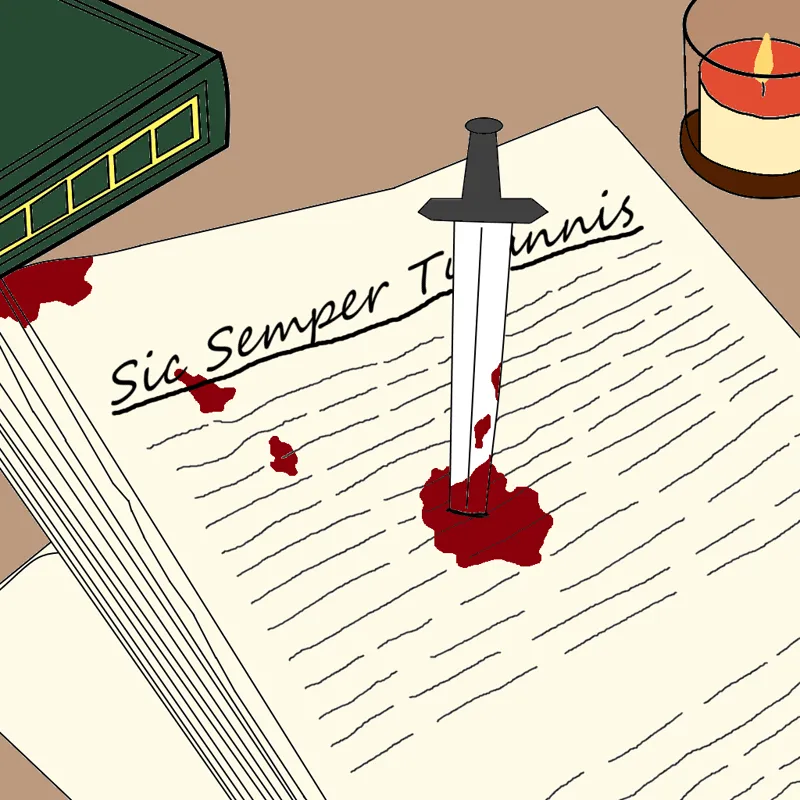
Sic Semper Tyrannis
CHAPTER 1
“We cast the walls against the sea, not for kings, nor for priests, nor for masters. We cast them for ourselves. Each circle raised from the waters shall be free, and together they shall stand as equals, bound not by blood nor crown, but by compact. So swears the First Convention.”
- Opening of the First Convention, 1703.
——
It is not the first time Marijke has been in these chambers, though each time she enters, she tells herself that she will perhaps stop seeing her society tear itself apart at the seams. What happens here is never loud, never quick, never the drama of open bloodshed; it is slower than that, and crueller. Like a baby smothered in its cradle, declared an accident the next morning.
She is one of the many bystanders called here to watch—a mere Officer of Petitions. The brass tubes rattle and hiss behind her, delivering the words of the people into her hands, and she smooths them flat, stamps them, files them, and passes them up the chain. The chamber debates, the chamber delays, and always the petitions die before they reach the light.
Today, the same crime takes place.
Marijke rises when called, hands tight around the folders of stamped petitions. They are ordinary things, letters and words she has seen hundreds of times in her career, but they are heavy all the same. She crosses the floor in silence, places them on the lower dais before the Assembly, and remains standing as the chamber waits. Her part is to give them shape before they are unmade. She is first to touch the cries of the people put to paper.
She clears her throat, though her voice is steady when it carries out across the hall.
“Petition Number Forty-Seven, submitted by the Dockworkers’ Guild of Circle Two.”
A pause, as ritual demands. Then she reads the foreword: an alarming, scalding review of safety conditions of the dock workers in the Oostdam Shipyard. Cranes strain under loads beyond their limit. Chains rust through and snap without warning. Derricks collapse, boilers leak, and men choke daily on coal dust and smoke. Water rises, along with the risk of terrible floods. Dozens have already been killed, the foreword warns, and more will follow unless immediate reforms are made.
That is where her big brother works. Marijke swallows, but her job is now done.
The petition passes from her hands into others. A tribune rises to speak, his voice roughened by the yards, his sleeves still marked with the grease of the machines he had walked among that morning. He repeats what she has read, with less restraint. He names the men lost this month alone, recites the injuries by the dozen, and accuses the Syndics of treating bodies as cheaper than iron. His words swell with the anger of the shipyards, until the chamber seems to tremble with it.
But that is only the People’s Spiral. The Technocracy and Military Spiral’s eyes are steeled; they have seen this time and time again.
The Syndics reply in turn, voices calm, precise, polished. They speak of costs and delays, of schedules and budgets. To halt construction now would weaken the fleet, imperil trade, and disrupt order. They call the measures impossible. Technically infeasible. Their tone is not cruel, but it is final, as though no other truth could exist.
The Admiralty follows. Their language is sharper, stripped even of pretense. The war has been won, but allies of yesterday are rivals of today, and they strengthen their fleets and armies each year. The Republics must project strength. Dockhands must be sacrificed if ships are to be launched on time. An admiral in a red sash leans forward and says the quiet part aloud: dockworkers can be replaced. Ships cannot.
Marijke types it all on her typewriter. Her fingers strike the keys in rhythm, metal on metal, capturing every syllable of the words that bury her brother alive.
She does not mean to speak, but she does. Her voice breaks through the chamber like a misfired shot. She reminds them of the freedom these blessed Republics were founded on, of the duty owed to all citizens of their dear nations, not just the steel that carries them to sea.
This time, the chamber stills. Every Spiral’s eyes are glued on her, a mere Officer of Petitions, daring to speak out of turn in this chamber built on nearly one century of rules and decorum. Marijke stands her ground; her heart beats with freedom for the people.
Then the Admiral with the red sash fixes his gaze on her from above on the tallest spiral. He is not how one would expect one of the Admirals wielding the most influence in the Republics to look like. He is a scrawny, thin and weak-looking man with a cough that sticks to him like a ghost, sharing the native Islanders’ familiar dark skin and silver hair and eyes. He looks down on her with the practiced apathy of someone for whom lives are numbers on a page.
“Tell me, Officer Marijke Jansen,” he begins with his familiar rasp, “have you forgotten that your own brother works the Oostdam yards?” He lets the question linger before continuing. “And tell me—why is it, after so many years of silence, that you choose to raise your voice now?” A pause, sharper than any outburst could be. Then his verdict follows. “This is not principle speaking. This is bias. Do not speak out again, or you will be removed from these chambers and your office. Permanently.”
Marijke nods, head held tight against her chest as her eyes the ever-looming bureaucracy wraps its cold hands around her throat. This is how it is, has been, and always will be. A slow death for a person of little conviction—
But Marijke is not without strength. Conviction burns in her like a forest fire. Since childhood, she has carried the fire to see her people free of greed and tyranny. And why not here? Why not in the Republics? They are the beacon of this age—the most advanced nation the world has ever known, masters of steel and light, builders of engines that conquer sea and sky.
The petition is struck down. The record is entered. The chamber disperses in its orderly fashion, as though no lives had been weighed and discarded, as though nothing of consequence had passed at all.
There is nothing to be done, she tells herself. Nothing to be done. She is just one soul amongst tens of millions. One voice amongst the political process. All of her rage is meaningless in the face of order.
What a shame, though, she thinks. What a shame.
——
The next day, her worst fear comes true.
At the Oostdam yards, a crane loaded with cargo from the farglung colonies collapses under the weight demanded of it. It is an old crane, patched and repatched, its chains rusted through and its frame warped from years of strain. The Republics boast the greatest shipyards in the world, proud harbors that cradle the largest navy and trading fleet ever built by human hands. They stretch so far they feel larger than life to Marijke. Steel and rivets and roaring engines, hulls lined row after row like iron leviathans, their prows jutting skyward like monuments. The air is always thick with smoke from coal furnaces, the hiss of steam pipes, and the smell of hot oil. Great derricks turn like skeletons of iron against the sky, lifting cargos of timber, copper, and spice from distant waters, setting them down with a mechanical precision that hides their fragility.
But all machines fail when pressed too long.
Her brother is there when it happens. He swings by her home that day reeking of coal smoke, his clothes damp with brine and sweat. He is unharmed, yet shaken—not with fear, but with anger. Marijke has held him in her arms as a baby, she has seen him grow into a toddler, into a curious child, into a rumbunctious teenager whose opinions grew more and more radical the more he experienced the Republics for what they are.
Marijke knows. She knows. Smoke and mirrors, the promise of a better life. The world seeks to move here to fulfill their dreams, but they find themselves stuck, forever hoping that they would one day reach the wealth that was promised. And why not hope? Is it not the Republics that have crafted airships that dock like titans in the skyports above? Is it not here that engines roar day and night, driving trams through the streets and ferries across the bridges, lighting towers burning bright against the fog? Is it not the Republics that have created bombs capable of reshaping the earth itself?
Thankfully, Tobias is only superficially wounded. Yet he glares at her as she tends to his wounds. Her home is a modest one, with plastered walls that have begun to crack and floors that creak when stepped on too heavily. The furnishings are plain—an iron stove that smokes when lit, shelves bowed under the weight of old books, a desk crowded with papers and discarded petitions she keeps as memory. Everything smells faintly of coal dust and salt, the scent of the city seeping in no matter how often she scrubs.
“You see it now, Mari,” he says, silver hair glinting in the light. “You knew this would happen, you spoke out against it, and yet they allowed their people to die.”
There is no denying it this time. “Yes.” She places a cold press against the burn on his well-built arm. “Yes, I have seen it,” she repeats. “I wish it wasn’t so, but what can we do against the tide of progress?”
Tobias laughs and shakes his head. “You know. You know, Mari, but you act like you don’t see it.”
She clicks her tongue. “Your hopes of revolution are meaningless, and Mom and Dad would have hated such violent ways of going about things.”
He bites his lip. “They died when we were children,” he takes a breath, clearly trying to remain calm, “but you know what they would have wanted?”
“I—”
He cuts her off. “You know what killed them, too. The bad air seeped into their lungs and choked them in their sleep. No one matters here but the rich and powerful. Is it not the workers who squeeze out profits? Without us, they are nothing.”
Mari scoffs. “Now you’re speaking like a Falkist.”
“I am a Falkist,” he forces out.
The silence ripples through the room. The ideology is officially banned in the Republics, but has seen a resurgence since the end of the Great War. Veterans have returned with nothing but scars and half-wages and tax increases, discharged into streets that no longer had work for them. Men who bled for the Republics now beg for bread in their circles, while Admirals feast beneath chandeliers and Syndics weigh fortunes from profiteering in gold.
It is among them that Falkism grows. In taverns that stink of sweat and coal dust, in boarding houses crowded with men who cannot sleep without hearing the echo of gunfire, in workshops where hands tremble too badly to grip tools. It speaks of equality, of labor as the true measure of a man, of tearing down the spirals of power and building anew from the ground.
Yet the ideology is illegal to hold. Terrorist cells have wrought pain and death throughout the city in the name of equality.
“You cannot be,” she breathes out.
“I am—”
“Think of the danger.” A hiss half-whispered, this time.
He is her only family left. Marijke cannot lose him.
“It is only a danger if you report me,” he states simply. “I know you are a woman of the people at heart. I know you were raging when Admiral Faust spoke down to you like you were nothing. It is always how these things go.” He shrugs, but winces when he remembers his wound. “They treat us worse than the soot under our shoes.”
“Tobi…”
He suddenly rises to his feet. “Think about it. Come with me to the lower levels, and think about it.”
Marijke stands in silence, the quiet wrapping around her conscience like children begging at her feet. A lonely hand reaching out for her, clamoring for a fragment of her mercy. For food to fill their stomach, to breathe clean air. The room breathes heavy with absence, and every second she delays feels like an indictment.
“I’ll follow you.”
He smiles at her.
It reminds Marijke of their days spent running around uncle Benji’s garden.
He is dead now, too. Claimed by the war.
——
Long ago, in the days of their forebearers, the Circles were nothing but sea and ocean. It was a particularly rough patch of ocean, too. Battered by hurricanes and storms that swallowed coastal villages and fields alike. The two coastal kingdoms of Monzia and Valtricio, even at the apex of their power, shunned the sea like it was a disease.
But there were those who did not turn away.
They were exiles and dreamers, guildsmen who defied their lords, engineers and merchants who believed that human hands could do what kings would not. Seamen who had grown tired of the neglect afforded to their trade. Aided by the technological advances of the Great Mechanization gripping the world at the turn of the seventeenth century, they cast walls of stone and steel against the sea, and behind them they dredged the silt and pumped the waters dry. First one Circle, then another, and then another still, each island perfectly round, raised from the ocean by naught but human ingenuity and grit.
Today, Marijke walks the upper levels of Circle Two, more colloquially known as Brightwater.
Like every Circle, the artificial island rises from the sea like a great stepped pyramid, each concentric ring climbing higher than the one before it. From the harbor below, the tiers look almost regal. Stacked terraces of stone, steel, and glass, girded by retaining walls that gleam under the sun. But Marijke knows the shine is a veneer, polished for those who look only from afar.
At the top, where Marijke lives, the air is clearer. Wind carries away the smoke from the factories below, and the chimneys of the upper districts burn cleaner fuel—refined oil and imported coal, their exhaust filtered through tall stacks that gleam like monuments. Broad boulevards ring the summit, lined with townhouses faced in pale brick and offices whose windows are tall and bright. Pneumatic trams run smooth and silent, polished brass fittings catching the light, carrying the upper class to their appointments or activities. Gardens stretch along the terraces, watered by pipes that carry clean, pressurized water up from the sea pumps. Airships dock at stations built high along the upper ring, their hulls vast as cathedrals.
Here the Republics parade their wealth. Here, the tired masses of the world hope to one day settle down, for a life in the upper levels of the Republics is the best life this world choked in diesel and machinery and bombs and mechs and coal can possibly hope to offer. Where even in the most brutal of wars, the navy and airforce can keep their slice of the world safe from ruin.
A humble longshoreman, Tobias lives another story.
The smoke that does not reach the summit settles here; it is thick, heavy, and acrid. Narrow streets twist between towering brick tenements, their windows blackened with soot, their balconies strung with lines of drying clothes. Trams here rattle and squeal on rusted rails, their carriages crowded with dockhands, thieves, seamstresses, fishermen, and so on and so forth. Steam vents hiss at the edges of walkways, coating everything in a thin grime. The shipyards stretch along the outer rim, cranes looming like skeletal giants over the water, their chains groaning with the weight of the Republics’ cargo.
The walls sweat with oil, and the air tastes of coal dust. Whole neighborhoods are built around them, each block arranged so that workers can wake, eat, and return to the line without leaving the shadow of the machines. Children run errands with grease still staining their hands; men cough into rags blackened from within.
Marijke knows. She knows, and she has always known that there is naught here but misery and poverty, yet she has rarely come down to see it. The people here look at her with envy and hope. Her clothes have not been stained with the taint of industry, the mask she wears shows that her lungs have not adapted to the toxicity in the air, and the way she carries herself make it all obvious that she is not from here; she sticks out like a lighthouse in a fog.
Her brother takes her to an apartment cramped in a not so particularly unique alley. There is nothing about it that would make it stick out in her mind, at least from the outside. Its soot-stained bricks and rusted pipes blend into the monotony of the maze that is the lowest ring.
There is, however, a secret passage inside that leads to a room further in arranged in the shape of a bar. It is full of dozens of people from all walks of life and all ages, passing drinks around and discussing their material lives or politics in earnest. They drink, they laugh, but above all they speak. Of wages, of rents, of safety and hunger, of politics uttered in liberated tones. Some speak with bitterness, others with hope, yet all with the urgency of those who have realized the system is broken.
Marijke lingers near the threshold, taking it all in. There are more people here who would fit in the upper and middle districts than the lowest where they had congregated. There is occasionally a man or woman with misery written all over them, but they are the exception rather than the norm.
Tobias drags her around the room and introduces her to them all. She files through name after name, job after job. Sebastian, doctor. Mathias, machinist. Anje, a typist for the Circle’s tram office. Willem, veteran of the Great War in the Western Expeditionary Fleet and now a statistics professor. Sofie, a helping hand at her father’s bakery. Name. Name. Name. They fly by in a flash, yet Marijke struggles to remember.
To remember is to live an active life, and to live an active life is to realize that she has been a rubber stamp for the agony of millions. I’m sorry, she says, I cannot stay and chat—over and over. Some recognize her and cast a heavy gaze upon her back when they think she isn’t looking. Her brother, though, is another matter. They respect him. They listen. When he speaks, the noise of the room bends toward him, each word drawn in and savored as though it were nectar.
Eventually, she finally manages to get him alone with her in the corner of the bar.
She leans in to whisper. “Tobias. Is this what I think it is?”
“It’s a debate club. The Red Mariners,” he answers with his usual nonchalance when rebuffing her. “We’re unsatisfied with the way the Republics are being run, so we talk about what could be better.”
“With Falkism written all over it, Tobi! I will not see you arrested because—”
“Tell me. Other than the fact that the ideology is banned, where do you disagree?”
She freezes for a second. “Plenty of things,” she says. “I… agree with a lot of what it fights for.” It feels like bugs crawling on her back to admit this. “But this talk of tearing things down, of the masses rising up and drowning the streets in blood—”
His fist clenches. “That is propaganda.”
“Is it, now? Because if you look to the west, in the UWR, that is exactly what happened, and the vanguard now leads the people.” Mari scoffs as she shakes her head. “They’ve replaced a ruling dynasty for a dictator, and they wage war across Zhalin.”
“No. That was corruption.” His jaw is tight. “Betrayal of the ideal. If the people here take power with discipline, if we do not flinch, it will not end that way. It cannot.”
“I thought,” she slowly speaks, “that this was a debate club.”
“It is. But we have funding from abroad and enough pull with the people to be planning something tomorrow—nothing bad,” he quickly adds, hands raised. “This is just one of many of our establishments, Mari. Our numbers are far more than this.”
Many thoughts race through Marijke's mind. What should she do? Report them and hope for leniency? Sweat builds and drips down her forehead, but her face remains steeled as she has practiced many times at the Tri-Spiral.
“What have you done?” she asks.
“A simple protest. We’ll walk up every level of the city until we reach the Tri-Spiral. Our voices deserve to be heard.”
She calls out to him, but he’s already leaving. She runs a sweaty hand through her braided hair and reaches into the furthest corners of her mind for what she could say to stop this. Protests are not banned, but should they carry Falkist imagery and disturb the upper layer’s peace…
Unfortunately, when Tobias gets an idea in his head, Mari knows there is hardly any stopping him. He is like a rock sent tumbling down a hill; all she could do was await what tomorrow would bring.
Out of the corner of her eye, Marijke notices a woman—the one who works the bar—brings Marijke a cup of cold water. Mari stares down the cup with a suspicious squint.
“It’s clean, I promise. We have good filters for seawater,” she says, voice rather high-pitched.
She is foreign, Marijke notices immediately. From the east Esera to the west, according to her complexion and accent—perhaps Zhalin? She is awful at differentiating their ethnicities, and it would be rude to ask. The girl’s face is delicate with a smoothness to her skin like polished porcelain, and dark eyes set beneath straight brows that give her a calm, unreadable air. Her hair is as black as ink and is drawn back neatly.
Marijke goes to swipe the cup, but misses, causing the stranger to giggle behind a raised hand covering her mouth. “I’m Liu. Liu Yijun.” The bartender holds out her hand.
She takes it. “Marijke Jansen. Thanks for the water,” she whispers into her cup as she takes a sip.
“I know who you are.” Liu winks, then leans against the bar. “Hard not to when your brother’s the leader of this little club.”
Mari knew this was no mere club, nor was it little. “Does he talk about me often?”
“Just when he needs to show people that reform is meaningless with those eggheads in charge.” She drums her fingers against the table. “The Admiralty and the Syndics think in abstract ways, but we think about the people. They ought to remember the founding words of this nation.”
Marijke nods—with hesitation. Not because she disagrees, but because agreeing leaves a strange taste in her mouth. The silence stretches for a while before Liu speaks up again.
“You’re as quiet as he says,” she laughs; her smile is a blooming flower.
“Oh. I’m sorry—”
It is true; she is a quiet woman for aforementioned reasons, but also because there is so much to think about—
“I don’t mind. It’s cute.”
The words reverberate inside her head, and they seize her heart and shake it. What is she even thinking about again?
Marijke clears her throat behind her cup. “So where are you from, Liu?” She steps around the bar and takes a seat next to Mari. “Don’t you have people to tend to?”
She tilts her head and stares into Mari’s eyes. Neither goes down, but Liu sneaks her hand a little closer. “They can wait. I’m from Zhalin. I came over here on a ship five years back to escape from the war and never looked back.”
The URW, the world’s leading Falkist nation had been raging a forever war on their land for over a decade, and yet here she was, committed to the movement regardless.
“I know what you’re thinking,” she says.
“How can I not?”
“One bad apple does not mean the entire ideology is rotten.” Liu’s fingers touch hers, which makes her jolt. “I’m sure you can see my perspective given your respect for the system.”
“It needs major overhaul,” Mari says, throat dry. “Believe it or not, I’m not against cutting out the rot. In my heart of hearts, since I’ve been a little girl, I have yearned for freedom just like my brother.” She searches for him in the room, and finds him talking to a chubby, balding man whose name she has forgotten.
She would, however, not forget Liu. They speak long into the evening about anything that comes to mind. First, politics, then their childhoods and differing cultures. Eventually, the room starts to thin, and it is soon time to close the bar down.
Marijke summons her courage and has to ask. “Do you want to go back to my place? To keep talking.”
“Of course. To talk.”
They do not get much talking done.
——
As expected, Liu is gone the next day. There are many preparations to be done for the protests, and Marijke does not expect to see her again regardless. It was a wonderful night full of laughs and warmth—her first one in a while—but it was also just that. One night.
Thus, she makes her way to work at the Tri-Spiral, as it is their duty to hold a session once a day to let the people’s voice be heard. She reads petitions aloud, keeps track of them, feels the paper against her digits and the desperation poured into them. A few are passed onward for consideration; for the Admiralty and Syndics are not caricatures of tyranny, she reminds herself, but men and women who genuinely believe they serve their country, however misguided their course may be.
Mari sees it in their faces and voices and eyes and bodies. She does not claim to understand them fully, but it at least reassures her some, even if she wishes their priorities lay with hers and the people of Brightwater.
Time somehow passes too quickly, yet also at the pace of a snail. Eventually a messenger enters the chambers carrying with him news of agitation reaching the upper levels. Tens of thousands of people flooding the street like a dam had burst, making their way to the Spiral with Falkist signage and red flags. The Admiral with the red sash and his countless war medals thanks the messenger for the warning and tells him to notify him should the police be unable to handle these hooligans.
The chamber proceeds with its duties, but every so often, messengers keep filing in. Each time they do, they grow more and more nervous: adjusting collars, trembling hands, and fidgeting feet. They speak of rising violence, property damage, and injuries in the dozens—on the side of the police. One dead. There are no mentions of casualties on the protester’s side.
“The situation has evolved into a Falkist riot, courtesy of funding and falsehoods spread by the Union of Worker’s Republics, no doubt.” He shakes his head in disappointment and sighs. Quickly and efficiently, he orders a vote to give the Admiralty full authority to send in the military. It passes. So easily. “As President of the chamber, I declare this session over. Please evacuate the chamber and make your way back home.”
There are countless whispers about radicals, hopes that the situation would be dealt with quickly, the prospect of raising this matter at the Assembly of Nations and lodging a complaint. Sanctions.
Marijke holds out a hand as every elected and appointed official leaves as if they had not ordered the mass arrest and slaughter of tens of thousands. She tries saying something, but her throat sears as though packed with coal.
The afternoon goes by in a flash. She spends it alone in her apartment.
Then, news starts to trickle in.
She learns of people choked and wounded by livewire, made undone by gunfire, arrested for standing just a little too close to the protests or sending along a supportive cheer or a thank you.
She learns of her brother barely escaping arrest and going into hiding. Already, they have questioned the others to identify him as ringleader. She is arrested that very day and relentlessly questioned for simply being related and harboring no ill will toward him. They’d been spotted together just yesterday, they say in the smoke-filled room. Are you sure you did not know anything about this?
She says no and is released. They have nothing on her. Still, she is fired from her job.
Marijke learns of Liu’s murder. Crushed underneath a duopod clearing a street. She does not cry, nor does she come close. She barely knew her, and had not loved her. Not even liked her. It had only been one night, but she knew her dreams and they had shared something more than words.
The aimless woman, twenty-eight years of age, now finds herself traveling the streets of Brightwater all night, from the upper echelons all the way to the guts of the city. The police patrol the streets in heavy gear, casting suspicious looks upon her. Some even question her for being outside alone this late. Marijke doesn’t remember what she answers.
One thought still grips her.
Did leaders too terrified to face their own citizens deserve to be in power at all?
Marijke travels to their parents’ old home down in the lower levels of the city. It is an abandoned apartment complex—one of many in the city, full of rats and rust and stale air. The homeless have claimed it as their own, swarming the complex by squeezing together like birds huddled in a storm.
Tobias is already there. They say nothing for a long while, maybe twenty minutes. Instead, they just hold hands like terrified children waiting for their parents to come get them. Tobi speaks of the violence. The police attacked first with rubber bullets and maces and gas for the crime of walking in the streets of their own city. He was at the head of the protest, and saw them beat an elderly man to death after dragging him out of the crowd.
He continues talking for what seems like forever of what he witnessed. People choking on gas used in the Great War that rolled down every nook and cranny, the sound of batons striking flesh echoing off steel and stone, of blood soaking cobblestone. The arrested were herded into freight cars, locked behind iron grates as though they were cargo rather than citizens. He speaks as though confessing, as though to stop talking would be to erase the dead.
“The people’s desires will not be brought about by ideals and votes and good speeches,” he tells her. “Nor will it be brought about by peaceful protest.” Yes. She understands now. “It will be brought by our own forceful hand. It is only a matter of time. If not me—if not us, it will be someone else picking up the mantle of the Red Mariners.” He reaches out his hand.
She shakes it, and drags him into a hug. “Thus always to tyrants.”
“I love you, baby sister.”
A/N: I tried making this in an experimental style, though I’m not sure it’s one of my strengths. This story would be a very political one (mostly on a city scale), though no opinions expressed would be my own and I hope to make this a nuanced fic if it wins. Thanks Mythix for beta reading as always.
Inspirations: (Pax Britannica hoi4 mod, Arcane)